汽车出海

Search documents
2026年乘用车-以高端-出海为矛破局
2026-03-04 14:17
2025 年乘用车批发 2,379.7 万辆(+6%),新能源销量 1,530 万辆 (+26%),渗透率达 52%;受以旧换新政策收官影响,Q4 出现阶段 性回调。 吉利在插混与纯电双赛道增量均居榜首;小米纯电增量 27.3 万辆;比 亚迪插混份额遭吉利挤占;理想因车型老化增程板块减量 15.8 万辆。 2026 年政策退坡:以旧换新转为比例补贴且力度减弱,新能源购置税 按 5%征收,插混纯电续航门槛由 43km 提升至 100km。 出口结构优化:2025 年出口 573.1 万辆(+21%),新能源占比首破 40%;奇瑞总量第一,比亚迪增速 144%领跑,市场重心转向拉美与中 东。 高端化与智能化:30 万+市场 BBA 份额下滑 6pct,赛力斯、江淮尊界 等自主品牌通过科技溢价突围;BBA 加速接入华为、Momenta 等本土 智驾供应链。 2027 年三大趋势:大电池长续航插混成主流;自主"9 系"旗舰深化高 端化;泛越野与 MPV 细分市场在智能化驱动下加速扩容。 Q&A 2026 年乘用车:以高端、出海为矛破局 20260304 摘要 国泰海通对乘用车行业 2026 年投资策略的核心判断与推荐 ...


吉利汽车:出口销量持续增长,品牌高端化逐步见效-20260304
Orient Securities· 2026-03-04 00:24
核心观点 盈利预测与投资建议 ⚫ 预测 2025-2027 年归母净利润分别为 170.41、206.04、243.18 亿元,维持可比公 司 26 年 PE 平均估值 11 倍,目标价 20.79 元人民币,23.54 港元(1 港元=0.8833 元人民币),维持买入评级。 吉利汽车 00175.HK 公司研究 | 动态跟踪 出口销量持续增长,品牌高端化逐步见效 公司主要财务信息 | | 2023A | 2024A | 2025E | 2026E | 2027E | | --- | --- | --- | --- | --- | --- | | 营业收入(百万元) | 179,204 | 240,194 | 319,444 | 387,363 | 448,685 | | 同比增长 (%) | 21.1% | 34.0% | 33.0% | 21.3% | 15.8% | | 营业利润(百万元) | 3,806 | 7,644 | 16,055 | 19,616 | 23,173 | | 同比增长 (%) | 4.3% | 100.8% | 110.0% | 22.2% | 18.1% | | 归属母公司净 ...
国泰海通|汽车:2026年乘用车:以高端、出海为矛破局
国泰海通证券研究· 2026-03-01 14:30
2025年回顾:乘用车内需与出口稳健增长,中低端新能源加速渗透。 2025年国内乘用车批发销量达2379.7万辆,同比+6%,在政策支持与消费复苏驱动下 保持韧性增长;乘用车出口573.1万辆,同比+21%,受益于自主品牌加速海外市场扩张与国产新能源车竞争力提升。中低端新能源加速渗透。据终端上险量 数据,10-15万元乘用车市场中,新能源渗透率已从2024 年的45%提升至 2025年的54%。 2026年展望:乘用车销量预计温和增长,新能源高端化趋势明确,细分市场供给加速释放。 我们预计2026年乘用车市场销量约2982万辆,同比+1%,新能 源乘用车销量约1705万辆,同比+10%,渗透率继续提升,但总量增速平缓。我们判断,新以旧换新政策边际利好中高端新能源车型,高端新能源,MPV、 越野等细分市场供给百花齐放。 投资建议: 我们看好全球化布局领先、高端化表现亮眼、智能化能力突出的车企。 扫码关注 星标不迷路 国泰海通证券研究所官方公众号 海量研报 | 热门活动 | 视听 内容 以上内容节选自国泰海通证券已发布的证券研究报告。 报告名称:2026年乘用车:以高端、出海为矛破局;报告日期:2026.02.2 ...


未知机构:天风汽车比亚迪底部再更新推荐为什么看好当前时间的拐点-20260224
未知机构· 2026-02-24 02:25
Summary of Conference Call Notes Company: BYD (比亚迪) Key Points 1. **International Expansion** BYD is expected to achieve significant breakthroughs in the European high-end market and PHEV models in 2025, validating the previously proposed DMI overseas replication of domestic penetration rates. The company anticipates a balanced regional structure with the establishment of overseas factories to mitigate geopolitical risks and market volatility [1][2] 2. **Sales Growth in Key Markets** In 2025, sales in five European countries (Germany, France, the UK, Italy, and Spain) are projected to grow by 2-7 times. In Latin America, combined sales in Brazil and Mexico are expected to reach 185,000 units, while the Asia-Pacific region, including Indonesia, Australia, and Thailand, is also showing strong growth trends. Sales in January 2026 in Australia, Indonesia, and Italy continue to maintain high growth [1] 3. **Production Capacity Expansion** New factories in Indonesia (Q1), Hungary (Q2), and Turkey (by year-end) are set to commence production. Brazil's production capacity is expected to increase from 150,000 to 300,000 units. The introduction of popular models (Seal Udmi, Dolphin surf, and Shark pickup) and new models (Sealion 5, Racoo) is anticipated to contribute to an estimated overseas sales volume of 1.6 million units in 2026, generating a profit of 32 billion, accounting for over 60% of total profits [2] 4. **Technological Advancements** The DM6.0 technology has recently been validated, focusing on power performance upgrades. The fast-charging and energy density of the dedicated hybrid battery have also been significantly improved. The intelligent driving features are expected to enhance accessibility, with the "Tian Shen Zhi Yan B" and urban NOA functions being made available for models priced under 100,000 [2] 5. **New Model Launches** In 2026, BYD plans to solidify its brand value through inclusive technology, with multiple new models set to launch: Song Ultra in Q1, Qin MAX, Han MAX, and Sea Lion 08 in Q2, along with various SUV models. The company aims to enhance its high-end offerings with models like the Fangcheng Leopard Magnesium 9 and Tengshi Z7 [2] 6. **Profit Forecast** The overall net profit for 2026 is projected to be 50.1 billion, increasing to 60.2 billion in 2027. This corresponds to a PE ratio of 16 for 2026 and 14 for 2027. The domestic profit is estimated at a PE of 15, while overseas profit is projected at a PE of 30, leading to a target market value of 1.2 trillion, indicating a potential upside of 42% [3] Additional Important Insights - The current market sentiment is seen as overly pessimistic, with expectations fully reflected in the current pricing. This presents an opportunity for a new cycle of model launches driven by improved domestic demand and stable international foundations [2][3]
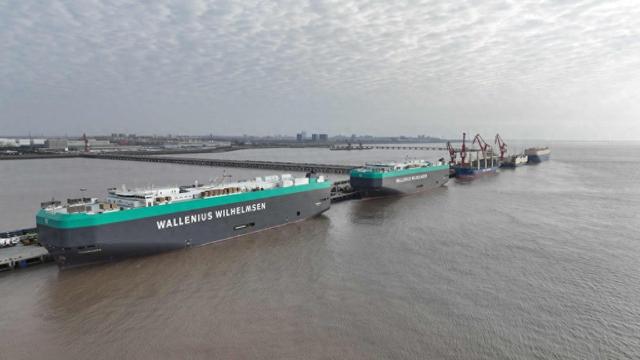
大年初一上海南港码头五船同时靠泊,工作人员顶风冒寒穿梭忙碌
Xin Lang Cai Jing· 2026-02-17 11:11
Core Insights - The Shanghai Nanguang Port experienced a record high operational load on February 17, 2026, with five vessels docking simultaneously, marking a significant start for Chinese automotive exports in the Year of the Horse [2][4] - The Malta-flagged vessel "Taibo" played a crucial role by unloading nearly 5,000 international transshipment vehicles and loading over 4,000 vehicles from brands like Kia and MG, achieving a total operational volume of nearly 10,000 vehicles in a single voyage, setting a historical record for single-vessel operations at the port [2] - Over 190 operational staff worked tirelessly in harsh weather conditions, ensuring efficient operations throughout the day, demonstrating strong coordination and commitment to meet the high production demands [2] Operational Efficiency - To support the peak period of vessel arrivals and departures during the Spring Festival, the Yangshan Border Inspection Station maintained a proactive service approach, dividing personnel into units for document processing, port inspections, crew changes, and emergency responses [5] - The station implemented tailored strategies for each vessel during critical docking times, such as completing entry and exit procedures for vessels with short docking times and expediting operations for those arriving from domestic ports, significantly reducing waiting times and ensuring zero delays for automotive exports [5]
财经观察:中国车企出海加拿大,机遇还是险滩?
Huan Qiu Shi Bao· 2026-02-12 22:56
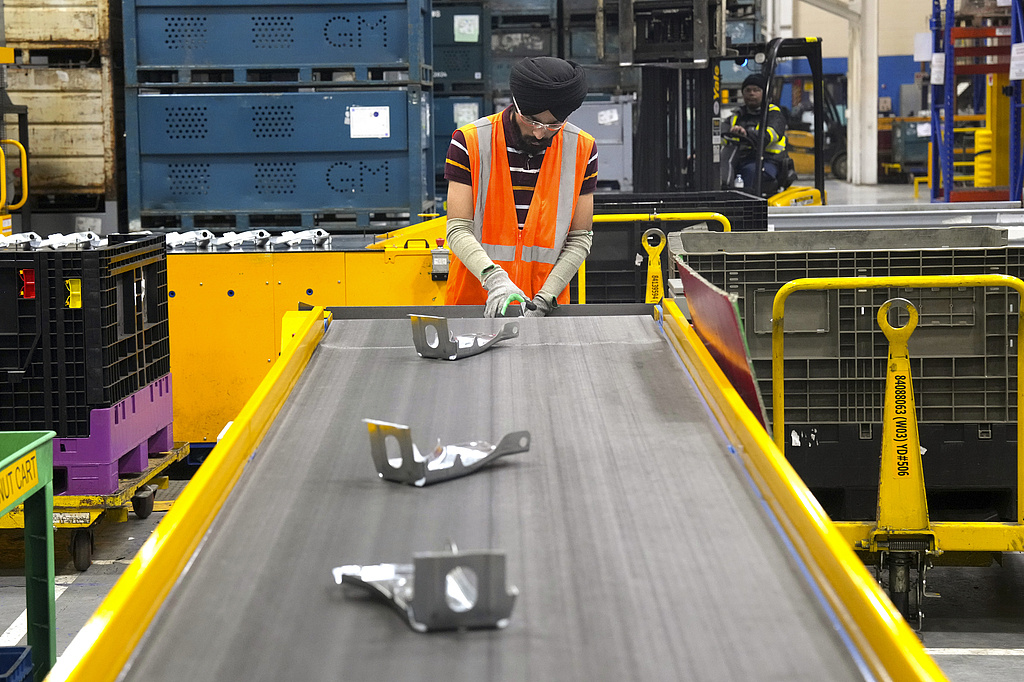
Core Viewpoint - Canada is actively pursuing a joint venture with Chinese automakers to establish an electric vehicle (EV) manufacturing plant aimed at global exports, reflecting a significant policy shift to reduce reliance on the U.S. automotive market and strengthen its domestic industry [1][4][5]. Group 1: Joint Venture and Collaboration - The Canadian government is in "active dialogue" with Chinese automakers to explore the establishment of an EV assembly plant in Canada, leveraging a joint venture model that combines Chinese vehicle platforms with Canadian labor and technology [2][4]. - Canadian companies like Magna International and Linamar are already engaged in business in China and are expected to participate in the joint venture, enhancing collaboration between local and Chinese firms [2][4]. Group 2: Policy Changes and Market Dynamics - The Canadian government has made significant adjustments to its EV import policy, allowing for an annual quota of 49,000 Chinese electric vehicles with a reduced tariff of 6.1%, a major shift from the previous 100% tariff [5][9]. - A recent survey indicates that 78% of Canadians support the new EV agreement with China, highlighting a broad public backing for diversifying trade away from the U.S. [5][6]. Group 3: Market Opportunities and Consumer Sentiment - The agreement is expected to lead to over 50% of imported Chinese EVs being priced below CAD 35,000, making them more accessible to Canadian consumers [7]. - Despite concerns about the impact on domestic industries and geopolitical implications, 62% of Canadians support allowing more Chinese EVs into the market, with many believing it will increase competition and lower prices [6][7]. Group 4: Infrastructure and Challenges - Current charging infrastructure in Canada, with 14,500 stations and 38,700 charging points, is deemed sufficient for the anticipated increase in EVs, but expansion is necessary to meet future demand [8]. - Concerns remain regarding after-sales service and the adequacy of infrastructure in remote areas, which could hinder the adoption of electric vehicles [7][8]. Group 5: Strategic Implications - The collaboration with Chinese automakers is seen as a pragmatic step for Canada to diversify its trade relationships and reduce dependency on the U.S. market, with experts suggesting that about 10% of Canada's EV sales could shift to Chinese manufacturers [9][10]. - The investment environment in Canada is under scrutiny, with experts advising caution regarding the sustainability of policies and the real market response to these changes [10].
海外市场成车企销量关键支撑
Jin Rong Shi Bao· 2026-02-05 02:31
Core Insights - In January 2026, the Chinese automotive market entered a traditional off-season, with new energy vehicle (NEV) companies facing significant sales pressure and a reshuffling of the sales rankings [1][2] New Energy Vehicle Sales Dynamics - Hongmeng Zhixing topped the new energy vehicle sales in January with 57,915 units delivered, marking a 65.6% year-on-year increase [2] - Xiaomi Auto delivered over 39,000 units, with a focus on the YU7 model as the initial SU7 model has been phased out [2] - Leap Motor delivered 32,059 units, a 27% year-on-year increase, but showed a notable month-on-month decline [2] - Li Auto's deliveries were 27,668 units, experiencing both year-on-year and month-on-month declines due to delays in the i6 model's delivery [3] - NIO delivered 27,182 units, a 96.1% year-on-year increase, with the new ES8 model performing exceptionally well [3] - XPeng Motors delivered 20,011 units, facing declines as it is in a product iteration phase [3] Traditional Automakers' Performance - BYD achieved total NEV sales of 210,051 units in January, with exports reaching 100,482 units, a 51.47% year-on-year increase [4] - Chery Group exported 119,605 vehicles, a 48.1% year-on-year increase, maintaining its position as a leading exporter [4] - SAIC Group sold 327,413 vehicles, a 23.9% year-on-year increase, with a significant rise in overseas sales [4] - Geely's total sales reached 270,167 units, with a notable increase in exports, achieving a doubling in export numbers [4] - Great Wall Motors sold 90,312 vehicles, with overseas sales growing by 43.77% [5] Market Trends and Future Outlook - The decline in market demand is attributed to changes in the new energy vehicle purchase tax policy and the release of pent-up demand from 2025 [5] - Analysts suggest that the domestic passenger car market's growth momentum will shift towards overseas markets, with companies focusing on international expansion as a core growth strategy [5]
国新证券汽车行业周报
Guoxin Securities Co., Ltd· 2026-02-04 13:25
Investment Rating - The report maintains a "Positive" outlook for the automotive industry, expecting the industry index to outperform the market index by 5% over the next six months [8]. Core Insights - The automotive industry is experiencing intensified competition in traditional vehicle manufacturing, leading to a gradual slowdown in revenue growth and a shift towards a "red ocean" market. Key strategies for profitability include international expansion and smart technology integration [4]. - The report highlights the importance of companies with comprehensive self-research capabilities and leading parts manufacturers that offer systematic solutions. It emphasizes the potential for vehicle exports and local manufacturing to mitigate trade barriers and adapt to local regulations [4]. Summary by Sections Market Review - The Shanghai Composite Index rose by 0.08%, while the Shenwan Automotive Industry Index fell by 5.08%, underperforming the market by 6.16 percentage points, ranking 29th among 31 primary industries. Among the sub-sectors, commercial vehicles increased by 0.33%, while passenger vehicles, motorcycles, auto parts, and automotive services saw declines of 4.83%, 5.59%, 5.74%, and 6.99% respectively [1]. Industry Data - In December, the steel commodity price index was 95.40, up 0.63% month-on-month but down 5.82% year-on-year. The rubber commodity price index was 48.10, up 1.05% month-on-month and down 19.50% year-on-year. As of January 20, the market price for float glass was 1,139.70 million yuan per ton, down 1.16% from January 10 and down 17.92% year-on-year. Zinc ingot prices were 24,600 yuan per ton, up 1.67% from January 10 and up 0.57% year-on-year, while aluminum ingot prices were 24,200 yuan per ton, up 1.17% from January 10 and up 19.72% year-on-year [2]. Investment Recommendations - The report suggests focusing on companies that can leverage international markets and smart technologies to enhance profitability. It recommends monitoring the export of complete vehicles and the overseas expansion of parts manufacturers, as these strategies are expected to yield growth in the automotive sector [4].
比亚迪(002594):1月销量有望为全年筑底 关注股价与基本面共振上行机遇
Xin Lang Cai Jing· 2026-02-04 10:35
Group 1 - The core viewpoint of the article highlights the challenges faced by the company in January 2026, with a significant decline in electric vehicle sales, indicating a need for recovery in the upcoming months [1] - In January 2026, the company reported a total of 210,000 electric vehicle sales, down 30.1% year-on-year and 50.0% month-on-month, with passenger vehicle sales at 206,000, reflecting similar declines [1] - The decline in sales is attributed to the reduction of purchase tax incentives and adjustments in subsidies, particularly affecting mid-to-low price models, while high-end brand sales increased by 53.6% [1] Group 2 - The company is experiencing a positive trend in overseas sales, with January 2026 exports reaching 100,000 electric vehicles, a 51.5% increase year-on-year, contributing significantly to overall sales [2] - The overseas sales accounted for 47.8% of total sales, supported by local production facilities in Thailand, Uzbekistan, and Brazil, with a factory in Hungary set to begin production in Q2 2026 [2] - The company aims to achieve a target of 1.3 million vehicles exported in 2026, leveraging lower competition in international markets for profit growth [2] Group 3 - The company is enhancing its vehicle lineup with new models and upgrades, including the launch of several long-range versions of existing models, which are expected to improve overall quality and efficiency [3] - Upcoming high-end models are set to strengthen the company's competitive position in the mid-to-high-end market, potentially increasing the average selling price (ASP) [3] - Technological advancements are being implemented, including upgrades to existing technologies and the introduction of new features, which are anticipated to support future growth [3] Group 4 - Revenue projections for 2025-2027 are estimated at 896.56 billion, 999.75 billion, and 1,111.26 billion yuan, reflecting year-on-year growth rates of 15.4%, 11.5%, and 11.2% respectively [3] - The company expects to achieve net profits of 35.51 billion, 46.53 billion, and 55.85 billion yuan for the same period, with a notable increase in 2026 and 2027 [3] - A "recommended" rating is suggested based on the anticipated recovery in stock price and fundamental performance [3]
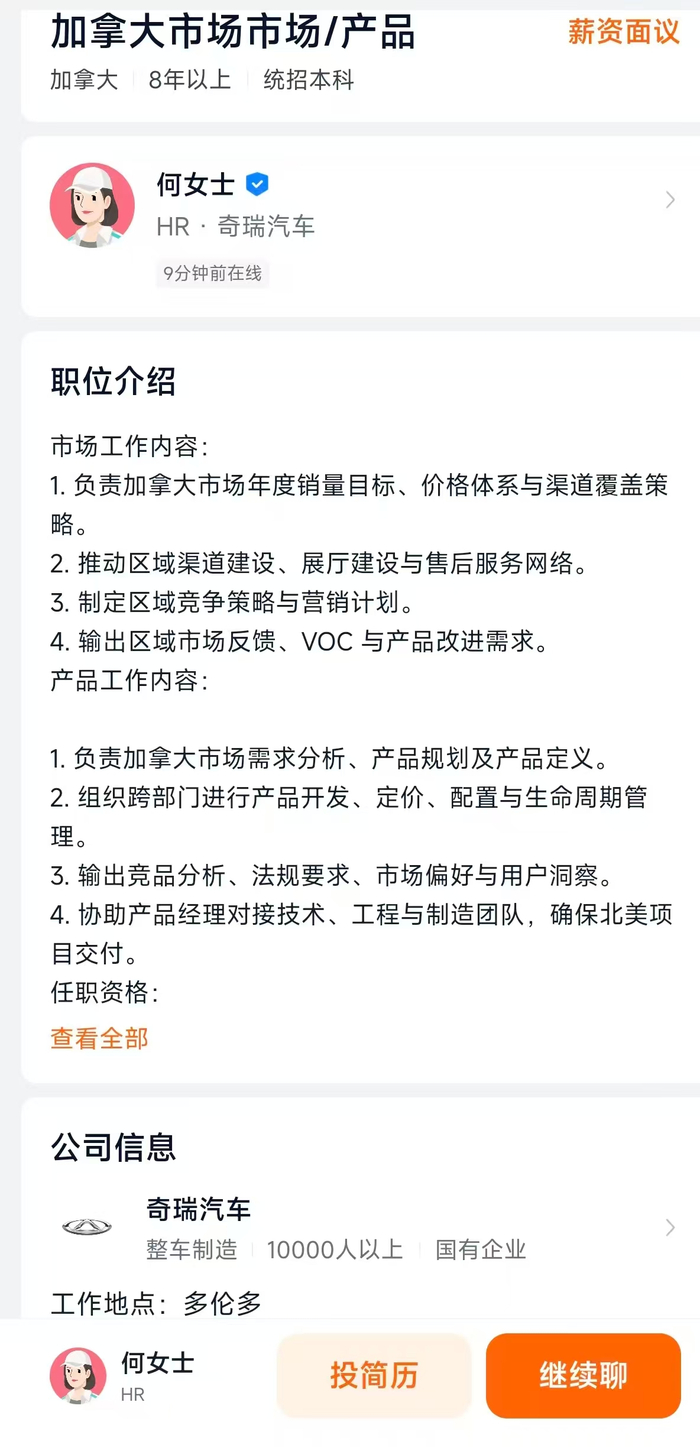
【出海头条】奇瑞与比亚迪开始启动加拿大业务筹备工作
Xin Lang Cai Jing· 2026-02-04 08:45
Core Viewpoint - Canadian government is adjusting tariffs on Chinese electric vehicles, creating opportunities for Chinese automotive companies like Chery to enter the Canadian market [1][6] Group 1: Market Entry and Strategy - Chery is actively recruiting for approximately 10 positions in North America, focusing on vehicle engineering, safety, electronic architecture, intelligent driving, and regulatory certification [1][6] - The Canadian government has announced a quota of 49,000 Chinese electric vehicles per year, with a favorable tariff rate of 6.1% for vehicles within this quota [1][6] - Chery's recruitment strategy indicates a dual-location approach, with product and market roles based in both Wuhu, China, and Toronto, Canada, suggesting a centralized decision-making process [6][11] Group 2: Industry Context and Competitors - Chery has been a leader in China's automotive exports, with a reported export volume of 1.344 million vehicles in 2025, marking a 17.4% year-on-year increase [6][8] - The Canadian automotive market is projected to sell 1.9 million vehicles in 2025, with major brands like GM, Ford, Toyota, and Hyundai-Kia holding over half of the market share [9] - Compared to Chery, BYD has already registered its vehicles for potential export to Canada, indicating a more advanced stage in market entry preparation [10][11] Group 3: Challenges and Opportunities - Chery's expansion into Canada is seen as a strategic move to establish a presence in a market that is less politically sensitive than the U.S., while still being closely linked to the North American supply chain [9][11] - The Canadian market presents challenges such as high competition and consumer sensitivity to brand quality and after-sales service [9] - Analysts suggest that Chery's current efforts are more about positioning for future opportunities rather than immediate sales, allowing for the accumulation of experience in mature markets [11][12]