
运力过剩

Search documents
以星航运面临港口罢工与行业挑战,机构展望谨慎
Jing Ji Guan Cha Wang· 2026-02-13 16:40
Core Viewpoint - A large-scale strike at multiple ports in Italy has disrupted operations for Evergreen Marine Corporation, increasing uncertainty in the Mediterranean supply chain [1] Group 1: Company Developments - Evergreen Marine Corporation and Maersk will upgrade their joint operating routes by adding new ports of call and increasing capacity to optimize their network [1] - The potential reopening of the Red Sea shipping route may exacerbate the risk of declining industry profitability, with ongoing pressures from overcapacity and shrinking demand [1] Group 2: Stock Performance - Over the past week, Evergreen Marine Corporation's stock price has shown volatility, with a range of 1.69% and an amplitude of 6.29% [2] - The latest closing price on February 13 was $21.03, down 0.71% for the day, with trading volume decreasing from 2.0093 million shares on February 12 to 266,600 shares on February 13, indicating a moderate decline in market activity [2] Group 3: Institutional Perspectives - Six institutions currently have no buy ratings for Evergreen Marine Corporation, with hold and sell opinions each accounting for 50%, and a target average price of $16.68, which is below the current stock price [3] - Jefferies and other institutions highlight that overcapacity and geopolitical risks remain significant pressures, although a high dividend yield may provide defensive support [3]
以星航运受罢工与航线升级影响,股价震荡机构谨慎
Jing Ji Guan Cha Wang· 2026-02-11 16:58
Core Viewpoint - The shipping industry, particularly ZIM Integrated Shipping Services, is facing operational disruptions due to geopolitical events and labor strikes, impacting supply chain stability in the Mediterranean region [1] Group 1: Operational Challenges - A large-scale strike at Italian ports on February 11, 2026, has caused ZIM's container ship "Zim Virginia" to be stranded or skip ports, exacerbating supply chain uncertainties [1] - The shipping market is experiencing uncertainty regarding the reopening of the Red Sea route and fluctuations in freight rates, with weakened demand from Asia potentially suppressing short-term profitability for ZIM and similar companies [1] Group 2: Market Performance - ZIM's stock price has shown volatility over the past week, closing at $20.77 on February 11, 2026, with a slight increase of 0.21% on that day, but a cumulative decline of 3.53% over the period [2] - Trading volume peaked at 3.86 million shares on February 5, 2026, but has since decreased, indicating a moderate decline in market trading activity [2] Group 3: Institutional Outlook - Analysts maintain a cautious outlook on ZIM, with no buy ratings among six institutions; half hold and half sell ratings, with a target average price of $16.68, below the current stock price [3] - Concerns about overcapacity and geopolitical risks are significant pressures, although the company's high dividend yield may provide some defensive support [3] - Earnings forecasts for 2025 indicate considerable year-over-year volatility, reflecting market disagreements on the pace of freight rate recovery [3]
红海航线重启前景加剧盈利下滑压力
Zhi Tong Cai Jing· 2026-02-09 02:41
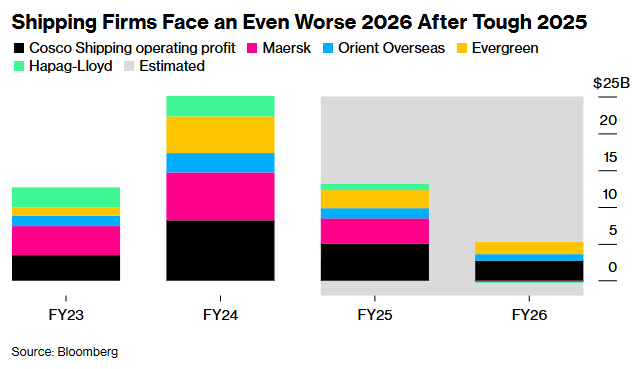
Core Viewpoint - Global container shipping companies are preparing for a decline in profits in 2026 due to the potential reopening of the Red Sea shipping route, which could exert pressure on freight rates and exacerbate the existing structural overcapacity issue in the industry [1][2]. Group 1: Market Conditions and Projections - The reopening of the Red Sea route is expected to increase existing overcapacity issues, with new ship capacity projected to surge by 36% from 2023 to 2027, while container shipping demand is anticipated to shrink by 1.1% in 2026 [1]. - As of January 29, the freight rate for a 40-foot container has decreased by 4.7% to $2,107 [1]. - Analysts from HSBC have revised their freight rate decline forecast to a potential drop of 10% if the Red Sea route reopens quickly, which could lead to losses for major companies like Maersk and Hapag-Lloyd [2]. Group 2: Company-Specific Insights - Maersk is expected to issue a "soft" profit guidance for 2026 and reduce its stock buyback program by 50%, with market consensus predicting its first annual loss since 2017 [2]. - Ocean Network Express (ONE) reported a net loss of $8.8 million for the third fiscal quarter due to an increase in new ships and slow cargo flow on Asia to North America and Europe routes [3]. - Asian shipping companies may have a profit margin advantage over European counterparts due to stronger regional demand and more resilient spot rates, benefiting from operational stability [3].
红海航线重启前景加剧盈利下滑压力!全球航运或迎“二次寒冬”
智通财经网· 2026-02-04 04:19
Core Viewpoint - The potential reopening of the Red Sea shipping route is expected to pressure freight rates and exacerbate the existing structural overcapacity in the global container shipping industry, leading to weaker earnings for major shipping companies in 2026 [1][4][8]. Group 1: Market Conditions - Analysts from Bank of America indicate that the reopening of the Red Sea route will intensify the current structural overcapacity issue, with new shipping capacity projected to increase by 36% from 2023 to 2027 [4]. - Container shipping demand is anticipated to decline by 1.1% in 2026 if companies fully return to the Red Sea route, despite a record expansion in shipping capacity [4]. - The Drewry World Container Index reported a 4.7% decrease in freight rates for a 40-foot container, bringing the price down to $2,107 as of January 29 [4]. Group 2: Company Performance - Major shipping companies like Maersk, Hapag-Lloyd, and Nippon Yusen Kaisha are expected to report weaker performance in 2026 following a challenging 2025 marked by tariff volatility [1][8]. - HSBC analysts predict that if the Red Sea route remains open, freight rates could drop an additional 10%, potentially leading to losses for Maersk and Hapag-Lloyd [8]. - Market consensus suggests that Maersk will issue a "soft" profit guidance for 2026 and reduce its stock buyback program by 50%, with expectations of its first annual loss since 2017 [8]. Group 3: Operational Challenges - Shipping companies remain cautious about significantly adjusting their route networks due to the unpredictable nature of the Houthi activities, which could necessitate a rapid change in shipping strategies [9]. - The volatility in the region has led to hesitance among cargo owners to risk high-value goods, resulting in longer shipping cycles [9]. - Despite some companies like Maersk resuming operations, others, such as CMA CGM, have reversed their decisions to use the Red Sea route, highlighting the area's instability [9]. Group 4: Regional Insights - Asian shipping companies may have a relative advantage in profit margins compared to European counterparts due to stronger regional demand and more resilient spot rates [10]. - The ongoing geopolitical disturbances, including tariff uncertainties and Red Sea security risks, continue to impact major global trade routes, particularly trans-Pacific and Asia-Europe routes [10].

港股异动 | 航空股跌幅居前 多家航司延长涉日航线免退改政策 油汇波动或影响航司业绩
智通财经网· 2026-01-28 07:50
Core Viewpoint - The aviation sector is experiencing significant declines, particularly among major airlines, due to travel restrictions and demand impacts related to Japan. [1] Group 1: Stock Performance - China Southern Airlines (01055) has dropped by 7.67%, trading at HKD 5.54 - China Eastern Airlines (00670) has decreased by 7.12%, trading at HKD 5.22 - Air China (00753) has fallen by 3.5%, trading at HKD 6.89 [1] Group 2: Travel Restrictions - The Ministry of Foreign Affairs has advised Chinese citizens to avoid traveling to Japan during the Spring Festival - Data from DAST indicates that all 49 flights to Japan have been canceled in February - Major airlines including Air China, China Eastern, and China Southern have extended their free ticket refund and change policy for flights to Japan until October 24 [1] Group 3: Market Analysis - Dongxing Securities reports that the demand for flights to Japan is affected, leading to excess capacity as some flight capacity shifts to other routes - Airlines need to strengthen supply management for international routes to mitigate overcapacity risks - Huachuang Securities notes that a 10% change in oil prices could impact the annual costs of the three major airlines by approximately CNY 4.3 to 5.1 billion, while a 1% fluctuation in exchange rates could affect them by CNY 130 to 260 million [1]
航运淡季预期影响下 集运04合约继续回吐往日涨幅
Jin Tou Wang· 2026-01-16 07:08
Group 1 - The domestic futures market shows a downward trend, with the European shipping index futures main contract opening at 1168.0 points and experiencing a decline of approximately 8.52% [1] - The European shipping index is currently in a weak performance phase, influenced by geopolitical tensions and expectations of a shipping off-season after the holiday [2] - The market is characterized by mixed factors, with short-term price fluctuations affected by geopolitical issues and port weather disturbances, while the long-term outlook is pressured by an expected increase in global shipping capacity outpacing demand growth by 2026 [2][3] Group 2 - The main contract for April is primarily driven by expectations, with potential support from export tax rebates and port congestion in Europe, although the current pricing has already factored in some positive elements [3] - Recent developments include Maersk's announcement of resuming its India-East Coast US route through the Suez Canal, which may encourage other shipping companies to follow suit, impacting future contracts [3] - The U.S. government's announcement of a 25% tariff on countries conducting business with Iran may lead to a temporary surge in inventory as foreign trade companies prepare for the new year [4]
中国航司年末集体订购148架飞机
Di Yi Cai Jing Zi Xun· 2025-12-31 14:32
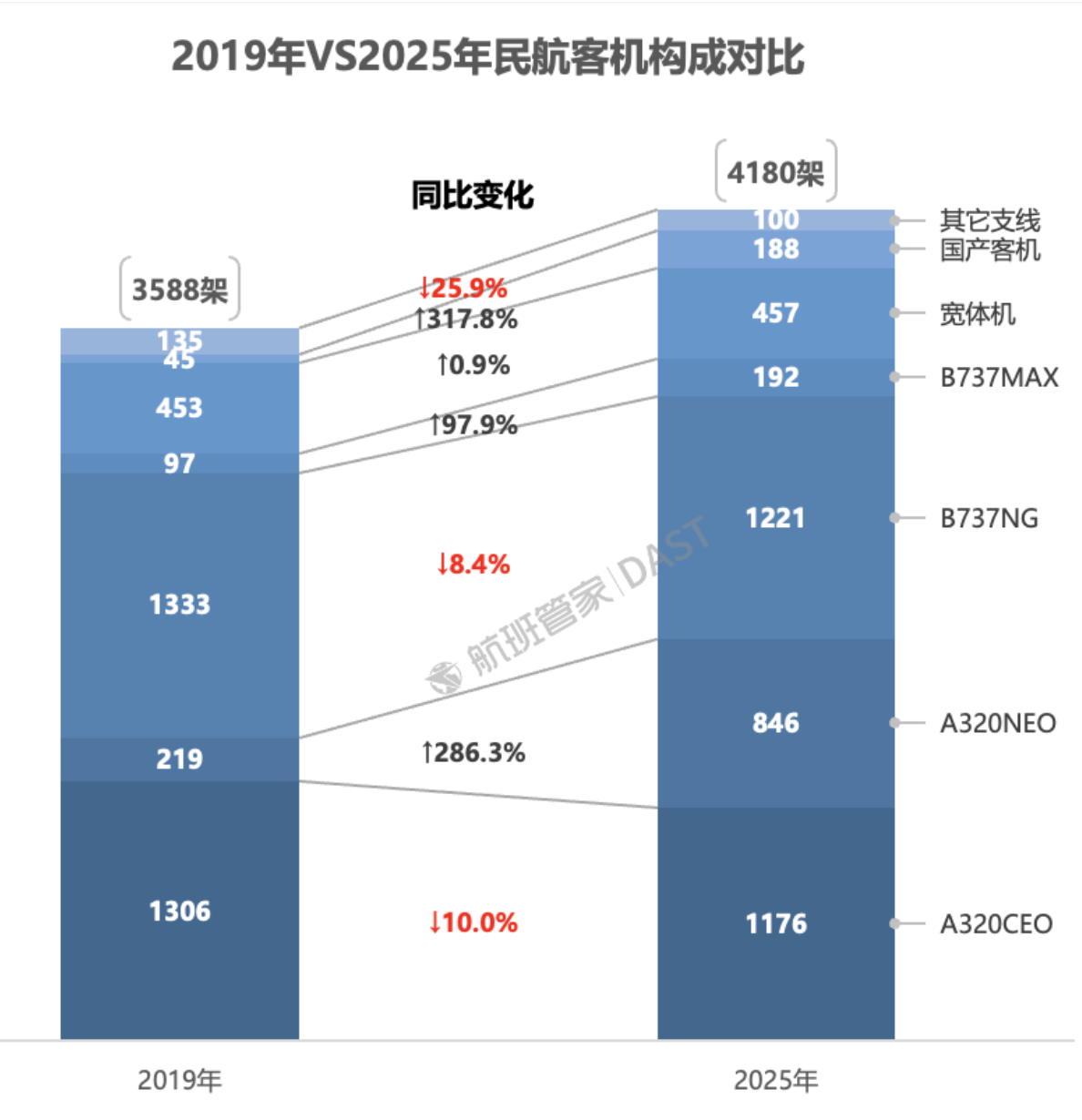
Core Insights - Multiple domestic airlines in China have signed agreements with Airbus to purchase a total of 148 A320 series aircraft, indicating strong demand for narrow-body planes in the market [2][5]. Group 1: Aircraft Orders - Air China and its subsidiary signed a purchase agreement for 60 A320neo aircraft, with a total catalog price of approximately $9.53 billion, scheduled for delivery between 2028 and 2032 [3]. - Huaxia Airlines ordered 3 A320 series aircraft, expected to be delivered over three years starting in 2030, pending government approval [3]. - Spring Airlines and Juneyao Airlines announced orders for 30 and 25 A320neo aircraft, respectively, with delivery planned between 2028 and 2032 [3]. - China Aircraft Leasing Company also signed an agreement for 30 A320neo aircraft, with deliveries planned before 2033 [4]. Group 2: Market Trends - Airbus has seen a significant increase in orders from China, with a market share expected to exceed Boeing's, reaching 55% by 2025 [5]. - The demand for narrow-body aircraft is rising, with older models like A320CEO and B737NG decreasing by 10% and 8.4%, while new models A320neo and B737max have surged by 286.3% and 97.9% respectively [8]. - The introduction of wide-body aircraft has stagnated, with only a net increase of 4 aircraft from 2019 to 2025, largely due to slow recovery in international routes [9]. Group 3: Operational Challenges - Airlines are facing operational challenges due to engine shortages, leading to increased grounded aircraft and delayed new deliveries [7]. - The International Air Transport Association reported over 5,000 grounded aircraft, the highest level historically, exacerbated by trade tensions affecting supply chains [7]. - Despite the operational challenges, the current tightness in capacity has somewhat alleviated the oversupply in the domestic market [7].





中国航司年末集体订购148架飞机
第一财经· 2025-12-31 13:06
Core Viewpoint - Multiple domestic airlines in China have signed significant aircraft purchase agreements with Airbus, totaling 148 A320 series aircraft, indicating a strong demand for narrow-body planes despite current market challenges [3][8]. Group 1: Aircraft Orders - China National Airlines and its subsidiary signed an agreement to purchase 60 A320neo aircraft, with a total list price of approximately $9.53 billion, scheduled for delivery between 2028 and 2032 [5]. - Spring Airlines and Juneyao Airlines announced orders for 30 and 25 A320neo aircraft, respectively, with total prices of up to $4.128 billion and approximately $4.1 billion, to be delivered from 2028 to 2032 [6]. - China Aircraft Leasing Company ordered 30 A320neo aircraft, with deliveries planned before 2033 [7]. Group 2: Market Dynamics - Airbus has secured a total of 148 aircraft orders from China in a short period, reflecting a growing trend of large orders from Chinese airlines [8]. - By 2025, Airbus is expected to hold a market share of over 55% in China, making it the largest single-country market for the company [9]. - The global second-largest aircraft leasing company, Avolon, indicated that popular aircraft models like the Boeing 737 MAX and Airbus A320neo are sold out by 2030, highlighting strong demand [9]. Group 3: Operational Challenges - The recent aircraft orders may be a strategic move to secure aircraft availability and mitigate operational challenges caused by engine shortages, which have led to increased grounded aircraft [11]. - The International Air Transport Association reported that over 5,000 aircraft are currently grounded, the highest level in history, exacerbated by supply chain issues due to U.S.-China trade tensions [11]. - Despite the current overcapacity in the domestic market, the introduction of new aircraft is slowing, with the fleet size growing at a compound annual growth rate of 2.6% from 2019 to 2025 [12]. Group 4: Aircraft Type Trends - The introduction of wide-body aircraft has nearly stagnated, with only a net increase of 4 aircraft from 2019 to 2025, primarily due to slow recovery in international routes [13]. - The domestic market is seeing a shift towards narrow-body aircraft, with significant increases in new models like the A320neo and B737 MAX, while older models are being phased out [12][13]. - The share of domestic aircraft in the fleet has increased from 1.3% in 2019 to 4.5%, indicating a growing presence of domestic manufacturers in the narrow-body market [13].

148架!中国航司年末给空客送大单,运力过剩为何还要买飞机
Di Yi Cai Jing· 2025-12-31 11:45
Core Insights - Airbus has secured a significant order for 148 narrow-body aircraft from multiple Chinese airlines, indicating strong demand in the narrow-body segment [1][5]. Group 1: Aircraft Orders - China National Airlines and its subsidiary signed a purchase agreement for 60 Airbus A320neo aircraft, with a total catalog price of approximately $9.53 billion, scheduled for delivery between 2028 and 2032 [2]. - Huaxia Airlines ordered 3 A320 series aircraft, while Spring Airlines and Juneyao Airlines ordered 30 and 25 A320neo aircraft, respectively, with deliveries planned from 2028 to 2032 [3]. - China Aircraft Leasing Company also signed an agreement for 30 A320neo aircraft, with deliveries expected before 2033 [4]. Group 2: Market Dynamics - Airbus's market share in China is projected to exceed Boeing's, reaching 55% by 2025, making China Airbus's largest single-country market for several consecutive years [6]. - The global second-largest aircraft leasing company, Avolon, indicated that models like Boeing 737 MAX and Airbus A320neo are expected to be sold out by 2030, highlighting the demand for these narrow-body aircraft [6]. Group 3: Production Capacity - To meet increasing demand, Airbus is enhancing its production capacity by activating a second A320 assembly line in Tianjin, aiming for a monthly production target of 75 A320 aircraft by 2027 [7]. Group 4: Industry Challenges - The recent aircraft orders may be a strategic move by Chinese airlines to secure aircraft availability and mitigate operational challenges caused by engine issues, which have led to temporary groundings [8]. - Despite a shortage of new aircraft, over 5,000 grounded planes represent a historical high, exacerbated by trade tensions affecting supply chains and increasing maintenance costs [8]. - The domestic market is experiencing a slowdown in fleet growth, with a projected fleet size of 4,180 aircraft by the end of 2025, reflecting a compound annual growth rate of 2.6% since 2019 [8]. Group 5: Aircraft Composition - The narrow-body aircraft segment is seeing a shift, with older models like A320 CEO and B737 NG decreasing by 10% and 8.4%, while new models like A320neo and B737 MAX have surged by 286.3% and 97.9% respectively [9]. - The introduction of wide-body aircraft has stagnated, with only a net increase of 4 aircraft from 2019 to 2025, largely due to slow recovery in international routes [10]. - Domestic airlines are accelerating the retirement of older wide-body aircraft, focusing on acquiring narrow-body models, which explains the recent orders being exclusively for narrow-body aircraft [10].
银河期货航运日报-20251218
Yin He Qi Huo· 2025-12-18 11:58
Report Overview - The report is a shipping daily from the Commodity Research Institute, dated December 18, 2025, focusing on container shipping, specifically the Container Shipping Index (European Line) [1][2][4] 1. Report Industry Investment Rating - Not provided in the given content 2. Report's Core View - The EC market experienced a corrective oscillation on December 18th. The market continues to speculate on the freight rate trend in January. The short - term market will remain volatile at a high level, and there are still differences in the market's expectations for the January freight rate. The key factors for future expected differences are the price adjustment rhythm and the time of the peak in January [5][6] 3. Summary by Relevant Catalogs 3.1 Market Analysis and Strategy Recommendation 3.1.1 Market Performance - On December 18, the EC2602 contract closed at 1,668.6 points, down 1.84% from the previous day. The latest delivery settlement price of the EC2512 contract on December 12 was 1,510.56 points, up 0.1% month - on - month, and it was lower than market expectations, which drove the EC2512 contract to correct downward [5] 3.1.2 Logic Analysis - **Spot Freight Rates**: The spot cargo - booking situation has improved recently. MSK released a quote for European base ports in the first week of the new year. Different shipping companies have different pricing strategies for December and January. For example, CMA will levy a PSS of $250/TEU from December 29 [6] - **Fundamentals**: The shipping volume from December to January is expected to gradually improve. The weekly average capacity of Shanghai - Northern Europe 5 ports in December is 283,000 TEU. The weekly average capacities in January and February 2026 are 296,500 TEU and 280,700 TEU respectively. The January capacity increased by about 3% compared with the previous week's schedule, and the February capacity decreased by 3.7% [6] - **Geopolitical Factors**: The second phase of the Israel - Palestine peace talks has begun but is still tortuous. The statements of shipping companies and the resumption of shipping after the Spring Festival need to be observed [6] 3.1.3 Trading Strategies - **Unilateral**: Partially take profits and hold part of the long positions in the EC2602 contract. Pay attention to the implementation of shipping companies' price increases and the improvement rhythm of cargo volume [7] - **Arbitrage**: Stay on the sidelines [8] 3.2 Industry News - In 2025, the number of container ship orders reached a new record of 633 ships, totaling 5.08 million TEUs, with Chinese shipyards accounting for 72% of the orders. There are concerns about future over - capacity in the container market [9] - Russian President Putin's speech indicates that the US government's efforts to reach a peace agreement in Ukraine have not changed the Kremlin's military goals [9] - If Putin rejects the peace agreement, the US is prepared to impose new sanctions on Russia [9] 3.3 Related Attachments - The report includes multiple figures, such as the SCFIS European Line Index, SCFIS US - West Line Index, SCFI Comprehensive Index, and container freight rates for different routes, which are sourced from institutions like Shanghai Shipping Exchange, Clarksons, and Wind [10][13][17]