
ADC

Search documents
海通国际:维持石药集团“优于大市”评级 目标价13.07港元
Zhi Tong Cai Jing· 2026-02-25 06:24
海通国际发布研报称,石药集团(01093)的主营业务收入、利润已经触底,2026年有望回到上升周期, 2027年开始受益于肿瘤和代谢创新产品放量,成药收入有望提速。石药集团当前潜在临床里程碑收入达 58亿美元(约人民币406亿元),有望在未来3-5年陆续增厚公司利润。该行认为首付款和里程碑收入将为 公司带来可持续的经常性收益,并上调了2027年后的授权收入预测。该行使用现金流折现(DCF)模型及 FY27-FY35的现金流进行估值。基于WACC7.9%,永续增长率2.5%(均不变),对应目标价13.07港元,并 维持"优于大市"评级。 海通国际主要观点如下: 研发能力多次获得认可,该行看好常态化里程碑收入夯实公司基本面 近两年来石药集团实现7笔对外合作交易,涉及首付款总额17.1亿美元,潜在里程碑总额超300亿美元。 公司与全球顶尖药企阿斯利康三度达成合作,彰显石药集团研发平台在全球范围的影响力与价值。该行 认为,加总近60亿美元的潜在研发里程碑将会在未来3-5年陆续增厚石药集团的利润,成为公司常态化 收入的重要组成部分。该行看好石药集团可以持续以销售里程碑和销售净额分成的方式在整个药品生命 周期分享经济效益 ...
海通国际:维持石药集团(01093)“优于大市”评级 目标价13.07港元
智通财经网· 2026-02-25 06:21
智通财经APP获悉,海通国际发布研报称,石药集团(01093)的主营业务收入、利润已经触底,2026年有 望回到上升周期,2027年开始受益于肿瘤和代谢创新产品放量,成药收入有望提速。石药集团当前潜在 临床里程碑收入达58亿美元(约人民币406亿元),有望在未来3-5年陆续增厚公司利润。该行认为首付 款和里程碑收入将为公司带来可持续的经常性收益,并上调了2027年后的授权收入预测。该行使用现金 流折现(DCF)模型及FY27-FY35的现金流进行估值。基于WACC 7.9%,永续增长率2.5%(均不 变),对应目标价13.07港元,并维持"优于大市"评级。 海通国际主要观点如下: 研发能力多次获得认可,该行看好常态化里程碑收入夯实公司基本面 近两年来石药集团实现7笔对外合作交易,涉及首付款总额17.1亿美元,潜在里程碑总额超300亿美元。 公司与全球顶尖药企阿斯利康三度达成合作,彰显石药集团研发平台在全球范围的影响力与价值。该行 认为,加总近60亿美元的潜在研发里程碑将会在未来3-5年陆续增厚石药集团的利润,成为公司常态化 收入的重要组成部分。该行看好石药集团可以持续以销售里程碑和销售净额分成的方式在整个药品 ...
中国生物医药产业加速发展,疫苗ETF(159643)收涨1.2%,近10日净流入超1亿元
Mei Ri Jing Ji Xin Wen· 2026-02-03 08:31
中国生物医药产业加速发展,2月3日,疫苗ETF(159643)收涨1.2%,近10日净流入超1亿元。 华福证券指出,中国生物医药产业正从"快速扩张"的1.0时代,迈入以"价值与全球竞争力"为核心的2.0 时代。中国已成为全球第二大新药首发市场,在靶向蛋白质降解(TPD)等颠覆性技术领域确立全球领 导地位。产业全球竞争力最直接体现是对外许可交易的快速增长,2025年1-8月交易额已突破500亿美 元。在技术与产业层面,分化与理性回归成为主题,中国在ADC、双抗等优势领域已跻身全球第一梯 队,但内部同质化竞争加剧。资本市场回归理性,资金集中涌向中后期项目及已验证赛道的头部公司, 促使企业竞争焦点从讲故事转向拼硬实力。 疫苗ETF(159643)跟踪的是疫苗生科指数(980015),该指数从沪深市场中选取涉及疫苗研发、生产 及相关生物技术等业务的上市公司证券作为指数样本,以反映疫苗与生物科技领域相关上市公司证券的 整体表现。 (文章来源:每日经济新闻) ...
医药主题性机会不断,资金持续布局,生物医药ETF(512290)连续10日资金净流入超4.6亿元
Mei Ri Jing Ji Xin Wen· 2026-02-03 05:20
Group 1 - The core viewpoint of the article highlights ongoing investment opportunities in the pharmaceutical sector, particularly in thematic areas such as brain-computer interfaces, AI healthcare, and small nucleic acids, with a strategic focus on the raw materials pharmaceutical sector [1] - The biopharmaceutical ETF (512290) has seen a continuous net inflow of over 460 million yuan for 10 consecutive days, indicating strong market interest [1] - The raw materials pharmaceutical sector is currently at a price bottom, with expectations of recovery driven by rising chemical prices and the introduction of new business lines such as small nucleic acids and peptides, which may lead to a mid-term positive cycle [1] Group 2 - The CS Biomedicine Index (930726), which the biopharmaceutical ETF tracks, selects listed companies involved in biotechnology, pharmaceuticals, and related life sciences from the Shanghai and Shenzhen markets to reflect the overall performance of the biopharmaceutical sector [1] - The rising prices of chemical products are expected to create cost pressures that will benefit integrated leading companies with cost advantages along the industry chain [1] - Innovative therapies such as GLP-1, small nucleic acid chronic disease drugs, and ADCs are generating significant global demand for APIs and intermediates, providing a second growth curve for raw material pharmaceutical companies [1]
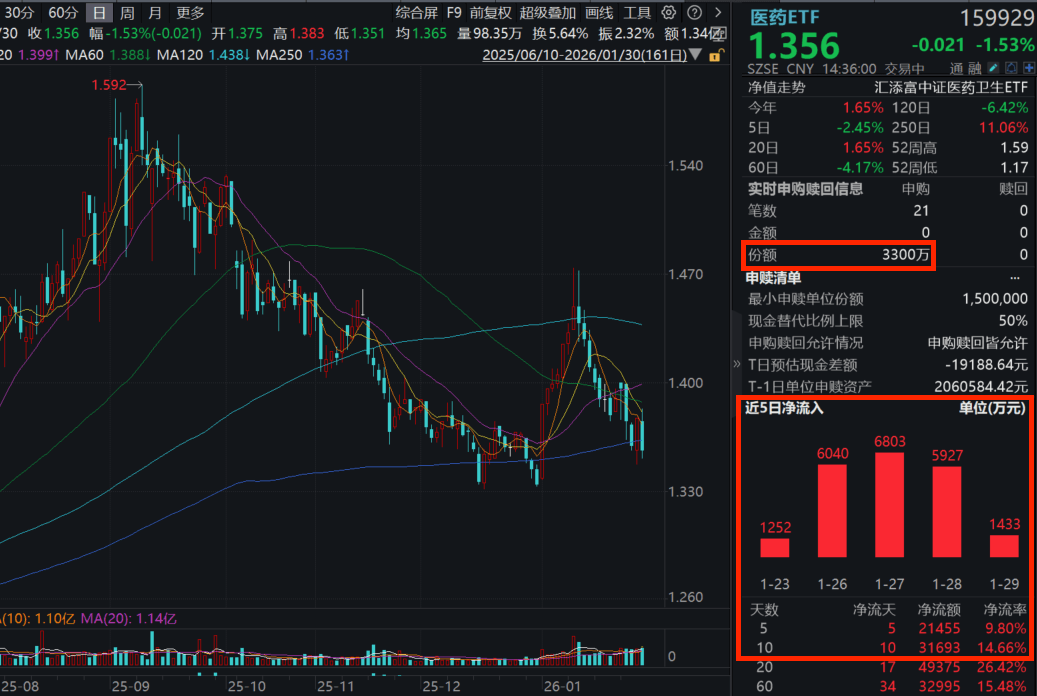
医药再度回调!医药ETF(159929)跌超1.5%,资金连续11天持续涌入!JPM 2026传递出哪四大医药创新风向标?
Sou Hu Cai Jing· 2026-01-30 07:00
Group 1 - The pharmaceutical sector experienced a pullback, with the pharmaceutical ETF (159929) declining by 1.53% and a trading volume exceeding 1.3 billion yuan, indicating a net inflow of over 45 million yuan during the day, marking 11 consecutive days of capital inflow totaling over 360 million yuan [1][3] - Major stocks within the pharmaceutical ETF saw most decline, including Meien Health and Pianzaihuang dropping over 3%, WuXi AppTec and Aier Eye Hospital falling over 2%, while Tigermed rose over 7% [3][4] - Tigermed is projected to see a net profit growth of 105% to 204% by 2025, indicating strong future performance [3] Group 2 - The JPM 2026 conference highlighted a shift in the global pharmaceutical industry's focus towards the effective allocation and long-term value realization of innovations amidst rising uncertainties [5] - Chinese innovation is gaining global recognition, with increased participation from Chinese companies at the JPM 2026, reflecting a growing acknowledgment from international capital and multinational pharmaceutical companies [5][6] - The evaluation logic of multinational pharmaceutical companies regarding Chinese innovative assets is evolving, focusing on their efficacy, differentiation, and competitive positioning for inclusion in global product portfolios [6][10] Group 3 - Multinational pharmaceutical companies are entering a critical patent cliff period, necessitating diversification in their pipelines to mitigate risks associated with single products and treatment areas [10][12] - The integration of AI into core strategies is becoming mainstream, with AI being utilized to enhance R&D efficiency and optimize operational systems, thus addressing challenges posed by the patent cliff [12][13] - The oncology sector remains a core area for pharmaceutical innovation, with a focus on antibody-drug conjugates (ADCs) and cell therapies, indicating a robust pipeline and commercial potential [13][15]




JPMMNC肿瘤进展梳理:IO和ADC为焦点,联用将迎突破
Orient Securities· 2026-01-28 05:45
Investment Rating - The report maintains a "Positive" outlook for the pharmaceutical and biotechnology industry in China [6] Core Insights - The focus remains on the combination of IO (Immuno-Oncology) and ADC (Antibody-Drug Conjugates), with significant advancements expected in their joint application [10][11] - The year 2026 is identified as a critical year for the combination of IO and ADC, with expectations for increased demand for ADCs, particularly in the context of various cancer treatments [11][41] Summary by Sections Section 1: Focus on Second-Generation IO and ADC - Merck's sac-TMT is a strategic focus, with 16 ongoing Phase III clinical trials, particularly in gynecological cancers [14][15] - AstraZeneca has 8 ADCs in clinical stages, with significant data readouts expected in 2026 [19][20] - Pfizer is advancing 4 Phase III clinical trials for its PD-1/VEGF dual antibody SSGJ-707, highlighting its strategic importance in oncology [26][27] - Johnson & Johnson aims to become the leading oncology company by 2030, focusing on multiple myeloma and various cancers [30] - Bristol-Myers Squibb (BMS) is advancing its PD-L1/VEGF dual antibody and oral CELMoD therapies, with significant data catalysts expected in 2026 [32][33] - Roche is focusing on breast cancer, with its oral SERD Giredestrant expected to be approved soon [37][38] Section 2: The Year of IO+ADC Combination - The combination of IO and ADC is seen as a key development direction, with various clinical trials underway [41] - The first-generation IO+ADC combinations are competitive, with sac-TMT emerging as a significant player [42] - The second-generation IO combined with chemotherapy is led by AK112, with multiple milestones expected in the coming years [47] - The second-generation IO combined with ADC is still in early exploration, with AstraZeneca leading the way [49] Section 3: Investment Recommendations and Targets - The report identifies several investment targets, including Kangfang Biotech, 3SBio, and others, highlighting their potential in the oncology sector [11][56]
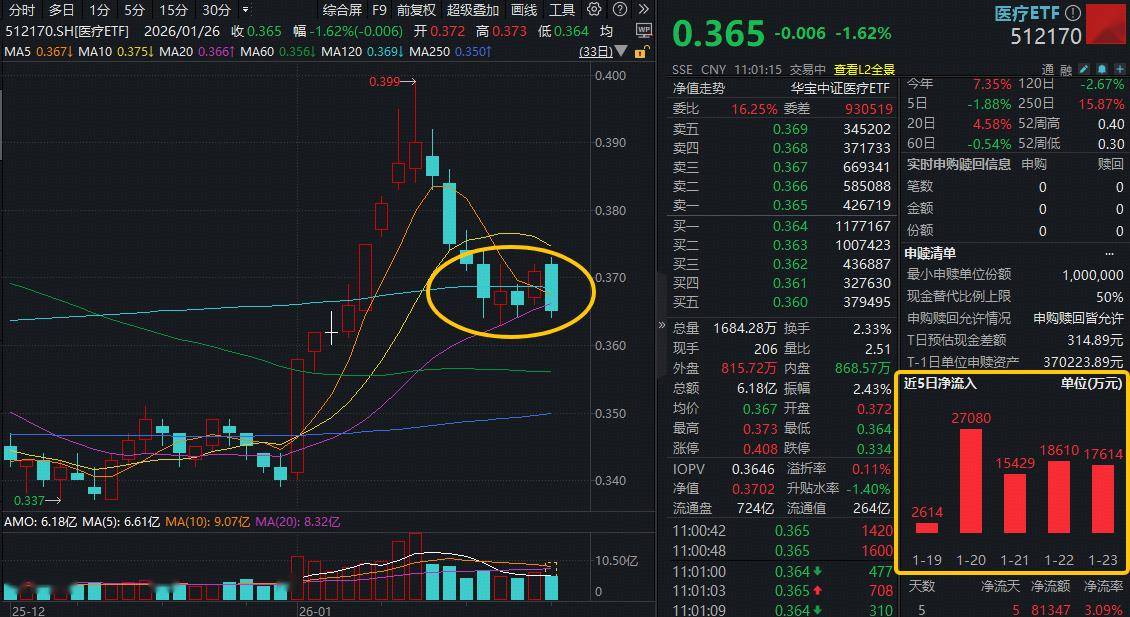
ETF盘中资讯|刚刚,全市场规模最大医疗ETF(512170)再失半年线,场内频现溢价,“抄底”资金单周爆买逾8亿元
Sou Hu Cai Jing· 2026-01-26 03:53
Group 1 - The A-share medical sector weakened on January 26, with AI medical and brain-computer interface concepts leading the decline, as Meien Health dropped by 6% and Weining Health and Sanbo Brain Science fell over 5% [1] - The largest medical ETF in the market (512170) declined by more than 1.6%, losing its half-year line, with real-time transactions exceeding 600 million yuan [1] - Despite the overall decline, the medical ETF (512170) showed high-frequency premiums in the market, indicating active buying interest, with a weekly increase in positions exceeding 813 million yuan [1] Group 2 - CITIC Securities recently published a weekly review of the pharmaceutical industry, indicating that policy impacts will eventually clear, and companies will gradually recover after strategic adjustments, with the medical device sector undergoing dual recovery in valuation and performance [3] - The report suggests increasing allocation to the medical device sector by 2026, with major investment opportunities arising from performance recovery, overseas expansion, brain-computer interfaces, and AI medical technologies, potentially leading to multi-bagger stocks in a tech bull market [3] - The CXO sector is experiencing rapid growth due to advancements in ADC and peptide drugs, with increasing demand for related CXO services, and segments like small nucleic acids and CGT are expected to develop quickly [3] Group 3 - The largest medical ETF (512170) has a fund size of 26.8 billion yuan, making it the largest in the market among medical ETFs [3] - The medical ETF and its linked fund (012323) cover 12 AI medical and brain-computer interface concept stocks, with over 50% weight in medical devices and nearly 25% in CXO [3] - For those interested in Hong Kong stock medical opportunities, the Hong Kong Stock Connect Medical ETF (159137) focuses on medical innovation, gathering core leaders in various pharmaceutical fields, including medical devices, AI medical, CXO, and innovative drugs [3]
药品零售行业高质量发展意见发布,科创医药ETF嘉实(588700)一键布局生物医药产业
Xin Lang Cai Jing· 2026-01-23 03:43
Group 1 - The core viewpoint of the news highlights the strong performance of the pharmaceutical and medical services sectors, with the Shanghai Stock Exchange Sci-Tech Innovation Board Biomedicine Index rising by 1.52% as of 11:05 AM on January 23, 2026, driven by significant gains in stocks such as Chengdu Xian Dao (+5.48%) and BGI Genomics (+4.25%) [1] - The Ministry of Commerce and eight other departments have issued opinions to promote high-quality development in the drug retail industry, encouraging retail enterprises to participate in centralized drug procurement and to enhance their bargaining power through joint purchasing [1] - The Chinese pharmaceutical industry is at a pivotal point for global value reassessment, with 2026 being a critical year to validate transformation outcomes, as highlighted by CITIC Securities [1] Group 2 - As of December 31, 2025, the top ten weighted stocks in the Shanghai Stock Exchange Sci-Tech Innovation Board Biomedicine Index include companies like United Imaging Healthcare and BeiGene, collectively accounting for 48.85% of the index [2] - The CSI Innovation Medicine ETF closely tracks the Shanghai Stock Exchange Sci-Tech Innovation Board Biomedicine Index, providing an easy investment option for those without stock accounts through the linked fund [3]


Molecular Partners (NasdaqGS:MOLN) FY Conference Transcript
2026-01-15 19:32
Summary of Molecular Partners FY Conference Call Company Overview - **Company Name**: Molecular Partners (NasdaqGS:MOLN) - **Focus**: Development of DARPin candidates, particularly in the field of radiotherapy - **Financial Position**: Over $100 million in cash (approximately CHF 93 million) available for investment in R&D [4][30] Key Industry Insights - **Biotech Sector Outlook**: Increased confidence in a turnaround for the biotech sector in 2026, following a challenging period [3] - **Radiotherapy Market**: Positive feedback and renewed interest in radiotherapy, highlighted by the successful IPO of Aktis Oncology [3] Core Product Focus - **Primary Candidate**: MP0712, a DLL3-targeted DARPin, is expected to drive value creation in the upcoming year [4][6] - **Pipeline Overview**: Emphasis on MP0712, with additional focus on MPO 317 and MPO 533, which are also in development [6][11] Product Development and Clinical Trials - **MPO 317**: Initially considered a dead program, it has been revived due to promising phase one data showing immune activation in colorectal carcinoma. A new trial will involve 75 patients across 11 centers in France, with results expected in 2027 [10][11] - **MPO 533**: A multispecific DARPin targeting acute myeloid leukemia (AML), designed to eradicate residual disease clones. The focus will be on low disease burden patients [11][12] Radiotherapy Mechanism - **Mechanism of Action**: MP0712 utilizes a DARPin vector linked to a radioisotope (Lead-212) to target DLL3 in small cell lung cancer. The approach aims to combine the efficacy of T cell engagers with the durability of antibody-drug conjugates (ADCs) [14][16][18] - **Clinical Strategy**: The company plans to initiate a phase one dose escalation trial, starting with a 75-megabecquerel dose, with a fast-to-market strategy for small cell lung cancer [27][30] Safety and Efficacy Considerations - **Safety Profile**: The rapid decay of Lead-212 is expected to result in minimal hematological toxicity, with recovery of blood values anticipated [34][37] - **Patient Experience**: Radiotherapy is expected to offer a better quality of life for patients compared to T cell engagers, which often cause acute side effects [37] Partnerships and Collaborations - **Orano Med Partnership**: A 50/50 partnership focused on the supply of Lead-212, with Orano Med providing a robust supply chain and infrastructure for the isotope [40][43] - **Future Collaborations**: The company is open to exploring partnerships for other isotopes, such as actinium, to enhance treatment options [45][46] Future Directions - **Expansion of Indications**: Beyond small cell lung cancer, there are plans to explore other neuroendocrine tumors with DLL3 expression [47][48] - **Innovative Imaging Techniques**: The use of imaging agents to select patients with DLL3 expression is seen as pivotal for maximizing treatment efficacy [48] Conclusion - **Focus for 2026**: The primary focus will be on MP0712, with expectations for first-in-human results and safety data in the first half of the year, followed by activity data in the second half [30]

JPM 2026:AI破局,肥胖引爆,巨头血战新王座
Xin Lang Cai Jing· 2026-01-15 14:15
Core Insights - 2026 is identified as a pivotal year for transformation and output in the global biopharmaceutical industry, with major companies revealing strategic developments at the JMP conference [1] - The industry is experiencing extreme differentiation, with ADC and GLP-1 seen as key growth engines for the next five years, while mRNA, siRNA, and RLT are transitioning from concepts to clinical norms [1][9] - The BD strategies are becoming more precise, with 2025's small-scale acquisitions starting to yield results, and the logic behind mergers and acquisitions in 2026 expected to diversify [1] Hot Track Dynamics: Dual Drivers of Technology Iteration and Indication Expansion - ADC remains a leading player in the oncology sector, with Merck advancing multiple ADC assets through collaboration with Daiichi Sankyo [12] - BeiGene views ADC as a core technology and is actively promoting drug accessibility globally [12] - Eli Lilly has completed several ADC-related transactions to enhance its capabilities in cancer treatment [12] Weight Management Market Transition - The weight management market is shifting from simple weight loss to comprehensive management of metabolic syndrome, with Eli Lilly focusing on AI-driven drug discovery and direct patient engagement [14] - Roche's acquisition of Carmot Therapeutics enhances its pipeline with new metabolic therapies [14] - Sanofi is expanding the indications for its core asset Dupixent and advancing its autoimmune pipeline [14] Key Corporate Strategic Planning: Core Track Deepening and Platform Layout - Eli Lilly's strategy focuses on obesity and AI-driven drug development, with a projected investment of up to $1 billion in collaboration with NVIDIA [15] - Pfizer aims to maximize core transaction value and apply AI across its business chain, targeting a $150 billion market in obesity by 2030 [15] - Amgen is accelerating the integration of biotechnology and AI, with a focus on rare diseases and partnerships in China [16] BD Trends: Core Logic of Track Reinforcement and Ecological Synergy - The pharmaceutical industry is seeing a concentration of mergers and acquisitions in ADC and bispecific antibodies, with major companies acquiring key assets and technology platforms [17] - Big Pharma is shifting from scale expansion to pipeline restructuring to avoid revenue cliffs due to upcoming patent expirations [18] - The focus is on mid-stage assets with immediate Phase 3 potential, which are expected to have a premium advantage over early-stage assets [18] Industry Outlook - The biopharmaceutical industry is entering an "innovation harvest period" from 2026 to 2030, with GLP-1 drugs evolving into comprehensive metabolic management platforms [19] - The market for GLP-1 receptor agonists in China is projected to reach approximately 38.3 billion yuan by 2030 [19] - The commercialization of cutting-edge therapies is approaching a "singularity," with advancements in cell and gene therapies and RNA therapies expected to overcome production and reimbursement challenges [19][20]


