AI旅游

Search documents
“史上最长春节假期”催生多元玩法
Hang Zhou Ri Bao· 2026-02-25 02:54
Group 1: Traditional Cultural Tourism - The collision of tradition and technology has led to a more diverse cultural tourism market during this year's Spring Festival, with traditional customs remaining a major attraction [1] - Popular destinations for traditional "New Year flavor" tourism include Shantou, Fuzhou, Beijing, Ganzhou, Suzhou, Jiujiang, Shanghai, Quanzhou, Dehong, and Kaifeng, with Shantou showing the highest growth in tourism popularity [1] - Fuzhou hosted over 1,800 events themed around "New Spring Cultural Tourism Month," while local minority cultural activities in places like Ganzhou and Dehong significantly boosted local homestay bookings, achieving over 200% growth during peak travel days [1] Group 2: Ice and Snow Tourism - Ice and snow tourism has become a popular activity during the Spring Festival, with destinations like Harbin, Changbai Mountain, Altay, and Zhangjiakou being favored [2] - Outdoor attractions such as Harbin Ice and Snow World and indoor ski resorts like Nantong Sandy Ice and Snow Ocean Park have seen high visitor numbers, appealing particularly to southern tourists [2] Group 3: Technology Integration in Travel - AI has emerged as an essential tool for travelers during the Spring Festival, with significant increases in traffic for travel smart assistants across various online travel platforms [3] - On Tongcheng's DeepTrip, the most common inquiries were about transportation tickets, scenic spots, and local New Year customs, with the latter seeing a notably higher question volume [3] - Flight bookings for long-distance international travel have increased, with popular destinations including Italy, Spain, Australia, the UK, Germany, Switzerland, and Denmark [3]
春节假期旅游市场点评:春节假期旅游需求旺盛,呈量价齐升、结构优化特点
EBSCN· 2026-02-24 07:14
Investment Rating - The report maintains a "Buy" rating for the social services industry, indicating an expected investment return exceeding 15% over the next 6-12 months [5]. Core Insights - The tourism market during the Spring Festival is characterized by strong demand, with a notable increase in both volume and price, alongside structural optimization [1]. - Domestic tourism is thriving, with a significant rise in orders and spending, reflecting a trend towards diversified experiences in both traditional and niche destinations [2]. - Cross-border travel is experiencing robust growth in both outbound and inbound sectors, with Southeast Asia being a key destination for outbound travel and a diverse range of destinations attracting inbound tourists [3]. Summary by Sections 1. Spring Festival Tourism Overview - The total cross-regional movement of people is expected to reach a new high, with an average daily flow of 299 million people, a 3.8% increase from the previous year [14]. - Hotel bookings during the Spring Festival saw a 75% increase in room nights, with high-end hotels showing a trend towards longer stays [16]. - Air ticket prices have risen due to increased demand, with average ticket prices reaching 965.1 yuan, a 3.6% increase from the previous year [24]. 2. Domestic Tourism Trends - Domestic travel orders reached a historical high, with a 10% increase in average spending per person [25]. - Traditional tourist destinations continue to attract visitors, while lesser-known locations are gaining popularity, with some areas seeing visitor numbers increase by over 400% [16][25]. - AI technology is enhancing the travel experience, with significant increases in ticket and hotel bookings facilitated by AI [29]. 3. Cross-Border Travel Dynamics - Outbound travel is primarily focused on Southeast Asia, with destinations like Bangkok and Hong Kong leading in popularity [34]. - Inbound tourism is benefiting from visa-free policies, with Beijing seeing a 37.1% increase in inbound visitors [37]. - The diversity of inbound travel destinations is expanding, with both major cities and smaller towns attracting international tourists [37]. 4. Investment Recommendations - The report suggests focusing on investment opportunities in the service-oriented consumption sector, particularly in hotels such as Jinjiang Hotels and Shouqi Hotels, as well as online travel agencies like Ctrip and Tongcheng Travel [41].


同程旅行春节盘点:米兰等意大利城市春节酒店预订热度同比增长超200%
Zhong Guo Min Hang Wang· 2026-02-23 05:40
Core Insights - The 2026 Spring Festival holiday has shown a significant increase in tourism, with many popular scenic spots experiencing high demand and ticket shortages, highlighting a robust travel consumption trend [1] Group 1: Regional Tourism Trends - Guangdong has emerged as a top destination for traditional "New Year flavor" tourism, with hotel bookings in places like Shantou increasing by over 80% year-on-year [4] - The top ten popular destinations for traditional "New Year flavor" tourism include Shantou, Fuzhou, Beijing, and others, showcasing a strong regional competition for attracting tourists [2][4] - Fuzhou's "Come to Fuzhou for a Happy New Year" campaign featured over 1800 events, covering various themes such as traditional customs and cultural tourism [4] Group 2: Ice and Snow Tourism - There is a strong demand for ice and snow tourism during the Spring Festival, with Harbin and Changbai Mountain being popular destinations [5] - Indoor ski resorts have become a new hotspot for ice and snow tourism, with several newly opened large indoor ski facilities gaining popularity [7][8] Group 3: Local and Reverse Travel Trends - "Return home travel" has become a significant trend, with local bookings in midwestern cities exceeding 60%, indicating a strong preference for local tourism during the holiday [9] - The "reverse New Year" trend has also contributed to increased travel to major cities like Beijing and Shanghai, with flight bookings from midwestern cities rising by nearly 40% [9] Group 4: County-Level Tourism Growth - Several county-level destinations have seen hotel booking increases of over 400%, driven by rich traditional customs and local attractions [10] - Notable county destinations include Huangshan's Yi County and Guilin's Yangshuo County, which have attracted significant tourist interest due to their cultural offerings [10] Group 5: International Travel Demand - There has been a notable surge in long-distance outbound travel, particularly to European destinations like Italy, with hotel bookings in cities like Milan increasing by over 200% [12][13] - The Winter Olympics in Milan has further boosted travel interest, with families combining event attendance with sightseeing in historical cities [13]

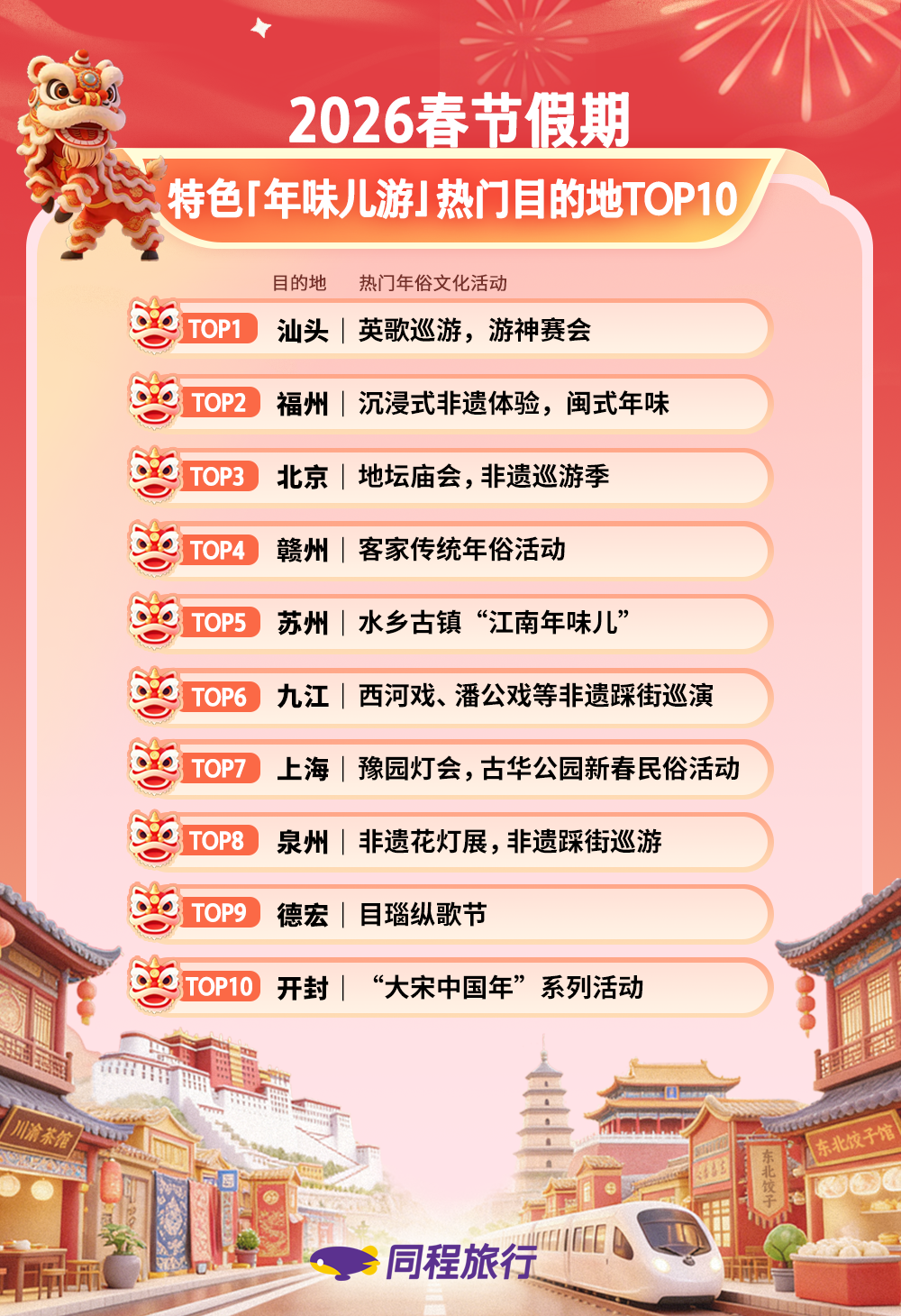
同程旅行(00780)春节盘点:广东年俗游热度居前,汕头酒店预订热度同比增长超80%
智通财经网· 2026-02-23 03:57
Core Insights - The 2026 Spring Festival holiday has shown a significant increase in tourism, with many popular destinations experiencing high demand and a surge in travel activities [1][2][5] Group 1: Tourism Trends - Traditional cultural experiences remain a major draw for domestic tourism during the Spring Festival, with Guangdong and Fujian hosting various New Year activities that have become popular among travelers [1][5] - Hotel bookings in Guangdong, particularly in Shantou, have seen an increase of over 80% compared to the previous year, making it a leading destination for cultural tourism [2][5] - The first Spring Festival holiday after the border reopening has led to a record high in tourism in Hainan, with hotel bookings increasing by over 70% [5] Group 2: Ice and Snow Tourism - Demand for ice and snow tourism has surged, with Harbin, Changbai Mountain, and other destinations being popular among families for winter activities [6][7] - Indoor ski resorts have become a new hotspot for ice and snow tourism, with several newly opened large indoor ski facilities attracting significant interest [8][9] Group 3: Local and Reverse Travel - "Return home" and "reverse New Year" travel trends have emerged, with local bookings in midwestern cities seeing over 100% growth compared to last year [10][12] - Many travelers are choosing to explore local attractions in their hometowns, contributing to a significant increase in local tourism [10] Group 4: County-Level Tourism - Smaller counties have experienced a remarkable increase in tourism, with hotel bookings in places like Huangshan and Yangshuo rising by over 400% [13][15] - These counties are attracting visitors with rich traditional cultural activities and well-known scenic spots [15] Group 5: AI in Travel Planning - The use of AI for travel planning has become prevalent, with a significant portion of inquiries related to local customs and traditions during the Spring Festival [16] - Young travelers, particularly those under 30, are increasingly relying on AI for travel assistance and information about local customs [16] Group 6: International Travel Demand - There has been a notable increase in long-distance outbound travel, with hotel bookings in Italian cities like Milan rising by over 200% during the Spring Festival [19][21] - Families are increasingly choosing to travel to Europe, particularly for events like the Winter Olympics, which has boosted interest in destinations such as Milan and Venice [20][21]
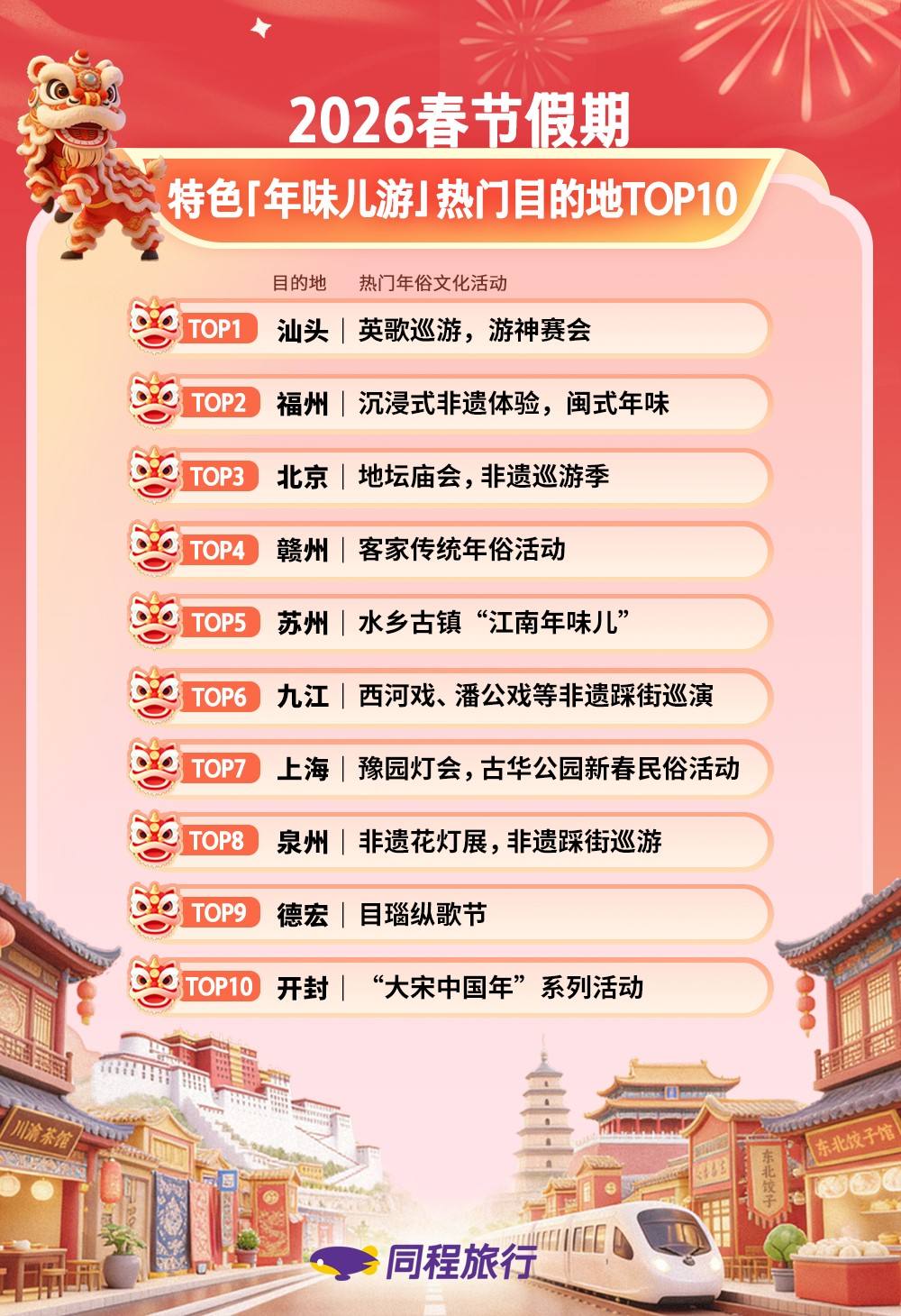
同程旅行春节盘点:汕头、福州、北京成热门目的地TOP3
Xin Lang Cai Jing· 2026-02-23 03:54
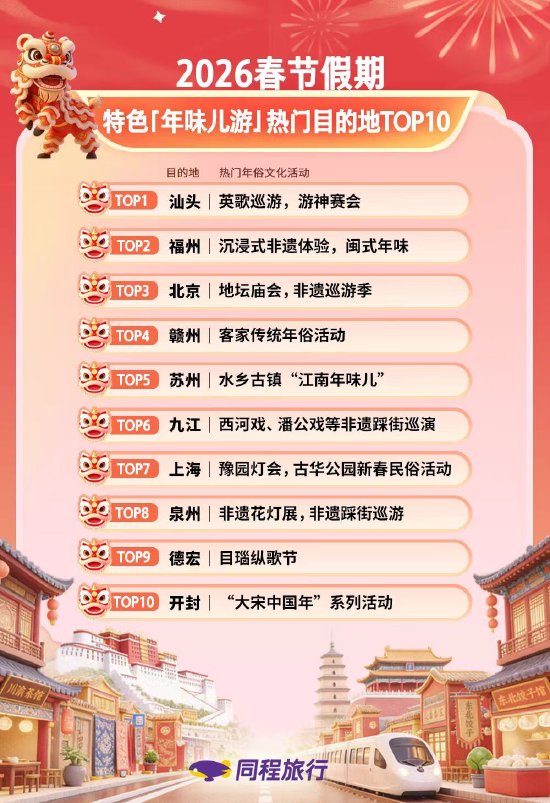
Core Insights - The report by Tongcheng Travel highlights new trends and characteristics in tourism consumption during the 2026 Spring Festival, emphasizing the continued popularity of traditional customs and cultural experiences [1][6]. Group 1: Traditional Cultural Tourism - Traditional customs remain a significant draw in the Spring Festival tourism market, with a focus on experiencing the "flavor of the New Year" becoming mainstream for domestic travel [1][6]. - Various New Year cultural activities in Guangdong and Fujian have become popular, with Shantou emerging as a "dark horse" destination due to a leading increase in tourism heat [1][6]. Group 2: Popular Destinations and Trends - The overall tourism heat in Hainan during the Spring Festival reached a new high, with hotel bookings increasing by over 70% year-on-year [1][6]. - Harbin is a leading destination for ice and snow tourism, with indoor ski resorts becoming the preferred choice for residents in southern regions [1][6][8]. - The trend of "returning home" and "reverse New Year" has led to over 100% year-on-year growth in local tourism bookings in cities like Chongqing and Chengdu [1][6]. Group 3: Emerging Travel Styles - The trend of consulting AI for travel advice on local customs has gained popularity among young travelers during the Spring Festival [1][6]. - The extended holiday has significantly boosted demand for long-haul outbound travel, with hotel bookings in Milan, Italy, increasing by over 200% year-on-year [1][6]. Group 4: Top Destinations for Ice and Snow Tourism - The top ten popular destinations for ice and snow tourism during the Spring Festival include: 1. Harbin, Heilongjiang - Harbin Ice World 2. Changbai Mountain, Jilin - Changbai Mountain Wanda International Resort 3. Altay, Xinjiang - General Mountain/Wooden Houses in He Mu Snow Town 4. Zhangjiakou, Hebei - Chongli Ski Resort 5. Jilin City, Jilin - Beidahu Ski Resort/Wusong Island 6. Shenyang, Liaoning - Qipanshan Ice World/Shenyang Palace Museum 7. Mudanjiang, Heilongjiang - Snow Pass 8. Changchun, Jilin - Changchun Ice New World/Jingyuetan 9. Aba, Sichuan - Bipenggou + Zhegu Mountain Ski Resort 10. Hulunbuir, Inner Mongolia - Genhe Cold Extreme Village + Manzhouli [4][9].
凯撒旅业(000796.SZ):公司暂未布局AI旅游行程规划、AI导游等业务
Ge Long Hui· 2025-11-17 07:48
Core Viewpoint - Caesar Travel Industry (000796.SZ) has not yet ventured into AI travel itinerary planning or AI tour guide services, focusing instead on building product barriers through self-developed offerings [1] Group 1: Company Strategy - The company emphasizes self-research and development to create unique product competitiveness [1] - It has established a product system covering 28 major themes and over 120 countries and regions [1] - The self-operated product development team is a key component in creating non-replicable products [1]

中秋国庆出游火爆,旅游产业链都有哪些投资机会?
智通财经网· 2025-09-30 07:21
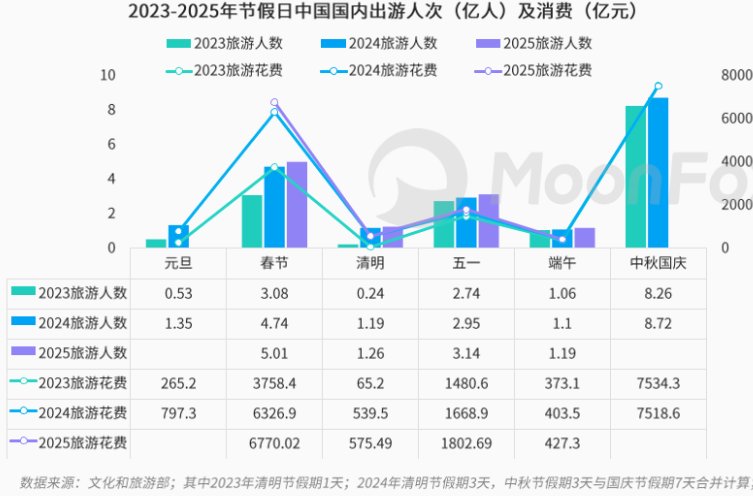
Core Insights - The tourism industry has been experiencing a strong recovery since 2022, with a double-digit compound growth rate in tourist numbers, and is expected to maintain high growth into 2025 [1][2] - Major holidays in 2025, including the upcoming National Day, have seen record-high travel enthusiasm, with significant increases in both domestic and international travel bookings [1][2] - The recovery in the tourism sector is anticipated to create investment opportunities, particularly in the OTA (Online Travel Agency) sector, with companies like Ctrip and Tongcheng Travel showing substantial stock price increases [1][7] Industry Trends - Domestic tourism in China has shown a remarkable increase, with 3.285 billion trips taken in the first three quarters of 2025, reflecting a year-on-year growth of 20.6% [2] - International tourism is also recovering, with 690 million international tourists globally in the first half of the year, a 5% increase, largely driven by China's performance [2] - The trend of mass tourism is evident, with a notable rise in travel from lower-tier cities, as rural tourism outpaces urban tourism growth [4] Structural Changes - The tourism structure is being reshaped, with a focus on experiential travel and innovative tourism models, such as high-end customized tours and luxury cruises [5] - AI technology is evolving within the industry, leading to the emergence of new demand avenues and enhancing user experiences across the tourism value chain [5][6] - Government policies are increasingly supportive, with measures aimed at fostering cultural and tourism consumption, contributing to the sector's stability and growth [6] Investment Opportunities - The ongoing recovery in the tourism sector and the rise of AI in travel are creating investment opportunities, particularly for leading companies in the OTA space like Ctrip and Tongcheng Travel [7][9] - Ctrip has shown robust growth in its accommodation and transportation booking segments, with revenue growth exceeding 20% [7] - Tongcheng Travel has become a major player in the lower-tier city market, with 87% of its registered users coming from non-first-tier cities, and has maintained double-digit growth in its core business segments [8]

在服贸会上,体验一站式入境游服务
Zhong Guo Jing Ji Wang· 2025-09-15 00:30
Core Insights - The article highlights the significant growth in inbound tourism to Beijing, with a 44% year-on-year increase in visitors from January to July, totaling 2.916 million tourists, attributed to enhanced services and innovative products in the tourism sector [1][2]. Group 1: Inbound Tourism Growth - Beijing's inbound tourism has shown strong growth, with 2.916 million visitors in the first seven months of the year, reflecting a 44% increase compared to the previous year [1]. - The city's efforts to leverage technology for service upgrades and enhance the overall travel experience have contributed to its rising attractiveness as an international tourism destination [1]. Group 2: Technological Innovations in Travel Services - Travel companies like Trip.com Group and "Qunar" have introduced digital tools such as smart booking systems and multilingual service platforms to facilitate travel planning for international visitors [2]. - The "BEIJING PASS" card allows tourists to access multiple transportation and consumption scenarios seamlessly, enhancing the convenience of travel within the city [2]. Group 3: Payment and Tax Refund Innovations - The introduction of electronic payment solutions, such as "畅游通" and "幂方卡," enables tourists to make cashless transactions like local residents, while also providing additional services like Wi-Fi and real-time translation [3]. - The "immediate refund" tax refund service launched by the Bank of China allows tourists to receive instant refunds on purchases, enhancing the shopping experience for international visitors [3]. Group 4: AI and Interactive Experiences - AI technologies showcased at the tourism exhibition, such as the AI assistant "小蚂BOT," provide interactive and engaging experiences for visitors, enhancing their understanding of popular tourist attractions [4]. - Multi-language AI translation tools and customized photo experiences allow tourists to communicate effortlessly and create memorable travel moments [4].
作者|闪电 编辑|Duke 来源
Sou Hu Cai Jing· 2025-06-16 02:03
Core Viewpoint - JD.com is expanding into the online travel industry, attempting to disrupt the market with aggressive hiring and a "no bundling" approach for ticket sales, but faces significant challenges due to its past failures and the competitive landscape [2][7]. Group 1: JD.com's Strategy and Challenges - JD.com is likely to replicate its "lightning war" strategy from the food delivery sector, involving high salaries and subsidies to attract talent and customers [2][3]. - The online travel market is fundamentally different from food delivery, as travel decisions are less frequent and involve a longer decision-making process, making it harder to sway users with subsidies [3][4]. - The complexity of the travel service chain, including hotel bookings and various travel services, presents significant challenges for JD.com in implementing a subsidy strategy effectively [3][4]. Group 2: Competitive Landscape - The online travel industry is dominated by established players like Meituan, Ctrip, and Fliggy, creating a strong "Matthew effect" where market share is concentrated among a few [4][5]. - Ctrip has a long-standing relationship with high-star hotels, while Meituan has built a strong advantage in the local market through a comprehensive service model [4][5]. - JD.com faces three major barriers: resource control, user perception, and the need for a robust service network to handle complex travel-related issues [5][6]. Group 3: Technological Integration - The integration of AI in the online travel industry is becoming essential, with competitors like Fliggy and Tongcheng leveraging AI for enhanced user experiences [6][7]. - JD.com has not made significant strides in AI applications within the travel sector, which could hinder its competitiveness as other players advance [6][7]. - The current landscape suggests that merely relying on price competition is insufficient for success in the online travel market, which has evolved beyond a "burning money" strategy [7].



低空与AI双轮驱动下的旅游场景创新
Bei Jing Shang Bao· 2025-05-28 15:51
Group 1: eVTOL and Low-altitude Tourism - eVTOL technology is revolutionizing traditional low-altitude tourism by offering advantages in operational costs, environmental impact, noise control, and autonomous driving capabilities, injecting new vitality into the cultural tourism industry [1] - The successful commercialization of low-altitude tourism requires collaboration among various stakeholders, including manufacturers, operators, scenic spots, and policymakers, to create a suitable economic model and industry environment [1] - The market for low-altitude tourism is transitioning from a niche to a mass market, driven by advancements in eVTOL technology and the increasing importance of travel service companies in this sector [2] Group 2: Challenges and Innovations in Cultural Tourism - The cultural tourism industry faces challenges in balancing profitability, experiential demand, and innovative applications, compounded by uncertainties in policy support and project revenue models [3] - Innovation in cultural tourism should not rely solely on technology but rather on collaboration among various professionals, including directors, visual designers, and equipment suppliers, to create immersive experiences [3] - The integration of low-altitude technology is hindered by policy decisions and airspace opening progress, necessitating a shift in government thinking from a "cost-focused" to an "ecosystem-focused" approach [3] Group 3: Characteristics and Development of Low-altitude Tourism - Suitable low-altitude tourism destinations should have a customer base with aviation spending capacity, open airspace environments, and adequate supporting facilities for takeoff, landing, and visitor reception [5] - Fixed routes for low-altitude tourism are essential for popularizing the service, as they help accumulate flight data and enhance public acceptance of low-altitude travel [6] - Initial fixed routes can reduce operational risks and improve visitor experiences through standardized services, laying the groundwork for the large-scale development of low-altitude tourism [6] Group 4: AI in the Tourism Industry - AI is providing new productivity in the tourism industry, with platforms that excel in three key traits: innovative models, differentiated services, and empowered intelligent agents [7] - The core competitiveness of AI tourism platforms lies in their "technological warmth," which combines data and algorithms with a focus on the experiential essence of the tourism industry [7] - The transformation from traditional platforms to those emphasizing tools and services, along with community engagement, is redefining the connection between tourists and destinations [7]