AI硬科技

Search documents
壁仞之后,昆仑芯、智谱也要来了!港股硬科技迎IPO热潮,首只“港股芯片链”ETF放量涨超3%
Xin Lang Cai Jing· 2026-01-05 06:25
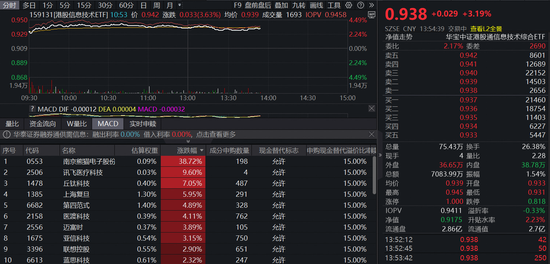
Core Viewpoint - The Hong Kong stock market is witnessing a strong performance in the technology sector, particularly with the launch of the first ETF focused on the "Hong Kong chip" industry chain, which has shown a significant increase in value and trading volume [1][4]. Group 1: ETF Performance - The Hong Kong Information Technology ETF (159131) opened high and maintained a slight fluctuation, currently up by 3.19% with a trading volume exceeding 700 million CNY [1][4]. - The ETF is designed to track the "Hong Kong Stock Connect Information Technology Composite Index," with a composition of 70% hardware and 30% software, focusing on semiconductor, electronics, and computer software sectors [4][9]. Group 2: Market Trends - The Hong Kong hard technology sector is experiencing an IPO boom, with companies like Baidu Kunlun Chip and others preparing for listings, indicating a growing interest in domestic AI and computing technologies [3][8]. - The Chinese intelligent computing chip market is projected to grow from 1.7 billion USD in 2020 to 30.1 billion USD by 2024, with a compound annual growth rate (CAGR) of 105%, significantly outpacing global market growth [3][8]. Group 3: Key Stocks Performance - Notable stocks within the ETF include Nanjing Panda Electronics, which surged over 40%, and other companies like iFlytek Medical Technology and Hillstone Technology, which also saw significant gains [1][4]. - Semiconductor companies such as SMIC and Hua Hong Semiconductor are included in the ETF, with respective weightings of 20.48% and 5.80%, highlighting their importance in the portfolio [4][9].

喜迎开门红,港股科技爆发!首只聚焦“港股芯片”产业链的港股信息技术ETF(159131)跳空高开大涨3.63%
Xin Lang Cai Jing· 2026-01-05 02:01
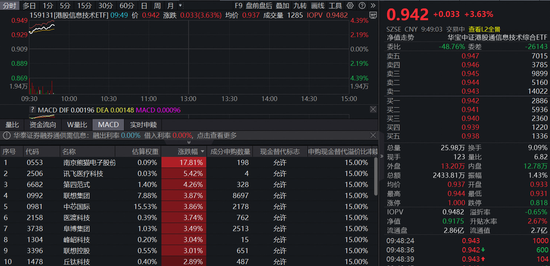
Core Viewpoint - The A-share and Hong Kong stock markets experienced a strong start to the year on January 5, 2026, with significant gains in technology sectors, particularly in the Hong Kong market, where indices such as the Hang Seng Technology Index rose over 4% [1][3]. Group 1: Market Performance - The first trading day of 2026 saw the Hong Kong stock market's technology sector surge, with the Hang Seng Technology Index and the Hong Kong Internet Index both increasing by over 4% [1][3]. - The first ETF focusing on the "Hong Kong chip" industry chain, the Hong Kong Information Technology ETF (159131), opened with a jump of 3.63%, achieving a real-time transaction volume exceeding 24 million CNY [1][3]. Group 2: Sector Insights - Analysts from Galaxy Securities predict that the Hong Kong stock market will continue to see increased trading activity and an overall upward trend, driven by multiple positive factors [3][9]. - The technology sector remains a key focus for medium to long-term investments, supported by price increases in the supply chain, mergers and acquisitions, and domestic substitution trends [3][9]. Group 3: IPO and Market Trends - The IPO of domestic GPU company Birun Technology on January 2 saw its stock price surge nearly 120% on its first day, marking it as the "first GPU stock" in Hong Kong [3][9]. - Birun Technology aims to capture a market share of 0.2% in the Chinese smart computing chip market by 2025, with the market size projected to reach 50.4 billion USD [3][9]. Group 4: ETF Composition - The Hong Kong Information Technology ETF (159131) is structured with a composition of 70% hardware and 30% software, heavily investing in semiconductor, electronics, and computer software sectors, including major companies like SMIC (20.48% weight) and Xiaomi (9.53% weight) [3][9]. - The ETF excludes large-cap internet companies such as Alibaba, Tencent, and Meituan, allowing for a sharper focus on AI and hard technology trends in the Hong Kong market [3][9].
部分产能涨价10%?中芯国际飙涨5%,首只“港股芯片链”ETF开盘涨近2%
Xin Lang Cai Jing· 2025-12-24 02:00
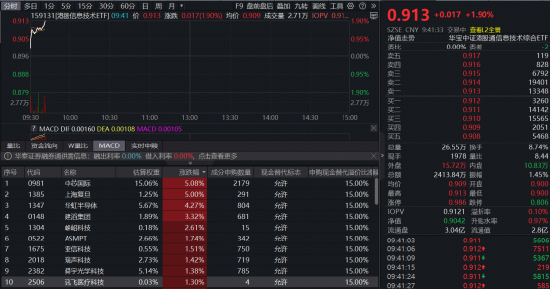
Core Viewpoint - The Hong Kong stock market is experiencing a strong surge in the semiconductor sector, with notable increases in stock prices for companies like SMIC and Hua Hong Semiconductor, alongside the launch of the first ETF focused on the Hong Kong semiconductor industry [1][7]. Group 1: Market Performance - On December 24, the Hong Kong stock market saw significant gains in semiconductor stocks, with SMIC and Shanghai Fudan rising by 5% and Hua Hong Semiconductor increasing by over 4% [1][7]. - The first ETF focusing on the Hong Kong semiconductor industry (159131) recorded a price increase of 1.9%, with a real-time transaction volume exceeding 24 million CNY [1][7]. Group 2: Price Increases and Demand - SMIC has implemented price increases on some of its production capacities, with an approximate rise of 10% expected to be executed soon [8][9]. - The demand for semiconductor products is driven by the continuous growth in mobile applications and AI, leading to increased wafer demand [9]. - The capacity utilization rates for SMIC and Hua Hong are nearing or exceeding full capacity due to strong demand [9]. Group 3: ETF Composition and Strategy - The ETF's index is composed of 70% hardware and 30% software, heavily investing in Hong Kong's semiconductor, electronics, and computer software sectors, covering 42 hard-tech companies [9]. - SMIC holds a weight of 20.48% in the ETF, while Xiaomi Group-W and Hua Hong Semiconductor have weights of 9.53% and 5.80%, respectively [9].

ETF盘中资讯|恒生科技异动拉升,首只“港股芯片链”ETF盘中大涨近2%!机构:港股迎来年内最后一次交易窗口
Jin Rong Jie· 2025-12-19 02:58
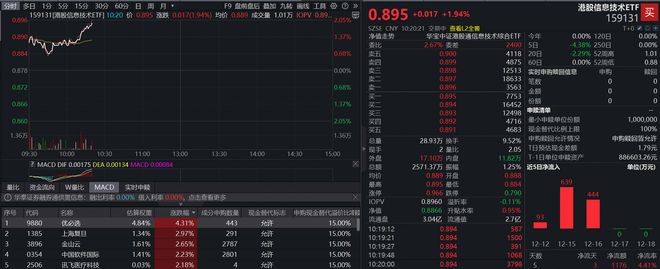
Core Viewpoint - The Hong Kong stock market is experiencing a strong performance, particularly in the technology sector, with a notable rise in the Hong Kong chip industry and the launch of the first ETF focused on this sector [1][3]. Group 1: Market Performance - The Hong Kong stock market showed strength on December 19, with the Hang Seng Technology Index rising over 1% [1]. - The first ETF focusing on the Hong Kong chip industry (ETF 159131) saw a price increase of 1.94% and a real-time transaction volume of 25 million CNY [1]. Group 2: ETF Details - The Hong Kong Information Technology ETF (159131) tracks an index composed of 70% hardware and 30% software, heavily investing in semiconductor, electronics, and computer software sectors [3]. - The ETF includes 42 Hong Kong hard-tech companies, with significant weights in companies like SMIC (20.48%), Xiaomi Group (9.53%), and Hua Hong Semiconductor (5.80%) [3]. - The ETF excludes major internet companies like Alibaba, Tencent, and Meituan, allowing for a sharper focus on the AI hard-tech market [3]. Group 3: Industry Outlook - There is a strong demand for AI computing power globally and in China, with the domestic AI chip market expected to grow rapidly due to supportive policies and strong downstream demand [3]. - The domestic AI chip industry is seen as a key area for future development, driven by multiple factors including policy support and significant replacement opportunities [3].
2025年半导体营收将站上8000亿美元!首只聚焦“港股芯片”产业链的港股信息技术ETF(15...
Xin Lang Cai Jing· 2025-12-12 05:47
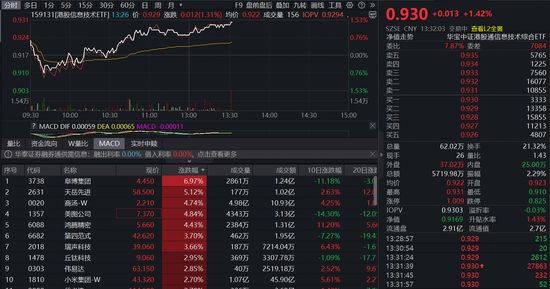
Group 1 - The Hong Kong stock market's chip industry chain showed strong performance, with notable gains from companies such as Fubo Group (+6%), Tianyue Advanced (+5%), SenseTime-W, Meitu, and Hong Teng Precision (+4%) [1] - The first ETF focusing on the Hong Kong chip industry chain (159131) experienced a price increase of 1.42%, with real-time transaction volume exceeding 57 million yuan [1][2] - According to Omdia's latest research, the semiconductor industry is projected to reach revenues of $216.3 billion in Q3 2025, marking a 14.5% quarter-over-quarter growth, with annual revenues expected to surpass $800 billion [1][3] Group 2 - The newly launched Hong Kong Information Technology ETF (159131) tracks an index composed of 70% hardware and 30% software, heavily investing in semiconductor, electronics, and computer software sectors, including major companies like SMIC (20.48% weight) and Xiaomi Group-W (9.53% weight) [3] - The ETF excludes large-cap internet companies such as Alibaba, Tencent, and Meituan, allowing for a sharper focus on the AI hard technology sector in Hong Kong [3]
海光信息终止并购曙光:资本周期、估值逻辑与国产算力格局的再平衡
Xin Lang Cai Jing· 2025-12-11 04:11
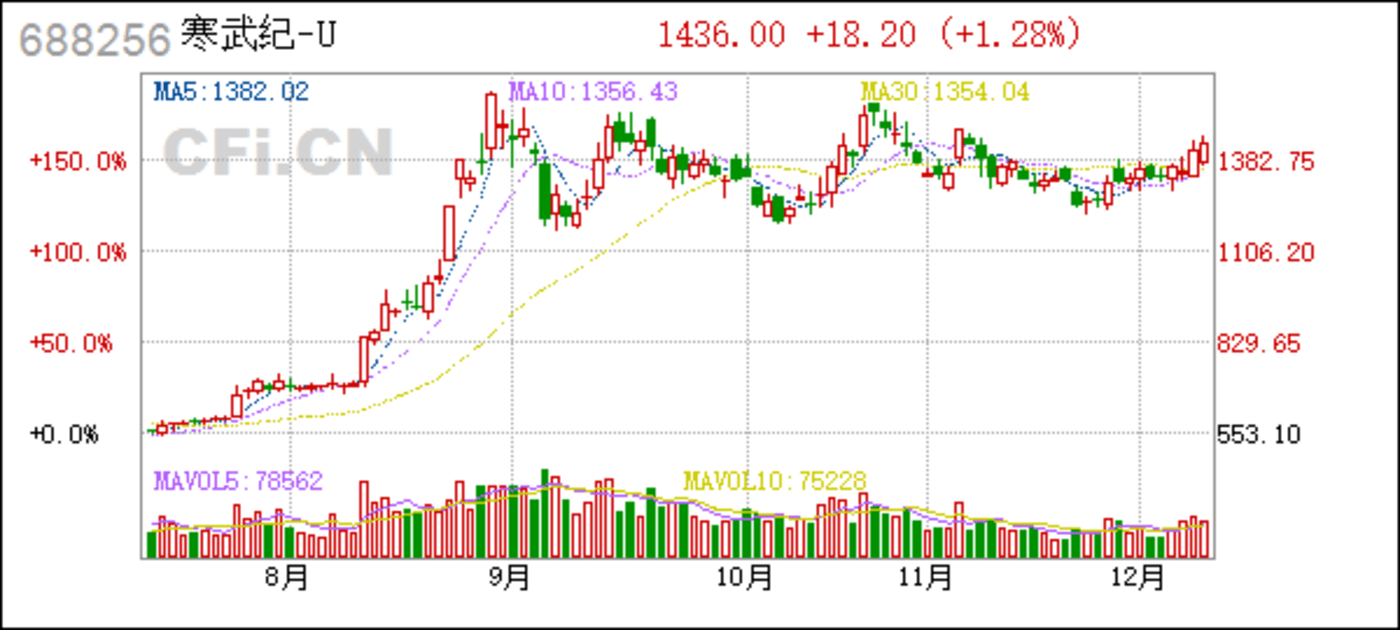
Core Viewpoint - The recent decision by Haiguang Information to terminate the acquisition of Shuguang Co. reflects a strategic choice influenced by the current high valuation cycle in the AI chip and computing power industry, rather than a failure in technical collaboration or increasing conflicts of interest [1][19][37] Group 1: Market Context - The AI chip and computing power industry in China has entered a rare valuation uplift period, with significant price increases and market enthusiasm for AI hardware technology [1][19] - Companies like Cambrian and Moer Thread have seen substantial stock price increases, with Cambrian's revenue for the first three quarters of 2025 reaching 4.607 billion yuan, a year-on-year increase of 2386% [2][21] - Moer Thread's stock surged 425.46% on its debut, reflecting high market expectations despite its current losses [4][22] Group 2: Haiguang's Position - Haiguang Information, as a mature CPU manufacturer, possesses high technical barriers and significant replacement potential, making it attractive in the current market [7][25] - The company's stock price rose from 136.13 yuan per share in May to 219.3 yuan by December 9, 2025, indicating a 61% increase in market capitalization [6][25] Group 3: Reasons for Termination - The termination of the merger was influenced by concerns from Haiguang's shareholders about the dilution of its technology value and the potential shift from a "scarce technology" valuation to a "hardware engineering" model [8][26] - The differing business models and profit structures of Haiguang and Shuguang create challenges in merging their valuations, as Haiguang focuses on high R&D and long-term growth, while Shuguang operates in a more traditional hardware engineering space [9][27] Group 4: Strategic Implications - Maintaining independence allows Haiguang to fully benefit from its unique valuation and enhances its negotiating power for future capital operations [8][26] - The relationship between Haiguang and Shuguang is characterized by strong collaboration rather than dependency, allowing both companies to pursue their strategic goals without being constrained by a merged capital structure [14][32] Group 5: Future Outlook - The decision to remain independent is seen as a rational choice that aligns with industry trends, enabling both companies to innovate and collaborate more effectively in the evolving AI infrastructure landscape [19][37] - The flexibility gained from this strategic "unbinding" may lead to increased innovation and cooperation opportunities within the domestic CPU and computing power ecosystem [19][37]

东方财富证券:国产算力链景气度有望提升 AI硬科技仍是核心投资主线
智通财经网· 2025-11-18 06:50
Group 1: North American Computing Power - North American cloud vendors are expected to increase capital expenditure to over $600 billion by 2026, indicating a strong growth trajectory for computing power investments and infrastructure development [1] - The demand for AI commercial realization is being driven by open interconnectivity and power cost reduction, validating the rationale for computing power investments [1] - The rise in power consumption per card/cabinet in North America highlights the importance of power supply assurance for cloud computing capacity [1] Group 2: Domestic Computing Power - Domestic AI infrastructure is anticipated to grow rapidly by 2026, driven by continuous upgrades in models and increased capital expenditure from leading cloud vendors and telecom operators [2] - The IDC industry is expected to enter a cyclical turning point due to high demand and improved supply quality, presenting long-term investment value [2] - Structural alpha opportunities are emerging in the industry chain due to the upgrade of network architecture and computing power chips, benefiting segments like optical modules, liquid cooling, switches, and power supplies [2] Group 3: Edge AI - The edge AI market is on the verge of large-scale deployment, supported by policy initiatives and collaboration within the industry chain [3] - The introduction of innovative products, such as MetaAI glasses, is expected to accelerate market growth for edge AI [3] - The combination of policy guidance, ecosystem improvement, and demand growth is likely to create a solid foundation for edge AI, transitioning the industry from thematic catalysts to performance realization [3] Group 4: Telecom Operators - Telecom operators are experiencing a phase of capital expenditure reduction, business structure transformation, and increasing dividend ratios, which enhances their investment appeal [4] - The mature basic telecom business continues to serve as a revenue stabilizer, while cost management and AI integration support profit growth [4] - The rising dividend ratio in a low-interest-rate environment further highlights the value of telecom operators, with potential for continued valuation improvement [4]

帮主郑重的复盘分享 :中长线核心标的清单(AI硬科技+出口受益+高分红)
Sou Hu Cai Jing· 2025-11-06 03:42
Group 1: AI Hard Technology Sector - Zhaoyi Innovation is positioned in the HBM (High Bandwidth Memory) industry chain, benefiting from the rising prices of HBM and the recovery of the storage chip market, with revenue growth driven by AI server storage demand [3][4] - Zhongji Xuchuang leads in optical modules for computing, with strong order volumes from overseas clients and a focus on the ramp-up of 1.6T optical modules, indicating strong future performance [4] - Sungrow Power Supply, a leader in energy storage and power equipment, is capitalizing on the growing demand for energy storage driven by AI, with a high global market share and stable cash flow from its photovoltaic inverter business [5] - Industrial Fulian is the largest AI server foundry globally, supplying major clients like NVIDIA and Microsoft, with over 30% of global AI server shipments, benefiting from increased capacity utilization [6] Group 2: Export Beneficiary Sector - Midea Group, a leader in home appliance exports, benefits from over 40% overseas revenue and a well-established factory layout in Southeast Asia and Europe, positively impacted by US-China tariff adjustments [7] - Fuyao Glass, a leader in automotive glass exports, holds over 25% global market share, with reduced export costs due to tariff relief and increasing demand for high-end glass from the growing penetration of electric vehicles [8][9] - Kuka Home, a leader in light industry exports, has nearly 50% overseas revenue, primarily from the US and Europe, with tariff reductions enhancing net profits and rapid expansion of cross-border e-commerce [10] Group 3: High Dividend Core Assets - Kweichow Moutai, an industry leader with strong brand barriers, shows stable revenue and profit growth, with a high cash dividend rate exceeding 3%, demonstrating strong risk resilience [11] - Yangtze Power, the largest publicly listed hydropower company globally, has stable and predictable cash flow, with a dividend rate exceeding 60% over the past decade, aligning with clean energy policies [12] - China Shenhua Energy, with a strong integrated layout in coal, electricity, and transportation, maintains a high dividend rate above 70% over the past five years, ensuring profitability amid stable coal prices [13]

潮起香江,决胜港股!一图速览港股投资利器
Xin Lang Ji Jin· 2025-10-29 10:27
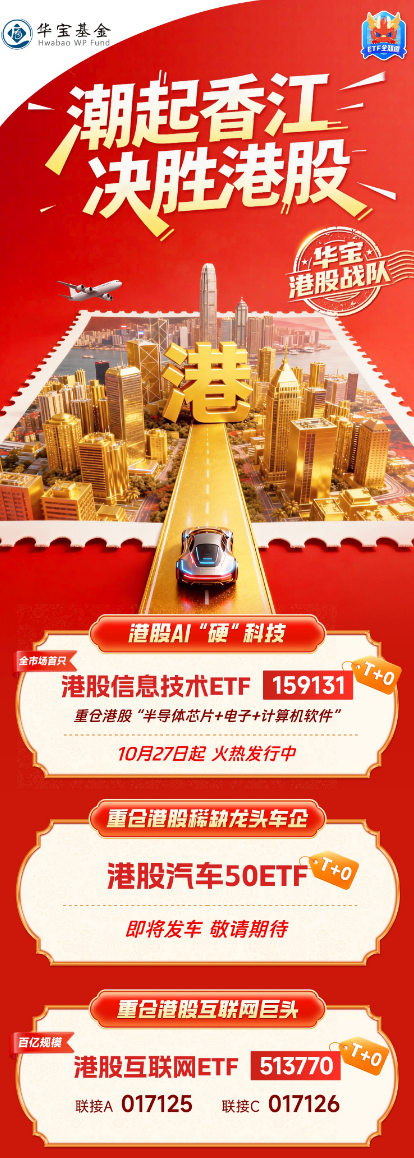
Group 1 - The first Hong Kong ETF focused on "hard" technology, specifically semiconductor chips, electronics, and computer software, is set to launch on October 27 [1][2] - The Hong Kong Automotive 50 ETF, which focuses on leading car manufacturers, is expected to be launched soon [1][2] - The Hong Kong Internet ETF is designed to invest in major internet giants in the region [1][2] Group 2 - The Hong Kong Innovation Drug ETF is 100% focused on innovative pharmaceuticals [1][3] - The Hong Kong Large Cap 30 ETF combines technology and dividend strategies [1][3] - The Hong Kong Dividend ETF offers high dividend yields with low volatility [1][3] Group 3 - The Hong Kong Small Cap LOF targets small and mid-cap assets [1][3] - The Value Fund LOF focuses on A+H shares with dividend characteristics [1][3] - The new consumption wave driven by Generation Z is highlighted through the Huabao CSI Shanghai-Hong Kong-Shenzhen New Consumption Index [1][3]
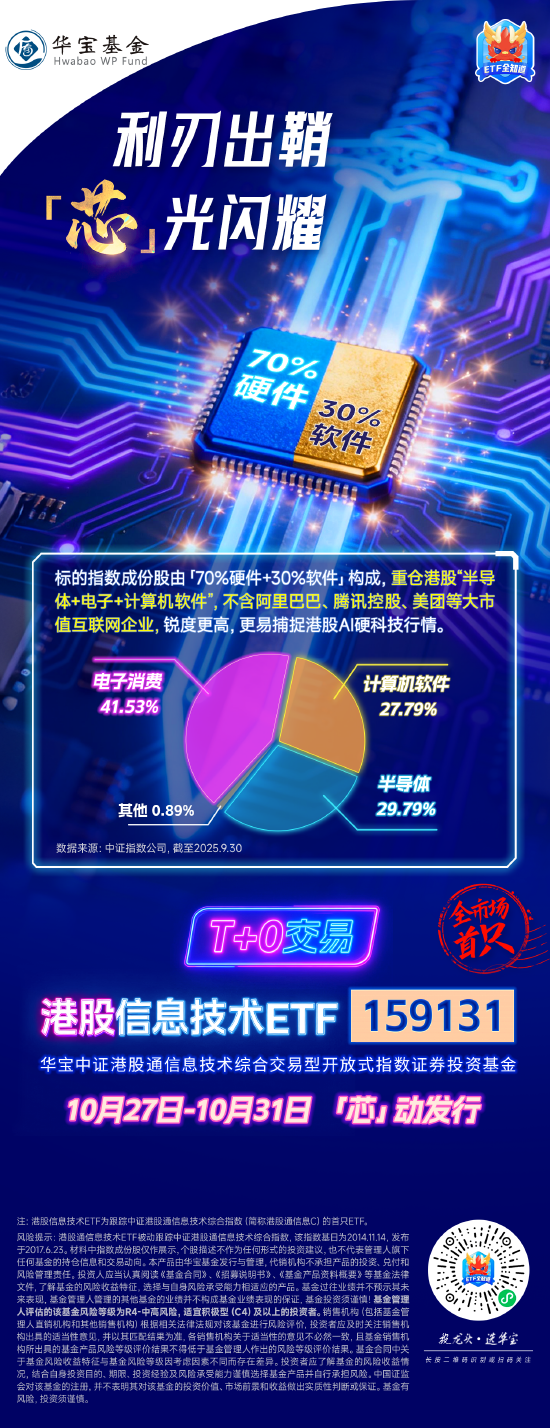
利刃出鞘,“芯”光闪耀!全市场首只港股信息技术ETF(159131)火热发行中
Xin Lang Ji Jin· 2025-10-28 05:44
Group 1 - The index composition consists of 70% hardware and 30% software, focusing on Hong Kong stocks in the semiconductor, electronics, and computer software sectors, excluding major internet companies like Alibaba, Tencent, and Meituan, which enhances the ability to capture AI and hard technology trends in Hong Kong stocks [2] - The sector breakdown shows that electronics consume 41.53%, computer software accounts for 27.79%, and semiconductors make up 29.79% of the index [2] - The MACD golden cross signal has formed, indicating a positive trend for certain stocks [3]