反倾销

Search documents
研究所日报:鑫新闻-20250916
Yintai Securities· 2025-09-16 06:06
Economic Data - In August, the industrial added value above designated size increased by 5.2% year-on-year, while retail sales of consumer goods rose by 3.4% year-on-year[2] - From January to August, fixed asset investment (excluding rural households) grew by 0.5% year-on-year, and real estate development investment decreased by 12.9%[2] - CPI in August fell to -0.4% year-on-year, primarily due to weak food prices, while PPI's year-on-year decline narrowed to -2.9%[7] Trade and Investment - From January to August, national railway fixed asset investment reached 504.1 billion yuan, a year-on-year increase of 5.6%[4] - In August, new RMB loans were 590 billion yuan, down 310 billion yuan year-on-year, indicating weak credit demand in real estate and enterprises[8] - Exports grew by 4.4% in August, with exports to the U.S. declining by 33%[9] Policy and Market Outlook - The Chinese government is expected to implement counter-cyclical policies, including a 500 billion yuan new policy financial tool and early issuance of local government debt limits for 2026[2] - The recent U.S.-China trade talks have established a framework for cooperation, which may reduce uncertainties in economic relations[3] - The ongoing adjustments in the real estate market and potential policy responses could impact future economic performance[2][32]
A股超2800股上涨,模拟芯片多股大涨,黄金珠宝股普跌
21世纪经济报道· 2025-09-16 04:07
Core Viewpoint - The article discusses the recent market performance, highlighting the impact of the anti-dumping investigation on the semiconductor industry, particularly in the analog chip sector, and the fluctuations in the gold jewelry market due to rising international gold prices. Market Performance - As of the midday close, the Shanghai Composite Index fell by 0.10%, the Shenzhen Component Index decreased by 0.26%, and the ChiNext Index dropped by 0.32% [2][3] - The total trading volume in the Shanghai and Shenzhen markets was 1.5 trillion yuan, a decrease of 25.1 billion yuan compared to the previous trading day, with over 2,800 stocks rising across the market [2][3] Semiconductor Industry - The anti-dumping investigation initiated by the Chinese Ministry of Commerce on U.S. imported analog chips is expected to alleviate price war pressures and improve profitability for domestic manufacturers [9][10] - The investigation focuses on general interface chips and gate driver chips, which are crucial for various electronic applications [9][10] - The U.S. accounts for over 50% of the global production capacity of these chips, with significant price declines impacting local manufacturers [9][10] - The import quantities of the investigated products have shown a continuous upward trend, with imports projected to reach 1.59 billion units by 2024 [10] - Analysts predict that the anti-dumping measures could expand the Chinese market for general interface chips and gate driver chips significantly, with potential market growth of 3.3 to 13.4 times [11] Gold Jewelry Market - The gold jewelry sector experienced a decline, with the gold jewelry index dropping over 2% during trading [12][13] - International gold prices reached new highs, with COMEX gold futures nearing $3,730 per ounce, influencing domestic gold jewelry prices to rise [15][17] - Major brands like Chow Sang Sang and Luk Fook Jewelry have seen their gold prices increase, with Chow Sang Sang's gold jewelry price surpassing 1,090 yuan per gram [17]






反倾销反歧视反垄断:中国还击美国芯片战
Hu Xiu· 2025-09-16 04:05
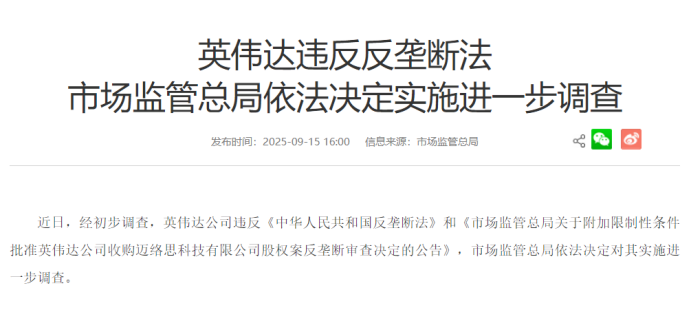
Group 1 - China has initiated anti-dumping investigations against American-made analog chips and anti-discrimination investigations related to integrated circuits on the same day, marking a significant counteraction in the ongoing chip war with the U.S. [1][2] - The U.S. Department of Commerce recently added 32 entities to its export control "entity list," with 23 of them located in China and many involved in the chip business, which may have triggered China's response [2][3] - The ongoing trade talks between China and the U.S. in Spain may be influenced by these actions, suggesting a strategy of "fighting while negotiating" [3][4] Group 2 - Nvidia has been found in violation of antitrust laws by China's State Administration for Market Regulation (SAMR), which has decided to conduct further investigations [8][10] - The investigation relates to Nvidia's acquisition of Mellanox Technologies in 2019, which was approved under certain conditions to prevent anti-competitive practices [12][15] - Nvidia's current supply of H20 chips to China is significantly limited in performance compared to its H200 chips, raising concerns about compliance with fair trade practices [18][17] Group 3 - The anti-dumping investigation targets analog chips produced by U.S. companies, with the investigation period set from January 1, 2024, to December 31, 2024 [31][32] - The application for the investigation cites that U.S. companies have significantly increased their product imports to China while simultaneously lowering prices, adversely affecting domestic producers [36][39] - If the anti-dumping investigation is upheld, it could lead to substantial penalties for major U.S. chip companies, potentially impacting their revenues in China, which exceed $10 billion collectively [41] Group 4 - The Chinese government is also conducting an anti-discrimination investigation against U.S. measures that restrict high-end chips while allowing low-end chips to flood the market, which are seen as discriminatory trade practices [44][45] - The outcome of these investigations could lead to increased tariffs or restrictions on U.S. products if found to be unfair [45][46] - The ongoing investigations and trade tensions highlight the complex dynamics of the U.S.-China trade relationship, particularly in the semiconductor sector [46][47]



早知道:中美在西班牙就有关经贸问题举行会谈;央行今日开展6000亿元买断式逆回购操作
Sou Hu Cai Jing· 2025-09-14 23:35
Group 1 - The US and China held discussions in Spain regarding trade issues [1] - The Ministry of Commerce initiated anti-dumping investigations on imported simulation chips from the US and launched anti-discrimination investigations related to US measures in the integrated circuit sector [1] - The People's Bank of China reported an increase of 13.46 trillion yuan in RMB loans over the first eight months, with a cumulative social financing scale increase of 26.56 trillion yuan [1] Group 2 - The People's Bank of China announced a 600 billion yuan reverse repurchase operation scheduled for September 15 [1] - A national standard draft for pre-prepared dishes in restaurants has been approved and will soon be open for public consultation [1] - The automotive industry aims for a sales target of approximately 32.3 million vehicles this year [1] Group 3 - The Federal Reserve's interest rate meeting is scheduled for September 16-17 [1]
中美在西班牙举行经贸会谈,将讨论美单边关税措施、滥用出口管制及TikTok等问题
Huan Qiu Shi Bao· 2025-09-14 23:07
Group 1: US-China Trade Talks - The US and China held trade talks in Madrid on September 14, focusing on issues such as unilateral tariffs, export controls, and TikTok [1][2][3] - The talks are seen as an opportunity to extend the truce in the ongoing trade war, which has impacted the global economy [3] - The US announced sanctions against 32 entities, including 23 from mainland China, prior to the talks, indicating stricter export controls on advanced chips [4][5] Group 2: China's Response - China initiated two investigations against the US, including a discrimination investigation related to integrated circuits and an anti-dumping investigation on imported simulation chips from the US [6][7] - The anti-dumping investigation was prompted by a significant increase in imports from the US, with a reported cumulative growth of 37% from 2022 to 2024, while prices dropped by 52% [7][8] - The Chinese Ministry of Commerce emphasized that the US's actions are seen as a form of unilateralism and bullying, which distorts the global market and harms legitimate business interests [5][6] Group 3: Implications for Semiconductor Industry - The semiconductor industry is particularly affected, with the US imposing stricter controls on high-end chips while simultaneously engaging in price dumping of simulation chips [4][8] - The investigation into simulation chips highlights the significant market share of US imports in China, which rose from 47.81% in 2022 to 62.14% in 2024 [8] - The ongoing trade tensions and investigations are expected to impact the stability of the global semiconductor supply chain [6][8]
中国商务部_对美产模拟芯片发起反倾销调查_维护国内产业公平竞争权益
Sou Hu Cai Jing· 2025-09-14 07:39
Core Viewpoint - The Chinese Ministry of Commerce has initiated an anti-dumping investigation against imported analog chips from the United States, responding to domestic industry calls and defending fair competition in international trade [3][8]. Trigger of the Investigation - The investigation was triggered by the U.S. government's misuse of export controls and "long-arm jurisdiction," which has severely harmed China's chip industry [4][5]. - The actions of the U.S. government, framed under national security, are seen as a violation of WTO rules and detrimental to Chinese enterprises [4]. Investigation Focus - The investigation specifically targets general interface chips and gate driver chips, which are critical components in electronic devices [5][9]. - Preliminary evidence indicates a 37% increase in import volume and a 52% drop in prices from 2022 to 2024, negatively impacting domestic product pricing [5][9]. Legal and Regulatory Compliance - The investigation adheres to the Anti-Dumping Regulations of the People's Republic of China and the WTO framework, demonstrating China's commitment to international rules [4][9]. - The process is designed to be transparent and fair, ensuring that all parties' rights are protected [9]. Impact on Domestic Industry - The anti-dumping measures aim to restore competitiveness for domestic enterprises, which have been pressured by low-priced imports [9]. - The investigation is expected to encourage domestic companies to enhance research and development, reducing reliance on foreign products and promoting the localization of analog chips [9]. Global Implications - This action may lead to a more equitable international chip market and encourage adherence to trade rules globally, countering unilateral sanctions [9]. - The investigation serves as a reminder that fair trade is essential for mutual benefits, advocating for dialogue over confrontation [9].
美国芯片巨头三年降价一半,中国企业陷入“被动跟跌” 困境
是说芯语· 2025-09-14 07:25
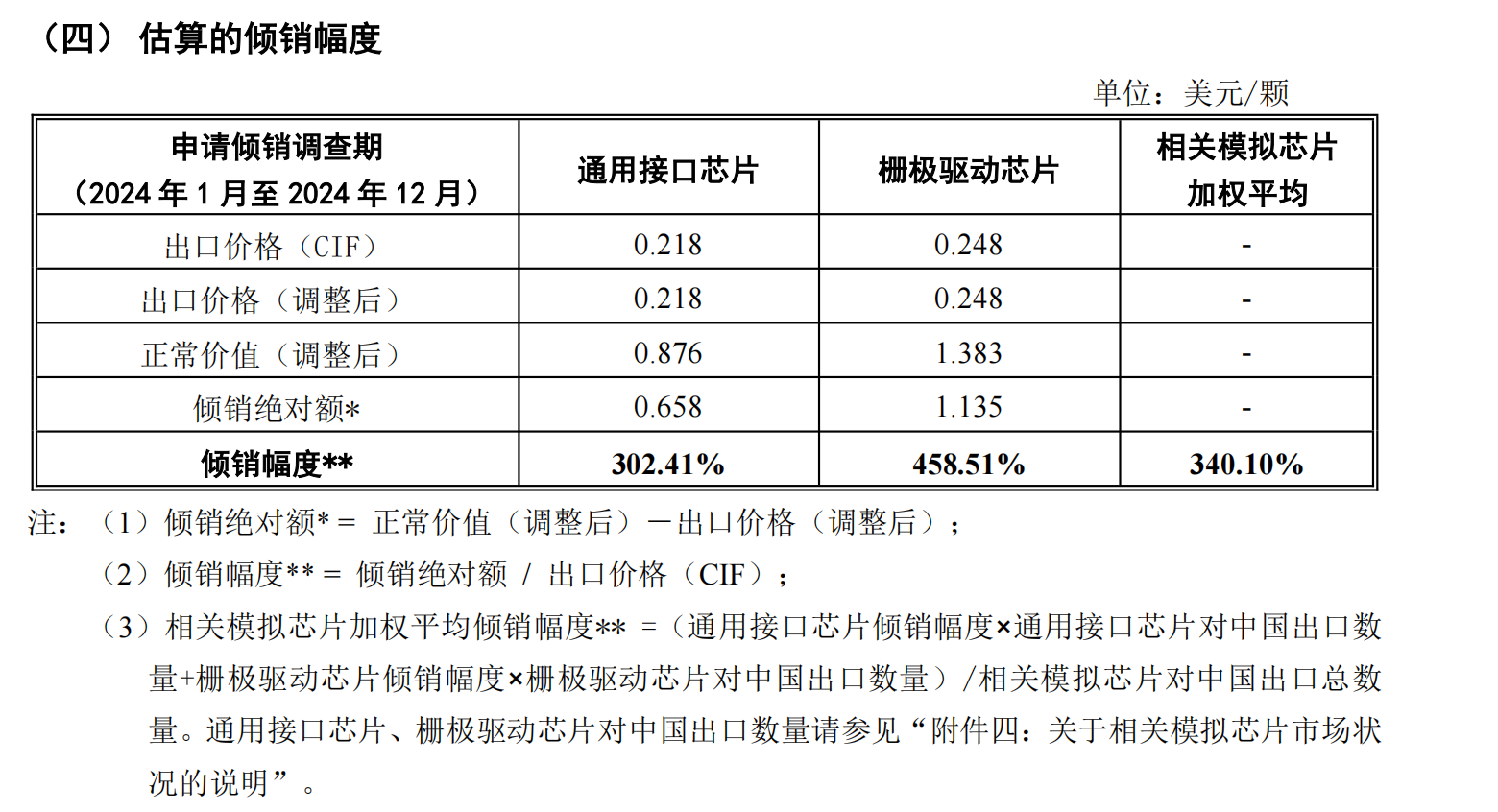
Core Viewpoint - The Chinese Ministry of Commerce has initiated an anti-dumping investigation into imported simulation chips from the United States, citing significant price drops and market share gains that harm domestic producers [2][12]. Summary by Sections Investigation Background - The investigation was prompted by a request from the domestic industry, aligning with Chinese laws and WTO rules. The products under scrutiny include general interface and gate driver chips [2][12]. - From 2022 to 2024, imports of these products from the U.S. increased by 37%, while their prices fell by 52%, negatively impacting domestic sales [2][3]. Import and Market Share Data - The U.S. simulation chips accounted for an average market share of 41% in China during the investigation period, with a significant increase in import volumes: 1.159 billion units in 2022, 1.299 billion in 2023, and 1.590 billion in 2024 [4][5]. - The market share of U.S. simulation chips rose from 35.40% in 2022 to 44.98% in 2024, indicating a growing dominance in the Chinese market [6][11]. Price Trends and Impact on Domestic Industry - The dumping margins for general interface chips reached 302.41%, while gate driver chips saw even higher margins at 458.51%, indicating severe price undercutting [3][4]. - Prices of U.S. general interface chips dropped from 3.00 CNY per unit in 2022 to 1.55 CNY in 2024, a cumulative decrease of 48.33%. Similarly, gate driver chips fell from 3.99 CNY to 1.76 CNY, a drop of 55.85% [7][9]. - In contrast, domestic prices for similar products decreased less significantly, leading to a situation where domestic companies are forced to follow the price drops of imported products, resulting in reduced profit margins [11]. Industry Response and Support - The Jiangsu Semiconductor Industry Association has expressed that the U.S. dumping practices have severely impacted the domestic industry, leading to losses and reduced operational rates [11][13]. - Both the China Chamber of Commerce for Import and Export of Machinery and Electronic Products and the China Semiconductor Industry Association have voiced their support for the anti-dumping investigation, emphasizing the need for fair competition in the semiconductor market [12][13].

美国芯片巨头三年降价一半,中国企业陷入“被动跟跌” 困境
第一财经· 2025-09-14 07:18
Core Viewpoint - The Chinese Ministry of Commerce has initiated an anti-dumping investigation into imported simulation chips from the United States, citing significant price drops and increased import volumes that harm domestic industries [3][5]. Group 1: Investigation Details - The investigation targets general interface and gate driver chips, with evidence showing a 37% increase in import volume and a 52% decrease in import prices from 2022 to 2024 [3][6]. - The dumping margins for the investigated products are exceptionally high, with general interface chips at 302.41% and gate driver chips at 458.51% [6][7]. - The market share of U.S. simulation chips in China has risen from 35.40% in 2022 to 44.98% in 2024, indicating a growing dominance in the market [10][8]. Group 2: Impact on Domestic Industry - The price of U.S. general interface chips has dropped from 3.00 CNY per unit in 2022 to 1.55 CNY in 2024, a cumulative decrease of 48.33%, while domestic prices have fallen by only 33.59% in the same period [11][15]. - Domestic companies have reported a significant decline in profitability, with average gross margins for similar products dropping by 33.41% in 2024 compared to 2023 [15]. - The domestic semiconductor industry has shifted from profit to loss since 2023, with losses expected to increase by 7.05% in 2024 and a 17 percentage point drop in operating rates since 2022 [15][18]. Group 3: Support from Industry Associations - The China Chamber of Commerce for Import and Export of Machinery and Electronic Products and the China Semiconductor Industry Association have expressed support for the anti-dumping investigation, emphasizing the need for fair competition [16][17]. - Both associations highlight the adverse effects of U.S. unilateral actions on the global supply chain and advocate for a fair market environment to foster healthy industry growth [16][17].

美国芯片巨头三年降价一半 中国企业陷入“被动跟跌” 困境
Di Yi Cai Jing· 2025-09-14 05:42
Core Viewpoint - The Chinese Ministry of Commerce has initiated an anti-dumping investigation into imported simulation chips from the United States, responding to domestic industry requests due to significant price drops and increased import volumes that harm local manufacturers [1][12]. Group 1: Investigation Details - The investigation targets general interface and gate driver chips imported from the U.S. [1]. - The investigation period is set from January 1, 2024, to December 31, 2024 [2][15]. - The Ministry's spokesperson confirmed that the investigation aligns with Chinese laws and WTO rules [1][13]. Group 2: Import Trends - From 2022 to 2024, the cumulative import volume of the investigated products from the U.S. increased by 37%, with annual import volumes of 1.159 billion, 1.299 billion, and 1.590 billion units respectively [3][6]. - The market share of U.S. simulation chips in China rose from 47.81% in 2022 to 62.14% in 2024, averaging 54.34% over three years [4][6]. Group 3: Pricing and Dumping Margins - The dumping margins for general interface chips and gate driver chips are reported at 302.41% and 458.51%, respectively, indicating severe price undercutting [2][3]. - The export prices of U.S. general interface chips dropped from 3.00 CNY per unit in 2022 to 1.55 CNY in 2024, a cumulative decrease of 48.33% [7][9]. - Domestic prices for similar products have also decreased but at a lower rate, with general interface chips dropping 33.59% over the same period [11]. Group 4: Impact on Domestic Industry - The influx of low-priced U.S. chips has severely impacted the domestic simulation chip industry, leading to losses for local companies starting in 2023, with losses expected to increase by 7.05% in 2024 [12]. - The operating rate of domestic manufacturers has decreased by 17 percentage points since 2022, and their R&D capabilities have been significantly weakened [12]. Group 5: Industry Associations' Response - The Jiangsu Semiconductor Industry Association supports the investigation, emphasizing the need for fair competition and the protection of domestic industry rights [12][14]. - The China Chamber of Commerce for Import and Export of Machinery and Electronic Products also expressed support, condemning unilateral actions by the U.S. that disrupt global supply chains [13][14].
商务部调查美国模拟芯片倾销,对华倾销幅度达300%
Sou Hu Cai Jing· 2025-09-14 04:50
Core Viewpoint - The Chinese Ministry of Commerce has initiated an anti-dumping investigation into U.S. manufactured analog chips, citing a dumping margin exceeding 300% [1] Group 1: Investigation Details - The investigation targets four U.S. manufacturers: Texas Instruments, ADI, Broadcom, and ON Semiconductor [1] - Preliminary evidence submitted by the Jiangsu Semiconductor Industry Association indicates a significant price decline for the investigated products during the investigation period [1] Group 2: Market Impact - The investigated products account for an average market share of 41% in China [1] - The total import quantity of the investigated products has shown a continuous upward trend, with imports recorded at 1.159 billion units in 2022, 1.299 billion units in 2023, and projected to reach 1.590 billion units in 2024 [1]