液冷技术

Search documents
英伟达Rubin平台发布-液冷行业专家解读
2026-01-08 02:07
Summary of Key Points from the Conference Call Company and Industry Overview - The conference call discusses the advancements in liquid cooling technology, specifically focusing on NVIDIA's Rubin platform and its components, including cold plates and related technologies [1][2][3]. Core Insights and Arguments - **Rubin Platform Design**: The Rubin platform utilizes a large plate model combined with microchannel technology to enhance GPU cooling efficiency, achieving 100% liquid cooling coverage for compute and switch trays [1][3]. - **Cold Plate Value Increase**: The introduction of microchannel technology and galvanized coating techniques has increased the value of cold plates for each compute tray to an estimated $500-$550, with expectations to drop below $500 by 2027 [1][5]. - **Microchannel Technology**: This technology, which embeds micron-sized water flow channels into cold plates via laser welding, significantly improves cooling efficiency but comes with high costs and limited current adoption [1][6][7]. - **Market Share Dynamics**: Taiwanese suppliers continue to dominate the cold plate market, but domestic suppliers like Invec and Siquan are expected to gain market share, potentially reaching 20% in the Ruby series [1][11]. - **Transition to Bidirectional Cooling**: The industry trend is shifting from unidirectional to bidirectional cold plates to enhance heat dissipation and conduction efficiency, although this technology faces challenges in precise control of liquid circulation systems [1][13][15]. Additional Important Content - **Supplier Selection Criteria**: NVIDIA prioritizes brand reputation, supply reliability, and pricing when selecting cold plate suppliers, favoring well-known brands unless suitable alternatives are unavailable [1][10]. - **Component Value Breakdown**: In a $70,000 72-node cabinet, cold plates account for approximately $32,000 to $34,500, while manifold components contribute around $25,000 [1][21]. - **Impact of New Suppliers**: The introduction of new suppliers has minimal impact on profit margins due to transparent pricing and direct negotiations between clients and suppliers [1][9]. - **Future Design Changes**: The Ruby Ultra may require design modifications to accommodate increased GPU power demands, potentially leading to more advanced cooling solutions [1][12]. - **Control of Key Components**: NVIDIA retains decision-making authority over the procurement of critical components like cold plates, ensuring assembly quality and consistency [1][22]. This summary encapsulates the essential points discussed in the conference call, highlighting the advancements in liquid cooling technology and the strategic positioning of NVIDIA and its suppliers in the market.

液冷行业专家电话会-Rubin平台冷却系统更新
2026-01-08 02:07
Summary of the Conference Call on Liquid Cooling Industry and NVIDIA's Ruby Platform Industry Overview - The liquid cooling industry is undergoing significant changes due to advancements in cooling technologies, particularly with NVIDIA's Ruby platform, which aims to innovate heat dissipation methods and reduce reliance on traditional cooling systems [1][3][11]. Key Points on NVIDIA's Ruby Platform - **Integration of Cooling Technologies**: The Ruby platform merges three small boards from the GB300 into a single large board, indicating breakthroughs in insulation or interface materials. It employs high-temperature water cooling technology (45 degrees Celsius inlet) to potentially replace traditional liquid-liquid exchange systems, eliminating the need for chillers [1][2]. - **Production Timeline**: Although NVIDIA announced early production at CES, large-scale production is not expected until November 2026. Currently, only small batch production is underway, with further adjustments anticipated over the next nine months [1][4]. - **Cooling Development Path**: NVIDIA's cooling solutions have evolved from air cooling to full liquid cooling, with a gradual transition aimed at accumulating experience. The Ruby platform does not yet utilize advanced technologies like dual-sided cold plates or microchannel technology due to developmental delays [1][6][7]. - **Performance Metrics**: The new products feature training performance of 35 and inference performance of 50, comparable to AMD's I455, but NVIDIA maintains an overall performance advantage due to ecosystem support [1][9]. Innovations and Challenges - **High-Temperature Water Cooling Impact**: This technology has led to a 6% reduction in data center energy consumption, significantly affecting the industry landscape. However, it has negatively impacted refrigerant and related equipment companies, causing stock prices to drop by approximately 20% [3][11]. - **Cooling System Simplification**: The use of 45-degree water simplifies the cooling system by eliminating the need for traditional chillers, thus reducing complexity and maintenance costs. This method is effective in non-extreme environments [14][15]. - **Future Improvements**: There is potential for further enhancements in liquid cooling methods, particularly through the adoption of microchannel technology, which could significantly improve cooling efficiency [12][24]. Market Dynamics and Competitive Landscape - **Competitive Pressures**: NVIDIA faces competition from companies like AMD, Google, Cambricon, and Huawei, necessitating a rapid release schedule despite some technologies not being fully mature [1][9]. - **Challenges in Heat Dissipation**: The complexity of heat dissipation, especially with technologies like HBM and optical modules, remains a significant challenge, as cooling technologies have not kept pace with rapid advancements in chip technology [20][21]. Conclusion - The Ruby platform represents a significant step forward in liquid cooling technology, with its innovative approaches and potential market impact. However, challenges remain in production timelines, competitive pressures, and the need for ongoing technological advancements in cooling solutions [1][3][11].
机构:AI发展带来功耗问题 液冷方案逐渐明朗
Zheng Quan Shi Bao Wang· 2026-01-08 00:55
Core Viewpoint - Nvidia's CEO Jensen Huang announced the full-scale production of the new AI computing platform, Vera Rubin, which features a 100% liquid cooling system and a third-generation fully cable-free design, marking a significant advancement in AI computing efficiency and liquid cooling technology [1] Group 1: Liquid Cooling Technology - The liquid cooling solution is becoming essential due to the increasing power consumption issues associated with the rapid growth of data centers and servers driven by AI demands [2] - Liquid cooling offers advantages such as high cooling efficiency, rapid temperature reduction, and low noise, making it a preferred choice over traditional air cooling in high-density environments [2] - The liquid cooling market in China is projected to grow at a compound annual growth rate (CAGR) of 46.8% from 2024 to 2029, reaching a market size of $16.2 billion by 2029 [2] Group 2: Market Opportunities - Emerging industries such as data centers, robotics, and photovoltaic energy storage are creating new growth opportunities for the liquid cooling market [2] - The exit of 3M from the high-performance fluorinated liquids market presents development opportunities for domestic companies, as these liquids are becoming a new cooling medium for servers [2] Group 3: Competitive Landscape - Domestic manufacturers are expected to capture global market share due to their production capacity, cost advantages, and faster response times, especially as some overseas firms are cautious about expanding production [3] - The demand for liquid cooling is expected to accelerate as AI power cards continue to increase in power consumption, pushing traditional air cooling to its limits [3] - Liquid cooling can significantly reduce electricity consumption in data centers, particularly in regions facing power shortages, by lowering the energy usage of cooling equipment and server fans [3]
千亿算力巨头超聚变启动IPO!四年逆袭冲击上市!10家关联企业谁最受益?
Sou Hu Cai Jing· 2026-01-07 16:59
Core Insights - Chaoju Huan's rapid rise in the server market is considered "counterintuitive," with revenue soaring from 10 billion yuan in 2022 to 40 billion yuan in 2024, making it the second-largest player in China and the sixth globally [1] - The company has maintained the largest market share in the liquid cooling server segment in China for two consecutive years, surpassing some established giants [1] - Chaoju Huan has opted for a direct IPO path, starting its listing guidance on January 6, 2026, despite earlier speculation about a reverse merger [1] Company Performance - Chaoju Huan's revenue growth is significant, with a projected increase from 10 billion yuan in 2022 to 40 billion yuan in 2024 [1] - The company has achieved a market share of 13.3% in the domestic server market as of 2024, while its AI training server market share reached 35% in the first half of 2025 [20][18] Market Impact - The upcoming IPO of Chaoju Huan is expected to lead to a revaluation of several related companies, including equity affiliates and business partners [2] - Companies like Dongfang Mingzhu and Cuiwei Co. have significant stakes in Chaoju Huan, with Dongfang Mingzhu investing 499 million yuan [4] Business Collaborations - Chaoju Huan's business partners include Tianyuan Dike, which generates nearly 80% of its revenue from Chaoju Huan's GPU servers, and Digital China, which has seen a 15% increase in related orders by Q3 2025 [4][9] - Yingweike has provided a full-chain liquid cooling solution, winning a project worth 350 million yuan in Q3 2025 [5] Technological Edge - Liquid cooling technology is a core competitive advantage for Chaoju Huan, with its "silent all-liquid cooling integrated system" achieving industry-leading specifications [7][8] - The liquid cooling server market in China is projected to grow by 67% in 2024, with Chaoju Huan holding the second-largest market share [8] Global Expansion - Chaoju Huan has established a global dealer network covering over 100 countries, with significant growth in emerging markets like the Middle East and Southeast Asia [16] - The company has set up 10 R&D centers and 6 supply centers globally, with overseas revenue exceeding 20% in 2025 [16] Competitive Landscape - Chaoju Huan faces competition from major players like Inspur and Huawei, with Inspur holding a 30.8% market share in 2024 [17][18] - The industry is experiencing a price war, impacting profit margins across server manufacturers [19] Strategic Support - The Henan provincial government has increased its support for Chaoju Huan, designating its IPO as a core task for state-owned enterprise reform by 2025 [12][14] - National-level capital, such as the National Adjustment Fund, has strategically invested in Chaoju Huan, enhancing its resource integration capabilities [15]

液冷行业展望及新技术分享
2026-01-07 03:05
Summary of Key Points from the Conference Call Industry Overview - The conference discusses the liquid cooling industry, focusing on advancements in technology and market opportunities, particularly in relation to the LoongArch N8 72 model and its implications for data centers and cooling solutions [1][2][3]. Core Insights and Arguments - **LoongArch N8 72 Design**: The LoongArch N8 72 features a fully liquid-cooled and modular design, eliminating fans and simplifying integration. The power consumption has increased to 2,300 watts while maintaining a heat density of 100 watts per square centimeter, which can be managed by single-phase cold plates [1][2][4]. - **Microchannel Technology**: New technologies like Microchannel Liquid Plates (MLCP) aim to enhance cooling efficiency by reducing thermal resistance and increasing heat exchange area. However, challenges such as yield control and leak protection hinder large-scale deployment in the short term [1][5]. - **Increased GPU Density**: The LoongArch Ultra and its associated chassis will adopt a vertical plug-in design, increasing GPU density from 72 to 576, necessitating adjustments in energy solutions to accommodate higher complexity and density [1][6]. - **International Liquid Cooling Solutions**: Overseas ASIC chip cooling solutions predominantly utilize liquid cooling, with companies like Meta and AWS implementing Advanced Liquid Cooling (ALC) solutions. Google’s TensorFlow 10 CPU supports 2 megawatts of power across eight cabinets [1][8][9]. - **Domestic Market Opportunities**: The domestic liquid cooling market is expected to see significant growth by 2026, driven by the need for high-performance computing solutions and the shortage of high-end chips, which pushes for the development of supernodes [1][10][11]. Additional Important Insights - **System Integration Needs**: Chinese liquid cooling manufacturers must provide comprehensive, one-stop solutions that integrate data centers, cabinets, and internal nodes to enhance competitiveness in overseas markets [1][3][13]. - **Challenges in High-Density Designs**: As physical density increases, challenges such as maintaining flow uniformity and ensuring welding quality become critical. Advanced welding techniques and optimized cooling system designs are necessary to address these issues [1][7][18]. - **Pump Technology Transition**: The shift from mechanical pumps to magnetic pumps in cooling systems is noted, as magnetic pumps eliminate leakage risks and improve reliability, although the performance of electronic pumps remains to be fully evaluated [1][20]. - **Material Considerations**: The selection of materials for cooling systems must consider aging, compatibility, and the effects of long-term exposure to liquids, ensuring reliability and preventing issues like deformation and blockages [1][21]. This summary encapsulates the key points discussed in the conference call, highlighting the advancements and challenges within the liquid cooling industry and the implications for future developments.
股价一度暴跌20%!黄仁勋称无需依赖冷水机组,制冷设备股惨遭市场抛售
美股IPO· 2026-01-06 23:16
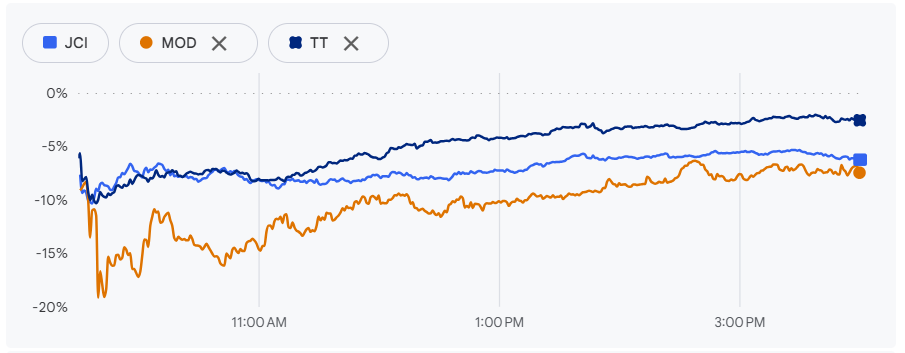
Core Viewpoint - Nvidia's CEO Jensen Huang's comments on the next-generation Rubin chip's cooling technology have raised concerns among investors regarding the demand for data center cooling equipment, leading to a significant drop in related stocks [2][3][5]. Group 1: Impact on Cooling Equipment Stocks - Nvidia's announcement that servers with the Rubin chip will utilize liquid cooling instead of traditional chillers has caused a sell-off in cooling equipment stocks, with Johnson Controls experiencing an 11% drop, marking its largest intraday decline since 2022 [2][3]. - Modine Manufacturing's stock fell by approximately 21% before recovering to a 7.44% decline, while Trane Technologies also saw a decrease [2][3]. - Analysts are reassessing the investment logic surrounding AI infrastructure, as companies like Johnson Controls saw a 52% cumulative increase in stock price since last year due to the AI boom [5]. Group 2: Analyst Insights - Analyst Timothy Wojs from Baird highlighted that Huang's comments have raised questions about the long-term role of chillers in data centers, especially with the increasing adoption of liquid cooling technology, which allows systems to operate at higher temperatures [6]. - Barclays analyst Julian Mitchell noted that while Vertiv holds a strong position in the liquid cooling sector and may benefit from the discussed technological advancements, its cooling business could face challenges [6]. - Citi analyst Andrew Kaplowitz described the sell-off in cooling stocks as "overdone," emphasizing that cooling system manufacturers have established partnerships with chip makers and data center operators, making the risks manageable [10]. Group 3: Market Reactions - Huang's statements have also spurred a surge in data storage stocks, with SanDisk's stock rising over 27%, becoming the best performer in the S&P 500 on that day, as demand for memory and storage was highlighted [10].



黄仁勋称无需依赖冷水机组,制冷设备股一度暴跌20%
Hua Er Jie Jian Wen· 2026-01-06 21:15
Group 1 - Nvidia CEO Jensen Huang's comments at CES regarding next-generation chip cooling technology have raised concerns among investors about the demand for data center cooling equipment, leading to a significant drop in related stocks [1][2] - Huang stated that servers equipped with the next-generation Nvidia Rubin chip will support liquid cooling, eliminating the need for traditional chillers, which are core equipment provided by companies like Trane and Johnson Controls [2] - On the day of the announcement, stocks of data center cooling equipment companies fell sharply, with Johnson Controls experiencing an 11% intraday drop, the largest since 2022, and Modine Manufacturing initially dropping around 21% before recovering to a 7.44% decline [2] Group 2 - The sell-off reflects a reassessment by investors of the investment logic in AI infrastructure, as these companies saw significant stock price increases due to the AI boom, with Johnson Controls rising 52% cumulatively by 2025 [4] - Analyst Timothy Wojs from Baird noted that Huang's comments raised questions about the long-term positioning of chillers in data centers, especially with the increasing prevalence of liquid cooling technology, which allows systems to operate at higher temperatures [5] - Barclays analyst Julian Mitchell mentioned that while Vertiv has a strong position in the liquid cooling sector and may benefit from the discussed technological developments, its cooling business could be negatively impacted [5] Group 3 - Citigroup analyst Andrew Kaplowitz described the investor flight from cooling stocks as "overdone," emphasizing that cooling system manufacturers have established partnerships with chip manufacturers and data center operators, making the risks of falling behind manageable [8] - Kaplowitz acknowledged that Huang's comments highlight the rapid evolution of data center thermal management technology but stated that it was not unexpected for their companies [9] - Huang's remarks also spurred a surge in data storage stocks, with SanDisk's stock rising over 27%, becoming the best performer in the S&P 500 on that day, as he emphasized the demand for memory and storage [9]
同飞股份双基地布局落子 9亿元加码温控赛道
Zheng Quan Ri Bao Wang· 2026-01-06 13:09
Core Viewpoint - Tongfei Co., Ltd. plans to invest a total of 900 million yuan in two projects, focusing on liquid cooling temperature control and establishing a southern headquarters, aiming to enhance production capacity and market presence in emerging industries [1][2][5] Investment Projects - The liquid cooling temperature control project in Sanhe has a planned investment of approximately 300 million yuan, including the construction of a liquid cooling workshop and R&D building, with a completion timeline of 24 months after construction begins [1][2] - The southern headquarters project in Suzhou has a larger investment scale of 600 million yuan, aiming to build an intelligent production facility with multiple digital production lines [1][2] Strategic Considerations - The dual-base layout is strategically aligned with the company's core business and future development needs, enhancing production capacity in the north while improving service proximity to customers in the south [2][5] - The projects are expected to meet specific output efficiency requirements, with the Sanhe project needing to achieve annual output value and tax revenue standards set by the local economic development zone [4] Market Demand and Industry Trends - The industrial temperature control equipment market is experiencing growth driven by emerging industries such as new energy vehicles, data centers, and semiconductors, with liquid cooling technology becoming a mainstream solution due to its energy efficiency [2][3] - The market for industrial temperature control equipment is expected to grow rapidly, supported by policy backing and increasing demand [3][5] Competitive Advantage - Tongfei Co., Ltd. has established a stable customer base and technical advantages, positioning itself to meet the expected output and market demands effectively [4][5] - The company's investment strategy is seen as a key move to capture market opportunities in high-growth emerging industries, enhancing its competitive edge in the industrial temperature control sector [5]
飞龙股份(002536.SZ):在液冷领域的产品主要包括电子泵系列和温控阀系列,未来还将逐步拓展至集成模块产品
Ge Long Hui· 2026-01-06 07:20
Core Viewpoint - Feilong Co., Ltd. (002536.SZ) is focusing on the liquid cooling sector, with current products including electronic pump series and temperature control valve series, and plans to expand into integrated module products in the future [1] Product Development - The company is primarily utilizing cold plate liquid cooling technology while actively advancing the research and application of immersion liquid cooling technology [1] Market Strategy - The company aims to continuously align with market demands and choose directions that are in line with industry trends and suitable for its own development for steady progress [1]

FINE2026 热管理火热招展丨机器人热管理+数据中心热管理+功率器件热管理+电池热管理.....
DT新材料· 2026-01-05 16:04
Core Insights - The article highlights the significance of the 2026 Heat Management Liquid Cooling Plate Industry Exhibition, emphasizing its role in showcasing advanced cooling technologies essential for future industries such as data centers, energy storage, electric vehicles, and AI chips [1][2][3]. Exhibition Overview - The exhibition will take place from June 10 to June 12, 2026, at the Shanghai New International Expo Center, featuring over 800 participating companies and an expected attendance of more than 100,000 professional visitors [1][14]. - The exhibition area will cover 50,000 square meters, with more than 30 forums planned to discuss industry trends and innovations [1][10][14]. Industry Focus - Liquid cooling technology is identified as a core thermal management solution for various sectors, including data centers, energy storage, electric vehicles, and robotics [1][2]. - The exhibition aims to provide a comprehensive view of the liquid cooling plate industry, from raw materials to system integration, facilitating connections between upstream and downstream partners [2][3]. Featured Exhibits - The exhibition will include five thematic areas: data center liquid cooling, energy battery and storage cooling, power semiconductor cooling, liquid cooling materials and components, and manufacturing and processing equipment [3][5]. - A wide range of products will be showcased, including various types of cooling plates, materials, system components, and production technologies [8][9]. Forum Activities - Over 30 specialized forums will be held, focusing on topics such as data center thermal management, power device thermal management, and advanced packaging [11][12]. - Industry leaders will be invited to share insights on technology innovations, market trends, and investment strategies [11]. Target Audience - The exhibition aims to attract participants from various sectors, including data centers, semiconductor companies, AI consumer electronics, and investment institutions [15][16]. - Expected attendees will include decision-makers, technical personnel, and representatives from research institutions [17]. Pricing and Participation - Standard booth pricing is set at CNY 16,800 for domestic exhibitors and USD 3,400 for foreign exhibitors, with early bird discounts available [20]. - The exhibition is positioned as a platform for technology transfer and collaboration, aiming to accelerate innovation in the new materials sector [24].