
资产负债管理

Search documents
中国人寿(02628.HK)上半年净利达409.31亿元同比增长6.9%,新业务价值达285.46亿元实现快速增长
Ge Long Hui· 2025-08-27 10:15
Core Insights - China Life Insurance reported a total revenue of RMB 239.49 billion for the first half of 2025, representing a year-on-year growth of 2.2% [1] - The net profit attributable to shareholders reached RMB 40.93 billion, marking a 6.9% increase compared to the previous year [1] - The board proposed a mid-term cash dividend of RMB 2.38 per 10 shares, totaling RMB 6.73 billion in cash dividends [1] Group 1: Business Performance - The total premium income for the company reached RMB 525.09 billion, achieving the best historical performance for the same period, with a year-on-year growth of 7.3% [1] - The first-year regular premium income was RMB 81.25 billion, maintaining the industry-leading position [1] - The proportion of first-year regular premium income from policies with a term of ten years or more was 37.3%, with individual insurance channels contributing over 45% [1] Group 2: Operational Efficiency - The company emphasized asset-liability management across all operational aspects, focusing on value and efficiency, leading to sustained operational quality improvements [2] - The new business value grew rapidly, reaching RMB 28.55 billion, a year-on-year increase of 20.3% compared to the same period in 2024 [2] - The 14-month policy persistency rate improved to 92.1%, an increase of 0.6 percentage points year-on-year, indicating a stronger development foundation [2] Group 3: Financial Strength - As of the end of the reporting period, total assets and investment assets both exceeded RMB 7 trillion, standing at RMB 7.29 trillion and RMB 7.13 trillion, respectively [3] - The equity attributable to shareholders was RMB 523.62 billion, reflecting a year-on-year growth of 2.7% [3] - The comprehensive solvency adequacy ratio was 190.94%, with a core solvency adequacy ratio of 139.54%, maintaining a high level of solvency [3]

保险业上半年保障水平提升
Jing Ji Ri Bao· 2025-08-25 03:03
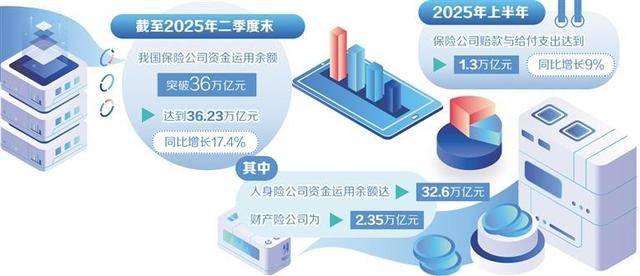
Core Viewpoint - The insurance industry in China has shown resilience and progress in the first half of 2025, with significant growth in asset utilization and premium income, while maintaining a stable solvency capacity [1][10]. Group 1: Asset and Premium Growth - As of the end of Q2 2025, the total investment balance of insurance companies exceeded 36 trillion yuan, reaching 36.23 trillion yuan, a year-on-year increase of 17.4% [2]. - The original insurance premium income for the first half of 2025 was 3.7 trillion yuan, reflecting a growth of 5.1% compared to 2024, indicating a recovery in the life insurance sector [2]. - The number of new insurance policies issued in the first half of 2025 reached 524 billion, marking an 11.1% increase year-on-year [2]. Group 2: Investment Strategies - Bonds remain the primary investment for insurance funds, with a bond investment balance of 17.87 trillion yuan as of Q2 2025, where life insurance companies hold 16.92 trillion yuan, accounting for 51.9% of their total investments [3]. - Stock investments have also gained traction, with insurance companies' stock investments surpassing 3 trillion yuan, showing a quarterly increase of 8.9% [3]. - The shift towards equity investments is seen as a long-term strategic choice, driven by the need for higher returns in a low-interest-rate environment [3][4]. Group 3: Claims and Coverage - Claims and benefits paid by insurance companies reached 1.3 trillion yuan in the first half of 2025, a 9% increase, indicating a deepening of the insurance protection function [5]. - Health insurance and long-term care insurance have emerged as the main contributors to claims growth, driven by an aging population and rising healthcare costs [6]. - The insurance industry has demonstrated its commitment to social responsibility through rapid response to claims during natural disasters, showcasing its role in public welfare [7]. Group 4: Solvency and Regulatory Environment - The overall solvency adequacy ratio for the insurance industry was 204.5% at the end of Q2 2025, significantly above regulatory requirements [8]. - Among 60 life insurance companies, six maintained an AAA rating, with solvency ratios exceeding 200%, indicating strong capital strength and risk management capabilities [8]. - The regulatory environment remains challenging, with some smaller companies facing solvency pressures, necessitating improvements in capital management and risk strategies [10].


经济日报:保险业上半年保障水平提升
Sou Hu Cai Jing· 2025-08-25 00:39
Core Insights - The insurance industry in China has shown resilience and progress in the first half of 2025, with total assets exceeding 39.2 trillion yuan and premium income growing by 5.1% year-on-year [3][10] - The industry is navigating challenges posed by low interest rates, stringent regulations, and new accounting standards, which present both risks and strategic opportunities for structural adjustments [2][10] Asset Management - As of the end of Q2 2025, the total investment balance of insurance companies surpassed 36 trillion yuan, marking a 17.4% increase year-on-year [3] - Bonds remain the primary investment choice for insurance funds, with a bond investment balance of 17.87 trillion yuan, while stock investments have also gained traction, reaching over 3 trillion yuan [4] Premium Income and Claims - The insurance sector's original premium income for the first half of 2025 reached 3.7 trillion yuan, with significant contributions from life insurance products such as dividend, annuity, and health insurance [3][6] - Claims and benefits paid by insurance companies amounted to 1.3 trillion yuan, reflecting a 9% increase, indicating a deepening of the insurance protection function [6][10] Solvency and Regulatory Environment - The overall solvency adequacy ratio for the insurance industry stood at 204.5% as of Q2 2025, well above regulatory requirements [8] - The regulatory environment remains challenging, with some smaller insurers facing capital and investment management weaknesses, necessitating innovation in capital supplementation and diversified asset allocation [10] Strategic Moves by Companies - Companies like China Ping An have actively increased their stakes in banks and other financial institutions, reflecting a strategic focus on long-term value recognition [5] - The industry is increasingly exploring diversified investment strategies, including the establishment of private equity funds to enhance asset allocation [5][9]

保险业上半年保障水平提升:赔付增长体现保障功能
Jing Ji Ri Bao· 2025-08-24 23:31
Core Viewpoint - The insurance industry in China has shown resilience and progress in the first half of 2025, with significant growth in asset utilization and premium income, while maintaining a stable solvency capacity [1][10]. Group 1: Asset and Premium Growth - As of the end of Q2 2025, the total investment balance of insurance companies exceeded 36 trillion yuan, reaching 36.23 trillion yuan, a year-on-year increase of 17.4% [2]. - The original insurance premium income for the first half of 2025 was 3.7 trillion yuan, reflecting a 5.1% year-on-year growth, indicating a recovery in the life insurance sector [2]. - The number of new insurance policies issued in the first half of 2025 reached 524 billion, a year-on-year increase of 11.1% [2]. Group 2: Investment Strategies - Bonds remain the primary investment for insurance funds, with a bond investment balance of 17.87 trillion yuan as of Q2 2025, where life insurance companies hold 16.92 trillion yuan, accounting for 51.9% of their total investments [3]. - Stock investments have also gained traction, with insurance companies' stock investments surpassing 3 trillion yuan, showing a quarterly net increase of 251.3 billion yuan, a growth of 8.9% [3]. - The shift towards equity investments is seen as a long-term strategic choice, driven by the need for higher returns in a low-interest-rate environment [3]. Group 3: Claims and Coverage - Claims and benefits paid by insurance companies reached 1.3 trillion yuan in the first half of 2025, a year-on-year increase of 9%, indicating a deepening of the insurance protection function [5]. - Health insurance and long-term care insurance have emerged as the main contributors to claims growth, driven by an aging population and rising healthcare costs [6]. - The insurance industry has demonstrated its commitment to social responsibility through rapid response to claims related to natural disasters, showcasing its role in public welfare [7]. Group 4: Solvency and Regulatory Environment - As of the end of Q2 2025, the industry’s comprehensive solvency adequacy ratio was 204.5%, with core solvency adequacy at 147.8%, significantly above regulatory requirements [8]. - Some companies, particularly smaller insurers, face challenges in capital replenishment and investment management, which may be exacerbated by market volatility [10]. - The extension of the transitional period for regulatory compliance is seen as both a buffer and a pressure for companies to enhance their capital and risk management strategies [10].
保险业上半年保障水平提升
Jing Ji Ri Bao· 2025-08-24 21:52
Core Insights - The insurance industry in China has shown resilience and progress in the first half of 2025, with total assets exceeding 39.2 trillion yuan and premium income growing by 5.1% year-on-year [2][10] - The industry is navigating challenges posed by low interest rates, stringent regulations, and new accounting standards, which present both risks and strategic opportunities for structural adjustments [1][10] Asset Management - As of the end of Q2 2025, the total investment balance of insurance companies surpassed 36 trillion yuan, marking a 17.4% increase year-on-year [2] - Bonds remain the primary investment choice for insurance funds, with a bond investment balance of 17.87 trillion yuan, accounting for 51.9% of total investments [3] - Stock investments have gained traction, with insurance companies' equity investments exceeding 3 trillion yuan, reflecting a strategic shift towards equities due to low fixed-income returns [3][4] Premium Income and Claims - In the first half of 2025, insurance companies reported original premium income of 3.7 trillion yuan, with significant recovery in life insurance products such as dividend, annuity, and health insurance [2][5] - Claims and benefits paid by insurance companies reached 1.3 trillion yuan, a 9% increase, indicating a deepening of the industry's protective functions [5][6] Solvency and Regulatory Environment - The overall solvency adequacy ratio for the insurance industry stood at 204.5% as of Q2 2025, well above regulatory requirements [8][10] - Some smaller insurance companies face solvency pressures, necessitating swift action in capital replenishment and risk management to avoid stricter regulatory measures [8][10] Strategic Developments - The industry is increasingly focusing on digitalization and service optimization to enhance claims efficiency and customer trust [7] - Insurance companies are exploring diversified investment strategies, including the establishment of private equity funds, to adapt to market conditions and regulatory changes [4][9]
30次举牌、6400亿新增入市,保险资金在买什么
3 6 Ke· 2025-08-22 00:30
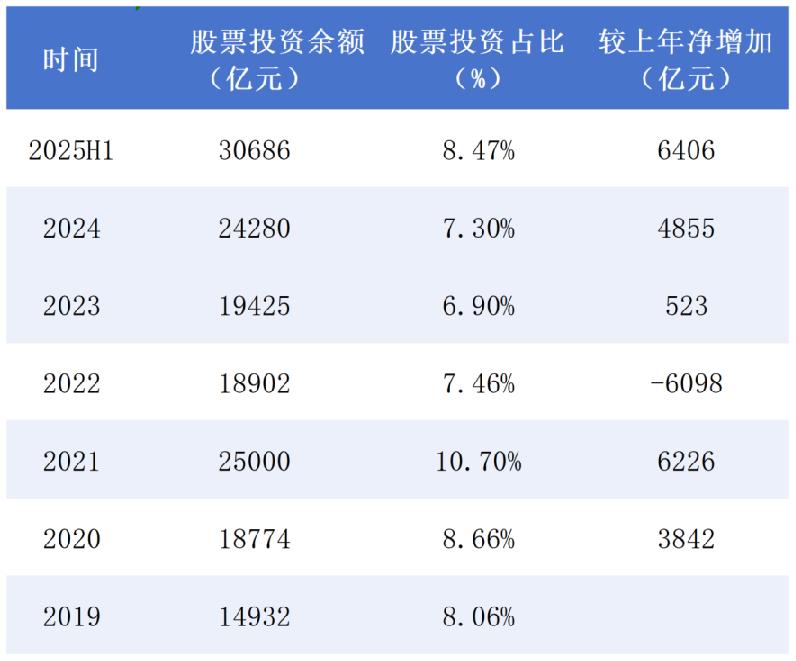
Core Viewpoint - The A-share market has seen a significant influx of insurance funds, with over 640 billion yuan entering the market in the first half of 2025, marking a historical high and contributing to the recent surge in stock prices and trading volumes [1][2][3] Group 1: Market Performance - On August 21, the total trading volume of A-shares exceeded 2 trillion yuan for the seventh consecutive trading day, with the Shanghai Composite Index reaching a 10-year high of 3787.98 points [1] - The total market capitalization of A-shares surpassed 100 trillion yuan, indicating a robust market recovery [1] Group 2: Insurance Fund Inflows - Insurance funds added over 640 billion yuan to the stock market in the first half of 2025, significantly higher than the total for the entire previous year [2][3] - The stock investment balance of insurance funds reached 3.07 trillion yuan, accounting for 8.47% of the total insurance fund assets, the highest since 2022 [1][2] Group 3: Investment Trends - There has been a notable increase in the number of stock acquisitions by insurance funds, with 30 instances of "shareholding" reported in 2025, second only to the 62 instances in 2015 [1][7] - The focus of insurance funds has shifted towards high-quality assets, particularly in the banking sector, with significant investments in H-shares of banks such as China Ping An and Postal Savings Bank [8][9] Group 4: Regulatory Environment - Recent regulatory changes have facilitated insurance funds' entry into the stock market, including adjustments to risk factors for equity investments and policies encouraging long-term capital market participation [14][15] - The insurance industry is adapting to a low-interest-rate environment, prompting a shift towards equity investments to meet return requirements and manage asset-liability mismatches [11][12][15]
非上市人身险公司业绩向好
Jing Ji Ri Bao· 2025-08-19 03:31
Group 1: Industry Performance - The non-listed life insurance companies reported a total insurance business income exceeding 760 billion yuan in the first half of the year, representing a year-on-year growth of approximately 4.7% [1] - The net profit reached nearly 30 billion yuan, doubling compared to the same period last year, with over 60% of companies achieving profitability [1] - The overall insurance industry, including listed companies, achieved original insurance premium income of 3.74 trillion yuan, a year-on-year increase of 5.3% [2] Group 2: Market Dynamics - Leading companies such as Taikang Life, Zhongyou Life, and Xintai Life maintained strong positions, with Taikang Life leading with 130.973 billion yuan in premium income [1] - Bank-affiliated life insurance companies like Jianxin Life and Nongyin Life saw premium growth rates exceeding 20%, while foreign companies like MetLife experienced over 50% growth [1] - The industry is witnessing a mixed performance, with some companies like Hengqin Life and China United Insurance experiencing declines of over 20% due to channel and product adjustments [1] Group 3: Profitability and Structural Changes - Taikang Life led the profitability rankings with a net profit of over 10 billion yuan, while Zhongyou Life earned 5.177 billion yuan, indicating a broadening and deepening of profit recovery across the industry [1] - The industry is entering a "repricing" era for liabilities, with the predetermined interest rate for ordinary life insurance products dropping to 1.99%, prompting a structural adjustment in product offerings [2] - The improvement in investment returns and cost optimization is driving the upward trend in profits, reflecting a shift from high-speed growth to high-quality development in the industry [3] Group 4: Future Outlook - The life insurance industry is expected to face challenges from low interest rates and a scarcity of quality assets in the second half of the year [3] - Companies are encouraged to enhance asset-liability management and innovate products and services to meet diverse customer needs, focusing on comprehensive solutions covering retirement, health, and wealth management [3] - Institutions with strong capital adequacy and stable operations are likely to gain a competitive edge in the upcoming market environment [3]
59家公司上半年收入同比增长约4.7%——非上市人身险公司业绩向好
Jing Ji Ri Bao· 2025-08-18 21:16
Core Insights - The non-listed life insurance companies have shown significant improvement in their mid-year performance, with a total insurance business income exceeding 760 billion yuan, a year-on-year growth of approximately 4.7% [1] - The net profit reached nearly 30 billion yuan, doubling compared to the same period last year, indicating a steady recovery in the industry [1] - Over 60% of the companies reported profits, with both the number and scale of profitable enterprises significantly increasing [1] Market Landscape - The leading companies in the market remain stable, with Taikang Life, Zhongyou Life, and Xintai Life ranking as the top three in premium income [1] - Taikang Life leads with 130.973 billion yuan, while Zhongyou Life surpassed 100 billion yuan with a year-on-year growth of 12.07% [1] - Bank-affiliated life insurance companies like Jianxin Life and Nongyin Life saw premium growth exceeding 20%, while foreign companies like MetLife experienced over 50% growth [1] - Some companies, such as Hengqin Life and China United Insurance, faced declines of over 20% due to adjustments in channels and products [1] Profitability - Taikang Life topped the profitability chart with a net profit in the hundred billion range, followed by Zhongyou Life with a net profit of 5.177 billion yuan [1] - Other companies like ICBC-AXA, Zhongyi Life, and CITIC Prudential achieved net profits exceeding 1 billion yuan, with CITIC Prudential turning from loss to profit, indicating a broad and deep recovery in profitability [1] Industry Trends - The insurance industry, including listed companies, achieved original insurance premium income of 3.74 trillion yuan, a year-on-year increase of 5.3%, with life insurance premium income at 2.77 trillion yuan, up 5.4% [2] - The recovery in performance is attributed to improved investment returns, as many insurance companies increased their stock and fund allocations, leading to better overall investment income [2] - The industry is entering a "repricing" era for liabilities, with the predetermined interest rate for ordinary life insurance products dropping to 1.99%, prompting a new round of structural adjustments [2] Company Performance - Zhongying Life reported an insurance business income of 14.268 billion yuan, a year-on-year increase of 31%, and a net profit of 681 million yuan [3] - The significant growth in net profit and the narrowing of losses reflect the dual impact of improved investment and cost optimization [3] - The industry is transitioning from high-speed growth to high-quality development, with leading companies leveraging their advantages to grow stronger, while smaller companies must accelerate their transformation in capital strength, governance, and investment strategies [3] Future Outlook - The life insurance industry will continue to face challenges from low interest rates and a scarcity of quality assets [3] - To maintain growth resilience, the industry must focus on asset-liability management, optimizing duration and funding costs with flexible liabilities like dividend insurance [3] - Companies with strong capital and stable operations are expected to leverage their solid solvency and cash flow advantages in the upcoming competitive landscape [3]
机构行为精讲系列之四:银行资负及配债行为新特征
Huachuang Securities· 2025-08-14 05:16
1. Report Industry Investment Rating No information provided in the given content. 2. Core Views of the Report - The report comprehensively analyzes commercial banks' bond allocation, regulatory frameworks, asset - liability structures, and bond investment behaviors. Low - interest rates may lead to an increase in the proportion of OCI accounts, amplifying large banks' trading behaviors. Investors should pay attention to the "buy short, sell long" seasonal characteristics of large banks' bond investments and trading opportunities. Rural commercial banks' bond investment behaviors also show new features, and investors can make decisions based on their seasonal characteristics and key trading varieties [4][9][10]. 3. Summary According to the Table of Contents 3.1 Commercial Banks' Bond Allocation Overview - As of the end of 2024, commercial banks' bond allocation reached 89.70 trillion yuan, accounting for 50.70% of China's bond market custody balance. They prefer interest - rate bonds, with interest - rate bonds accounting for 82.7% (74.0 trillion yuan), followed by credit bonds (11.3%, 10.2 trillion yuan) and certificates of deposit (6.0%, 5.4 trillion yuan). Since 2024, the growth rate of commercial banks' bond allocation has first declined and then increased, which is highly correlated with the supply rhythm of government bonds [14][16]. 3.2 Bank Main Regulatory Frameworks: Macro - Prudential + Micro - Supervision, Multi - Dimensional and Multi - Level - **Central Bank Macro - Prudential Assessment**: Focuses on "broad credit" and interest - rate pricing. The assessment objects include various banking financial institutions, divided into three categories. It contains seven major indicators, and the assessment results are divided into A, B, and C grades, with different incentives and constraints for each grade [21][24]. - **Financial Regulatory Bureau Micro - Indicator Assessment** - **Capital Measures and Bank Ratings**: Centered on capital adequacy ratio, the 2023 "Commercial Bank Capital Management Measures" guide banks to form an interest - rate bond - based investment structure. Bank ratings have additional requirements for systemically important banks and global systemically important banks [28][29][34]. - **Liquidity Risk Assessment Indicators**: Aim to guide banks to increase stable liabilities and hold high - quality liquid assets. Mainly focus on LCR, NSFR, HQLAAR, and LMR, with different applicable scopes. The assessment pressure mainly lies in the quarter - end compliance pressure of NSFR [46][48]. - **Duration Indicators**: A "hard constraint" for large banks to extend bond investment duration. When the economic value change of state - owned large banks exceeds 15% of their primary capital, regulatory assessment is required [49]. 3.3 Bank Asset - Liability Structure - **Liability Structure** - **Deposit Structure**: Deposits account for about 70% of liabilities. Personal deposits exceed corporate deposits, and non - bank inter - bank deposits account for a relatively stable proportion. The weighted deposit term has been lengthening. Since 2024, large banks' dependence on inter - bank liabilities has increased, and the cost of liabilities has been declining rapidly [55][57][70]. - **Inter - bank Liabilities**: Since 2024, high - interest deposit - soliciting behaviors have been prohibited, and large banks' inter - bank liability ratio has increased to around 15%. After the optimization of non - bank inter - bank current deposit pricing in late 2024, large banks rely more on inter - bank certificates of deposit to supplement liabilities [63][65]. - **Asset Structure** - **Loan Structure**: Loans are the main asset, but the growth rate of household and corporate loans has been declining since 2023, and the loan term has been lengthening. The loan term has shown a trend of "first lengthening, then shortening, and then lengthening" since 2015 [73][77][84]. - **Inter - bank Assets**: The proportion of inter - bank assets has been declining, and the term has been lengthening since 2022. Among them, the proportion of lending funds has remained stable, while the proportions of placed - with - banks and reverse - repurchase assets have declined [87][91]. 3.4 Bank Bond Investment Behaviors - **Bond Allocation Varieties**: Mainly interest - rate bonds, with interest - rate bonds > certificates of deposit > credit bonds in terms of EVA comparison [4]. - **Financial Investment Account Structure**: The OCI account is both offensive and defensive and is more favored by banks in the low - interest rate stage. State - owned banks in the OCI account mainly trade government bonds, while small and medium - sized banks conduct credit down - grading. In the AC account, government bonds dominate. The TPL account has the strongest trading attribute, with a relatively high proportion of outsourced funds [4]. - **Large Banks' High - Frequency Duration of Holdings**: Since 2024, the duration pressure has gradually increased, and the characteristic of "buying short and selling long" at the end of the quarter has been strengthened. In 2025, the duration of large banks has continued to lengthen, and the duration pressure may ease after the peak of government bond issuance [4]. 3.5 New Developments: New Features of Large and Small Banks' Investment Behaviors - **Large Banks** - **Buying Bonds**: Driven by the central bank's bond - buying, large banks "buy short" and control the short - end pricing. Constrained by duration indicators, the "buy short, sell long" characteristic is strengthened. - **Selling Bonds**: To meet profit requirements, they sell old bonds to realize floating profits. Facing liquidity pressure, they reduce lending, redeem funds, and then increase bond sales [4]. - **Small Banks**: In 2025, "small banks' bond - buying" has returned, with a more flexible investment style. Rural commercial banks attach importance to trading in bond investment, with an overall increase in turnover rate. They have pricing power over certain bonds, and their bond - buying peaks usually occur in specific periods. Attention should be paid to the leading signals of rural commercial banks' early - bird actions at the end of the year [7].
中国人寿2024年归母净利润超千亿,同比大幅增长108.9%
Zhong Guo Jing Ji Wang· 2025-08-08 07:27
Core Viewpoint - China Life Insurance Company emphasizes high-quality development while navigating opportunities and challenges, focusing on its core mission of serving the public and enhancing value through reform and risk management [1][22]. Group 1: Financial Performance - In 2024, China Life achieved total premiums of 6714.57 billion yuan, a year-on-year increase of 4.7% [2]. - The company reported a net profit attributable to shareholders of 1069.35 billion yuan, marking a significant year-on-year growth of 108.9% [2]. - Total investment income reached 3082.51 billion yuan, reflecting a substantial increase of 150.4% year-on-year [16]. Group 2: Business Development - The first-year premium income was 1190.77 billion yuan, with a notable 14.3% increase in premiums for policies with a term of ten years or more [3]. - The company maintained a leading sales force of 666,000 agents, with significant improvements in productivity [3][6]. - The individual insurance channel generated total premiums of 5290.33 billion yuan, up 5.5% year-on-year [5]. Group 3: Asset Management - As of December 31, 2024, total assets and investment assets exceeded 60 trillion yuan, reaching 67.7 trillion yuan and 66.1 trillion yuan, respectively [4]. - The company's core solvency ratio stood at 153.34%, indicating strong financial stability [4]. Group 4: Marketing and Distribution - The company is actively transforming its marketing system, focusing on value creation and optimizing business structure [5][6]. - The bancassurance channel achieved total premiums of 762.01 billion yuan, with a significant contribution from renewal premiums [8]. Group 5: Innovation and Digital Transformation - China Life is advancing its digital financial practices, enhancing data management and operational efficiency [19][20]. - The company launched over 100 new or upgraded products in 2024 to meet evolving market demands [13]. Group 6: Social Responsibility and Customer Service - The company is committed to supporting a multi-tiered healthcare system and has actively developed various health insurance products [9][14]. - Customer service initiatives have been enhanced, with a focus on providing comprehensive and accessible services [21]. Group 7: Future Outlook - Looking ahead to 2025, China Life aims to maintain a focus on core functions and value creation while fostering transformation and solidifying its market position [22].