
AI医疗

Search documents
减持创新药,补换AI医疗!部分基金动向曝光
证券时报· 2025-08-19 05:03
Core Viewpoint - The public fund's strategy of "first doing drugs, then doing medicine" is enhancing the net value of pharmaceutical theme funds and creating switching opportunities in the market [1][4]. Group 1: Market Dynamics - In June and July, innovative drug theme funds began to double in value, accelerating the demand for portfolio adjustments among public funds, which in turn boosted interest in AI healthcare [1][3]. - By the end of June, many healthcare and technology theme funds reduced or completely sold off their positions in innovative drugs, reallocating those funds to AI healthcare stocks [1][3]. - As of August, AI healthcare stocks gained significant traction in the market, with several prominent fund managers predicting that AI healthcare would attract funds previously directed towards innovative drugs [1][10]. Group 2: Fund Performance - As of August 17, medical theme funds achieved a maximum return of nearly 150% in just eight months, primarily driven by the "drug" segment [3]. - Funds like Huatai-PineBridge and E Fund focused heavily on drug stocks, which contributed to their substantial returns, with some funds doubling their value within the year [3][4]. - The shift in focus from innovative drugs to AI healthcare is evident, with funds like Silver华 and 华夏 increasing their positions in AI healthcare stocks significantly by the end of June [6][8]. Group 3: Investment Strategy - Fund managers emphasize the importance of timing in the investment strategy, advocating for a sequential approach of "first doing drugs, then doing medicine" to maximize returns [4][10]. - The current phase of innovative drugs is characterized by a concentration of results and clear performance indicators, while AI healthcare is still in the early stages of product validation and commercialization [4][10]. - Fund managers are increasingly liquidating their positions in innovative drug stocks to switch to AI healthcare stocks, indicating a strategic pivot in their investment focus [8][10]. Group 4: Future Outlook - There is a growing expectation for AI healthcare to experience a rebound in the latter half of the year, with funds beginning to recognize its potential [9][10]. - Fund managers believe that AI healthcare could become a key investment theme by 2025, driven by collaborations between internet giants, pharmaceutical companies, and leading hospitals [10].


470+款首发新品!2025 Medtec 解码医械创新底盘
思宇MedTech· 2025-08-19 03:59
Core Viewpoint - The 2025 Medtec International Medical Device Design and Manufacturing Exhibition will focus on high-quality raw materials, precision components, and manufacturing technologies, taking place from September 24-26, 2025, at the Shanghai World Expo Exhibition and Convention Center [2][44]. Industry Overview - The medical device industry in China reached a market size of 1.18 trillion yuan in 2023, with a circulation market size of 1.36 trillion yuan, reflecting a year-on-year growth of 6.25%. The revenue of manufacturing enterprises is expected to reach 1.35 trillion yuan in 2024, maintaining its position as the second-largest single-country market globally [5]. - From 2018 to 2024, a total of 608 innovative medical devices were approved, with domestic products accounting for 91.45% (556 items). The growth rate for 2024 is projected at 24.83% [5]. Exhibition Highlights - The exhibition will showcase over 470 new products, including medical device components, innovative materials, electronic components, medical tubing, and extrusion products, as well as manufacturing equipment [4][8]. - The event will feature more than 1,000 global suppliers and brands across 17 categories, emphasizing a comprehensive approach to medical device design and manufacturing [7]. Innovation and Technology - Key areas of innovation include AI medical software, brain-machine interfaces, and exoskeleton robots, with a focus on advanced technologies such as AI pathology diagnosis systems and laparoscopic surgical robots [5]. - The exhibition will also introduce a "Manufacturing Festival" to highlight innovative products from the supply chain, allowing attendees to quickly locate exhibitors and learn about new offerings [19]. Networking and Collaboration - The event will host specialized networking opportunities, including a lunch meeting for major buyers with clear procurement needs, aimed at facilitating valuable discussions between exhibitors and attendees [27]. - A closed-door meeting on innovative medical device R&D will take place, inviting companies and universities to share breakthrough products and technologies [29]. Regulatory and Market Trends - The exhibition will address regulatory challenges, such as the FDA's new requirements for continuous clinical monitoring of AI medical devices, emphasizing the need for real-time risk warning systems to avoid post-market recalls [39]. - The event will also explore emerging markets, such as the weight management sector, which is projected to grow significantly under national initiatives [40].

泰达生物与弘信电子携手打造端边医疗诊疗一体机产品 为全球医疗贡献中国数智力量
Quan Jing Wang· 2025-08-19 02:56
Group 1: Event Overview - The 31st China International Medical Instrument and Equipment Exhibition and Technology Exchange Conference (China-Hospeq) was held from August 15 to 17 in Beijing, showcasing cutting-edge medical technology and serving as a catalyst for health industry transformation [1] - The National Health Commission announced the establishment of the "China-Africa Hospital Alliance" during the event, launching several joint working groups including "Health Silk Road AI Development" [1] Group 2: Strategic Collaborations - A seminar titled "Walking with AI: Health Silk Road AI Empowerment" was successfully held, where Hongxin Electronics' Chairman Li Qiang revealed a collaboration with Boya Quan Jian Technology to develop an integrated diagnostic machine for medical scenarios [1][3] - The integrated diagnostic machine aims to achieve efficient adaptation between domestic computing platforms and NVIDIA's Clara medical AI model, showcasing it at the exhibition [1][3] Group 3: Technological Innovations - Suihong Huachuang, a subsidiary of Hongxin Electronics, has built a comprehensive AI development system based on the national strategy of "National Core, National Model, National Use," providing end-to-end services from chip sourcing to application development [2] - The collaboration between Suihong Huachuang and Boya Quan Jian represents a significant step towards integrating computing power with medical applications, addressing challenges in data processing and algorithm execution [2][3] Group 4: AI Model Development - Boya Quan Jian's "Xihe No. 1" medical model, developed over nearly 10 years with 1 million real case data, boasts a 98% medical knowledge coverage and over 90% accuracy in disease prediction and personalized treatment [3] - The collaboration aims to bridge the gap in medical resource allocation, particularly in grassroots medical institutions facing computing power shortages [3][4] Group 5: Market Impact and Future Prospects - The integrated diagnostic machine is positioned as a key solution for achieving equitable distribution of medical resources, with a focus on enhancing diagnostic accuracy for prevalent diseases in Africa [4][7] - The strategic partnership is expected to create a replicable commercial pathway in the AI medical field, significantly lowering operational costs and enhancing service quality [6][7] - The initiative aims to serve over 100 million patients within three years and establish a global medical AI collaboration network [7]

医疗器械机构持仓仍处于历史低位,下半年业绩端有望迎来改善
Sou Hu Cai Jing· 2025-08-19 01:52
Core Viewpoint - The medical device sector has started a rebound since June 20, 2023, with the medical device index rising over 18% amid a bullish market trend, as the Shanghai Composite Index reaches a ten-year high [1] Group 1: Market Performance - The medical device index ETF (159898) has seen strong capital inflow, with an increase of 12.01 million yuan in the latest session and a total net subscription of 140 million yuan over the past 20 days, reaching a new high of 355 million yuan in total assets [1] - The medical device index has outperformed its benchmark by 9.8% since its inception, indicating strong relative performance [2][9] Group 2: Institutional Holdings - As of Q2 2025, the institutional holding value of the medical device sector is approximately 1.73%, a decrease of 0.20% from the previous quarter, suggesting potential for future increases as the sector's fundamentals improve [11] - The core sub-sectors of medical devices and consumables are currently at historically low levels of institutional holdings, with medical devices at 1.66% and consumables at 0.07% [11] Group 3: Future Outlook - The medical device sector is expected to improve in the second half of 2025, driven by factors such as the end of excessive procurement competition and advancements in AI technology [1][15] - Companies with independent innovation capabilities and international expansion potential are favored, particularly those benefiting from domestic substitution and procurement policies [15] - The sector is anticipated to transition from scale expansion to higher-level development, with a focus on high-quality growth and long-term investment opportunities [15]



CXO再传捷报,药明合联业绩高增!港股通医疗ETF(520510)创新高
Mei Ri Jing Ji Xin Wen· 2025-08-19 01:33
Core Viewpoint - WuXi AppTec reported strong H1 performance with revenue of 2.701 billion RMB, a year-on-year increase of 62.2%, and net profit of 746 million RMB, up 52.7%, with a net profit margin of 27.6% [1] Group 1: Financial Performance - Revenue for H1 reached 2.701 billion RMB, reflecting a 62.2% year-on-year growth [1] - Net profit increased to 746 million RMB, representing a 52.7% year-on-year growth [1] - Total uncompleted orders rose to 1.329 billion USD, marking a 57.9% year-on-year increase [1] Group 2: Market Drivers - The growth in H1 performance is attributed to the active development of the global antibody-drug conjugates (ADC) and broader bioconjugates market, leading to an increase in both customer and project numbers [1] - The company's solid position as a leading ADC CRDMO service provider has contributed to an increase in market share [1] - Steady progress of projects into later stages has also supported the growth [1] Group 3: Industry Trends - Recent positive developments in the CXO sector have led to the Hang Seng Medical ETF (159892) reaching a new high [1] - The Hong Kong Stock Connect Medical ETF (520510), which focuses on CXO and AI medical concepts, has seen over a 7% increase since its launch on August 7, with trading prices hitting new highs [1] - The sustained performance of leading companies like WuXi AppTec and WuXi Biologics has boosted market confidence in the CXO sector [1]
基金早班车丨基金减持创新药,加仓AI医疗赛道
Sou Hu Cai Jing· 2025-08-19 00:50
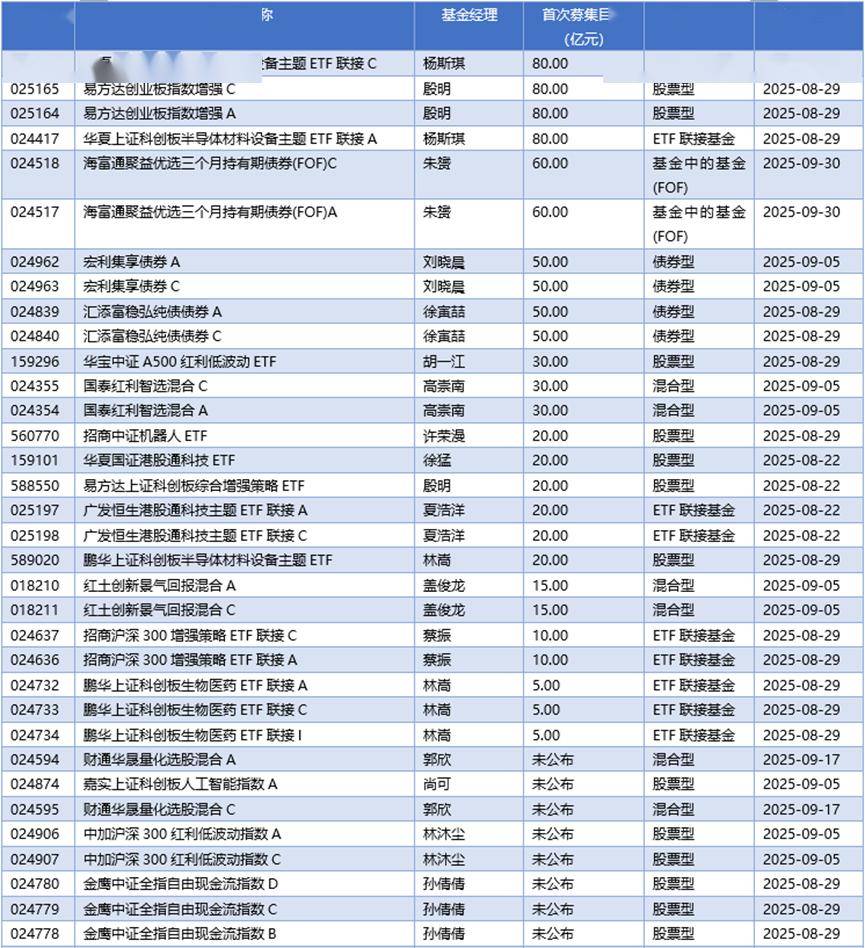
Group 1: Market Overview - The A-share market experienced a significant surge on August 18, with the Shanghai Composite Index reaching a nearly 10-year high, closing at 3728.03 points, up 0.85% [1] - The total trading volume in the Shanghai and Shenzhen markets hit a new annual high of 2.76 trillion yuan, with over 4000 stocks rising [1] - The market focus shifted towards AI hardware and large financial sectors, indicating a strong interest in AI-related investments [1] Group 2: Fund News - On August 18, 65 new funds were launched, primarily stock and ETF linked funds, with the Huaxia SSE Sci-Tech Innovation Board Semiconductor Materials and Equipment Theme ETF Link C aiming to raise 8 billion yuan [2] - Over 95% of Fund of Funds (FOF) reported positive returns year-to-date, with 36 products exceeding a 20% return, particularly those heavily invested in Hong Kong's innovative pharmaceutical and technology sectors [2] - The issuance of new funds has increased, with 45 new funds starting fundraising from August 18 to 24, marking a 36.36% week-on-week increase [2] Group 3: ETF Insights - The Jiashi Fund's Hong Kong Stock Connect Consumer ETF and Technology ETF officially launched on August 19, allowing mainland investors to trade Hong Kong stocks without opening a separate account [3] - The Hong Kong Stock Connect Consumer ETF has seen a 42.30% increase over the past year, while the Technology ETF has surged by 93.86%, highlighting their growth potential [3] - The Hong Kong market showed mixed performance on August 18, with the innovative pharmaceutical sector gaining traction, particularly after the National Healthcare Security Administration's announcement regarding the adjustment of drug directories [3] Group 4: Fund Performance - The best-performing fund on August 18 was the Xinhua Strategy Selected Stock Fund, with a daily growth rate of 7.0792%, followed closely by the Xinhua Trend Navigation Mixed Fund at 7.0644% [6][7] - Among stock funds, the top performers included the Bosera North Certificate 50 Index Initiating C and A, both showing growth rates above 6.5% [8] - In the bond fund category, the South China Changyuan Convertible Bond A led with a daily growth rate of 2.3540% [7]
港通医疗股价微跌0.94% 公司回应多项业务布局进展
Sou Hu Cai Jing· 2025-08-18 19:50
Core Viewpoint - 港通医疗's stock closed at 23.30 yuan on August 18, experiencing a decline of 0.22 yuan from the previous trading day, with a trading volume of 1.01 billion yuan and a turnover rate of 6.77% [1] Group 1: Company Overview - 港通医疗 specializes in the research and production of medical gas equipment and systems, as well as medical clean equipment and systems, primarily used in hospital wards and operating rooms [1] - The company's products are a crucial part of smart hospital construction [1] Group 2: Recent Developments - 港通医疗 has not yet initiated business in clean medical warehouse robots or fertility robots, nor has it established business relations with brain-machine equipment companies [1] - The company is focused on monitoring advancements in AI medical technology to enhance product intelligence and meet the modernization needs of hospitals [1] Group 3: Financial Performance - The stock's current price-to-earnings ratio is 368.92 times, and the price-to-book ratio is 1.88 times [1] - On August 18, the main funds experienced a net outflow of 12.40 million yuan, with a cumulative net outflow of 8.71 million yuan over the past five trading days [2]
减持创新药,补换AI医疗!部分基金动向曝光
券商中国· 2025-08-18 15:25
Core Viewpoint - The public fund's strategy of "first doing drugs, then doing medicine" is enhancing the net value of pharmaceutical-themed funds and creating switching opportunities [1] Group 1: Fund Performance and Strategy - In June and July, innovative drug-themed funds began to double in value, accelerating the demand for portfolio adjustments among public funds and boosting interest in AI healthcare [2][4] - As of August 17, medical-themed funds achieved a maximum return rate of nearly 150% within eight months, primarily driven by the "drug" segment [4] - Fund managers have started to reduce their positions in innovative drugs and shift towards AI healthcare stocks, indicating a strategic transition in the market [6][9] Group 2: Market Dynamics and Fund Manager Insights - Fund managers emphasize that innovative drugs and AI healthcare are at different developmental stages, with innovative drugs currently in a results realization phase, while AI healthcare is still exploring product validation and commercialization [5] - The shift towards AI healthcare is reflected in the significant stock price increases of AI healthcare companies, such as a 65% rise in the stock price of Crystal Technology within ten trading days [7] - Fund managers are increasingly optimistic about AI healthcare becoming a major investment theme by 2025, with a focus on companies that can leverage high-quality data for improved healthcare outcomes [10]

麦澜德股价小幅回落 公司AI医疗布局引关注
Sou Hu Cai Jing· 2025-08-18 13:17
Group 1 - The latest stock price of Mylande is 47.28 yuan, down 1.27% from the previous trading day, with an opening price of 48.00 yuan and a trading range between 46.20 yuan and 48.00 yuan, achieving a transaction amount of 264 million yuan [1] - Mylande is primarily engaged in the research and production of medical devices, focusing on women's health. The company has recently ventured into the AI medical field, beginning trials of the DeepSeek multimodal data fusion technology to create an intelligent diagnostic and treatment closed-loop system [1] - Mylande is exploring the application of artificial intelligence in the medical sector by deploying the DeepSeek system, aiming to construct an intelligent diagnostic solution that covers the entire process of prevention, diagnosis, treatment, and rehabilitation, achieving precise matching of clinical pathways across departments [1] Group 2 - Capital flow data indicates that Mylande experienced a net outflow of 31.24 million yuan on the day, accounting for 1.79% of its circulating market value. Over the past five trading days, the cumulative net outflow reached 39.11 million yuan, representing 2.25% of its circulating market value [1]

2025年中国AI脑卒中诊断医疗器械行业概览:人机协同深化,AI将重塑脑卒中诊疗生态链
Tou Bao Yan Jiu Yuan· 2025-08-18 12:49
Investment Rating - The report does not explicitly state an investment rating for the AI stroke diagnosis medical device industry Core Insights - The demand for AI stroke diagnosis medical devices is surging due to the continuous increase in stroke incidence globally and in China, driven by aging populations and lifestyle changes [4][15][16] - The market for AI stroke diagnosis medical devices in China is projected to grow from 180 million yuan in 2022 to 610 million yuan by 2024, with a compound annual growth rate (CAGR) of 83.4% [20][22] - By 2030, the market size is expected to reach 6.36 billion yuan, indicating a CAGR of 47.6% [22] Summary by Sections Industry Overview - Stroke is defined as a sudden loss of neurological function due to brain blood circulation disorders, with AI medical devices aiding in diagnosis and treatment decisions [4][9] - The global stroke incidence has risen from 13.5 million in 2018 to 14.38 million in 2022, with a CAGR of 1.6% [16] - In China, stroke incidence increased from 4.605 million in 2018 to 5.353 million in 2022, with a CAGR of 3.8% [16] Market Demand - The increasing stroke incidence, coupled with an aging population, is driving the demand for AI stroke diagnosis medical devices [15][16] - The lifetime stroke risk for individuals over 25 years old is 24.9%, with East Asia having the highest risk at 38.8% [15] Market Size - The market for AI stroke diagnosis medical devices in China is expected to grow significantly, from 180 million yuan in 2022 to 610 million yuan in 2024, and further to 6.36 billion yuan by 2030 [20][22] Competitive Landscape - As of May 2025, 14 AI stroke diagnosis products have received approval as Class III medical devices in China, covering various indications such as intracranial hemorrhage and ischemia [37][38] - Key players include Pushang Medical, United Imaging, and Neusoft Medical, each focusing on different aspects of stroke diagnosis [38] Industry Chain Analysis - The industry chain consists of upstream raw material suppliers, midstream AI stroke diagnosis device manufacturers, and downstream distribution and sales entities [24][25] - The report emphasizes the need for companies to focus on "technology accessibility, precision medicine, and ecological collaboration" to seize market opportunities [25]