智能化

Search documents
拥抱行业变革 中通客车2026全系旅团新品及全球服务品牌发布
第一商用车网· 2025-12-10 07:04
Core Viewpoint - The tourism passenger transport industry is undergoing a transformation, shifting from mere transportation to a focus on travel experience, necessitating innovation and service-driven value creation [1][3]. Industry Trends - The tourism passenger transport sector is experiencing diversification, personalization, and quality enhancement, with new travel models like concert tourism and customized family trips gaining popularity. Domestic travel reached 4.998 billion trips in the first three quarters of 2025, marking an 18% year-on-year increase [3][4]. - The recovery of inbound tourism, such as "China Tour" and "China Purchase," is providing strong momentum for the tourism passenger transport industry [3]. Challenges - The industry faces issues such as an incomplete network system and poor connectivity to tourist attractions, which need to be addressed for high-quality development [4]. Company Innovations - Zhongtong Bus, a leading player in the bus industry for over half a century, is aligning with industry trends and customer needs through product iteration, technological innovation, and service upgrades [6]. - The launch of the 2026 series of travel products integrates smart solutions, enhancing the driving experience, passenger comfort, and operational efficiency [6][9]. Product Features - The 2026 H-series travel products feature significant improvements in comfort and energy efficiency, with a focus on interior design and advanced technology like wireless charging [9]. - The L-series platform offers unique design and flexible seating arrangements, emphasizing driver comfort and operational reliability through lightweight design and low energy consumption [11]. Smart Solutions - Zhongtong Bus is incorporating advanced smart technologies into its travel products, including a combination of assisted driving systems and a smart driving cockpit, enhancing safety and passenger experience [13][14]. - The vehicle networking big data platform provides comprehensive safety management throughout the vehicle's lifecycle, from pre-departure checks to post-operation analysis [16]. Service Brand Launch - The introduction of the "Zhongtong U·Serve" global service brand aims to create a comprehensive service guarantee system covering the entire lifecycle of the vehicle, focusing on speed, efficiency, intelligence, enjoyment, and selection [17][19]. - This service model transition reflects a deep understanding of customer needs and market trends, moving from traditional after-sales responses to a full-cycle value protection approach [19]. Event Significance - The event not only showcased Zhongtong Bus's strengths and innovations but also served as a platform for collaboration and exploration of new development paths in the tourism passenger transport industry [20].


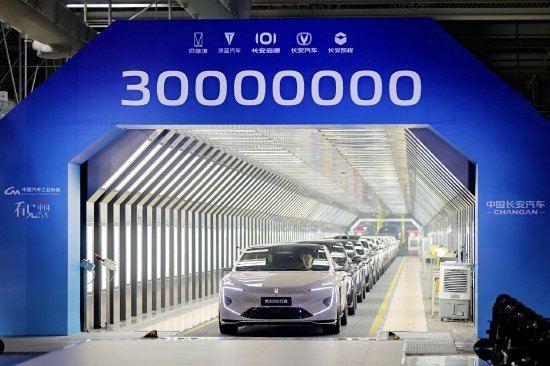
长安汽车宣布第3000万辆汽车下线,到2030年将力争实现年产销500万辆
Xin Lang Cai Jing· 2025-12-10 06:40
Core Insights - China Changan has officially launched its 30 millionth vehicle, becoming the fastest Chinese brand to reach this milestone [1][5] - The company attributes this achievement to the support of users, partners, and the dedication of its employees [3][7] Production Milestones - The first 10 million vehicles were produced in 30 years, the second 10 million in 7 years, and the third 10 million is projected to be achieved in just 4.5 years by 2025 [3][7] Strategic Blueprint - Changan's new strategic plan includes three main initiatives: "Shangri-La" for new energy, "Beidou Tianshu" for intelligence, and "Haina Baichuan" for globalization [3][7] - The company aims to produce and sell 5 million vehicles by 2030, with over 60% being new energy vehicles and over 30% in overseas markets [3][7] New Energy Focus - Changan will emphasize safety and core technology development, launching three new energy brands: Avita, Deep Blue, and Changan Qiyuan [3][7] - The company plans to focus on next-generation batteries and IGBT technology, while also exploring digital energy and battery recycling opportunities [3][7] Intelligent Technology Development - Changan is developing the "Tianshu Intelligent" brand, focusing on core technologies such as intelligent driving, chassis, and smart cabins [4][8] - Future plans include mass production of humanoid robots by 2028 and commercial flying cars by 2030 [4][8] Global Expansion Strategy - The company is committed to long-term, localized, and systematic global expansion, enhancing ESG initiatives [4][8] - Changan aims to build a global operational system with localized capabilities across research, manufacturing, logistics, marketing, and customer operations [4][8]

三个潮汕人的百亿生意,能否扛住“新国标”与“投诉潮”?
Feng Huang Wang Cai Jing· 2025-12-10 06:04
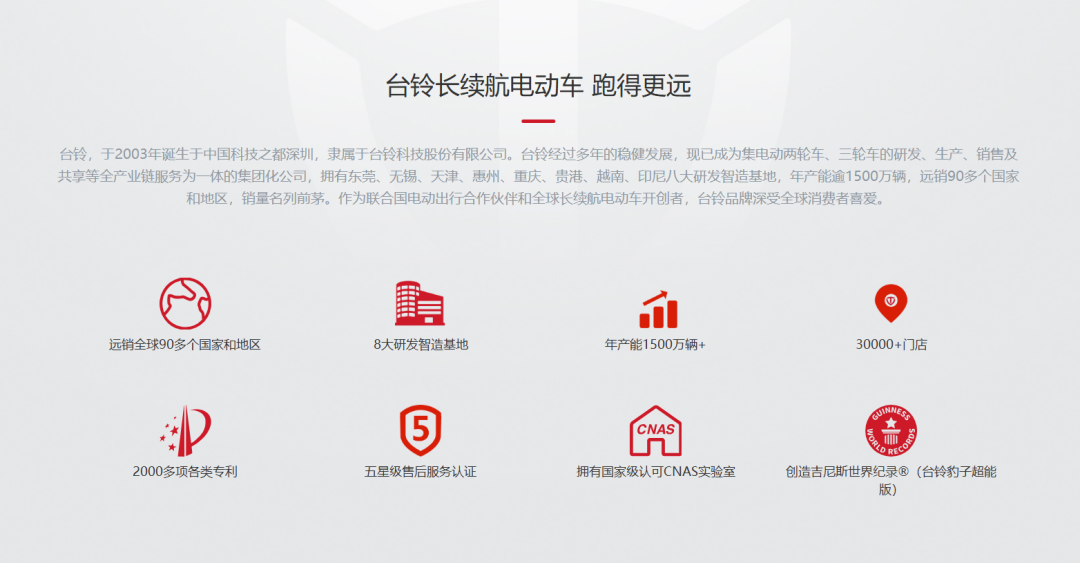
Core Viewpoint - The electric two-wheeler company Tailling, with annual revenue exceeding 12 billion yuan, has officially initiated its listing guidance, planning to go public in Hong Kong by 2026, potentially becoming the third major player in the industry to enter the capital market after Yadi and Aima [1] Group 1: Company Overview - Tailling has transformed from a small workshop into an industry giant, boasting ten R&D and manufacturing bases, an annual production capacity exceeding 15 million units, and a global store network of over 30,000, with products sold in more than 90 countries [2][4] - The company is projected to achieve approximately 12 billion yuan in revenue for 2024, with estimated annual sales between 5 million and 7 million units, maintaining its position as the third-largest player in the industry [4] Group 2: Market Challenges - The implementation of the new national standard for electric bicycles (GB 17761-2024) starting September 1, 2025, poses significant compliance challenges and market adaptation pains for Tailling [1][9] - The shift in industry growth logic from "quantity expansion" to "value enhancement" centered on smart and high-end products presents a profound transformation challenge for Tailling [1] Group 3: User Experience and Brand Reputation - Tailling's reliance on the "downstream market" has led to a focus on price-sensitive consumers, such as delivery riders and rural commuters, which has resulted in a practical product image but has hindered its appeal to younger consumers who prioritize technology and smart features [4] - User complaints regarding after-sales service and battery performance have emerged, with over 2,000 complaints reported, highlighting issues such as battery life being only 60% of advertised figures [4][8] Group 4: Regulatory Compliance - The new national standard introduces stringent requirements aimed at addressing long-standing safety issues in the industry, which could significantly impact Tailling's operations if compliance is not met [9] - Previous regulatory cases have revealed compliance management vulnerabilities within Tailling's distribution channels, raising concerns about the company's ability to enforce the new standards across its extensive network [9] Group 5: Governance and Ownership Structure - Tailling's ownership is highly concentrated among the founding brothers and their partners, which has facilitated efficient decision-making during the company's rapid growth but may pose challenges as the company transitions to a publicly traded entity [10][12] - The current ownership structure may limit Tailling's ability to offer attractive equity incentives to attract talent, potentially putting it at a disadvantage compared to competitors with more balanced governance structures [12]
中投公司,最新发布!
券商中国· 2025-12-10 03:59
Core Viewpoint - The report highlights the strategic positioning and investment performance of the China Investment Corporation (CIC) amidst a challenging global economic environment characterized by high interest rates, inflation, and geopolitical changes [2]. Group 1: Financial Performance - As of December 31, 2024, CIC's total assets reached $15.7 trillion, with net assets amounting to $13.7 trillion, achieving an annualized net return on foreign investments of 6.92% over the past decade, exceeding performance targets by 61 basis points [1]. - The Central Huijin, managing state-owned financial capital, reported an increase to 6.87 trillion RMB, reflecting a growth of 6.44% since the beginning of the year [1]. Group 2: Investment Strategy - In 2024, CIC aims to maintain strategic focus as a long-term investor while optimizing investment models and enhancing professional management to improve asset allocation and portfolio management [2]. - The investment portfolio in the public market consists of 34.65% in publicly traded stocks, with the top five sectors being Information Technology (25.85%), Financials (16.41%), Consumer Discretionary (11.85%), Health Care (9.88%), and Industrials (9.72%) [3]. Group 3: Market Adaptation - CIC is adapting its investment strategies in response to the new technological revolution and industrial transformation, focusing on both public and private market investments [9]. - In the public market, CIC emphasizes refined management and research on market trends and risks, while in the private market, it seeks to innovate investment models and deepen partnerships [9]. Group 4: Role of Central Huijin - Central Huijin continues to act as a stabilizing force in the capital market, increasing its holdings in exchange-traded funds (ETFs) to support market stability [10]. - Since 2008, Central Huijin has participated in various efforts to maintain capital market stability and will continue to enhance the governance and competitiveness of its controlled institutions [11].

三个潮汕人的百亿生意,能否扛住“新国标”与“投诉潮”?
凤凰网财经· 2025-12-10 03:35
Core Viewpoint - The article discusses the upcoming IPO of Tai Ling, a leading electric two-wheeler company in China, which plans to go public in Hong Kong by 2026, marking a significant moment for the industry as it joins other major players like Yadea and Aima in the capital market [1][2]. Group 1: Company Overview - Tai Ling has transformed from a small repair shop into a major industry player, achieving annual revenues exceeding 12 billion yuan (approximately 1.2 billion) and an annual production capacity of over 15 million units [4][6]. - The company has established a global network of over 30,000 stores and exports products to more than 90 countries, positioning itself as the third-largest player in the industry with estimated annual sales between 5 million and 7 million units [4][6]. Group 2: Market Challenges - The upcoming implementation of the new national standard for electric bicycles (GB 17761-2024) poses significant compliance challenges for Tai Ling, as it requires strict adherence to safety regulations and could impact the company's operations [3][11]. - The shift in industry growth from quantity expansion to value enhancement through smart and high-end products presents a challenge for Tai Ling, which has primarily focused on cost-sensitive consumers such as delivery riders and rural commuters [7][10]. Group 3: Governance and Ownership Structure - Tai Ling's ownership is highly concentrated among the founding brothers and their partners, which has facilitated efficient decision-making during the company's growth phase [18][21]. - However, this concentrated ownership structure may hinder the company's ability to attract talent and innovate as it transitions to a publicly traded company, where a more balanced governance structure is often required [21][22]. - The current ownership structure, with 100% held by founders, poses a challenge for meeting public shareholding requirements for the IPO, potentially leading to concerns about stock liquidity [23][24].

观车 · 论势 || 现在说市场透支,尚早
Zhong Guo Qi Che Bao Wang· 2025-12-10 02:55
Group 1 - The core viewpoint of the articles highlights the mixed performance of the Chinese automotive market in November, with retail sales showing a year-on-year decline of 7% but a month-on-month increase of 1%, indicating underlying market resilience despite concerns about potential market saturation and the impact of subsidy reductions [1][2]. - The decline in November's retail sales is attributed to a high comparison base from the previous year, where sales reached 2.423 million units, marking a 16.5% year-on-year increase, suggesting that the current year's performance is still stable with double-digit growth compared to the same period last year [1]. - The Chinese government continues to support automotive consumption, as evidenced by a recent policy that encourages green and low-carbon consumption in the automotive sector, indicating a long-term commitment to fostering a sustainable automotive market [2]. Group 2 - China's automotive exports have emerged as a new growth point, with exports reaching 5.616 million units from January to October, reflecting a 15.7% year-on-year increase, showcasing the increasing competitiveness of Chinese brands in international markets [3]. - The automotive market's natural fluctuation after rapid growth is seen as a transition towards high-quality development rather than a sign of market exhaustion, emphasizing the industry's ongoing innovation and adaptation [3]. - The continuous improvement in electric and intelligent vehicle penetration rates, along with a robust supply chain, positions the Chinese automotive market for sustained long-term growth and resilience against market risks [3].
智能化赋能涂料柔性生产新业态
Zhong Guo Hua Gong Bao· 2025-12-10 02:42
Group 1: Industry Trends - The core driving force behind the profound transformation of coating manufacturing processes is the deep integration of intelligence, digitalization, greening, and automation [1] - Digital technology-driven intelligent upgrades are becoming a new solution for the increasing market demand for small-batch and personalized coating products, enabling flexible production and delivery [1] Group 2: Supply Chain Transparency - Traditional factories face challenges such as lack of order transparency, chaotic logistics, slow equipment response, and high communication costs [2] - Digital factories achieve smooth information and material flow, effectively reducing communication costs, waiting times, and error rates [2] - Companies like PPG and Nippon Paint are actively promoting intelligent manufacturing across the entire process, including supplier management, product development, production operations, and logistics [2][3] Group 3: Advanced Information Systems - Companies are planning to enhance supply chain services by optimizing customer relationship management (CRM) systems and introducing supplier relationship management (SRM) systems [3] - The use of big data analytics to build customer profiles aims to improve integrated supply chain services from production to after-sales [3] Group 4: Flexible Production Lines - Equipment is considered the backbone of industrial upgrades, with technological breakthroughs directly impacting high-quality industry development [4] - There is a need for equipment systems that can quickly respond to small-batch and diverse demands to achieve flexible customization [4] - Collaboration between coating production enterprises and equipment manufacturers is essential for achieving comprehensive digital transformation [4] Group 5: Automation Solutions - Automation upgrades are crucial for chemical companies to enhance competitiveness, with solutions like automated material extraction systems achieving high efficiency and product recovery rates [5] - The implementation of automation requires attention to demand research, solution design, installation, and operational maintenance [5] Group 6: Color Management - Small-batch and customized coating production necessitates high standards, precision, and stability in color formulation [7] - Traditional factories relying on manual input face challenges in precision and confidentiality, while foreign companies have achieved standardization and automation in small-batch color management through digitalization [7] - Automation and digital applications in quality control laboratories significantly reduce human errors and enhance data traceability [7]
均胜电子(0699.HK):全球汽车TIER1的技术外溢-从智能汽车到具身智能
Ge Long Hui· 2025-12-10 01:39
Core Insights - The company has undergone several developmental phases, starting from local component manufacturing to becoming a global Tier 1 supplier in the automotive industry [1][2] Phase Summaries Foundation Phase (2004–2010) - The company began by supplying interior and functional components to domestic automakers, establishing core customer relationships and understanding vehicle development processes [1] - Focus was on solidifying manufacturing, quality, and supply chain management systems, evolving from "able to supply" to "reliable, stable, and replicable" [1] Internationalization Phase (2011–2018) - The company went public in 2011, using capital market support to acquire quality assets like Preh and KSS, transitioning from a single Chinese supplier to a global Tier 1 player [1] - Key strategies included acquiring capabilities, customers, and platforms, gaining access to advanced technologies and global automotive projects [1] - The company established R&D and production bases in Europe and America, creating an operational network across China, Europe, and North America [1] Optimization and Integration Phase (2019–2024) - Building on successful acquisitions, the company entered a phase of "digesting and optimizing," increasing R&D investment in smart cabins, vehicle networking, and energy management [2] - The company is restructuring global factories and supply chains, aiming to enhance efficiency and profitability, with a noticeable recovery in gross margin and expense ratio starting in 2023 [2] - The focus is on transforming previously acquired assets into reusable platform capabilities to realize scale effects in profitability [2] Re-Entrepreneurship Phase (2025–Present) - The company aims to innovate and expand into a dual pillar development path of "automotive + robotics Tier 1" while maintaining stability and improving profitability in its core business [2] - It plans to deepen its expertise in automotive safety and electronics while establishing a subsidiary for humanoid robots, leveraging automotive-grade capabilities in new applications [2] - The shift is towards surrounding intelligent hardware and embodied intelligence ecosystems, laying the groundwork for future growth [2]

中投公司,最新发布!
Zheng Quan Shi Bao Wang· 2025-12-10 01:36
Core Insights - The report from China Investment Corporation (CIC) indicates total assets of $15.7 trillion and net assets of $13.7 trillion as of December 31, 2024, with an annualized net return on foreign investments of 6.92%, exceeding performance targets by 61 basis points [1] - The macroeconomic environment in 2024 is characterized by high interest rates, high inflation, and increased volatility, leading to greater challenges and uncertainties in foreign investment activities [1] - The acceleration of digitalization, greening, and intelligence is creating new investment opportunities alongside global growth [1] Investment Strategy - CIC maintains a strategic focus on long-term investments, emphasizing internationalization, marketization, professionalism, and responsibility while optimizing investment models and enhancing management systems [1] - In the public market, the investment portfolio is 34.65% in publicly traded stocks, with the top five sectors being Information Technology (25.85%), Financials (16.41%), Consumer Discretionary (11.85%), Health Care (9.88%), and Industrials (9.72%) [2] - The company is adapting its investment strategies in both public and private markets to respond to market trends and risks, enhancing flexibility and effectiveness in investment management [2] Performance and Outlook - In the first half of 2025, CIC reported good investment returns in the public market, exceeding board assessment indicators, while maintaining a flexible and proactive approach in the private market [3] - Central Huijin, a wholly-owned subsidiary of CIC, plans to increase its holdings in exchange-traded funds (ETFs) to support market stability, continuing its role as a stabilizing force in the capital market [4] - Central Huijin aims to enhance the governance and competitiveness of its controlled institutions, ensuring compliance and effective risk management to safeguard the quality of financial assets [5]
东风商用车2025成绩单抢先看!
第一商用车网· 2025-12-10 01:30
Core Viewpoint - Dongfeng Commercial Vehicle is accelerating its development in the commercial vehicle industry through a focus on new energy, intelligence, connectivity, and internationalization, aiming for high-quality growth in 2026 [3][6]. Group 1: Performance and Achievements - In 2025, Dongfeng Commercial Vehicle is expected to achieve wholesale sales of 131,000 units, representing a year-on-year growth of 24% [3]. - The market share of traditional energy vehicles is projected to exceed 16%, outperforming the overall market [3]. - Sales of new energy vehicles are expected to surpass 10,000 units, with a remarkable year-on-year growth of 98% [3]. Group 2: Strategic Insights - Dongfeng Commercial Vehicle is committed to a dual approach of advancing both traditional and new energy vehicles, strategically investing in electric, hydrogen fuel, and hybrid technologies to meet diverse customer needs [4]. - The company has achieved significant milestones in independent innovation, including the establishment of China's first diesel engine oil D1 standard, enhancing its influence in the lubricants sector [4]. - The Dragon Power 3.0 efficient smart powertrain has set a new industry benchmark with a maximum efficiency of 51.08% [4]. Group 3: Customer-Centric Approach - Dongfeng Commercial Vehicle emphasizes a customer-centric philosophy, engaging with clients through various experience activities and enhancing the "Tianlong Brother Club" benefits to foster customer loyalty and emotional connection [4]. - The company is committed to social responsibility through initiatives like the "Happy Truck" public welfare IP, which aims to deepen brand warmth and responsibility [4]. Group 4: Future Outlook - The year 2026 is positioned as a critical year for Dongfeng Commercial Vehicle to achieve high-quality development and become a leading international enterprise [6]. - The company plans to leverage its strengths in brand, product, technology, and marketing to build a new ecosystem for high-quality development [6]. - The upcoming partner conference in Chongqing is expected to showcase new products and solutions that will help customers create greater value [7].