关税战

Search documents
为什么美国现在只敢用贸易战、关税战这些经济方式与中国对抗?
Sou Hu Cai Jing· 2025-05-08 10:03
Group 1 - The United States is currently limited to using economic methods such as trade wars and tariffs to confront China due to complex considerations and various influencing factors [2] - The U.S. economy exhibits structural vulnerabilities, with consumer spending accounting for approximately 30% of global household final consumption, leading to a high dependency on imports [2] - The manufacturing sector's contribution to GDP has decreased from 17% in 1991 to 10.2% in 2023, indicating a hollowing out of domestic manufacturing [2] Group 2 - The political environment in the U.S. is characterized by high levels of partisanship and polarization, with figures like Trump leveraging a tough stance on China to gain electoral support [3] - This strategy diverts public attention from domestic issues, focusing blame on China and consolidating political backing, particularly in regions like the Rust Belt [3] Group 3 - From the perspective of international law and order, the U.S. recognizes that direct military confrontation would violate international laws and norms [4] - Trade disputes and tariff adjustments provide a framework within international rules, allowing the U.S. to express dissatisfaction and exert influence without resorting to military action [4] Group 4 - The U.S. military strategy is complex, with a global network of alliances and strategic positioning, maintaining a dominant military presence [5] - Direct military confrontation could provoke a strong response from China, leading to significant casualties and economic losses, as well as potential global economic repercussions [5]


笑死,让你打关税战,美国250年国庆或将无烟花可放!
商业洞察· 2025-05-08 09:05
Group 1 - The article highlights the significant reliance of the U.S. on Chinese imports, particularly in the fireworks industry, where 95% of fireworks are sourced from China [4][5][10] - Due to high tariffs imposed by the U.S. government, American fireworks companies are facing severe shortages, which could impact major celebrations like the 250th anniversary of the U.S. [5][7] - The American Pyrotechnics Association has urged the government to reconsider the tariffs, emphasizing the unique nature of the fireworks industry and the impossibility of domestic production [7][10] Group 2 - The article discusses the broader implications of U.S. tariffs on consumer goods, indicating that many household items are heavily reliant on Chinese manufacturing, with some products having import rates as high as 99% [11][14] - It notes that the recent tariff policies have already led to price increases on various products, with an average price hike of 29% observed on Amazon for 930 items [18] - The toy industry is particularly affected, with nearly 80% of toys sold in the U.S. being manufactured in China, leading to significant price increases and potential industry collapse [18][19] Group 3 - The article emphasizes the economic consequences of the tariff policies, including a 60% drop in shipping container orders from China to the U.S. and potential job losses in logistics and retail sectors [19] - It suggests that the tariffs are counterproductive, as they ultimately harm American consumers who are dependent on affordable Chinese goods [19][20] - The article concludes that Americans are beginning to realize the critical role of Chinese products in their daily lives, indicating a growing sentiment of missing these imports [19]

关税战下的经济风云:三大热点事件解析
Sou Hu Cai Jing· 2025-05-08 08:52
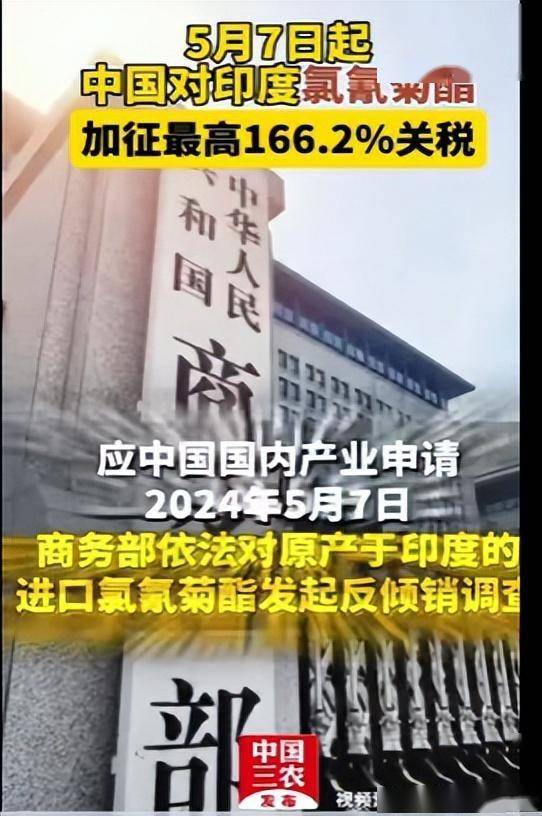
Group 1: China's Anti-Dumping Measures - China has decided to impose anti-dumping duties on imported chlorpyrifos from India, with rates ranging from 48.4% to 166.2% starting May 7, 2025 [3][4] - The anti-dumping investigation was initiated due to significant price drops in Indian chlorpyrifos exports to China, which fell from 89,675 RMB per ton in 2019 to 51,950 RMB per ton in 2023, a decrease of 42.07% [4] - The move aims to protect China's domestic chlorpyrifos industry and ensure fair competition, as well as stabilize the agricultural supply chain [5] Group 2: U.S. Port Trade Volume Decline - The largest U.S. port has experienced a significant drop in trade volume, influenced by high inflation, rising interest rates, and declining consumer confidence [8] - Changes in supply chain dynamics, with companies relocating production to Southeast Asia and India, have reduced cargo volumes at traditional U.S. ports [9] - The decline in port activity has adverse effects on local economies, leading to reduced revenues in logistics and transportation sectors, and potentially increasing unemployment rates [10] Group 3: Federal Reserve's Interest Rate Decisions - The Federal Reserve has maintained interest rates steady over three consecutive meetings, reflecting concerns over inflation and economic growth disparities [12][13] - The Fed is cautious about lowering rates too soon due to uncertainties in inflation trends and the potential for market instability [14] - Conditions for future rate cuts include achieving stable inflation around 2%, sustainable economic growth across sectors, and maintaining financial market stability [15][16]
中方再回应中美经贸高层会谈:美方要拿出诚意、拿出行动!
Zheng Quan Shi Bao· 2025-05-08 08:08
在会上,商务部新闻发言人何亚东在回应中美经贸高层会谈相关问题时表示,中方坚决反对美国滥施关 税的立场是一贯的,美方想要通过谈判解决问题,就要正视单边关税措施给自身和世界带来的严重负面 影响,正视国际经贸规则、公平正义和各界理性声音,拿出谈的诚意,要在纠正错误做法、取消单边加 征关税等问题上做好准备,拿出行动,与中方相向而行,通过平等协商解决双方关切。如果说一套做一 套,甚至企图以谈为幌子,继续搞胁迫、讹诈,中方绝不会答应,更不会牺牲原则立场、牺牲国际公平 正义去寻求达成任何协议。 此外,5月2日起美国正式取消对华小额包裹免税政策,一些国家的零售商近期调整甚至暂停了对美业 务。 对此何亚东表示,跨境电商直接满足了各国消费者个性化的需求,具有效率高、到货快、费用省等独特 的优势,近期美方取消对华小额免税政策,这将损害两国企业和消费者的利益,对此我们坚决反对。我 想强调的是,美方取消对华小额免税政策,改变不了跨境电商快速发展的势头,我们愿意同各国一道加 强合作,共同营造公平可预期的政策环境,促进跨境电商健康可持续发展。 商务部5月8日下午召开例行新闻发布会。 一、美方近期通过多种渠道主动向中方传递信息,希望就关税等 ...
油脂产业期现日报-20250508
Guang Fa Qi Huo· 2025-05-08 07:43
Group 1: General Information - The reports cover various industries including oils and fats, sugar, cotton, eggs, meal, livestock, and corn [1][3][4][7][9][12][14] - The date of the reports is May 8, 2025 [1][3][4][7][9][12][14] Group 2: Oils and Fats Industry Investment Rating - Not provided Core View - Palm oil: Potential over - supply due to increased production may push down prices. Domestic palm oil futures may follow the downward trend of Malaysian palm oil [1] - Soybean oil: Sino - US meeting may boost CBOT soybeans, but US biodiesel policy may limit the upside. In China, high basis and increasing supply may lead to a decline in basis quotes [1] Summary by Catalog - Price Data: Different price changes are shown for spot and futures prices of palm oil, soybean oil, and rapeseed oil, along with basis, spreads, and inventory data [1] Group 3: Sugar Industry Investment Rating - Not provided Core View - Supply concerns are alleviated with good starts in Brazil's new sugar - cane season and expected increase in India's sugar production. In China, the overall supply - demand is loosening, and sugar prices are expected to be weak after the holiday [3] Summary by Catalog - Price Data: Futures and spot prices of sugar show certain fluctuations, along with basis, spreads, and inventory data [3] - Industry Data: National and regional sugar production, sales, and inventory data show year - on - year changes [3] Group 4: Cotton Industry Investment Rating - Not provided Core View - In the short term, macro factors dominate the market, and cotton prices may fluctuate. The downstream market is slightly weakening, and inventory is slightly accumulating [4] Summary by Catalog - Price Data: Futures and spot prices of cotton show changes, along with basis, spreads, and inventory data [4] - Industry Data: Inventory, import volume, and textile - related data show month - on - month changes [4] Group 5: Egg Industry Investment Rating - Not provided Core View - Post - holiday replenishment has a limited impact on egg prices due to supply pressure. Egg prices may remain stable in May and decline in June. Short - selling is recommended for 06 and 07 contracts [7] Summary by Catalog - Price Data: Futures and spot prices of eggs, along with related spreads and costs, show certain changes [7] Group 6: Meal Industry Investment Rating - Not provided Core View - US soybeans are following the decline of US soybean oil. Spring sowing is progressing well, and the supply pressure from Brazil is continuing. In China, the supply is recovering, and the basis is under pressure [9] Summary by Catalog - Price Data: Spot and futures prices of soybeans, soybean meal, and rapeseed meal are presented, along with basis, spreads, and inventory data [9] Group 7: Livestock (Pig) Industry Investment Rating - Not provided Core View - During the May Day holiday, pig prices were stable. Secondary fattening may lead to more supply in May, and demand is weak. Pig prices are expected to remain volatile. The 09 contract has priced in the weak post - holiday expectation [12] Summary by Catalog - Price Data: Futures and spot prices of pigs, along with related indicators such as slaughter volume, profit, and inventory, are shown [12] Group 8: Corn Industry Investment Rating - Not provided Core View - The corn market has a tight supply, and spot prices are strong. However, new wheat listing and policy releases may put pressure on prices. Corn prices are expected to be high and volatile in the short term and may rise in the long term [14][15] Summary by Catalog - Price Data: Futures and spot prices of corn and corn starch are presented, along with basis, spreads, and inventory data [14]
关税动荡日,名私募们的仓位都在近年来的高点……
聪明投资者· 2025-05-08 06:48
在 4 月初的关税大跌日来临之前,私募投资管理人的仓位多数达到最近几年的高点。 翻看 3 月底重点跟踪私募部分产品的月报,能看到彼时的乐观。一些过往 5-6 成的私募将仓位加到 8-9 成,也有不少私募保持满仓不能再满了。 4 月结束,正好是上市公司季报披露完毕,也是私募管理人 3 月份月报集中推出的时间点,照例盘点 mark 下。 总体而言,医药板块配置比例在多家私募中明显上升,仁桥夏俊杰将医药仓位从 9.6% 提升至 12.5% ;世诚投资陈家琳也明确指出 " 医药板块的复兴只是开始 " ;重阳投资对于创新药的看好更是体现在 个股和港股创新药 etf 的持仓当中。 加仓房地产及物业股的也不少,除了宁泉资产一直打的"明牌",在港股增持碧桂园服务和万科企业,一 些私募的持仓也在上来,比如静瑞资本持仓超过 20% ,成为第二大重仓行业。 一直对紫金矿业偏爱有加的高毅资产邓晓峰,自 2023 年一季度起连续 7 个季度减持,在 2024 年四 季度恢复增持,今年一季度更是继续加码。同期还新进了云铝股份和中国铝业的前十大流通股东,这两 家公司都是他的过往爱股。在有色金属深度研究中赚到大钱的邓晓峰,也从不放过市场波动 ...

《农产品》日报-20250508
Guang Fa Qi Huo· 2025-05-08 05:23
1. Report Industry Investment Ratings There is no information regarding the report industry investment ratings provided in the documents. 2. Core Views of the Reports - **Palm Oil**: The potential negative impact of increased production leading to a significant rise in inventory has caused the futures price to decline further and test the support at 3700 ringgit. In China, the Dalian palm oil futures market is weak due to the influence of the Malaysian palm oil market, and it may test the previous low of around 7880 and could potentially break through and reach a new low [1]. - **Soybean Oil**: The upcoming Sino - US meeting in Switzerland has led to an optimistic outlook on Sino - US trade relations, boosting the CBOT soybean market. A decrease in US soybean crushing margins may reduce factory production, which is positive for the market. However, the US biodiesel policy may have a negative impact. In China, high basis has led to low purchasing, and an increase in Brazilian soybean arrivals will raise factory production, potentially easing the current supply shortage [1]. - **Sugar**: The supply concerns have eased as the new Brazilian sugar - cane crushing season has started well, and the US Department of Agriculture predicts an increase in India's sugar production. In China, rainfall in Guangxi has alleviated the drought to some extent, and future imports may determine the market trend. The overall supply - demand situation is loosening, and sugar prices are expected to remain weak after the holiday [3][4]. - **Cotton**: In the short term, the macro environment dominates the market, and there may be significant fluctuations due to variables such as weather. The downstream market is slightly weakening, and finished - product inventories are accumulating slightly. Domestic cotton prices are expected to fluctuate, and attention should be paid to the macro situation [5]. - **Eggs**: The downstream market has started post - holiday replenishment, but overall egg prices are stable with minor fluctuations due to supply pressure. The theoretical inventory of laying hens is expected to increase from May to June, which may have a negative impact on prices. In May, demand may support high - level stability, while in June, the supply - demand imbalance may lead to price drops. Short - selling is recommended for the 06 and 07 contracts [8]. - **Meal**: US soybeans have followed the decline of US soybean oil. The spring sowing progress is fast, and there is no weather - related speculation. The supply pressure from Brazil continues, and China's soybean arrivals are sufficient. In May, domestic arrivals are increasing, and oil - mill production is rising, but demand is not strong, putting pressure on the basis. Attention should be paid to the Sino - US trade negotiations [10]. - **Pigs**: During the May Day holiday, the live - pig spot price was stable, and the supply - demand relationship changed little. Second - fattening transactions declined in late April, and in May, the出栏 of previously second - fattened pigs may suppress the spot price. The demand is weak, and the pig price is expected to remain volatile. The 09 contract has factored in the post - holiday weakening expectation, and the market is expected to be stable with limited upward and downward movement [13]. - **Corn**: The market supply is tight, and the spot price is strong. The remaining grain at the grassroots level is less than half, and the selling enthusiasm in Northeast China is low. The downstream deep - processing industry has limited demand due to losses, and the breeding industry has limited growth due to wheat substitution. The port inventory needs to be digested, which restricts the price increase. In the long - term, supply tightening and increased breeding demand will support the price, but in the short - term, new wheat listings and policy releases may put pressure on the price [15][16]. 3. Summary by Related Catalogs Futures Market - **Palm Oil**: On May 7, the spot price of 24 - degree palm oil in Guangdong was 8550 yuan/ton, a decrease of 0.81% from February 6. The futures price of P2509 was 8204 yuan/ton, a decrease of 2.68%. The basis was 346 yuan/ton, an increase of 82.11% [1]. - **Soybean Oil**: On May 7, the spot price of first - grade soybean oil in Jiangsu was 8240 yuan/ton, a decrease of 0.24% from February 6. The futures price of Y2509 was 7900 yuan/ton, unchanged [1]. - **Sugar**: On May 8, the futures price of sugar 2601 was 5730 yuan/ton, a decrease of 0.21%; the price of sugar 2509 was 5868 yuan/ton, a decrease of 0.37%. The ICE raw - sugar main contract was 17.14 cents/pound, a decrease of 1.55% [3]. - **Cotton**: On May 8, the futures price of cotton 2509 was 12900 yuan/ton, an increase of 1.22%; the price of cotton 2601 was 13090 yuan/ton, an increase of 1.16%. The ICE US cotton main contract was 67.40 cents/pound, a decrease of 0.62% [5]. - **Eggs**: On May 8, the futures price of the egg 09 contract was 3769 yuan/500KG, an increase of 0.21%; the price of the 06 contract was 2890 yuan/500KG, an increase of 0.21% [8]. - **Meal**: On May 8, the spot price of Jiangsu soybean meal was 3200 yuan/ton, unchanged; the futures price of M2509 was 2920 yuan/ton, an increase of 0.17%. The spot price of Jiangsu rapeseed meal was 2500 yuan/ton, unchanged; the futures price of RM2509 was 2565 yuan/ton, an increase of 0.67% [10]. - **Pigs**: On May 8, the futures price of the pig 2507 contract was 13535 yuan/ton, an increase of 0.26%; the price of the 2509 contract was 13985 yuan/ton, an increase of 0.18% [13]. - **Corn**: On May 8, the futures price of corn 2507 was 2369 yuan/ton, an increase of 0.17%. The futures price of corn starch 2507 was 2745 yuan/ton, an increase of 0.15% [15]. Spot Market - **Palm Oil**: On May 7, the spot price of 24 - degree palm oil in Guangdong was 8550 yuan/ton, a decrease of 0.81% from February 6 [1]. - **Soybean Oil**: On May 7, the spot price of first - grade soybean oil in Jiangsu was 8240 yuan/ton, a decrease of 0.24% from February 6 [1]. - **Sugar**: On May 8, the spot price in Nanning was 6160 yuan/ton, a decrease of 0.16%; the price in Kunming was 6015 yuan/ton, a decrease of 0.08% [3]. - **Cotton**: On May 8, the Xinjiang arrival price of 3128B cotton was 13839 yuan/ton, a decrease of 0.05%; the CC Index of 3128B was 14100 yuan/ton, a decrease of 0.09% [5]. - **Eggs**: On May 8, the egg - producing area price was 3.18 yuan/jin, a decrease of 1.93% [8]. - **Meal**: On May 8, the spot price of Jiangsu soybean meal was 3200 yuan/ton, unchanged; the spot price of Jiangsu rapeseed meal was 2500 yuan/ton, unchanged [10]. - **Pigs**: On May 8, the spot price in Henan was 14980 yuan/ton, unchanged; the price in Shandong was 15090 yuan/ton, unchanged [13]. - **Corn**: On May 8, the Jinzhou Port flat - hatch price of corn was 2320 yuan/ton, an increase of 0.43%; the Changchun spot price of corn starch was 2620 yuan/ton, unchanged [15]. Industry Situation - **Sugar**: The cumulative national sugar production was 1074.79 million tons, an increase of 12.27% year - on - year; the cumulative national sugar sales were 599.58 million tons, an increase of 26.64% year - on - year [3]. - **Cotton**: The commercial inventory was 451.52 million tons, a decrease of 6.7% month - on - month; the industrial inventory was 95.43 million tons, a decrease of 0.5% month - on - month [5]. - **Eggs**: The price of egg - laying chicken chicks was 4.20 yuan/feather, a decrease of 1.18%; the price of culled chickens was 5.24 yuan/jin, an increase of 0.96% [8]. - **Meal**: The soybean inventory was 26008, an increase of 59.83%; the rapeseed meal inventory was 23735, an increase of 51.18% [10]. - **Pigs**: The daily slaughter volume of sample points was 148474, a decrease of 1.31%; the weekly self - breeding profit was 85 yuan/head, a decrease of 15.09% [13]. - **Corn**: The north - south trade profit of corn was - 26 yuan/ton, a decrease of 23.81%; the weekly profit of corn starch in Shandong was - 174 yuan/ton, a decrease of 1.75% [15].
关税打击来了!加拿大出口暴跌 进口下滑
Sou Hu Cai Jing· 2025-05-08 04:49
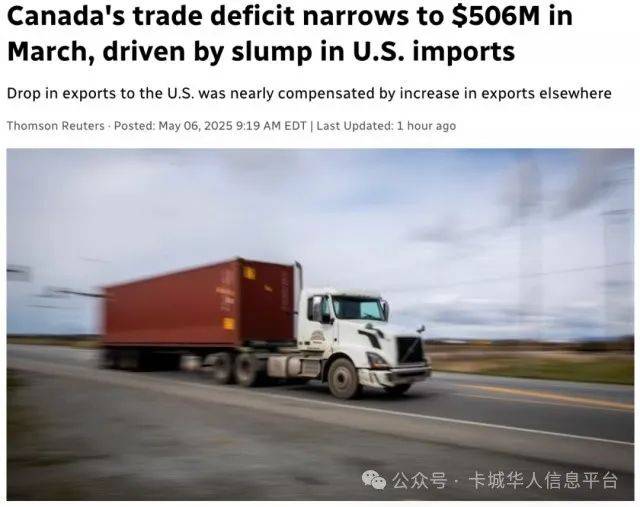
Group 1 - Canada's trade deficit narrowed to 5.06 billion CAD in March 2025, significantly lower than the expected 15.6 billion CAD, indicating a decline in trade activity with the U.S. due to tariffs [1][8] - The imposition of a 25% tariff on Canadian steel and aluminum by the U.S. led to a 2.9% drop in imports from the U.S. and a 6.6% decrease in exports to the U.S. in March [2][8] - Despite a 10.2% year-over-year increase in exports, the total export value fell to 69.9 billion CAD in March, marking the second consecutive month of decline, primarily due to falling commodity prices [5][6] Group 2 - Total imports decreased to 70.4 billion CAD in March, a decline of 1.4% from February, with significant drops in metal and non-metal mineral products (down 15.8%) and energy products (down 18.8%) [6][8] - The economic outlook remains concerning, with a recorded contraction of 0.2% in February and potential growth in March not alleviating the overall pessimism [8][11] - The trade tensions have led to increased pressure on Canadian consumers, with potential price hikes on imported goods and risks of layoffs or hiring freezes in domestic manufacturing [11]
突发!中国驻美国大使馆,最新发声!
券商中国· 2025-05-08 02:52
Core Viewpoint - The article emphasizes China's stance on the recent high-level economic talks with the United States, asserting that the discussions were initiated at the request of the U.S. and highlighting China's firm opposition to the imposition of tariffs by the U.S. [1] Group 1 - The U.S. has actively communicated with China through various channels, expressing a desire to discuss tariff issues, leading China to agree to engage in talks after careful evaluation of the U.S. signals [1] - China maintains a consistent position against the U.S. imposing tariffs, asserting its commitment to protect its legitimate rights and uphold international fairness and justice, as well as the rules of the World Trade Organization and the multilateral trading system [1] - The trade conflict is characterized as initiated by the U.S., and China calls for dialogue based on equality, respect, and reciprocity, rejecting any coercive tactics from the U.S. and emphasizing that it will not compromise its principles for any agreement [1]

特朗普愿意和解?关键时刻,中国商务部爆出内幕,事情果然不简单
Sou Hu Cai Jing· 2025-05-08 02:29
针对特朗普的这一说法,近日,商务部新闻发言人表示,中方注意到美方高层多次表态,表示愿与中方就关税问题进行谈判。同时,美方近期通 过相关方面多次主动向中方传递信息,希望与中方谈起来。对此,中方正在进行评估。中方立场始终如一,打,奉陪到底;谈,大门敞开。关税 战、贸易战是由美方单方发起的,美方想谈就应拿出谈的诚意,要在纠正错误做法、取消单边加征关税等问题上做好准备,拿出行动。 据海外网报道,美国总统特朗普再度对美国联邦储备委员会主席鲍威尔施压,要求美联储降息。这已经是特朗普连续两天就利率问题催促鲍威尔 了。此前,特朗普已经多次敦促美联储降息。而鲍威尔在多个公开场合强调,美联储将保持政策独立性,称当前美国的关税政策令美联储在制定 货币政策时极为棘手。鲍威尔的讲话十分明确,关税政策导致美国经济走势"怪异",美联储不会急于降息,究竟是保持高利率抗通胀,还是更快 降息托底经济,美联储可能需要留足观察的时间窗口。 特朗普(资料图) 与此同时,美国总统特朗普在前几日的白宫新闻发布会上明确表示,对中国商品征收的关税虽然不会降至零,但会大幅度下降。特朗普声称,他 会对中国"非常友好",不会采取强硬态度。就在特朗普对中方示好之前, ...