脑机接口

Search documents
医药生物行业周报(20260112-0116):产业化进程加速,脑机接口发展进入快车道-20260116
Shanghai Securities· 2026-01-16 12:29
Investment Rating - The industry investment rating for the medical biology sector is "Hold" [2]. Core Insights - The report highlights significant advancements in the brain-computer interface (BCI) industry, emphasizing the acceleration of industrial development and the establishment of a robust innovation ecosystem [3][4]. - The Shanghai Municipal Government has released a plan to cultivate the BCI industry, aiming for clinical applications of semi-invasive and invasive BCI products by 2027, with a comprehensive application by 2030 [4]. - The report suggests that the BCI field is entering a rapid development phase, driven by the release of industry standards and supportive government policies [7]. Summary by Sections Industry Overview - The BCI industry is experiencing accelerated industrialization, with recent breakthroughs in invasive devices and the establishment of new treatment paradigms for conditions like epilepsy [4][6]. - The report notes the importance of integrating BCI technology with artificial intelligence and virtual reality to enhance product offerings and market reach [4]. Government Initiatives - The Shanghai action plan outlines key milestones, including the development of over five invasive and semi-invasive BCI products for clinical trials and the establishment of a national-level BCI industry development zone [4]. - The plan also emphasizes the need for collaboration between innovative entities and medical institutions to foster product development in various applications, including rehabilitation and education [4]. Investment Recommendations - The report recommends focusing on companies such as Innovation Medical, Aipeng Medical, and Sanbo Brain Science, which are positioned to benefit from the growing BCI market [7].
四中全会精神在基层丨一间实验室,何以攀登“脑机接口”高峰?
Xin Hua Wang· 2026-01-16 12:17
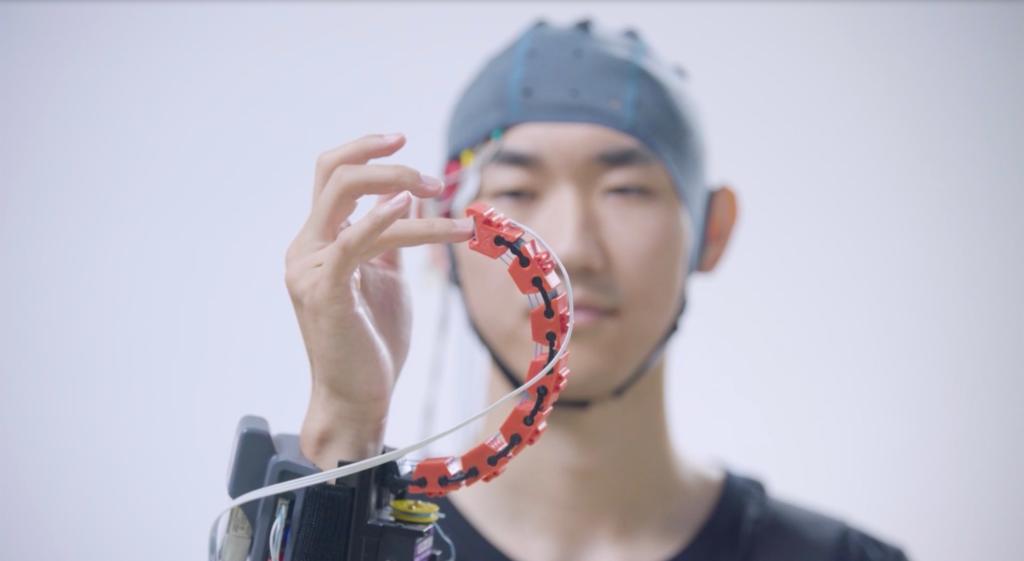
Core Insights - The Tianjin University Brain-Machine Interaction and Human-Machine Integration Haihe Laboratory is advancing in the field of non-invasive brain-machine interfaces, focusing on technology innovation and industrial application [2][3] - The laboratory has developed a wearable device called "Shengong-Lingxi Finger," which allows users to control it through thought, aiding in rehabilitation for patients with motor function impairments [1][4] - The laboratory is also exploring the potential of on-chip brain-machine interface technology, which could lead to advancements in mixed intelligence and brain-like computing [3] Group 1 - The laboratory was officially established on March 27, 2023, and is one of seven Haihe laboratories in Tianjin focusing on cutting-edge technology [2] - The laboratory holds a significant number of patents in the field of brain-machine interaction, ranking among the top globally [2] - The team is committed to aligning research with market needs and trends to ensure practical applications of their innovations [2] Group 2 - The laboratory is working on a special fund aimed at developing a brain-machine interface industry with a target scale of 10 billion yuan [6] - The incubated company, Tiankai Suishi (Tianjin) Intelligent Technology Co., has been recognized as a national high-tech enterprise and a technology-based small and medium-sized enterprise [6] - The laboratory aims to integrate technological innovation with industrial transformation, contributing to the broader goals outlined in the 14th Five-Year Plan [6]

喜娜AI速递:今日财经热点要闻回顾|2026年1月16日
Xin Lang Cai Jing· 2026-01-16 11:52
Group 1 - Xibei's Vice President has resigned, and 102 stores will close nationwide, affecting approximately 4,000 employees, due to previous losses exceeding 500 million [2][7] - Central University of Finance and Economics' He Qiang warns of excessive speculation in the stock market, suggesting regulatory measures to prevent a "crazy bull" market [2][7] - Muyuan Foods expects a net profit of 15.1 to 16.1 billion yuan for 2025, with a significant reduction in production costs and plans for international expansion [2][7] Group 2 - Some brokerage firms face a shortage of margin trading quotas, leading to a potential slowdown in leveraged investments as the financing balance exceeds 2.6 trillion yuan [3][8] - Nvidia has lowered its copper demand forecast from 500,000 tons to 200 tons, causing a nearly 3% drop in copper prices, indicating a shift in market expectations [3][8] - A-shares show three signals indicating a cooling market, with a focus on maintaining a "slow bull" market through regulatory actions [3][8] Group 3 - Brain-computer interface company NaoHu Technology has begun construction of a "super factory," indicating a move towards large-scale production in the sector, with related stocks seeing increased investment [4][9] - The China Securities Regulatory Commission has outlined tasks for 2026, focusing on market stability, regulatory enforcement, and promoting company development [4][10] - CITIC Securities predicts an influx of 1.5 trillion yuan in new capital for A-shares in 2026, supporting a slow bull market [4][10] Group 4 - Multiple A-share companies have reported positive earnings forecasts for 2025, with SAIC Motor expected to see a profit increase of 438% to 558%, reflecting a recovery in industry conditions [5][10]

A股脑机接口概念风起:十日涨出千亿市值,多只个股坐上“过山车”
Bei Ke Cai Jing· 2026-01-16 11:29
Core Viewpoint - The brain-computer interface (BCI) sector in the A-share market has shown significant activity at the beginning of 2026, with a cumulative increase of 18.04% in the BCI theme index as of January 16, 2026, indicating a strong interest and potential for commercialization in this emerging industry [2][4]. Industry Overview - The BCI industry is projected to reach a market size of trillions, transitioning from laboratory research to commercial applications, driven by advancements in technology and supportive government policies [3]. - The Ministry of Industry and Information Technology and other departments have emphasized the importance of BCI in their strategic plans, including its inclusion in the "14th Five-Year Plan" for future industrial development [3]. Market Performance - As of January 16, 2026, the total market capitalization of 26 listed companies in the BCI sector has increased by approximately 108.7 billion yuan over ten trading days [8]. - Notable companies like Innovation Medical and Meihua Medical have experienced significant stock price fluctuations, reflecting the volatile nature of the market and investor sentiment towards BCI technologies [5][7]. Company Developments - Innovation Medical's subsidiary, Boling Brain Machine Technology, has launched products aimed at rehabilitation for stroke patients, although it reported operating losses of 6.6 million yuan and 8.66 million yuan in 2023 and 2024, respectively [6]. - Meihua Medical, a leader in cochlear implants, is actively collaborating with BCI clients to facilitate the transition from laboratory research to commercial production, highlighting the interconnectedness of BCI and existing medical technologies [7]. Strategic Collaborations - Companies like Yahui Long and Shenzhen Brain Machine Star Chain Technology have entered strategic partnerships to develop BCI-related products, aiming to enhance diagnostic and treatment capabilities in central nervous system diseases [9]. - Aipeng Medical is also expanding its business into BCI applications, focusing on pain management and sleep disorders, indicating a broader trend of diversification within the medical device sector [9]. Technical Insights - The core technological barriers in the BCI industry are concentrated in the upstream supply chain, including hardware components and surgical techniques, with significant potential for growth in domestic market penetration and localization [10].



脑机接口、AI医疗接力助攻,港股通医疗ETF华宝(159137)上市首周跑赢大市!机构:2026年看好医疗硬科技
Xin Lang Cai Jing· 2026-01-16 11:17
Core Viewpoint - The Hong Kong stock market continues to adjust, with the pharmaceutical sector declining alongside the market, particularly affected by a short-term cooling of AI medical concepts [1][12]. Group 1: Market Performance - The Hong Kong Medical ETF Huabao (159137) fell by 0.93%, marking two consecutive days of decline, while the Hong Kong Innovation Drug ETF (520880) dropped by 1.08% [1][12]. - The medical sector saw 13 stocks rise and 37 fall, with Ark Health, a hot stock in AI medical concepts, leading the decline at 6.98%, and Alibaba Health also falling by 5.16% [2][13]. - The Hong Kong Medical Theme Index achieved a record nine consecutive days of gains before experiencing a pullback, with the Medical ETF Huabao having a cumulative increase of 6.9% in its first week, outperforming the Hang Seng Index [3][14]. Group 2: Sector Analysis - The Hong Kong Medical ETF Huabao covers 50 leading stocks across various medical fields, including CXO, AI medical, medical devices, and innovative drugs, indicating a comprehensive approach to capturing market trends [5][16]. - The medical sector has shown significant recovery since 2026, driven by hot themes like brain-computer interfaces and AI medical, with increasing investment value [6][17]. - The CXO sector is expected to see a "Davis Double Play" with both profit and valuation improvements, as demand gradually recovers and supply has been cleared over the past three years [18]. Group 3: Future Outlook - Analysts predict that by 2026, key areas of growth will include innovative overseas expansion and hard technology sectors such as AI medical and brain-computer interfaces, with a focus on monitoring the expansion of medical insurance and essential drug directories [18]. - The Medical ETF Huabao is positioned as a high-elasticity tool for capturing new opportunities in the medical field, particularly in AI medical, brain-computer interfaces, and innovative drug supply chains [18]. - The total scale of the medical ETF fund reached 27 billion yuan, making it the largest in the market for medical-related ETFs [19].

四中全会精神在基层|一间实验室,何以攀登“脑机接口”高峰?
Xin Hua She· 2026-01-16 11:15
Core Insights - The Tianjin University Brain-Machine Interaction and Human-Machine Integration Haihe Laboratory has developed a wearable device called "Shengong-Lingxi Finger," which allows users to control it using their thoughts, aiding in rehabilitation for patients with motor function impairments [1][2] - The laboratory focuses on non-invasive brain-machine interface technology and aims to drive technological innovation and industrial application, particularly in aerospace and rehabilitation medicine [1][2] - The laboratory has established a special fund targeting a scale of 10 billion yuan for the development of the brain-machine interface industry, indicating a strong commitment to integrating technological innovation with industrial practices [3] Research and Development - The laboratory has assembled a research team covering various aspects of brain-machine interfaces, human-computer interaction theories, device systems, and application transformations, emphasizing the importance of aligning research with market needs [2] - The laboratory is exploring the potential of brain-machine interfaces and aims to implement the spirit of the 20th National Congress of the Communist Party of China by promoting the transformation of cutting-edge scientific achievements [2] - The laboratory is advancing a new technology branch called on-chip brain-machine interfaces, which is expected to contribute to the development of mixed intelligence and brain-like computing [2] Industrialization Efforts - The laboratory has incubated Tiankai Suishi (Tianjin) Intelligent Technology Co., which has been recognized as a national high-tech enterprise and a technology-based small and medium-sized enterprise [3] - The laboratory's efforts align with the "14th Five-Year Plan" that emphasizes the deep integration of technological and industrial innovation, positioning the laboratory as a catalyst for industrial transformation [3]
OpenAI投资山姆·奥特曼脑机接口初创公司Merge Labs
Sou Hu Cai Jing· 2026-01-16 10:44
Core Insights - OpenAI has invested in Merge Labs, a brain-computer interface startup founded by CEO Sam Altman, which aims to connect biology and artificial intelligence to enhance human capabilities [2][3] - Merge Labs completed a $250 million seed funding round, with a valuation of $850 million, and OpenAI was the largest investor [2][3] - The company plans to develop non-invasive technology that connects to neurons using molecules instead of electrodes, utilizing methods like ultrasound for information transmission [2][3] Company Overview - Merge Labs is defined as a research laboratory focused on maximizing human capabilities by connecting biology and AI [2][7] - The startup's mission includes restoring lost abilities, supporting healthier brain states, and enhancing connections between individuals [2] Competitive Landscape - The investment intensifies competition between Altman and Elon Musk, whose company Neuralink is developing invasive brain-computer interface chips for severely paralyzed patients [3] - Neuralink's approach requires surgical implantation, contrasting with Merge Labs' non-invasive technology [3][7] Investment Dynamics - OpenAI's investment in Merge Labs is described as a "circular transaction," as success for Merge Labs could lead to more users for OpenAI, validating the investment [5][7] - OpenAI aims to collaborate with Merge Labs to develop scientific foundational models and advanced tools, enhancing research in bioengineering and neuroscience [5] Founders and Leadership - Merge Labs' co-founders include Alex Blania and Sandro Herbig from Tools for Humanity, along with Tyson Aflalo and Sumner Norman from Forest Neurotech, and researcher Mikhail Shapiro from Caltech [3][4] - The co-founders will continue their roles in their respective companies while also serving on the board of Merge Labs [4][5] Future Vision - Altman has long envisioned the concept of "fusion" between humans and machines, suggesting that this integration could be essential for human survival in the face of superintelligent AI [6] - The potential for brain-computer interfaces to create natural, human-centered interactions with AI is highlighted as a key reason for OpenAI's investment [5][6]

公司问答丨大地熊:公司高性能稀土永磁产品可应用于医疗器械、核磁共振器械等领域
Ge Long Hui A P P· 2026-01-16 08:58
Core Viewpoint - The company, Dadi Xiong, has confirmed that its high-performance rare earth permanent magnet products can be applied in the medical device sector, including MRI equipment [1] Group 1 - Investors inquired about the potential applications of brain-computer interface technology in conjunction with MRI imaging for research and surgical purposes [1] - The company responded positively, indicating that its products are suitable for high-end medical devices and MRI equipment [1]

马斯克领衔,脑机接口商业化元年来了?
Tai Mei Ti A P P· 2026-01-16 08:14
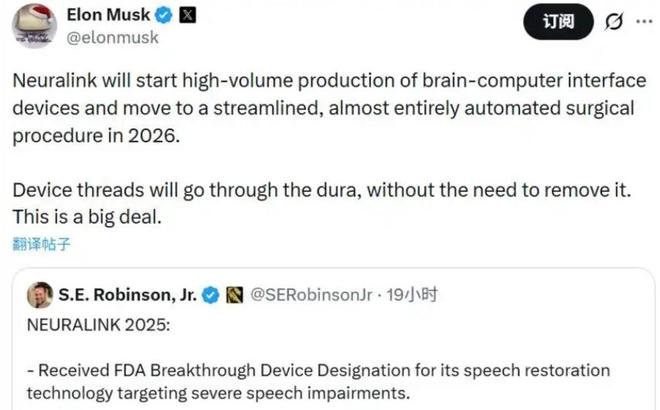
Core Insights - The announcement by Elon Musk regarding Neuralink's plans for large-scale production and fully automated surgeries in 2026 marks a significant step towards the commercialization of brain-machine interfaces (BMIs) [1][2] - The excitement in global capital markets is evident, with related stocks in the A-share market experiencing significant gains, indicating a strong investor interest in the BMI sector [2] Group 1: Technological Advancements - Neuralink is leading the invasive BMI sector by integrating AI into the entire process, significantly reducing surgery time from 6-8 hours to approximately 30 minutes, which is described as a "production line" approach [3][4] - The R1 surgical robot developed by Neuralink utilizes AI for real-time navigation, achieving micro-level precision in electrode placement, thus minimizing surgical trauma [3] - Neuralink's devices can decode neural signals with over 95% accuracy, allowing paralyzed individuals to perform tasks like gaming and social media interaction using only their thoughts [4] Group 2: Competitive Landscape - Chinese companies are exploring different technical routes in the BMI space, with firms like Boryeong and BrainTiger focusing on semi-invasive and flexible electrode technologies to balance signal quality and safety [5][6] - Boryeong's NEO system has successfully completed surgeries on 36 spinal injury patients, demonstrating the potential for restoring motor functions [5] - BrainTiger has made strides in real-time Chinese language decoding, achieving a 71.5% accuracy rate in clinical trials, showcasing advanced capabilities in high-level brain function decoding [6] Group 3: Market Challenges - Despite the technological advancements, the BMI industry faces significant hurdles in transitioning from innovative technology to a mature business model, with current clinical trials being limited in scope [7][8] - The market for BMIs is highly specialized, targeting severe neurological conditions, which may limit its immediate commercial viability [8] - The long-term reliability of implanted devices is a concern, as immune responses can lead to signal degradation, posing challenges for sustained use [9] Group 4: Ethical and Regulatory Considerations - The collection and use of neural data raise ethical questions regarding privacy and data security, with a lack of established regulations in place [10][11] - The potential for misuse of technology and risks associated with hacking highlight the need for a robust ethical framework to guide the commercialization of BMIs [10][11] - The balance between investor enthusiasm and the practical realities of the BMI market will be crucial for the industry's future [11]
如何解读交易所调整融资保证金比例︱重阳问答
重阳投资· 2026-01-16 07:33
Core Viewpoint - The adjustment of the financing margin ratio from 80% to 100% aims to cool down market sentiment and prevent excessive speculation in the A-share market [2][3]. Summary by Sections - **Market Conditions**: Since the beginning of the year, the A-share market has experienced rapid growth, with trading volume increasing from around 2 trillion to nearly 4 trillion, marking a historical high. The balance of margin financing has also surged to approximately 2.7 trillion, indicating a significant rise in leverage [3][4]. - **Regulatory Response**: The increase in the financing margin ratio serves as a regulatory signal to indicate heightened market sentiment and the need to be cautious of excessive speculation. This is particularly important given the high proportion of retail investors in the A-share market, which can lead to significant losses if speculative behavior escalates [3][4]. - **Comparison with Past Events**: While the current market conditions may evoke memories of the 2015 market surge, the situation is different due to a more mature regulatory framework. The average maintenance margin ratio is around 288%, suggesting that leverage levels are still relatively healthy [4]. - **Market Outlook**: Despite the short-term increase in market heat, there is no systemic risk currently present. The long-term outlook for the A-share market remains positive, supported by a mature regulatory environment and the increasing global competitiveness of Chinese companies [4][5]. - **Conclusion on Financing Margin Adjustment**: The increase in the financing margin ratio is primarily a short-term measure to suppress market sentiment and does not alter the long-term positive outlook for the A-share market [5].