AI医疗

Search documents
让OpenAI只领先5天,百川发布推理新模型,掀翻医疗垂域开源天花板
量子位· 2025-08-11 07:48
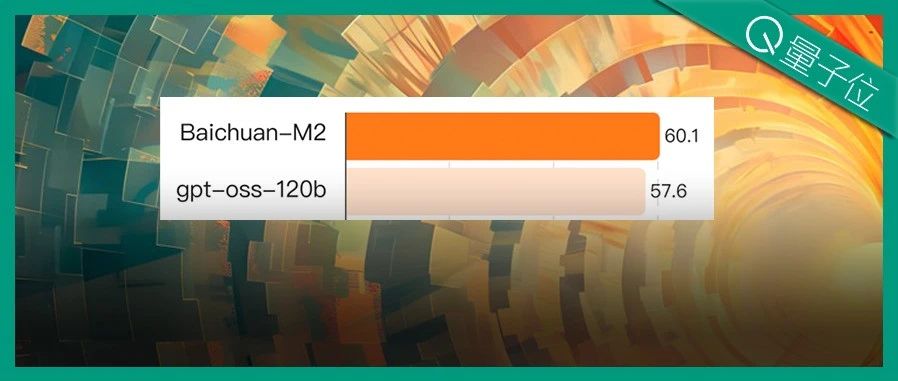
Core Viewpoint - Baichuan-M2-32B, a new medical reasoning model from Baichuan, surpasses all existing open-source and closed-source models except for GPT-5 in the Healthbench evaluation, indicating a significant advancement in AI medical applications [1][2][19]. Group 1: Model Performance - Baichuan-M2 is designed for real-world medical reasoning tasks and has 32 billion parameters, outperforming larger models in various benchmarks [12][13]. - In the HealthBench standard version, Baichuan-M2 achieved state-of-the-art (SOTA) performance, surpassing models like gpt-oss-120B and DeepSeek-R1 [19]. - In the HealthBench Hard version, Baichuan-M2 scored 34.7, making it one of only two models globally to exceed a score of 32, alongside GPT-5 [26][28]. Group 2: Accessibility and Deployment - The model can be deployed on a single RTX 4090 card, making it affordable for small and medium-sized medical institutions [4][35]. - Baichuan-M2's lightweight design reduces deployment costs significantly, allowing for a 57-fold cost reduction compared to previous models [35][56]. Group 3: Focus on Medical Applications - AI in healthcare is a highly discussed vertical, with significant attention from major AI companies, including OpenAI, which emphasizes its importance in real-world applications [5][6][7][68]. - Baichuan has positioned itself as a pioneer in focusing on AI medical applications, being the first major model company in China to do so [8][70]. Group 4: Innovative Training Techniques - Baichuan-M2 employs a Large Verifier System and a patient simulator to enhance its medical reasoning capabilities through reinforcement learning [40][44]. - The model's training incorporates a diverse dataset, balancing high-quality medical data with general data to maintain its overall capabilities [49][50]. Group 5: Real-World Collaboration - Baichuan has initiated collaborations with institutions like Beijing Children's Hospital to implement AI medical solutions in practical settings [66].

政策利好密集,医疗股振奋,A股最大医疗ETF(512170)冲高2%!机构:关注底部核心资产反弹机遇
Xin Lang Ji Jin· 2025-08-11 06:29
Group 1 - The medical sector in A-shares is experiencing a surge, with the largest medical ETF (512170) seeing a volume increase of 2% and over 5 billion yuan in transactions, indicating strong buying interest [1] - Medical device stocks are leading the gains, with Nanwei Medical rising nearly 11% and Xinmai Medical increasing by nearly 8% [1] - The CXO concept is also active, with Zhaoyan New Drug up over 3% and Tigermed up over 2% [1] Group 2 - In July, the National Medical Products Administration announced support for high-end medical device innovation, focusing on areas like medical robots and AI medical devices, with ten key support measures proposed [3] - The adjustment of centralized procurement policies is expected to help medical device companies maintain reasonable sales prices and profit margins, enhancing the competitive advantage of leading companies with strong product performance and brand power [3] - According to CITIC Securities, the optimization of procurement policies and improving bidding data suggest that the medical device sector may see performance turning points from the second half of this year into next year [3] Group 3 - The market is shifting funds from high-valued sectors to reasonably valued ones, indicating a potential expansion of the medical market from innovative drugs to lower-valued medical devices [3] - The largest medical ETF (512170) focuses on "medical devices (52%) + medical services (40%)" and is highly correlated with AI medical applications, covering six leading CXO stocks [3]


ETF盘中资讯|政策利好密集,医疗股振奋,A股最大医疗ETF(512170)冲高2%!机构:关注底部核心资产反弹机遇
Sou Hu Cai Jing· 2025-08-11 06:23
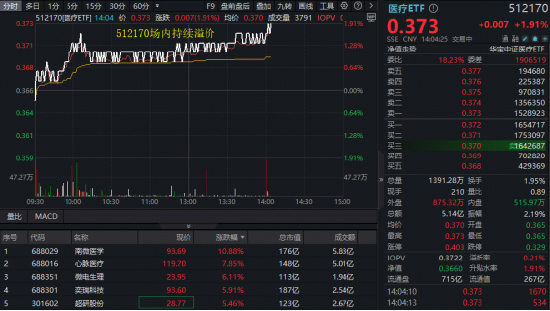
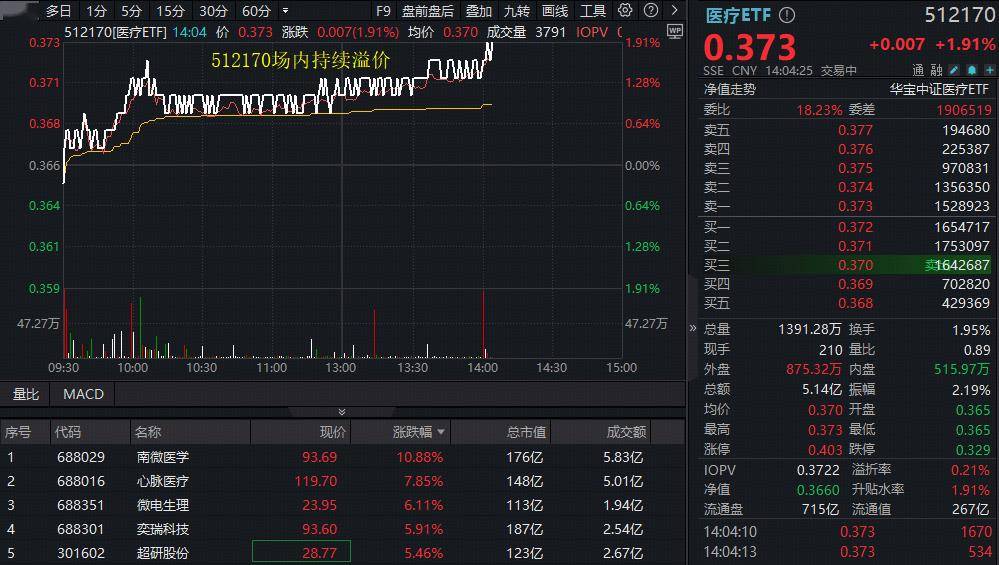
8月11日午后,医疗板块再发力,A股最大医疗ETF(512170)放量冲击2%,成交超5亿元,场内持续溢价交易,显示买盘资金旺盛。 成份股方面,医疗器械概念股领涨,南微医学飙升近11%,心脉医疗涨近8%。CXO概念亦活跃,昭衍新药涨超3%,泰格医药涨超2%。 | | | 多日 1分 5分 15分 3047 | 6047 19 | | Ed | 盘前盘后 叠加 九转 画线 工具 谷 | 12 > | 医疗ETF O | | 512170 | | --- | --- | --- | --- | --- | --- | --- | --- | --- | --- | --- | | | | | 512170[医疗ETF] 14:04 价 0.373 涨跌 0.007(1.91%) | | | 均价 0.370 成交量 3791 | OPV 9196 | | | +0.007 +1.91% | | | | | | 512170场内持续溢价 | | | | 0.376 | | 通融/● + | | | | | | | | | | SSE CNY 14:04:25 不用用 | | | | 0.371 | | | | Cl ...
AI医疗风起,港股通医疗ETF(520510)有望乘势而上
Sou Hu Cai Jing· 2025-08-11 02:49
Core Viewpoint - The AI healthcare sector is emerging as a new market focus, driven by favorable policies and technological advancements in brain-computer interface (BCI) applications [1] Group 1: Policy and Market Developments - Seven government departments jointly issued implementation opinions to promote innovation in the BCI industry, with Hubei establishing the first BCI industry innovation development alliance [1] - The first national medical service pricing standard for BCI has been released, accelerating the transition of technology to clinical applications [1] Group 2: Industry Growth and Investment Opportunities - The BCI industry chain is experiencing explosive growth, significantly benefiting the innovative medical field from recent policy dividends [1] - Market confidence is continuously boosted, and the willingness to invest is increasing, with expectations for accelerated commercialization in cutting-edge technology areas like BCI and AI healthcare [1] Group 3: Financial Insights - According to Xinda Securities, the AI healthcare industry is entering a new development opportunity period due to the combined effects of a new technological revolution and industrial transformation [1] - The Hong Kong Stock Connect medical ETF (520510), with over 20% weight in AI healthcare, is expected to continue sharing industry growth dividends, aided by recent breakthroughs in BCI technology and the release of GPT-5 [1]
华为即将发布AI推理领域突破性成果;GPT-5差评如潮GPT-4o紧急重新上线
Guan Cha Zhe Wang· 2025-08-11 00:59
Group 1: AI Developments - Huawei is set to release breakthrough technology in AI inference on August 12, which may reduce China's reliance on HBM technology and enhance domestic AI model inference performance [1] - OpenAI's CEO Sam Altman acknowledged the underestimation of user preference for GPT-4o, leading to its re-launch for Plus and Team users after the disappointing reception of GPT-5 [1] - Altman also mentioned that by 2035, tools like GPT-8 could potentially cure or effectively treat many diseases, including certain types of cancer [1] Group 2: Robotics and AI Integration - Chinese Academy of Engineering academician Ni Guangnan emphasized the need to build an "AI + Robotics" ecosystem to enhance the productivity of the robotics industry during the 2025 World Robotics Conference [3] - Yu Shu Technology's CEO Wang Xingxing highlighted that the key challenge for intelligent robots is the development of embodied intelligent robot models, which is still in its early stages compared to AI language models [3] - The Beijing Economic and Technological Development Zone announced a series of support policies for the innovation and development of embodied intelligent robots, focusing on technology collaboration and application promotion [6] Group 3: New Robotics Ventures - The world's first intelligent robot 4S store and robot-themed restaurant opened to the public in Beijing, showcasing advanced robotics technology in everyday life [4]

首届汕头康博会开幕!123行动计划打造“国际健康华侨城”
Nan Fang Du Shi Bao· 2025-08-09 05:37
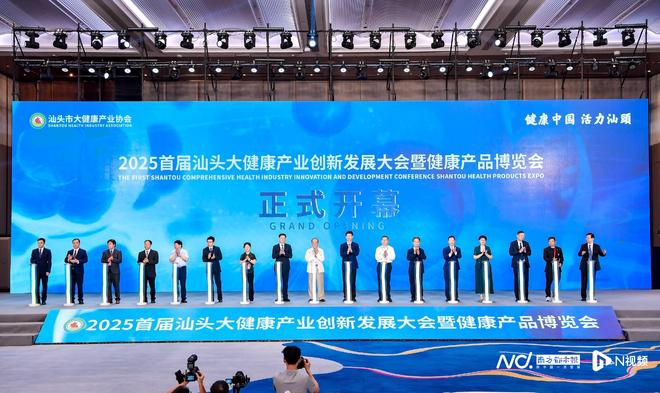
Group 1 - The first Shantou Health Industry Innovation Development Conference and Health Product Expo was held on August 8, 2025, marking an important milestone in the development of the health industry in Shantou with the theme "Healthy China, Vibrant Shantou" [1] - The conference attracted over 300 enterprises, showcasing a comprehensive view of the industry including traditional and modern medicine, health food, and medical aesthetics. It featured AI medical services and free health consultations for the public [3] - The event announced 10 measures to promote the health industry, established strategic cooperation with 7 international chambers of commerce, signed 13 projects, and initiated 12 key projects [3] Group 2 - The health industry is a powerful engine for high-quality development, deeply rooted in Shantou's history, with significant contributions from local enterprises and charitable organizations since the Song and Yuan dynasties [6] - Shantou currently has 165 "Four Up" enterprises covering the entire industry chain, with local products dominating over 90% of the national market for certain anti-infection drugs and high-end medical devices exported to over 100 countries [8] - Future plans include the "123 Action Plan" to develop a core hub for the bird's nest industry, attract over 100 health enterprises to establish headquarters and production bases, and create a competitive trillion-level industry cluster [10]

【港股收评】三大指数齐跌!芯片、医药股表现低迷
Sou Hu Cai Jing· 2025-08-08 09:03
医药外包概念、生物医药、创新药等板块纷纷下滑。凯莱英(06821.HK)跌11.58%,康龙化成 (03759.HK)跌3.77%,和黄医药(00013.HK)跌15.99%,再鼎医药(09688.HK)跌10.47%,百济神 州(06160.HK)跌6.14%。 脑机接口概念股也表现不佳,南京熊猫电子股份(00553.HK)跌10.4%,心玮医疗-B(06609.HK)跌 5.68%,微创脑科学(02172.HK)跌3.47%。 8月8日,港股三大指数集体回调。其中,恒生指数跌0.89%,国企指数跌0.96%,恒生科技指数跌 1.56%。 分板块看,芯片、机器人概念等板块普遍回调。中芯国际(00981.HK)绩后跌8.19%,优必选 (09880.HK)跌5.06%,微创机器人-B(02252.HK)跌3.46%,贝克微(02149.HK)跌3.43%,上海复 旦(01385.HK)跌2.87%。 消息面,中芯国际 Q2营收同比增长16.2%,环比下降1.7%;净利润同比下降19%,不及市场预期,Q3 指引较为谨慎。此外,8月8日至12日,2025年世界机器人大会在北京盛大举行。分析称,这场备受瞩目 的产业 ...

几家欢喜几家愁 卷土重来的医药基金何时“长大”
Zhong Guo Zheng Quan Bao· 2025-08-08 07:19
Core Insights - The pharmaceutical sector has recently experienced a rebound, with over 100 medical-themed funds achieving a return rate exceeding 10% year-to-date as of May 9 [1][2] - Despite the overall positive performance of many medical-themed funds, there is significant performance disparity, with some funds experiencing declines over 13% [2][4] - Investor sentiment appears cautious, with many holders adopting a "sell once back to break-even" mentality, leading to a reduction in fund sizes despite some funds performing well [1][5] Fund Performance - More than 100 out of over 280 medical-themed funds have reported year-to-date returns exceeding 10%, with 6 funds achieving returns over 40% [2] - The innovative drug sector has been highlighted as a standout performer, with specific funds like the Zhongyin Hong Kong Stock Medical Fund showing returns over 38% [2] - There is a stark contrast in performance among funds, with the worst-performing fund down over 13%, indicating a performance gap of more than 50 percentage points compared to the best [2][4] Investment Trends - Fund managers have adjusted their portfolios, reducing exposure to previously high-performing innovative drug stocks while increasing allocations to AI-related medical stocks [3] - Despite some volatility in AI medical stocks, there is a strong belief in the long-term investment potential within the pharmaceutical industry, particularly with AI integration [3][5] Market Dynamics - Several public fund institutions are increasing their investments in medical-themed funds, as evidenced by multiple new fund applications [4] - However, the growth in fund performance has not translated into increased fund sizes, with some funds nearing liquidation despite positive returns [4][5] - The pharmaceutical industry is undergoing a transformation, with Chinese innovative drug companies gaining a competitive edge globally, supported by favorable government policies [5]
脑机接口重磅政策落地!医疗板块掀起新风口
Mei Ri Jing Ji Xin Wen· 2025-08-08 02:21
Core Viewpoint - The Ministry of Industry and Information Technology, along with six other departments, has issued an implementation opinion to promote the innovation and development of the brain-computer interface (BCI) industry, aiming for key technological breakthroughs by 2027 and establishing an advanced technical, industrial, and standard system for the sector [1] Group 1: Industry Development - Brain-computer interfaces are identified as a critical sector that integrates cutting-edge neuroscience and information technology, with applications spanning medical detection, disease screening, and drug treatment [1] - The clinical advancement of brain-computer interfaces is accelerating, with significant potential for commercialization once the relevant technologies are mature and approved for clinical use [1] Group 2: Investment Opportunities - Xiangcai Securities highlights that the weight of brain-computer interfaces in the medical device ETF (562600) is as high as 22.72%, ranking it among the top in the entire market [1] - The recently listed Hong Kong Stock Connect medical ETF (520510) provides investors with more opportunities to allocate resources in sub-sectors such as AI healthcare and CXO [1]
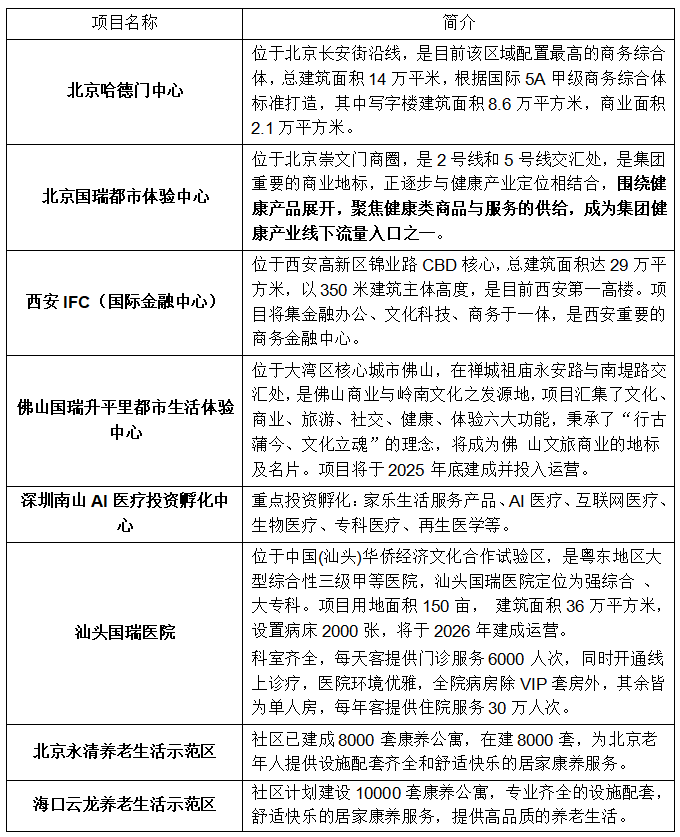
国瑞健康百亿资产筑基重构中国智慧康养新生态
Sou Hu Cai Jing· 2025-08-08 01:53
Core Viewpoint - Guorui Health is transitioning from a traditional real estate developer to a leader in the health industry, supported by a solid asset base of 9.929 billion RMB in net assets, which provides stable cash flow and strong risk resistance [1] Group 1: Asset Overview - Guorui Health's net assets are concentrated in core locations of first and second-tier cities such as Beijing, Shenzhen, and Xi'an, forming a diversified asset matrix that includes high-end commercial real estate, large hospitals, and modern health and wellness communities [1] - The company has developed key projects such as the Beijing Hademen Center, which is a premium business complex with a total area of 140,000 square meters, and the Xi'an IFC, which is the tallest building in Xi'an at 350 meters [3][3] Group 2: Strategic Goals - The strategic goal of Guorui Health is to become a leader in elderly care management, health maintenance, and cultural entertainment online services, leveraging resources from the Ministry of Civil Affairs to build a complete health value chain [7] - The company has launched the "Health Online" smart health service platform aimed at providing comprehensive services to 300 million elderly people in China [8] Group 3: Community Health Model - Guorui Health has made significant progress in community health, with the Beijing Yongqing and Haikou Yunlong elderly living demonstration zones, which provide well-equipped and comfortable living services for the elderly [10][10] - The community health model includes the establishment of health living centers that offer six smart health scenarios: home services, online shopping, health management, leisure and entertainment, smart home, and community management [14] Group 4: AI Medical Investment - The company is expanding its innovative industrial investments in Shenzhen, focusing on AI medical, internet medical, and biomedicine, with plans to establish 300 R&D projects and achieve 200 technology patents in the next five years [17] - The AI medical investment center aims to enhance the accuracy of medical prescriptions to 90% and reduce operational costs by 50% [17] Group 5: Business Model Transformation - Guorui Health is integrating AI technology, health industry, and service ecology to create a comprehensive smart health industry ecosystem, marking a successful transition from traditional real estate to a high-value, technology-driven elderly care industry [18] - The model emphasizes scalability and replicability, effectively connecting technology, services, and assets, while aligning with national policy support and demographic trends in the health industry [18]