
战略性新兴产业

Search documents
300620,重大资产重组!复牌
中国基金报· 2025-08-11 16:02
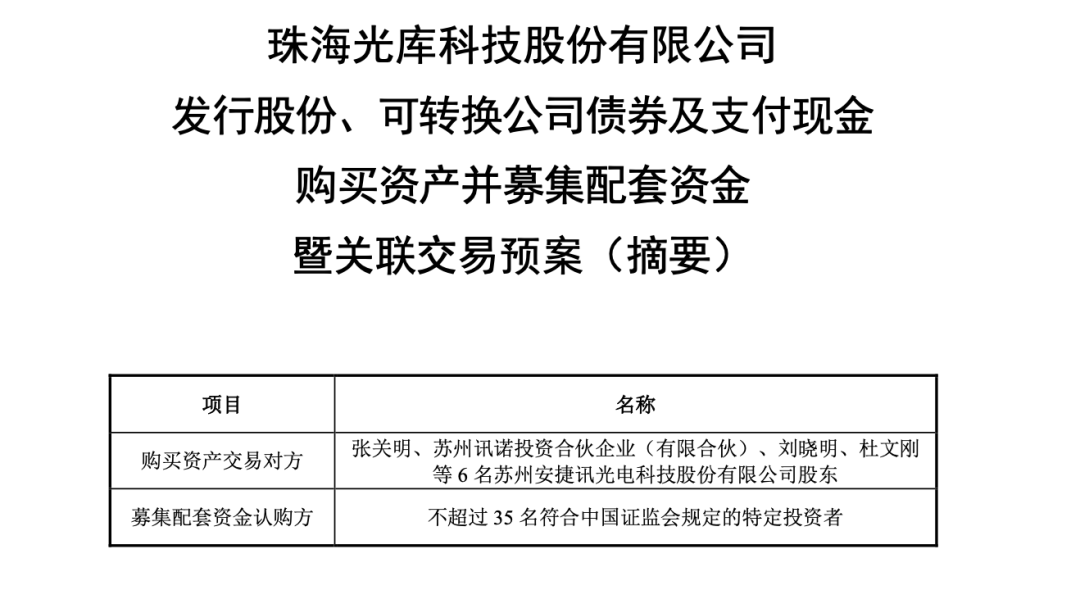
Core Viewpoint - The company Guangku Technology plans to acquire 100% equity of Suzhou Anjie Xun Optoelectronics, aiming to enhance its product and technology layout in the optical communication field [2][4][9]. Group 1: Acquisition Details - Guangku Technology will purchase the equity through issuing shares, convertible bonds, and cash payments to six counterparties including Zhang Guanming and Suzhou Xunuo Investment Partnership [4][5]. - The transaction is expected to constitute a related party transaction and a major asset restructuring, but it will not result in a restructuring listing [6]. Group 2: Strategic Benefits - The acquisition will allow Guangku Technology to broaden its product and technology offerings, quickly establish efficient manufacturing capabilities, and enhance its product matrix [9]. - The synergy between Guangku Technology and Anjie Xun Optoelectronics in technology routes and production processes is expected to lower costs and improve profitability [10]. Group 3: Financial Overview of Anjie Xun Optoelectronics - As of the end of 2024, Anjie Xun Optoelectronics has total assets of 431 million yuan, with projected revenue of 509 million yuan and a net profit of 105 million yuan for the same year [11]. - Financial data shows a significant increase in total assets and net profit from previous years, indicating strong growth potential [12]. Group 4: Market Position - Guangku Technology's stock resumed trading on August 12, with a closing price of 55.07 yuan per share and a total market capitalization of 13.7 billion yuan as of July 28 [7][13].


300620,重大资产重组!复牌
Zhong Guo Ji Jin Bao· 2025-08-11 15:55
Group 1 - The company, Guangku Technology, announced its intention to acquire 100% equity of Suzhou Anjie Xun Optoelectronics Technology Co., Ltd. [1][2] - The acquisition will be financed through the issuance of shares, convertible bonds, and cash payments to six counterparties, including Zhang Guanming and Suzhou Xunuo Investment Partnership [1][2] - The transaction is expected to constitute a related party transaction and a major asset restructuring, but it will not result in a restructuring listing [2] Group 2 - Guangku Technology's stock resumed trading on August 12, following the announcement [3] - The acquisition aims to enhance the company's product and technology layout in the optical communication field, which is a strategic emerging industry encouraged by the state [4] - Anjie Xun Optoelectronics specializes in the research, production, and sales of passive optical components, with expected total assets of 431 million yuan and projected revenue of 509 million yuan for 2024 [4]
国资赋能产业升级!东实产投公司“以投促引”8宗硬科技项目
Nan Fang Du Shi Bao· 2025-08-11 03:20
最近,新入驻松山湖国际创新创业社区D栋的深圳云豹智能科技有限公司(以下简称"云豹智能")正在 装修中。这家国内领先的云计算与数据中心数据处理器(DPU)芯片及解决方案提供商、DPU领域全球 独角兽企业,刚刚将研发子公司注册在松山湖。这是东实集团旗下东莞市东实产业投资控股有限公司 (以下简称"东实产投公司")通过股权投资完成资本招商的最新案例,也是该公司成立不到两年"以投 促引"的第8宗"硬科技"项目。 7月底刚刚揭晓的中国股权投资领域权威榜单"融中2024-2025年度有限合伙人榜单",东实产投公司凭借 城市发展母基金2024年以来的亮眼表现,跻身"融中2024-2025年度中国最佳市场化机构有限合伙人 TOP30"。 这是继东实产投公司首登投中榜"2024年度中国新锐私募股权投资机构TOP10"后,再次以"国资力量"打 破区域与赛道的传统标签,成为粤港澳大湾区新兴产业投资机构的"现象级"样本。 一个是全球独角兽项目的"落地生根",一个是行业权威的"市场认可",这家年轻的市属产投平台,正 以"产业投资+资本招商"的双轮驱动,在东莞这片制造业沃土上书写着国有资本赋能产业升级的新故 事。 新锐崛起:从"新入局者" ...
“科技变量”如何变为强劲动能(人民观点) ——安徽以科技创新引领高质量发展观察
Ren Min Ri Bao· 2025-08-10 22:50
搭建平台、健全体制机制,扎实推进深度融合,新质生产力对高质量发展的推动力更为强劲 从更大视野看,应善用市场化的方式,激发各类要素资源活力 科技创新做到"苟日新,日日新,又日新",关键就在于"形成'乔木'参天、'灌木'茁壮、'苗木'葱郁的创 新生态" 百年变局重塑全球格局,科技创新是关键变量。推进中国式现代化,科技要打头阵。 "抢占科技竞争和未来发展制高点",党中央高瞻远瞩、布局落子。 "安徽的科技创新,可谓'士别三日,当刮目相看',每一次来都看到新的飞跃、新的发展",习近平总书 记的话语,蕴含着国家向前发展的秘诀。 "科技变量",如何变为高质量发展的强劲动能、"最大增量"?安徽以科技创新引领新质生产力发展的实 践,提供了一个方法论视角。 看"融合"。 科技创新和产业创新深度融合,是加快发展新质生产力的重要方法。 搭建平台、健全体制机制,扎实推进深度融合,新质生产力对高质量发展的推动力更为强劲。 看"有为"。 智能网联新能源汽车,迫切要求融合发展汽车产业、交通产业、人工智能产业、能源产业。 "合工大—蔚来创新研究院"瞄准智能电动汽车的前瞻性技术等开展攻关;超80%的研发经费、超90%的 省产业创新研究院由企业牵 ...
有色业投资保持两位数增长
Jing Ji Ri Bao· 2025-08-10 21:54
Core Insights - The overall performance of China's non-ferrous metal industry in the first half of the year shows a stable operation with a year-on-year increase in industrial added value of 7.6%, which is 1.2 percentage points higher than the average growth rate of the industrial sector [1] - Key drivers for growth include refined copper and electrolytic aluminum, with refined copper production reaching 7.363 million tons (up 9.5% year-on-year) and electrolytic aluminum production at 22.379 million tons (up 3.3% year-on-year) [1] Industry Performance - The non-ferrous metal industry has maintained strong resilience and development vitality, with steady growth in industrial added value driven by policy guidance, institutional support, industry transformation, and emerging demand [1] - Fixed asset investment in the non-ferrous metal industry increased by 16.1% year-on-year, surpassing the national industrial investment growth rate by 5.8 percentage points, indicating a positive development trend [2] - Investment in the non-ferrous metal mining and selection industry surged by 46.5%, with a clear shift towards upstream resource sectors and new energy applications, reflecting significant structural adjustments in response to market demand [2] Future Outlook - The annual growth rate of industrial added value in the non-ferrous metal industry is expected to be around 5%, with production of ten common non-ferrous metals projected to increase by 2% to 3% year-on-year [3] - Prices for commonly used non-ferrous metals like copper and aluminum are expected to remain high, while industrial silicon and lithium carbonate prices are likely to stay at lower levels [3]
广东建科: 招商证券股份有限公司关于公司首次公开发行股票并在创业板上市的上市保荐书
Zheng Quan Zhi Xing· 2025-08-10 13:14
Core Viewpoint - Guangdong Provincial Academy of Building Research Group Co., Ltd. (hereinafter referred to as "Guangdong Jian Ke") is preparing for its initial public offering (IPO) on the ChiNext board, with a focus on providing high-tech services in the construction engineering field, particularly in inspection and testing [1][2]. Group 1: Company Overview - The registered capital of Guangdong Jian Ke is 31.39 million yuan, and it was established on December 25, 2013, with its shares incorporated on December 16, 2014 [1]. - The company is recognized as a large-scale construction technology service provider in Guangdong Province and has received multiple national honors, including "National High-tech Enterprise" and "National Model Enterprise for Scientific and Technological Reform" [2][3]. Group 2: Main Business and Services - Guangdong Jian Ke's primary business involves inspection and testing technology services in the construction engineering sector, which is a key area supported by the national government [3][4]. - The company has developed over 4,100 recognized testing standards and holds various qualifications, including comprehensive Class A qualifications for highway engineering and all five categories of Class A qualifications for water conservancy engineering [3][4]. Group 3: Technological Capabilities - The company emphasizes technological research and development, having established multiple provincial and national-level innovation platforms, including the only national green building quality inspection and testing center in South China [5][6]. - Guangdong Jian Ke has participated in over 20 national scientific and technological projects and has received 89 national and provincial-level scientific and technological awards [6][7]. Group 4: Industry Impact and Recognition - The company has provided inspection and testing services for major projects such as the Hong Kong-Zhuhai-Macao Bridge and Guangzhou Baiyun International Airport, contributing to significant economic and social benefits [6][7]. - Guangdong Jian Ke has been awarded titles such as "National AAA Credit Enterprise in the Construction Industry" and "National Green Building Pioneer Award," reflecting its strong reputation in the industry [6][7].

世运电路(603920.SH)拟出资1.25亿元参与投资新声半导体
Ge Long Hui A P P· 2025-08-10 08:20
Group 1 - The company plans to invest 125 million yuan in Shenzhen New Sound Semiconductor Co., Ltd. to acquire a 3.8238% stake [1] - Filters are core components in the electronic information industry, closely related to strategic emerging industries such as 5G/6G communication, smart vehicles, and satellite internet [2] - New Sound Semiconductor specializes in the R&D, production, and sales of SAW and BAW filters, holding over 170 authorized patents in China and the U.S. [2] Group 2 - The investment aligns with the company's strategic focus on high-tech segments within the electronic information industry, particularly in smart vehicles and AIOT [3] - The company aims to establish a deep cooperative relationship with New Sound Semiconductor to promote the application of new vehicle-mounted filters and modular solutions [3]

省属企业实现高质量稳增长
Liao Ning Ri Bao· 2025-08-10 01:57
Group 1 - Liaoning Province General Aviation Industry Development Co., Ltd. was recently established to fully integrate provincial state-owned enterprises into the low-altitude economic development of the province, marking a significant outcome of the provincial state-owned assets supervision and administration commission's strategic emerging industry cultivation initiative [1] - As of the end of June, the total assets of provincial state-owned enterprises reached 610.355 billion yuan, a year-on-year increase of 4.1%, while total profits amounted to 2.78 billion yuan, reflecting a comparable year-on-year growth of 14.2% [1] - The provincial state-owned assets supervision and administration commission has implemented extraordinary measures to promote economic stability, resulting in significant achievements in the performance of state-owned enterprises [1] Group 2 - Key enterprises have demonstrated their responsibilities, with the Energy Holding Group increasing raw coal production to 28.61 million tons, a year-on-year increase of 1.29 million tons or 4.7% [2] - The Transportation Group reported a total highway exit traffic of 146.988 million vehicles, reflecting a year-on-year growth of 5.4% [2] - The Liaoning Water Group improved water resource allocation, achieving an ecological water supply of 18.476 million cubic meters, up 11.9% year-on-year [2] Group 3 - The province's state-owned enterprise reform has achieved 90% of its established tasks, with strategic restructuring and professional integration progressing smoothly [3] - The provincial state-owned assets supervision and administration commission has launched an "Embrace AI" initiative, collaborating with Northeast University to establish the Liaoning State-owned Assets Artificial Intelligence Research Institute [3] - In the first half of the year, 168 key projects were initiated or resumed, with a total investment of 317.09 billion yuan, indicating strong collaboration between central and local enterprises [3]
辽宁省属企业实现高质量稳增长
Sou Hu Cai Jing· 2025-08-10 00:46
不久前,辽宁省通用航空产业发展有限公司宣布成立,省属企业全方位融入全省低空经济发展,这是省 国资委启动战略性新兴产业"育苗壮干"梯次培育行动的成果之一。通过梯次培育、分级培养、精准滴灌 等举措,省国资委推动各类生产要素资源向战略性新兴产业企业和竞争优势企业聚集,打造地方国有经 济新的增长引擎。 这是今年上半年省属企业迎难而上、加压奋进的一个缩影。近日,省国资委发布数据:截至6月末,省 属企业资产总额6103.55亿元,同比增长4.1%,资产规模稳中有增;实现利润总额27.8亿元,按可比口 径同比增长14.2%,完成"双过半"任务目标,实现了高质量稳增长。 面对复杂严峻形势,各企业发展亮点频现,源于全省国资国企系统加快结构调整步伐,以新动能的有效 培育对冲经济下行压力,促进传统产业升级和新兴产业成长的协同发力。 截至目前,我省国企改革深化提升行动已完成既定任务的90%。在摸清全省国企底数情况前提下,今年 我省在省级层面统筹规划国企改革发展实施方案。加快推进战略性重组和专业化整合。省属企业集团战 略性重整顺利推进,重组后11户企业集团功能定位和主责主业更加明确,数智、科创、人才、新能源等 新质生产力业务初现成效。 ...
高校密集调整院系专业设置 近五年撤销本科专业TOP5都有谁
Di Yi Cai Jing· 2025-08-09 09:27
Core Viewpoint - The adjustment of undergraduate programs in various universities for the 2025 academic year is being implemented to align with emerging industries and societal needs, leading to the introduction of new programs and the discontinuation of less relevant ones [1][2][3]. Group 1: New Program Additions - Several universities, including Shenyang Aerospace University and Northeast Normal University, are proposing new programs such as Low-altitude Technology and Engineering, Data Science, and Intelligent Aircraft Technology, reflecting a trend towards fields that support national strategic needs and emerging industries [1][2][3]. - A total of 603 new programs have been proposed across over 150 universities, with a significant focus on areas like artificial intelligence, digital economy, and intelligent manufacturing [2]. Group 2: Program Discontinuations - Many programs are being discontinued due to poor employment prospects and misalignment with societal needs, with the top five discontinued programs from 2020 to 2024 being Information Management and Information Systems, Public Administration, and Marketing [4]. - The trend indicates a shift away from traditional programs that do not meet current market demands, with universities focusing on optimizing their offerings to better align with economic and technological advancements [4][5]. Group 3: Institutional Responses - Universities are establishing management measures to facilitate the transition of faculty from discontinued programs to related fields or administrative roles, ensuring a smooth adjustment process [6]. - The emergence of new research-oriented universities is attracting high-scoring students, prompting traditional institutions to reassess and streamline their program offerings to remain competitive [5].