AI泡沫

Search documents
刚刚,20%涨停!利好引爆,直线拉升!
中国基金报· 2025-11-07 05:03
【导读】化工板块迎来涨停潮,锂电、光伏大爆发,德明利两连板 中国基金报记者 晨曦 大家好!又到周五,来一起关注上午的市场行情和最新资讯 ~ | 序号代码 名称 现价 涨跌 涨跌幅 - | | --- | | 1 68.450 -4.100 -5.65% | | 2 9866 蔚来-SW 55.750 -2.650 -4.54% | | 3 9626 哔哩哔哩-W 215.60 -9.000 -4.01% | | ব 14.600 -0.580 -3.82% 0268 金蝶国际 | | 5 1698 腾讯音乐-SW 85.750 -3.050 -3.43% | | 6 0020 商汤-W 2.170 -0.070 -3.13% | | 7 1810 小米集团-W 42.080 -1.360 -3.13% | | 8 9988 阿里巴巴-W 160.30 -4.700 -2.85% | | 77.850 -2.250 -2.81% 9 1347 华虹半导体 | | 10 2382 舜宇光学科技 68.400 -1.950 -2.77% | 来看详情 —— 化工板块狂掀涨停潮 11 月 7 日上午, A 股低开高走 ...



一句话引发巨头集体闪崩
Sou Hu Cai Jing· 2025-11-07 03:57
Core Viewpoint - OpenAI executives' comments regarding the need for government backing for their chip investments have raised concerns about a potential AI bubble, leading to a significant decline in major US tech stocks [1][3][4]. Group 1: Market Reaction - US and European stock markets experienced a collective decline, with major tech stocks like Nvidia and Tesla falling over 3%, and Supermicro Semiconductor dropping more than 7% [1][2]. - The sudden drop in stock prices was attributed to fears stemming from OpenAI's CFO Sarah Friar's remarks about seeking a government backstop for financing [3][4]. Group 2: Employment and Economic Indicators - The US job market shows signs of cooling, with nearly 950,000 layoffs announced by companies as of September, marking the highest level for this period since 2020 [3][4]. - The Challenger report indicated that over 150,000 jobs were cut in October, the highest number for that month in over two decades, driven by cost-cutting measures and AI adoption [4]. Group 3: Valuation Concerns - Various valuation indicators signal potential overvaluation in the US stock market, with the Buffett Indicator showing the market cap exceeding GDP by more than double, a level not seen since the internet bubble [4][5]. - The S&P 500's Shiller P/E ratio is approaching levels seen during the 1999 internet bubble, raising alarms about a possible market correction [4][5]. Group 4: Investment Strategies and Warnings - Notable investors like Michael Burry are heavily shorting AI stocks, indicating a bearish outlook on the sector [6][10]. - Warren Buffett has opted to hold cash reserves at a record $381.7 billion, reflecting a cautious stance amid rising market valuations [11][13]. - High-profile figures like Goldman Sachs CEO David Solomon and Bridgewater's Ray Dalio have issued warnings about the sustainability of current market trends, emphasizing the cyclical nature of markets and the risks of an AI-driven bubble [18][22][24].
“AI泡沫”引发市场恐慌之际 花旗高呼逢低买入“AI贝塔+周期贝塔”
智通财经网· 2025-11-07 03:28
智通财经APP获悉,随着全球股票市场近日因"AI泡沫论调"持续发酵而从历史最高位持续回调,投资者 们现在有足够多的理由从股票资产中套现或者是获利了结其中一大部分收益。来自花旗集团的资深美国 市场股票策略师Drew Pettit 认为,"大量利好已经被计入市场价格之中",但是他在采访中调强调道,短 期市场疲软/向下回调可能在投资者们普遍预期之内,支撑股票市场长期牛市的"人工智能基本面叙 事"依然完好无损,这可能为回调期间创造重大逢低买入机遇。 "市场不是经济体本身。"Pettit在采访中强调道,并且解释称,人工智能和人类社会生产率的进步共同驱 动了标普500指数 (SP500) 近年来牛市强劲涨幅表现的大约一半。 在这位股票市场资深策略师看来,市场的另一半则与传统的宏观经济环境因素以及周期性的增长模式联 系更为紧密,形成了Pettit所描述的当今全球投资环境中的"杠铃效应"。 瑞银表示,AI科技巨头们权重占比愈发庞大的美国股票市场仍处潜在的泡沫最早期阶段——即处于泡 沫未成形阶段,远未达到堪比"2000年互联网泡沫破裂"的危险顶峰,主要因市场估值未达极端泡沫水 平、科技投资占GDP比重可控,并且远未出现类似千禧 ...

刚刚,全线重挫!美联储降息分歧加剧,美股科技股遭猛烈抛售
Sou Hu Cai Jing· 2025-11-07 02:47
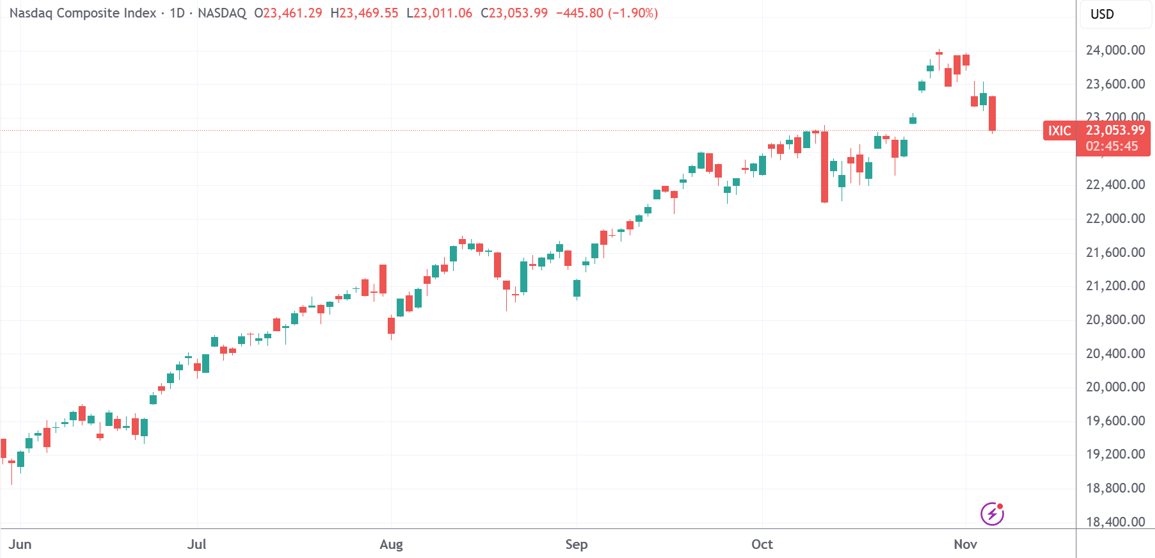
Market Overview - The U.S. stock market experienced a significant downturn on November 6, with all three major indices declining sharply. The Nasdaq fell by 1.9% to close at 23053.99, with an intraday drop exceeding 2%. The S&P 500 index decreased by 1.12%, while the Dow Jones Industrial Average saw a smaller decline of 0.84. The VIX fear index surged over 8%, indicating rising market anxiety [1][2]. Technology Sector Impact - The technology sector was notably affected, with major tech stocks facing substantial losses. AMD dropped over 7%, while Nvidia, Tesla, and Qualcomm fell by more than 3%. Amazon, Meta, and Oracle saw declines exceeding 2%, and Microsoft and TSMC ADRs decreased by over 1%. Apple and Broadcom also experienced slight declines. The AI sector was particularly hard hit, with related stocks generally declining, reflecting concerns over high valuations in the tech space. Duolingo's stock plummeted over 25%, marking its largest single-day drop ever, primarily due to disappointing earnings guidance and a focus on "user growth" rather than short-term monetization. This turmoil in the AI sector was exacerbated by misinterpretations of comments made by OpenAI executives regarding support for chip investments [4]. Employment Market Concerns - The deterioration of the U.S. employment market has further dampened market sentiment. In October, U.S. companies laid off a total of 153,074 employees, driven mainly by the tech and warehousing sectors, marking an increase of 183% from September and nearly three times the number from the same month last year, reaching the highest level for October since 2022. Additionally, October saw a decrease of 9,100 in non-farm employment, contrasting with a gain of 33,000 in September, raising widespread concerns about the labor market's weakness [5][6]. Federal Reserve Divergence - Uncertainty regarding the Federal Reserve's interest rate cut outlook is a core reason for the recent stock market decline. Several officials have expressed significant divergence on the path to rate cuts. Chicago Fed President Goolsbee, who previously advocated for gradual cuts, has recently adopted a cautious stance due to missing key inflation data and a recent uptick in overall inflation. Cleveland Fed President Mester has taken a more hawkish view, emphasizing that inflation is a more pressing concern than labor market weakness and suggesting that current rates are "almost non-restrictive." New York Fed President Williams indicated that the low-rate environment persists, with neutral rates estimated around 1%. The differing views among Fed officials add considerable uncertainty to the December FOMC meeting regarding the continuation of rate cuts [7][8].





日股跳水,日经225指数跌2%,软银一度跌近9%
21世纪经济报道· 2025-11-07 01:38
Market Overview - Japanese and Korean stock markets opened lower, with the Nikkei 225 index falling below 50,000 points and a decline of 2% [1] - Hitachi Zosen led the decline with an 18.4% drop, followed by Ajinomoto with a 16.17% decrease, and SoftBank Group down nearly 9% [2] Company Performance - Hitachi Zosen: Current price 936.0d, down 211.0, -18.40% [2] - Ajinomoto: Current price 3624.0d, down 699.0, -16.17% [2] - SoftBank Group: Current price 21250.0d, down 2050.0, -8.80% [2] - SK Hynix: Current price 592000d, down 0.17% [3] - Samsung Electronics: Current price 99400d, up 0.20% [3] US Market Trends - US tech stocks collectively fell, with Nvidia losing over 3% and a market cap drop of $173.3 billion [4] - Concerns about a potential bubble burst are rising, with Michael Burry indicating a strategy to short the AI bubble [4] - Goldman Sachs and Morgan Stanley predict a 10% to 20% correction in global (US) stock markets within the next 1-2 years due to tech stock bubbles, while remaining optimistic about the Chinese market, particularly in AI, electric vehicles, and biotechnology [4] Investment Sentiment - Concerns about panic selling in the market are noted, likely starting from overvalued sectors [4] - Despite high valuations in the AI sector, there is still support from potential Fed rate cuts and corporate earnings [5]

AI泡沫论调席卷全球之际 资金悄然回流苹果(AAPL.US)“安全避风港”
智通财经网· 2025-11-07 01:37
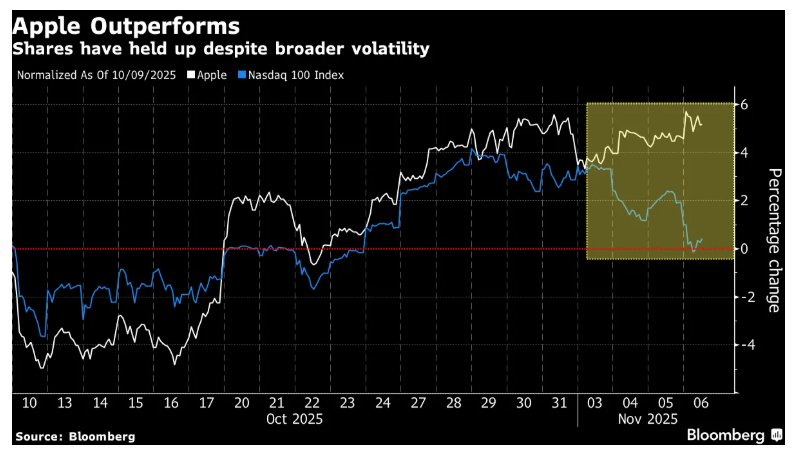
Core Viewpoint - A significant sell-off in tech stocks has impacted popular AI companies, but Apple has shown resilience, maintaining a stable stock price and market capitalization amidst market volatility [1][2]. Group 1: Apple’s Performance - Apple’s stock price has only decreased by 0.14% while the Nasdaq 100 index fell by 1.9%, indicating its relative strength during market downturns [1]. - Over the past month, Apple’s stock has increased by over 5%, contrasting with the Nasdaq 100 index's less than 1% increase [1]. - Apple’s market capitalization is approximately $4 trillion, making it the second-largest company after Nvidia, which recently surpassed $5 trillion [1]. Group 2: Market Sentiment and AI Bubble Concerns - The market is experiencing fears of an AI bubble, leading investors to retreat from speculative AI stocks, while Apple’s strong cash flow and stability are attracting attention [3][5]. - Analysts believe that the current market is in the early stages of a potential AI bubble, with valuations not reaching extreme levels seen during the 2000 internet bubble [5]. - Concerns about high leverage financing for AI data centers are prevalent, but analysts from UBS and Societe Generale suggest that significant risks are not imminent [5]. Group 3: Apple’s Strategic Positioning - Apple’s recent performance is partly due to its strong cash flow and a solid balance sheet, which have historically provided stability during market turbulence [2]. - Despite a lack of direct involvement in the AI investment frenzy, Apple’s stock has shown resilience, with a year-to-date increase of 8.4%, compared to the Nasdaq 100 index's nearly 20% rise [6]. - Apple is planning to invest approximately $1 billion annually to purchase an AI model from Google, which is seen as a strategic move to enhance its Siri voice assistant [7]. Group 4: Future Growth Opportunities - Analysts are optimistic about "physical AI" as a potential growth engine for Apple, with projections suggesting that its planned robotics series could generate around $130 billion in revenue by 2040 [8]. - The integration of AI and robotics could position Apple as a leading player in the physical AI market, leveraging its extensive device ecosystem and proprietary technology [8]. - The potential market share for Apple in the robotics sector could reach 22% by 2040, similar to its current share in the smartphone market, significantly impacting its future stock value [8].

OpenAI高管言论引发风暴,AI板块再遭抛售!纳指跌近2%
Xin Lang Cai Jing· 2025-11-07 00:16
Core Viewpoint - The recent comments from OpenAI executives regarding seeking government backing for their investments have sparked significant market reactions, leading to declines in major tech stocks and raising concerns about an "AI bubble" [1][3][6]. Market Reaction - The S&P 500 index fell by 1.12% to 6720.32 points, the Nasdaq Composite dropped by 1.9% to 23053.99 points, and the Dow Jones Industrial Average decreased by 0.84% to 46912.3 points [2]. - Major tech stocks led the decline, with Nvidia down 3.65%, Tesla down 3.5%, and Microsoft experiencing a seven-day losing streak [2][8]. OpenAI's Clarification - OpenAI's CFO Sarah Friar initially suggested the need for a financial ecosystem involving banks, private equity, and federal government support for their chip investments, which was misinterpreted as seeking government guarantees [2][4]. - Following the backlash, both Friar and CEO Sam Altman clarified that OpenAI does not intend to seek government backing for its infrastructure investments and emphasized that if the company fails, it should be allowed to fail [6][7]. Future Projections - Altman projected that OpenAI's annual revenue is expected to exceed $20 billion, potentially reaching "hundreds of billions" by 2030, with plans to launch enterprise-level products and expand into consumer electronics and robotics [6]. - Altman also suggested that the government should establish a "national strategic computing reserve" to sign power procurement agreements for public benefit, rather than to support private companies [6]. Employment Impact - The Challenger report indicated that U.S. employers cut over 150,000 jobs in October, the highest number in over two decades, influenced by cost-cutting measures and the adoption of AI [8].


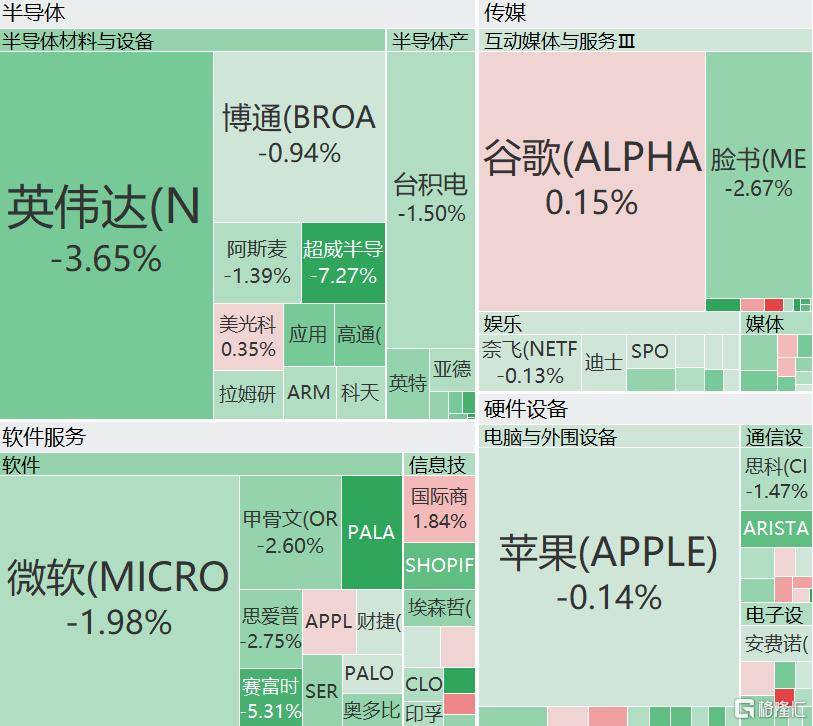
英伟达↓3.65%、特斯拉↓3.5%、苹果↓0.1%、微软↓1.98%、谷歌↑0.2%、亚马逊↓2.86%、Meta↓2.67%
财联社· 2025-11-06 23:45
Core Viewpoint - The article discusses the recent decline in major tech stocks due to concerns over the U.S. job market and misinterpretations of OpenAI executives' statements regarding government backing for AI investments [1][3]. Group 1: OpenAI's Financial Strategy - OpenAI's CFO, Sarah Friar, indicated the company is seeking a financial ecosystem involving banks, private equity, and federal government guarantees to support its substantial chip investments [2]. - Following public backlash, Friar clarified that OpenAI is not seeking government guarantees for its infrastructure investments, and the term "backstop" was misinterpreted [3][6]. - CEO Sam Altman emphasized that OpenAI does not intend to seek government backing and is prepared to face failure without federal support, while projecting annual revenues to exceed $20 billion and potentially reach "hundreds of billions" by 2030 [6]. Group 2: Market Reactions and Employment Trends - The Challenger report revealed that U.S. employers cut over 150,000 jobs in October, marking the highest number of layoffs in that month in over two decades, influenced by cost-cutting and AI adoption [8]. - The tech sector is experiencing greater labor market risks compared to 2022, as layoffs are not being absorbed by other industries as quickly as before [8]. Group 3: Stock Performance - Major tech stocks saw declines, with Nvidia down 3.65%, Apple down 0.14%, and Microsoft down 1.98%, among others, reflecting the overall market sentiment [9]. - Duolingo, a language learning platform, experienced a significant drop of 25% due to disappointing earnings guidance, while an unnamed food delivery platform fell 17.45% for similar reasons [11]. - Chinese stocks showed mixed performance, with Alibaba up 1.69% and JD down 0.28%, indicating varied investor sentiment in the Chinese market [12].

刚刚,全线重挫!美联储,降息大消息!
券商中国· 2025-11-06 23:32
Core Viewpoint - The U.S. stock market, particularly technology stocks, has experienced significant sell-offs, driven by concerns over an "AI bubble," worsening employment data, and uncertainty regarding the Federal Reserve's interest rate decisions [2][10]. Market Performance - On November 6, major U.S. stock indices opened lower and closed with the S&P 500 down 1.12%, the Nasdaq down 1.9%, and the Dow down 0.84% [4]. - Large-cap tech stocks faced substantial declines, with AMD dropping over 7%, Nvidia, Tesla, and Qualcomm down over 3%, and Amazon, Meta, and Oracle down over 2% [6]. AI Sector Concerns - AI-related stocks plummeted, with Duolingo's share price crashing over 25%, marking its largest single-day drop ever. This decline was attributed to the company's disappointing earnings guidance and a focus on user growth rather than short-term monetization [6][7]. OpenAI's Statements - Recent comments from OpenAI executives sparked discussions about the need for government guarantees for AI companies, intensifying fears of an "AI bubble." OpenAI's CFO clarified that the company is not seeking government backing for its infrastructure investments [7]. Employment Market Data - The employment situation in the U.S. is deteriorating, with a reported 153,074 layoffs in October, a 183% increase from September, primarily in the tech and warehousing sectors. This marks the highest number of layoffs for October since 2022 [7]. - Additionally, U.S. non-farm employment decreased by 9,100 in October, following a prior increase of 33,000 [7]. Federal Reserve's Interest Rate Outlook - Uncertainty regarding the Federal Reserve's interest rate decisions is contributing to market volatility. Recent statements from Fed officials reveal significant internal disagreements about the future path of interest rates [10][11]. - Some officials, like Chicago Fed President Austan Goolsbee, expressed caution about further rate cuts due to missing key inflation data, while others, like Cleveland Fed President Beth Hammack, emphasized the urgency of addressing inflation concerns [10][11].

OpenAI高管言论引发风暴,纳指跌近2%
Feng Huang Wang· 2025-11-06 23:14
Core Points - The U.S. job market shows signs of deterioration, leading to a collective decline in major tech stocks, with the S&P 500 down 1.12%, Nasdaq down 1.9%, and Dow Jones down 0.84% [1] - OpenAI's CFO Sarah Friar mentioned the need for a financial ecosystem involving banks, private equity, and federal government support for massive chip investments, which sparked concerns about an "AI bubble" [3][4] - OpenAI's CEO Sam Altman clarified that the company does not seek government guarantees for its data center investments and emphasized the importance of a national strategic computing reserve for public benefit [6][7] Company Performance - Major tech stocks experienced declines, with Nvidia down 3.65%, Apple down 0.14%, Microsoft down 1.98%, and Amazon down 2.86% [9] - Duolingo, a language learning platform, saw a significant drop of 25% due to disappointing earnings guidance, marking its largest single-day decline [9] - Chinese stocks showed mixed results, with Alibaba up 1.69% and JD down 0.28% [9] Economic Indicators - The Challenger job-cut report indicated that U.S. employers cut over 150,000 jobs in October, the highest number for that month in over two decades, influenced by cost-cutting and AI adoption [8] - Vanguard's economist noted that the report's predictive ability for future labor market conditions has historically been poor, but current layoffs pose greater risks compared to 2022 [8] Other Industry News - Google Cloud launched its seventh-generation TPU, "Ironwood," which offers over four times the performance of its predecessor, enabling the connection of up to 9,216 chips in a single cluster [11] - The U.S. government updated its critical minerals list, adding copper, silver, and uranium, which caused significant fluctuations in the mining sector [12]