太空算力

Search documents
天融信(002212.SZ):公司暂未布局太空算力
Ge Long Hui· 2026-02-04 07:40
格隆汇2月4日丨天融信(002212.SZ)在投资者互动平台表示,公司暂未布局太空算力,公司持续关注太 空算力新场景。 ...

“算力上天”引领新一轮科技革命
Xin Lang Cai Jing· 2026-02-04 04:02
Core Insights - The article discusses the development of space computing, which involves deploying data processing capabilities in space through satellite constellations, marking a significant shift in data handling and technology paradigms [3][5][7]. Group 1: Space Computing Overview - Space computing aims to move data centers to Earth’s orbit, allowing satellites to perform AI training, inference, and large-scale data computation directly in space [3][5]. - The goal is to enable real-time data processing, intelligent analysis, and autonomous decision-making at the source of data collection in space [3][5]. Group 2: Challenges of Ground-Based Data Centers - Ground-based data centers face physical limits and increasing energy consumption, with a projected annual growth rate of about 20% in electricity usage from 2024 to 2030 [5]. - The need for high-performance computing is constrained by communication latency, requiring proximity in deployment to maintain efficiency [5][6]. Group 3: Advantages of Space Computing - The space environment offers abundant energy supply, high cooling efficiency, and flexible deployment options, making it a favorable setting for computing [6]. - Space computing allows for efficient data utilization, processing data in orbit and only transmitting results back to Earth, significantly enhancing data value [6]. Group 4: Economic and Industrial Implications - The deployment of space computing is expected to create a new industrial chain and commercial ecosystem, benefiting sectors like digital economy, low-altitude economy, and emergency safety [7][8]. - The market potential for satellite internet and related services is estimated to reach 126 billion yuan [7]. Group 5: Strategic Importance - Space computing is viewed as a strategic asset in global technology competition, with implications for national security and economic development [10][11]. - The development of space computing is not just a technological endeavor but also a means to secure a competitive edge in the next generation of space information infrastructure [10][12]. Group 6: China's Initiatives - China is actively pursuing space computing, with plans to establish a large-scale data center in orbit by 2035, following a three-phase development strategy [15][16]. - Beijing is leading these efforts, forming a collaborative innovation platform to integrate resources from commercial aerospace and artificial intelligence sectors [16][17]. Group 7: Global Competition - Major tech companies are investing in space computing initiatives, indicating a growing interest in establishing computing capabilities in space [13][14]. - The competition for satellite frequency and orbital resources is intensifying, with countries racing to secure their positions in space [11][12].

xAI员工赢麻了,全员换股SpaceX,AI月烧10亿美元终于有人兜底了
3 6 Ke· 2026-02-04 03:49
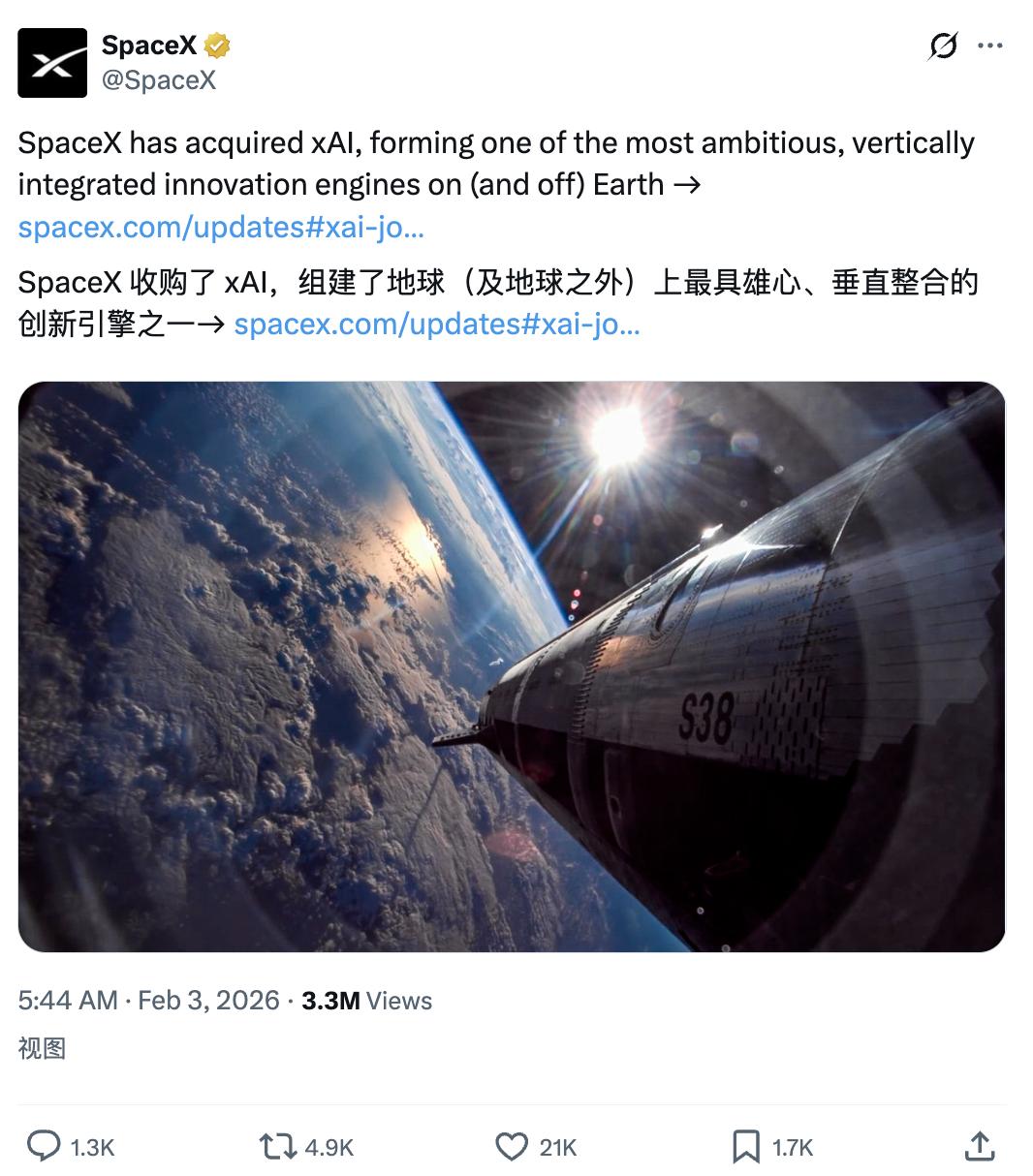
Core Insights - SpaceX has acquired xAI, with a combined valuation of $1.25 trillion, significantly higher than xAI's current valuation of approximately $250 billion [1][18] - The acquisition is structured as an all-stock deal, with xAI investors receiving 0.1433 shares of SpaceX for each share of xAI [1] - The merger aims to create a vertically integrated innovation engine that combines space technology with AI capabilities [7][17] Financial Overview - SpaceX's internal valuation is around $1 trillion, while xAI is valued at approximately $250 billion, leading to a combined valuation of $1.25 trillion post-merger [18] - SpaceX's revenue is projected to grow from $8.7 billion in 2023 to $15 billion in 2025, with Starlink contributing significantly to this growth [20] - xAI has been facing financial challenges, reportedly burning cash at a rate close to $1 billion per month, while SpaceX has a stable and growing cash flow [20][21] Strategic Implications - The merger positions SpaceX not just as a rocket company but as a comprehensive system covering AI, space, and communication infrastructure, enhancing its narrative for an upcoming IPO [21] - The integration of xAI into SpaceX allows for a potential shift in xAI's focus from merely developing models to becoming a system-level capability within a broader technological framework [17] - The acquisition is seen as a strategic move to stabilize xAI's financial situation by merging it with a cash-rich entity [20][21] Technological Vision - Elon Musk envisions that the future of AI computation will be in space, where energy and cooling requirements can be more efficiently met compared to terrestrial data centers [4][8] - The potential for deploying AI computation in orbit could lead to significant advancements in processing power, with Musk suggesting a pathway to deploy 1 terawatt of computing power annually [10][11] - The merger is expected to leverage SpaceX's capabilities in satellite deployment to create a more integrated system for AI computation and data processing [9][10]
中银国际证券:马斯克旗下SpaceX 与xAI 计划合并 太空算力或是商业航天的核心商业模式
智通财经网· 2026-02-04 03:26
Group 1 - Musk plans to merge SpaceX and xAI to create a "space AI" empire, integrating various technologies and services, with a potential IPO for SpaceX in June [1][2] - The merger aims to leverage SpaceX's $800 billion valuation and xAI's capabilities, enhancing the integration of AI and space technologies [1] - This initiative represents a significant step in merging commercial space and artificial intelligence, addressing limitations of terrestrial data centers [2] Group 2 - Meta's Q4 2025 earnings exceeded expectations, with revenue of $59.89 billion (up 24% year-over-year) and net profit of $22.77 billion, leading to a surge in stock price [3] - The company plans to double its capital expenditure to $115-135 billion in 2026 to support AI infrastructure and core business upgrades [3] - Meta is shifting focus from the metaverse to AI, evidenced by layoffs in the Reality Labs department and resource reallocation towards AI and wearable devices [3] Group 3 - Nvidia, Amazon, and Microsoft are in talks to invest up to $60 billion in OpenAI, with Nvidia potentially contributing $30 billion [4] - Concerns arise regarding the nature of this funding, as it may lead to "circular financing" without improving OpenAI's cost and revenue balance [4] - The competitive landscape in AI is evolving into a capital and ecosystem binding game, posing sustainability challenges for OpenAI despite potential large investments [4] Group 4 - The merger of SpaceX and xAI is expected to drive growth in the space computing industry, with recommendations to monitor related companies [5]
顺灏股份2026年2月4日涨停分析:股份回购+太空算力布局+技术储备
Xin Lang Cai Jing· 2026-02-04 02:36
Group 1 - The core point of the article is that Shunhao Co., Ltd. (SZ002565) reached its daily limit with a price of 18.62 yuan, reflecting a 9.98% increase and a total market value of 19.737 billion yuan, driven by factors such as share buybacks, space computing layout, and technological reserves [1] Group 2 - Shunhao Co., Ltd. has executed a significant share buyback plan, completing 100 million yuan of repurchases, which is close to the lower limit of the plan, demonstrating strong execution capability and enhancing market confidence in the company [1] - The company holds a 28.68% stake in Tuidao Chuangguang, actively engaging in the space computing sector, aligning with national digital infrastructure policies, and benefiting from Tuidao Chuangguang's technological advantages in energy supply and heat dissipation [1] - Recent market trends indicate that emerging technology concepts like space computing are gaining attention, potentially leading to a sector-wide rally, with Shunhao Co., Ltd. benefiting from increased capital inflow and stock price appreciation [1]

中金公司 _ 太空光伏深度报告——冉冉升起的卫星能源市场
中金· 2026-02-04 02:33
Investment Rating - The report suggests a positive outlook on the space photovoltaic industry, indicating a transformative opportunity within the entire supply chain driven by advancements in satellite technology and applications [3]. Core Insights - The space economy is becoming a core battleground for technological competition, with photovoltaic energy being the preferred energy source in space environments. Solar energy is efficient and sustainable for long-term power supply in satellites, where solar arrays determine the power capacity [3]. - The demand for space photovoltaics is expected to grow significantly, particularly in the low Earth orbit (LEO) satellite sector, with market size potentially reaching hundreds of billions by 2025-2030. If optimistic deployment scenarios for space computing materialize post-2030, demand could see exponential growth [3]. - The report emphasizes the importance of technological iterations in space photovoltaic systems, highlighting the transition from traditional silicon-based technologies to advanced heterojunction (HJT) and perovskite solutions, which cater to the evolving needs for efficiency, flexibility, and cost-effectiveness [3]. Summary by Sections Section 1: Commercial Space Growth - The commercial space sector is experiencing dual growth in scale and technology, enhancing industry prosperity. The sector encompasses manufacturing, launching, and operational services, focusing on cost efficiency and scalability [5][8]. - The commercial space industry's growth is driven by the deployment of satellite constellations and the increasing demand for applications such as communication, navigation, and remote sensing [9]. Section 2: Satellite Manufacturing and Launch - Global satellite manufacturing and launch activities are entering a high-speed development phase, with the number of satellite launches expected to reach 4,524 by 2025. This growth is fueled by the acceleration of commercial constellation projects [21]. - The competition for orbital and frequency resources is intensifying as the number of satellites increases, leading to strategic planning for scarce orbital positions [28]. Section 3: Space Computing Demand - The rise of AI and advanced computing models is driving a surge in demand for space computing capabilities, which can alleviate energy constraints faced by terrestrial data centers. This shift is expected to enhance the value and commercial potential of satellites [17][18]. - The report outlines the advantages of space computing, including energy efficiency and cost-effectiveness, which are critical for supporting high-energy applications in space [17]. Section 4: Technological Advancements in Photovoltaics - The report highlights the evolution of solar cell technologies in response to the unique challenges of space environments, with a focus on improving energy-to-weight ratios and flexibility [3]. - The photovoltaic systems are crucial for satellite operations, with solar arrays constituting a significant portion of satellite costs and performance [62][63]. Section 5: Domestic Developments in Commercial Space - Domestic commercial space development is undergoing a significant transformation, with policies and infrastructure supporting rapid growth. The establishment of dedicated launch facilities and streamlined approval processes are enhancing operational efficiency [41][43]. - The report notes that China is advancing towards a new cycle of industrialized large-scale launches, with ambitious plans for satellite constellations and increased launch frequency [48].

太空算力定义光伏设备未来 - 推荐:迈为股份&晶盛机电
2026-02-04 02:27
谈沂鑫 东吴证券机械分析师: 各位领导晚上好,我是东吴机械的谭艺馨。今天和各位领导更新一下太空光伏深度,然后 再深度梳理一下各环节的一个推荐标的。最近整个太空光伏板块,它的催化还是非常多的 马斯克在这个达沃斯论坛上,明确了 SpaceX 和特斯拉会在 3 年内分别建设 100 吉瓦的 太空,还有地面的这个光伏产能。然后最近特斯拉和 SpaceX 的团队,也在国内的各大设 设备商进行了技术交流。然后订单,近期是有望加速落地的。然后在今,就在今天,马斯 克这边也是公布了 SpaceX 他会将收购这个 XAI 的这个 AI 公司。 形成它这个太空和 AI 算力的一个联动。所以我们认为,在 6 月 SpaceX 上市前,其实市 场的这个催化会一直不断。然后我们也是持续看好太空光伏设备这个板块的标的这样一个 可持续性。下面我们就汇报下报告,然后最后在报告的后面,我们再跟各位领导深深度的 梳理一下。每一个环节的这个标的。对于光伏设备来说,其实你真正要放量,还是要看太 空算力。因为你平时的这些通信或者传感的卫星,你的用量对于光伏的用量是没有那么大 的。所以我们这个报告也是围绕着太空算率去展开。 太空数据中心其实也很好理解, ...



太空光伏深度报告——冉冉升起的卫星能源市场
2026-02-04 02:27
Summary of the Conference Call on Space Photovoltaics Industry Overview - The conference focused on the space photovoltaics industry, particularly the advancements and investment opportunities related to satellite power systems and commercial space activities [1][2][3]. Key Points and Arguments 1. **Investment Logic in Space Photovoltaics**: The development of space photovoltaics is seen as a core direction for upgrading satellite power systems, driven by the deployment of low Earth orbit (LEO) satellite constellations and emerging applications in space computing [1][2]. 2. **Commercial Space Development**: The potential of space photovoltaics is fundamentally linked to the progress of commercial space activities, which emphasize cost, efficiency, and scalability compared to traditional state-driven space missions [1][2]. 3. **Satellite Functionality and Cost**: Traditional satellites are categorized by their functions (communication, navigation, remote sensing), with costs varying significantly. The cost of early Beidou navigation satellites reached hundreds of millions, while current values range from millions to tens of millions [2]. 4. **Emerging Applications**: Space computing is highlighted as a new application area, driven by the exponential growth in AI and the corresponding demand for computing power, which can be more efficiently managed in space [2][3]. 5. **Growth in Satellite Launches**: The global satellite launch market is experiencing rapid growth, with projections of 4,524 satellites launched by 2025, up from 237 in 2016, indicating a growth rate of over 30% [3][4]. 6. **Competition for Orbital Resources**: The limited availability of orbital resources, particularly in low Earth orbit, is intensifying competition among countries and companies, with significant implications for satellite deployment strategies [4][5]. 7. **Regulatory Framework**: The International Telecommunication Union (ITU) has established a regulatory framework that prioritizes satellite launch applications based on a first-come, first-served principle, impacting the competitive landscape [5][6]. 8. **SpaceX's Dominance**: SpaceX is identified as a leading player in the commercial space sector, with a significant share of satellite launches and a growing number of active satellites in orbit [6][7]. 9. **China's Commercial Space Development**: China's commercial space sector is evolving from a focus on small satellite development by private companies to a more integrated model involving state-owned enterprises, enhancing policy stability and infrastructure support [7][8]. 10. **Satellite Power Systems**: The power system of satellites, particularly solar arrays, is crucial for their operational lifespan and capabilities. Solar photovoltaic technology is the primary energy source, with significant cost implications [8][9]. 11. **Trends in Solar Array Technology**: The solar arrays are evolving towards larger and more flexible designs to meet increasing power demands from satellite constellations [9][10]. 12. **Battery Technology**: The conference discussed three main types of solar cell technologies: crystalline silicon, gallium arsenide, and perovskite, each with distinct advantages and challenges in terms of efficiency, cost, and suitability for space applications [10][11][12]. 13. **Market Potential for Perovskite Technology**: Perovskite technology is viewed as having significant long-term potential, with expectations for increased market penetration and efficiency improvements [15][20]. 14. **Investment Opportunities**: Companies involved in the manufacturing of solar cells and related technologies, such as Junda Co., Oriental Sunrise, and Shanghai Port, are highlighted as key players in the space photovoltaics supply chain [22][23][24][25]. Additional Important Content - The discussion emphasized the importance of the entire supply chain in space photovoltaics, from satellite design to power system delivery, and the need for companies to adapt to the evolving technological landscape [21][22]. - The potential for market growth in space photovoltaics is substantial, with estimates suggesting a market size of hundreds of billions to trillions of yuan by 2030, depending on the deployment of space computing capabilities [20][26]. This summary encapsulates the key insights and discussions from the conference call, providing a comprehensive overview of the space photovoltaics industry and its future prospects.
SpaceX股东:合并突然且迅速 源于马斯克的巨大野心
Di Yi Cai Jing· 2026-02-04 02:00
"这是他一个非常巨大的野心。" 在埃隆·马斯克(Elon Musk)宣布旗下 SpaceX 正式收购人工智能初创公司 xAI数小时后,SpaceX股东、Fusion Fund创始人张璐在接受第一财经记者独家采 访时说。 这笔交易不仅将马斯克商业版图中最核心的两大未上市板块合二为一,更标志着马斯克试图通过物理与数字基础设施的终极整合,构建一个估值可能突破 1.25 万亿美元的超级商业实体。这也是SpaceX计划于今年IPO前,最激进的一次资本与战略重组。 作为长期深耕硅谷硬科技赛道的投资人,张璐在2017年就参与了SpaceX的融资。她评价,这就是马斯克的风格。他希望通过这样一场收购组合以及未来的 IPO,同时吸纳看好太空科技和看好AI的资本,"给公司定一个更加广阔、多样化的前景。" 张璐还透露,这场合并相当突然,目前已得到董事会批准。她调侃起马斯克的"小心思":他或许就是想抢在竞争对手OpenAI之前IPO。 "意料之外,情理之中"的超级合并 "确实之前没有听到过风声。"张璐对第一财经记者说,这一决定来得非常突然且迅速。 两周前,在SpaceX上市传闻四起时,第一财经记者曾与张璐有过一次交流,当时她表示,从业 ...