
宽基指数

Search documents
A股市场快照:宽基指数每日投资动态-20251021
Jianghai Securities· 2025-10-21 08:30
- The report provides a snapshot of the performance of broad-based indices in the A-share market, highlighting that all indices experienced an increase on October 20, 2025, with the ChiNext Index (1.98%) and CSI 2000 (1.43%) showing the largest daily gains[1][2][10] - The ChiNext Index achieved the highest annual growth rate of 39.78%, followed by CSI 2000 (28.01%) and CSI 500 (23.47%), while the SSE 50 recorded the smallest annual growth rate of 10.81%[10][11] - The ChiNext Index broke above its 5-day moving average, while other indices remained below their 5-day and 10-day moving averages, with all indices being more than 1.5% away from their 250-day highs[13][14] - The turnover rate of indices on October 20, 2025, was led by CSI 2000 (3.21), followed by CSI 1000 (2.25) and ChiNext Index (2.07), while SSE 50 had the lowest turnover rate at 0.31[16][17] - The distribution of daily returns showed that the ChiNext Index had the largest negative skewness and kurtosis deviation, while CSI 1000 had the smallest negative skewness and kurtosis deviation[23][24] - Risk premium analysis revealed that the ChiNext Index (88.81%) and CSI 2000 (85.08%) had relatively high 5-year percentile values, while CSI 1000 (72.7%) and SSE 50 (62.22%) had lower values[28][30] - PE-TTM analysis indicated that CSI 500 (98.26%) and CSI All Index (95.62%) had high 5-year percentile values, while CSI 2000 (82.89%) and ChiNext Index (58.02%) had lower values[39][41] - Dividend yield analysis showed that the ChiNext Index (71.07%) and CSI 1000 (50.66%) were at relatively high 5-year historical percentile values, while CSI 2000 (24.13%) and CSI 500 (16.61%) were at lower values[50][51] - Current net break rates for indices were reported as follows: SSE 50 (20.0%), CSI 300 (15.67%), CSI 500 (11.6%), CSI 1000 (7.4%), CSI 2000 (3.3%), ChiNext Index (1.0%), and CSI All Index (5.99%)[52][54]
螺丝钉指数地图来啦:指数到底如何分类|2025年10月
银行螺丝钉· 2025-10-21 07:58
Core Viewpoint - The article presents a comprehensive index map for investors, detailing various stock indices, their codes, selection rules, industry distribution, and average and median market capitalizations of constituent stocks, which will be regularly updated for easy reference [1][2]. Group 1: Types of Indices - The index map includes several categories of stock indices: broad-based indices, strategy indices, industry indices, thematic indices, and overseas indices [4][5]. Group 2: Broad-based Indices - Important broad-based indices in the A-share market include the CSI series such as the CSI 300, CSI 500, CSI 800, and the CSI All Share, which are selected based on the market capitalization of listed companies and cover a wide range of industries [9]. Group 3: Strategy Indices - Common strategy indices in the A-share market include: - CSI 300: Represents large-cap stocks - CSI 500: Represents mid-cap stocks - CSI 1000: Represents small-cap stocks - CSI 2000: Represents micro-cap stocks [11]. - Strategy indices enhance investment options and cater to diverse investor needs [13]. Group 4: Dividend and Value Indices - Dividend indices select stocks with high dividend yields, while value indices focus on stocks with low price-to-earnings and price-to-book ratios, as well as high dividend yields [12]. - Low volatility indices target stocks with lower price volatility, and fundamental indices select stocks based on revenue, cash flow, net assets, and dividend size [12][13].


A500ETF成交突然霸屏,是何原因?
财联社· 2025-10-20 13:20
Core Viewpoint - The A500 ETF, as the second largest broad-based index in the A-share market, is expected to ignite a new round of competition, especially with the potential inclusion of selected A500 ETFs as options trading targets by the Shanghai and Shenzhen Stock Exchanges [1][2]. Group 1: Market Dynamics - The first batch of A500 ETFs has been listed for over a year, and the inclusion of options trading targets is anticipated [2]. - Currently, there are over 40 A500-related ETFs listed, with both exchanges holding a significant share of the market [2]. - The total scale of the 40 A500 ETFs and enhanced ETFs is approximately 192.82 billion yuan, with three ETFs exceeding 20 billion yuan in scale [3][6]. Group 2: Trading Activity - On October 20, A500 ETFs dominated trading volumes, with five of the top ten stock ETFs by trading volume being A500 ETFs [4]. - The leading A500 ETF by trading volume was Huaxia A500 ETF, with a trading volume of 5.08 billion yuan, followed by Guotai A500 ETF and Huatai-PineBridge A500 ETF, both exceeding 4 billion yuan [4]. - The total trading volume of A500 ETFs exceeded 27.4 billion yuan, indicating strong liquidity in the market [4]. Group 3: Competitive Landscape - The leading A500 ETFs by scale include Huatai-PineBridge A500 ETF (23.90 billion yuan), Guotai A500 ETF (21.88 billion yuan), and E Fund A500 ETF (21.17 billion yuan) [7][10]. - The competition among A500 ETFs is intensifying, especially as the market anticipates the inclusion of certain ETFs as options trading targets [9][11]. - A total of 17 A500 ETFs meet the criteria for inclusion as options trading targets, highlighting the competitive nature of the market [10][12].

今年发行ETF性价比不太高啊
Sou Hu Cai Jing· 2025-10-20 11:47
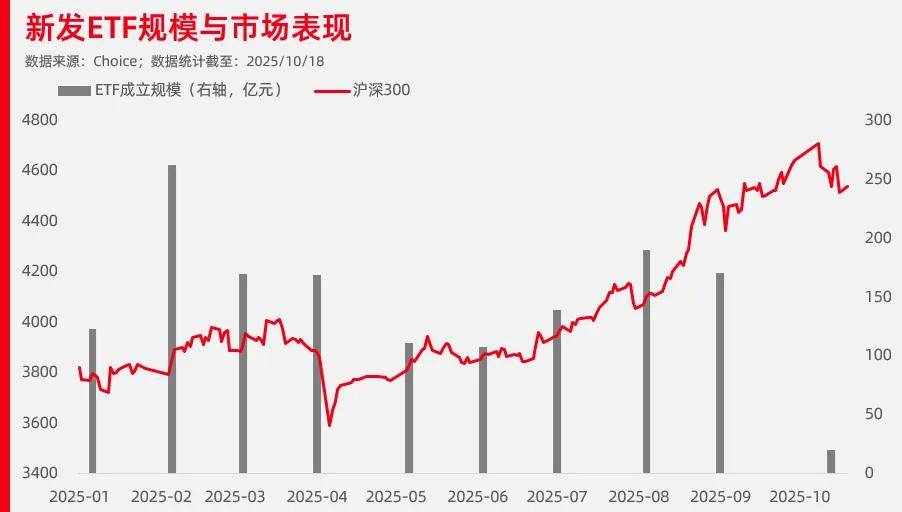
Core Viewpoint - The A-share market is experiencing a decline in investor sentiment following a significant correction last week, leading to lower trading volumes and a temporary halt in the current market trend [1][2]. Group 1: ETF Issuance and Market Trends - As of October 18, 2023, a total of 257 stock ETFs have been established this year, with an issuance scale of 1460.14 billion [3][4]. - The issuance of ETFs has shown a correlation with market conditions, with a peak issuance in February at 261.93 billion, despite the market's volatility in April and subsequent recovery [7][8]. - Monthly ETF issuance has remained relatively stable, with no significant fluctuations in the number of ETFs launched each month [8]. Group 2: ETF Performance and Investor Preferences - The majority of newly issued ETFs are focused on thematic industry indices, which account for over 40% of the total, reflecting investor interest in sectors like technology and anti-involution [10]. - Specific indices such as the ChiNext Composite Index and the Science and Technology Innovation Index have seen significant ETF tracking, with notable year-to-date returns [11][12]. - Despite the overall positive performance of many ETFs, the average issuance scale is 5.68 billion, and over 70% of the ETFs have seen a decrease in scale since issuance [13][15]. Group 3: Challenges for Fund Companies - Fund companies face challenges as the overall scale of newly issued ETFs has decreased by 71 billion since their launch, impacting profitability [15][24]. - The competition among ETF providers is intensifying, with many companies struggling to maintain scale while managing costs associated with new ETF launches [20][21]. - Only a few fund companies, such as GF Fund and Huaxia Fund, have seen significant growth in their newly issued ETFs, while the majority have experienced scale shrinkage [23][24].
A股市场快照:宽基指数每日投资动态-20251015
Jianghai Securities· 2025-10-15 12:14
- The report provides a snapshot of the A-share market performance, highlighting that all broad-based indices experienced a decline on October 14, 2025, with the largest drops seen in the ChiNext Index (-3.99%) and the CSI 500 (-2.46%) [3][11][12] - All tracked indices have fallen below their 5-day and 10-day moving averages, with the SSE 50 remaining above its 20-day moving average. The ChiNext Index has retreated 9.4% from its 250-day high [3][14] - The turnover rate of the indices on October 14, 2025, was highest for CSI 2000 (4.2), followed by ChiNext Index (3.32), CSI 1000 (3.14), CSI 500 (2.45), CSI All Share Index (2.21), CSI 300 (1.14), and SSE 50 (0.51) [3][16] - The daily return distribution analysis shows that the ChiNext Index has the largest negative skewness and kurtosis deviation, while CSI 1000 has the smallest negative kurtosis deviation [3][22][23] - Risk premium analysis indicates that SSE 50 (42.06%) and CSI 2000 (12.46%) have relatively high 5-year percentile values, while CSI 500 (2.62%) and ChiNext Index (1.19%) are relatively low. The risk premium volatility of CSI 1000 and CSI 2000 is higher compared to other indices [3][27][29] - PE-TTM analysis reveals that CSI 500 (99.01%) and CSI All Share Index (96.53%) have high 5-year percentile values, while CSI 300 (84.21%) and ChiNext Index (57.36%) are relatively low. The PE-TTM values of all indices except ChiNext Index exceed their danger threshold (80%) [4][39][40] - Dividend yield analysis shows that ChiNext Index (69.67%) and CSI 1000 (43.8%) are at relatively high 5-year historical percentiles, while CSI 2000 (19.17%) and CSI 500 (15.21%) are at lower percentiles. Current dividend yields are as follows: SSE 50 (3.29%), CSI 300 (2.67%), CSI 500 (1.33%), CSI 1000 (1.11%), CSI 2000 (0.78%), CSI All Share Index (1.99%), and ChiNext Index (1.01%) [4][49][50] - The current net asset value (NAV) ratios for the indices are as follows: SSE 50 (24.0%), CSI 300 (16.67%), CSI 500 (11.0%), CSI 1000 (7.3%), CSI 2000 (3.35%), ChiNext Index (1.0%), and CSI All Share Index (6.01%) [4][51]
大盘回调,沪指仍维持3900点,关注A500ETF易方达(159361)、沪深300ETF易方达(510310)等配置价值
Mei Ri Jing Ji Xin Wen· 2025-10-10 05:31
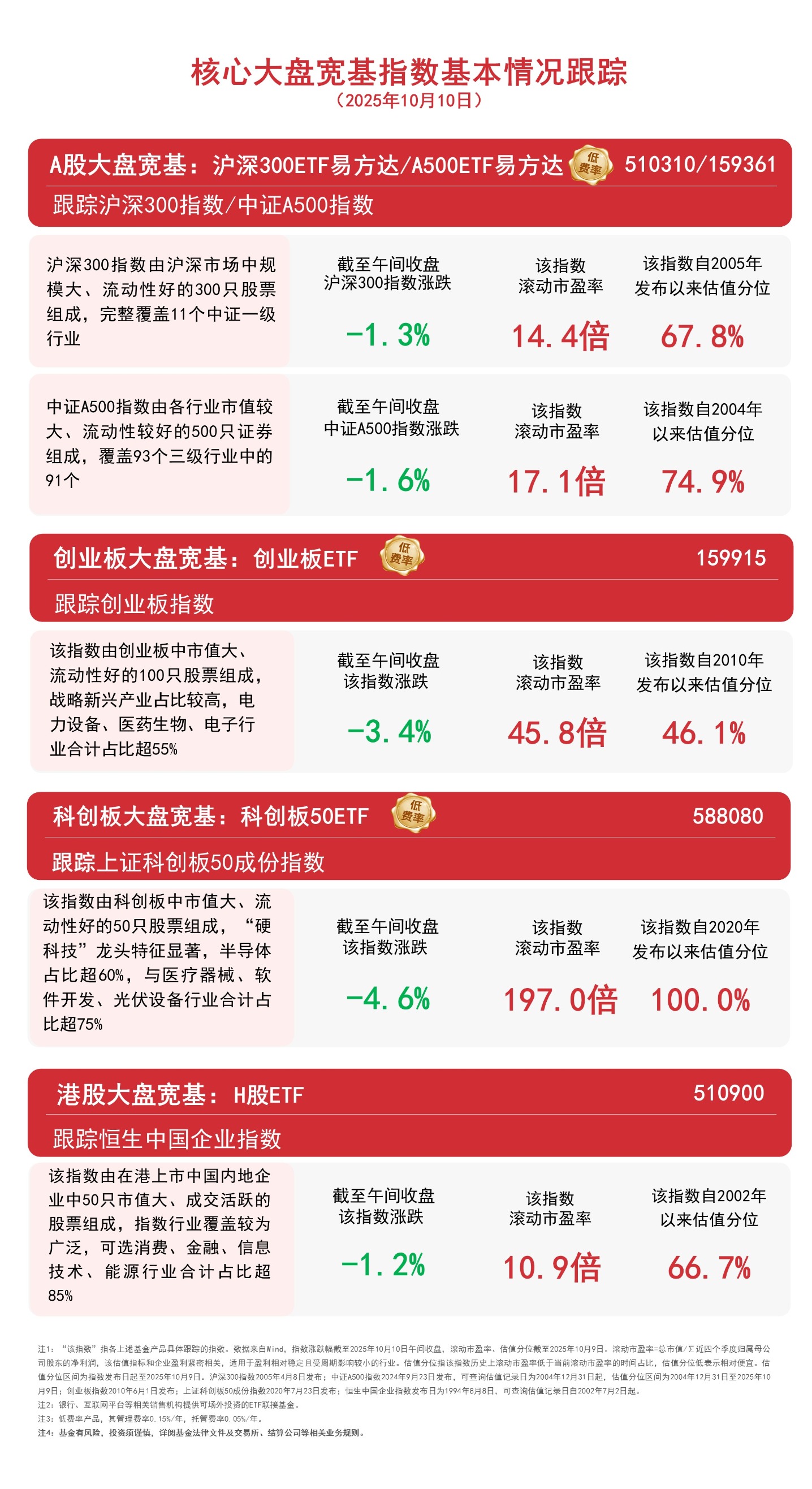
Market Overview - The A-share market experienced a collective decline across the three major indices, with the Shanghai Composite Index remaining above 3900 points [1] - The CSI 600 index fell by 1.6%, the CSI 300 index decreased by 1.3%, the ChiNext index dropped by 3.4%, and the STAR Market 50 index declined by 4.6% [1] - The Hang Seng China Enterprises Index decreased by 1.2% [1] Sector Performance - Sectors showing gains included gas, textile manufacturing, electric grid equipment, and coal [1] - Popular sectors such as precious metals, solid-state batteries, photovoltaic equipment, and computing hardware saw declines [1] - In the Hong Kong market, the entertainment and beverage sectors performed well, while the metals and mining sectors faced losses [1] Index Details - The CSI 300 index consists of 300 stocks with good liquidity and large market capitalization, covering 11 primary industries, with a rolling P/E ratio of 14.4 times [3] - The CSI 500 index includes 500 stocks from various industries, covering 91 out of 93 tertiary industries, with a rolling P/E ratio of 17.1 times [3] - The ChiNext index is composed of 100 stocks with high market capitalization and liquidity, primarily in strategic emerging industries, with a rolling P/E ratio of 45.8 times [3] - The STAR Market 50 index includes 50 stocks with significant market capitalization and liquidity, heavily weighted towards "hard technology," particularly semiconductors, with a rolling P/E ratio of 197.0 times [3] - The Hang Seng China Enterprises Index includes 50 large-cap, actively traded stocks from mainland China listed in Hong Kong, with a rolling P/E ratio of 10.9 times [3]
每日钉一下(投资不同类型指数需要注意什么?)
银行螺丝钉· 2025-10-09 14:00
Group 1 - The article emphasizes the importance of understanding different types of index funds, particularly bond index funds, which are less familiar to most investors compared to stock index funds [2] - It introduces four main categories of indices: broad-based indices, strategy indices, industry indices, and thematic indices [6] Group 2 - For broad-based index investment, it is crucial to consider the balance between large-cap and small-cap stocks, noting that in 2024, large-cap stocks like CSI 300 are expected to perform well while small-cap stocks may lag [8] - A classic combination for investment is the pairing of CSI 300 with CSI 500, and potentially adding CSI 1000 for more small-cap exposure [9] - In strategy index investment, it is important to balance growth and value styles, as A-shares exhibit a rotation between these styles over time [10][11] - The article highlights that from 2019 to 2020, growth style was strong, while from 2021 to 2024, value style is expected to dominate [12] Group 3 - Industry and thematic index investments are characterized by high volatility, with broad-based indices typically experiencing 20%-30% fluctuations annually, while industry indices can see 30%-50% volatility [13] - It is recommended to limit exposure to any single industry to 15%-20% to manage risk effectively [13] - The article advises investors to select long-term themes when investing in thematic indices, citing examples of past popular themes that may no longer be relevant [13]

科创50创业板指并列榜首,四季度宽基榜首争夺战,谁笑到最后?
Sou Hu Cai Jing· 2025-10-08 05:54
Core Insights - The top-performing broad-based indices in A-shares for the first three quarters are the ChiNext Index and the Sci-Tech 50 Index, both rising by 51.2% [3][9] - The North Exchange 50 Index has also shown significant growth, increasing by 47.29% year-to-date, with a closing value of 1528 points as of September 30 [3][11] - The performance of these indices sets the stage for an exciting fourth quarter, with speculation on which index will finish the year with the highest growth [3][11] Summary by Index ChiNext Index - The ChiNext Index has a price-to-earnings (P/E) ratio of 45.4, placing it at the 99.3% percentile over the past three years [5] - It experienced a substantial increase of 50.4% in the third quarter, contributing nearly all of its gains for the year [7][9] - The trading volume on September 30 was 580.5 billion yuan, with 97 tracking funds totaling 160.8 billion yuan in assets [7] Sci-Tech 50 Index - The Sci-Tech 50 Index has a P/E ratio of 193, which is at the 100% percentile for the past three and five years, indicating high valuation concerns [9] - It also saw a significant rise of 49% in the third quarter, similar to the ChiNext Index, contributing almost all of its year-to-date gains [9] - The trading volume on September 30 was 99.8 billion yuan, which is less than 20% of the ChiNext Index's trading volume [9] North Exchange 50 Index - The North Exchange 50 Index has a P/E ratio of 71.8, positioned at the 93.7% percentile over the past three years [11] - It had a modest increase of 5.63% in the third quarter, contrasting sharply with the other two indices [11] - Despite the slower growth in the third quarter, it has seen a cumulative increase of over 150% since the start of the current market rally [11]

A股市场快照:宽基指数每日投资动态-20250929
Jianghai Securities· 2025-09-29 13:12
- The report provides a snapshot of the A-share market performance, highlighting that all broad-based indices experienced a decline on September 26, 2025, with the largest drops seen in the ChiNext Index (-2.6%) and CSI 2000 (-1.55%) [1][2][10] - The report notes that most indices, except SSE 50, fell below their 5-day moving averages, with CSI 1000 and CSI All Share Index also falling below their 10-day moving averages, and SSE 50 and CSI 2000 dropping below their 20-day moving averages [2][13][15] - The turnover rate of the indices on September 26, 2025, is highlighted, with CSI 2000 having the highest turnover rate (3.69), followed by ChiNext Index (3.02) and CSI 1000 (2.67) [2][18] - The daily return distribution of the indices is analyzed, showing that CSI All Share Index has the largest negative kurtosis deviation, while CSI 1000 has the smallest negative kurtosis deviation. CSI All Share Index also has the largest negative skewness, whereas SSE 50 and CSI 300 have the smallest negative skewness [2][23][25] - The risk premium of the indices relative to the 10-year government bond yield is discussed, with SSE 50 (33.65%) and CSI 300 (14.92%) having relatively high 5-year percentile values, while CSI 500 (10.63%) and ChiNext Index (4.68%) have lower values [2][30][32] - The PE-TTM values and percentiles of the indices are analyzed, showing that CSI 500 (99.75%) and CSI All Share Index (96.45%) have high 5-year percentile values, while SSE 50 (82.48%) and ChiNext Index (60.5%) have lower values [3][40][42] - The stock-bond valuation ratio is calculated using the reciprocal of PE-TTM and the difference with the 10-year government bond yield. None of the indices exceed their 80% percentile, and CSI 500 is below its 20% percentile [45][46] - Dividend yield trends are analyzed, showing that ChiNext Index (63.39%) and CSI 1000 (47.19%) are at relatively high 5-year historical percentiles, while CSI 2000 (18.6%) and CSI 500 (15.12%) are at lower percentiles [3][50][53] - The report highlights the current net asset value discount rates of the indices, with SSE 50 having the highest rate (26.0%), followed by CSI 300 (17.33%) and CSI 500 (12.0%), while ChiNext Index has the lowest rate (1.0%) [3][54]
招期金工股票策略环境监控周报:本周宽基指数二八分化上行,双节前建议降低权益敞口或对冲风险或布局做多波动率策略-20250929
Zhao Shang Qi Huo· 2025-09-29 06:40
Report Industry Investment Rating - No relevant content found. Core Views - From the perspective of cumulative returns this year, the three best - performing indices are the Micro - cap Index (+65.84%), the ChiNext Index (+47.16%), and the STAR 50 Index (+46.71%), while the three weakest are the CSI Dividend (-2.27%), the Shanghai Composite Index (+14.21%), and the CSI 300 (+15.63%) [10][12]. - Looking ahead, recent option sentiment dimensions indicate a bearish sentiment for the CSI 1000, CSI 300, and CSI 500, and combined with factors such as institutional fund withdrawals, it may suggest further market adjustments. Investors need to manage risks in the short - term [10]. - In terms of positions, the overall stock long - only strategy should maintain a moderately low position, and the neutral strategy should further reduce the position to a moderately low level before the holiday [10]. Summary by Directory 1. Equity Market Review - **Factor Calendar Overview**: This week, most of the equity market rose. The CSI A500 rose 1.19%, the CSI 300 rose 1.07%, the CSI 500 rose 0.98%, the CSI All - Share rose 0.21%, the CSI Dividend fell 0.25%, the CSI 1000 fell 0.55%, and the CSI 2000 fell 1.79%. The best - performing Barra style factors were size, growth, and momentum, with returns of 0.61%, 0.56%, and 0.18% respectively, while the worst were value, BETA, and residual volatility, with returns of -0.41%, -0.61%, and -1.17% respectively [14][15]. - **Main Broad - based Index Review**: - **Short - term Market Activity**: It is at a moderately high level but shows a marginal decline. The CSI All - Share's daily average trading volume was 2.26 trillion yuan. The trading volume proportions of the CSI 300 and CSI 500 increased marginally, while those of the CSI 2000, CSI 1000, and others decreased marginally [20][22]. - **Medium - term Market Activity**: It is at a moderately high level. The CSI All - Share's 20 - day rolling average daily trading volume was 2.39 trillion yuan. The trading volume proportions of the CSI 300 and CSI 500 increased marginally, while those of the CSI 2000, CSI 1000, and others decreased marginally [23][25]. - **Volatility**: Most broad - based indices rose, and volatility generally declined. For example, the CSI 500's volatility was 23.63% (82.41% quantile), with a marginal weekly decline of 0.79% [17][19]. - **Equity Industry Index Review**: This week, 19.4% of industries had positive returns, with the power equipment sector leading. The top three industries in terms of weekly returns were power equipment (3.86%), non - ferrous metals (3.52%), and electronics (3.51%), while the bottom three were retail (-4.32%), comprehensive (-4.61%), and social services (-5.92%) [26]. - **Equity Style Factor Review**: - **Barra Style Factors**: The size, growth, and momentum factors performed well, with returns of 0.61%, 0.56%, and 0.18% respectively, while the value, BETA, and residual volatility factors performed poorly, with returns of -0.41%, -0.61%, and -1.17% respectively [30]. - **Giant Tide Style Indices**: Most of them rose. The top three indices in terms of returns were large - cap growth (2.48%), mid - cap growth (2.30%), and small - cap growth (2.03%), while the bottom three were mid - cap value (0.56%), large - cap value (-0.34%), and small - cap value (-0.85%) [34]. - **Stock Index Futures Market Review**: - **Premium Convergence and Volatility**: The premium of IC, IF, and IM contracts converged, and volatility generally declined [36][38]. - **Impact on Neutral Products**: From the perspective of quarterly - contract hedging, the estimated average returns of neutral products affected by the hedging of IF, IC, and IM contracts were -0.280%, -0.270%, and -0.320% respectively [39]. - **Options Market Review**: This week, implied volatility generally declined, which is expected to be unfavorable for option - buying and arbitrage strategies. The top three products with the highest implied volatility were the E Fund STAR 50 ETF (50.20%), the Huaxia STAR 50 ETF (49.84%), and the E Fund ChiNext ETF (42.33%), while the bottom three were the CSI 300 Index (19.51%), the SSE 50 Index (19.10%), and the Huaxia SSE 50 ETF (18.48%) [41][42]. 2. Strategy Environment Monitoring - **Intraday Alpha Environment for Neutral and Index - Enhancement Strategies**: Overall, it is unfavorable for intraday Alpha accumulation. Although liquidity slightly increased and volatility slightly decreased, the net capital outflow was 516 billion yuan per day this week [44][49]. - **Trading - based Alpha Environment for Neutral and Index - Enhancement Strategies**: Overall, it is unfavorable for trading - based Alpha accumulation. Although trading volume and turnover rate are at high levels and stock differentiation is in a high - level range, the number of stocks outperforming the benchmark index is low and shows a marginal decline [50][55]. - **Holding - based Alpha Environment for Neutral and Index - Enhancement Strategies**: Overall, it is unfavorable for holding - based Alpha accumulation. Although stock liquidity is at a high level, factors such as market style, the proportion of stocks outperforming the index, and factor rotation speed have a negative impact [58][74]. - **Hedging Environment for Neutral Strategies**: The basis spread fluctuation is in a moderately high - level range, posing certain challenges to cost control. The IF, IC, and IM basis spreads all converged this week [75][80]. 3. Future Strategy Research and Judgment - **Return Performance**: From the 20 - day rolling returns, the relative returns of the CSI 1000, CSI 2000, and CSI 500 to the CSI 300 are in the normal range, and the return of the CSI 300 is also in the normal range [84]. - **Derivatives Option Sentiment**: The option sentiment dimension shows that the sentiment of the CSI 1000 is stable, while the CSI 300 and CSI 500 are bearish [88]. - **Derivatives Futures Sentiment**: The futures sentiment dimension shows that the basis spreads of IC, IF, and IM all converged, with a differentiated overall sentiment [92]. - **Risk Preference**: As of September 25, 2025, the margin trading balance was 2.43 trillion yuan, at a high - level range in the past three years, indicating a high risk preference [95]. - **Trading Heat**: The trading heat of the CSI 300, CSI 500, CSI 1000, and CSI 2000, as well as the market trading volume, are at different quantile levels [97]. - **Style Attention Multiple**: The CSI 1000 is in the normal range, the CSI 500 is in the high - level range, and the CSI 2000 is in the extremely low - level range [100]. - **Profit Spread**: The profit spreads of the CSI 1000, CSI 500, CSI 2000, and CSI 300 are in the low or extremely low - level ranges [103]. - **Dividend Spread**: The dividend spreads of the CSI 1000, CSI 500, CSI 2000, and CSI 300 are in the normal range [105]. - **Trading Congestion**: The trading heat of the TMT sector is in the high - level range, the trading heat of the micro - cap sector is in the normal range, and the market trading volume is in the extremely high - level range [111].