市场估值

Search documents
继续上涨,A股节后也将接力,不然白搭了!
Sou Hu Cai Jing· 2025-05-03 05:58
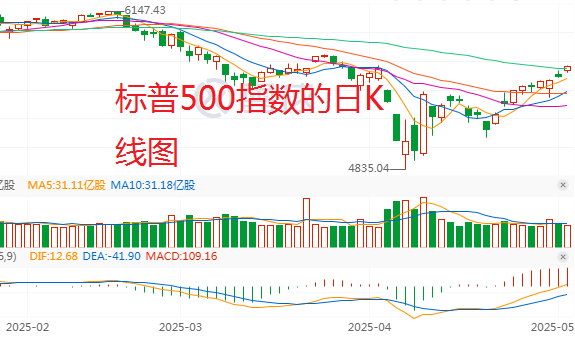
Group 1 - The core viewpoint is that the U.S. stock market has shown significant recovery, with the Dow Jones and S&P 500 indices achieving a nine-day winning streak, marking the longest consecutive rise since 2004, indicating strong market sentiment [1] - The A-share market is currently trading below 3,300 points, presenting a valuation attractiveness compared to global markets, with lower price-to-earnings and price-to-book ratios [2] - The recent rally in the U.S. stock market was supported by prior gains in the A-share market, suggesting a potential for A-shares to follow suit in the global bullish trend [3] Group 2 - The prolonged low valuation of A-shares indicates a lack of sustained upward momentum in the market, suggesting that being "cheap" has become a long-term trend rather than a temporary state [4] - Despite the attractive valuations, funds are hesitant to enter the market due to doubts about the sustainability of economic recovery and corporate profit improvements, creating a paradox where lower prices lead to lower buying interest [5] - For the market to thrive, it requires not only value support but also visible profit potential and investor confidence, as a lack of market enthusiasm can lead to liquidity issues [7]

市场波动中的信号洞察——鹏华碳中和混合基金致鹏友们的第四封信
Sou Hu Cai Jing· 2025-04-28 08:46
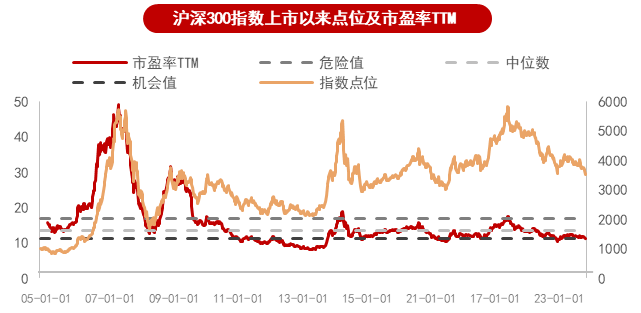
A. 恐慌抛售怕被套牢 B. 逢低加仓期待反弹 C. 不知所措观望等待 亲爱的鹏友们: 展信佳!第二封信我们初步认识了"牛市也会有回撤"。 我们回归到实战操作,当你的持仓市值一周内回落 15%,你会: 正确答案取决于:这到底是上涨路途的中场休息,还是盛宴结束? 识别市场位置需要跳出情 绪干扰,借助成体系的指标工具进行理性诊断。今天,我们将以 A 股历史为参照, 分析各指标工具和市场表现的关系,帮助大家在波动行情中找到自己的锚点。 估值信号灯:低买高卖的标尺 市盈率(PE)分位数是判断市场估值水位的常用指标。2007 年全市场 PE 突破 70 倍(历史分位数 98%), 2015 年创业板 PE 达 145 倍(分位数 99%),均构成显著泡沫特征。 我们可根据指数的估值历史百分位划分状态,再根据估值状态来辅助决定买入、持有或卖出。比如: 低于25%——低估 介于25%和75%之间——适中 高于75%——高估 当前数据:全 A 指数 PE18 倍,处于近十年 34% 分位,沪深 300 指数 PE12 倍(分位数 39%),中证 500 指 数 PE27 倍(分位数 39%),整体估值处于适中区间,未现系统性 ...
风险月报 | 关税冲击下权益市场估值、情绪双降,黑色系评分步入低风险区域
中泰证券资管· 2025-04-24 10:04
Core Viewpoint - The overall market sentiment has stabilized after initial panic due to the tariff war initiated by the U.S., but uncertainties in global economic recovery and geopolitical risks continue to pose challenges for future investments [5]. Group 1: Market Risk Assessment - The Zhongtai Asset Management risk system score for the CSI 300 index is 45.53, a slight decrease from 47.51 last month, indicating moderate to low risk in the market [2]. - The valuation of the CSI 300 has decreased to 38.93 from 45.01 last month, reflecting a general decline in market valuation levels [2]. - Valuation adjustments have occurred in previously high-valued sectors like electronics and computers, while defensive sectors have remained relatively stable [2]. Group 2: Market Expectations - The market expectation score has decreased to 48.00 from 56.00 last month, indicating a decline in market optimism [3]. - Fiscal and monetary policies are expected to continue supporting economic recovery, with local infrastructure spending showing improvement [3]. - Market sentiment has increased to 50.89 from 45.77 last month, primarily due to increased market volatility [3]. Group 3: Economic Indicators - The GDP growth rate for Q1 is reported at 5.4%, with industrial output and retail sales showing significant improvements [8]. - Fixed asset investment growth has strengthened to 4.3%, while real estate investment has declined [8]. - The government is focusing on expanding domestic demand, with measures to enhance consumption and support new industries [9]. Group 4: Sector-Specific Insights - The Zhongtai risk system score for the black commodity sector is 41.6, indicating low risk, with recent improvements in inventory and demand data [13]. - The real estate market is still in a phase of adjustment, with significant declines in development investment and new construction area [13]. - The overall scoring for the black commodity sector is approaching its lowest since the supply-side reform, suggesting high asset value from a valuation perspective [13].

风险月报 | 关税冲击下权益市场估值、情绪双降,黑色系评分步入低风险区域
中泰证券资管· 2025-04-24 10:04
截至2025年4月20日,中泰资管风险系统对各大资本市场的系统评分情况如下: 沪深300指数的中泰资管风险系统评分为45.53,较上月47.51略有下降,市场情绪出现一定波动,整体风险 评分仍处于中等偏低风险区间。 沪深300估值较上月有所下降(本月38.93,上月45.01),显示出市场整体估值水平有所回落。从行业分布 来看,部分前期估值较高的行业如电子、计算机等,估值有所调整,而部分防御性板块或低估值板块的估 值相对稳定。 行业间估值分化有所减小。 目前,28个申万一级行业中钢铁、房地产、国防军工、计算机 的行业估值高于历史60%分位数;农林牧渔、纺织服装、公共事业、非银金融等行业的估值低于历史10% 分位数。 市场整体估值的调整,有超预期的关税冲击的影响,也反映了市场对经济复苏节奏和企业盈利 预期的重新评估。 市场预期分数较上月有所下降(本月48.00,上月56.00)。分析师认为,政策层面持续发力,财政政策和 货币政策协同配合,为经济复苏提供了有力支持。财政方面,当月地方基建支出有所改善,土地市场的恢 复虽不均衡,但政府债发行提速,继续支撑政府性基金支出。预计二季度财政仍将保持积极。但全球经济 复苏的 ...
两大巨头,深夜出手!机构资金:加仓、抄底
21世纪经济报道· 2025-04-08 00:08
Core Viewpoint - The article highlights the proactive measures taken by various companies and institutions in the Chinese capital market to stabilize and enhance investor confidence amid market fluctuations, indicating a strong belief in the long-term growth of the Chinese economy. Group 1: Company Actions - China Electronics Technology Group announced a stock buyback exceeding 20 billion yuan, demonstrating confidence in the long-term economic outlook [1] - Contemporary Amperex Technology Co., Ltd. plans to repurchase shares worth no less than 40 billion yuan and up to 80 billion yuan for employee incentive plans [3] - Central Huijin, China Chengtong, and China Guoxin have also announced stock purchases to support the stability of the capital market [5] Group 2: Market Reactions - On April 7, following the Qingming Festival, Asian stock markets experienced declines, with significant drops in the Nikkei 225 and the KOSPI, leading to a collective pullback in A-shares [7] - The total trading volume in the market reached approximately 1.62 trillion yuan, an increase of 460 billion yuan from the previous trading day [7] - Analysts suggest that the A-share adjustment is primarily driven by overseas pessimism, with a potential overlap of easing policies between the US and China later this year [7] Group 3: Institutional Investment - Central Huijin has increased its holdings in exchange-traded funds (ETFs), indicating a commitment to maintaining market stability [10] - The trading volume of ETFs surged to 332.14 billion yuan, marking a significant increase of nearly 30% from the previous trading day [10][11] - Major ETFs, such as the Huatai-PineBridge CSI 300 ETF, recorded substantial trading volumes, with the highest reaching 243.15 billion yuan, the third-highest daily volume in its history [11] Group 4: Investment Strategies - Institutions are taking advantage of market volatility by increasing their positions in undervalued stocks, particularly in the consumer and healthcare sectors [14][17] - Analysts recommend focusing on sectors with lower correlation to tariff impacts, such as aerospace, animal health, and high-end manufacturing, as potential beneficiaries of policy changes [17]


指数研究|全球股票市场结构与运行特征解析
中信证券研究· 2025-03-20 00:05
Core Insights - The report focuses on the characteristics and structural changes of the global stock market, providing quantitative tracking and horizontal comparisons for investors [1] Group 1: Market Dynamics - The US dominates developed markets with a 74% weight in the MSCI developed market index, while China, Taiwan, and India are emerging market powerhouses with 28%, 20%, and close to 20% respectively [2] - The technology and financial sectors are the main drivers of market growth globally, with tech stocks being the most actively traded in major markets [2] - Global capital is increasingly flowing into Asia, with technology and finance sectors being the core drivers of capital market performance [2] Group 2: Market Capitalization and Liquidity - As of January 2025, the total market capitalization of NYSE and NASDAQ exceeds $30 trillion, significantly higher than other global exchanges [3] - The average daily trading volume of US stocks and Shenzhen Stock Exchange exceeds $100 billion, while some Southeast Asian markets have daily trading volumes below $10 million, indicating limited liquidity in certain emerging markets [3] - Over the past five years, the number of global listed companies has remained stable, with developed markets experiencing slower growth, while emerging markets like China and India are the main growth drivers [3] Group 3: Market Performance and Returns - In February 2025, the MSCI emerging market index rose by 0.4%, while the MSCI developed market index fell by 0.8%, indicating mixed performance across global markets [4] - The US market has shown the strongest long-term returns from 2010 to 2024, with the NASDAQ100 achieving an annualized return of 24% driven by tech stocks [5] - Asian markets exhibit significant internal structural differences, with Japan, Taiwan, and India showing annualized returns exceeding 10%, while markets like Hong Kong, Indonesia, and the Philippines have experienced negative returns due to economic slowdowns and capital outflows [5] Group 4: Valuation Trends - Major developed markets are maintaining high valuations, while some emerging markets face significant valuation pressures [6] - As of February 2025, US, Australian, and Taiwanese markets are at historical highs, while markets in the Philippines, Indonesia, and Malaysia still have relative valuation advantages [6] - The S&P 500 has surpassed a price-to-earnings (PE) ratio of 5, indicating strong market confidence in US earnings, while other markets like Taiwan and India also maintain high PE ratios [6]