
指数化投资

Search documents
基金早班车丨主题狂欢与个股寒潮并存,私募年末策略多空分歧加大
Sou Hu Cai Jing· 2025-12-25 00:38
Market Overview - The A-share market showed mixed performance with the Shanghai Composite Index rising by 0.53% to 3940.95 points, the Shenzhen Component Index increasing by 0.88% to 13486.42 points, and the ChiNext Index up by 0.77% to 3229.58 points, as of December 24 [1] - The total trading volume in the Shanghai and Shenzhen markets reached 1.88 trillion yuan, with over 4100 stocks rising [1] Fund News - On December 24, five new funds were launched, primarily stock and ETF linked funds, with E Fund's CSI 800 Index Enhanced A aiming to raise 8 billion yuan [2] - The issuance of stock index funds exceeded 400 billion yuan for the year, setting a new annual record, driven by low fees and clear investment styles [2] - The bond market experienced a downturn, with long-term government bond yields rising, leading to a significant decline in bond fund performance, with mid-to-long-term pure bond fund indices only increasing by 0.81% this year, the lowest in nearly 20 years [2] - The total scale of cross-border ETFs reached 924.1 billion yuan, more than doubling since the beginning of the year, indicating a strong demand for global allocation [3]

逾4000亿元! 2025年股票指基募资创历史新高
Shang Hai Zheng Quan Bao· 2025-12-24 19:15
Group 1 - The core viewpoint of the articles highlights a significant increase in the issuance of stock index funds, surpassing 400 billion yuan this year, marking a record high and indicating a shift towards tool-based investment products among investors [1][2] - A total of 1,604 new funds were established this year, with a combined issuance scale of 1,138.739 billion yuan, of which 816 were stock funds, contributing 413.843 billion yuan, second only to 2015 [1] - The rapid growth in stock index funds is attributed to their clear style and low fees, attracting more investors, while the recovery of trust in actively managed equity funds is still ongoing, leading to a significant gap compared to previous peaks [1][2] Group 2 - The issuance of stock index funds is driven by both on-market and off-market factors, with record highs in both ETF and off-market index-enhanced funds this year [2] - Major fund companies are focusing on ETFs and index-enhanced funds, reflecting a shift in investor demand from star fund managers to tool-based products with clear styles and sustainable excess return capabilities [2] - The positive outlook for the market is supported by the rapid development of AI, with many technology companies expected to benefit, leading to a continued focus on investment opportunities in the technology sector [3]
2025公募高质量发展迎新篇 行业臻繁茂权益强修复
Xin Lang Cai Jing· 2025-12-24 18:49
回望2025,公募基金行业奋楫前行,在时代变革的浪潮中焕发蓬勃生机。历经27载耕耘的公募行业,正以持续改 革之姿迎来蝶变时刻。 今年是公募基金行业从"粗放发展"向"高质量发展"转型的关键节点。一系列标志性政策法规陆续落地见效,公募行 业生态体系迎来系统性重构;费率改革稳步推进,行业竞争格局重塑;科技资产异军突起,成为配置新主线;债 券基金震荡加剧,考验机构风险管控能力;公募REITs家族持续扩容,丰富基础设施投资版图;多元资产配置重要 性愈发凸显,公募基金以源源不断的创新产品,诠释普惠金融的初心与本色。 临近岁末,证券时报特推出"公募基金十大新闻",全景回溯2025年行业的发展脉络。 证券时报记者 吴琦 改革重塑行业生态 2025年,我国公募基金行业迈入改革深水区,一系列改革举措不断向前推进,精准回应了市场关切与社会期待。 引导公募行业高质量发展的政策法规密集出台,这些政策法规通过优化收费模式、强化利益绑定、提升权益投资 稳定性、强监管防风险等举措,推动行业从"重规模"向"重回报"转型,行业生态迎来重塑。 5月7日,证监会制定并发布《推动公募基金高质量发展行动方案》,提出通过全面深化改革,强化公募基金行业 与 ...

“吸金”超百亿、A500ETF强势崛起 南方基金做对了什么?
Sou Hu Cai Jing· 2025-12-23 07:25
Core Viewpoint - The A500 ETF has seen significant trading activity and inflows, indicating a shift in investor preference towards quality assets amid market volatility, with institutional investors leading the charge [2][3][4]. Group 1: Market Activity and Trends - On December 17, the total trading volume of A500 ETFs exceeded 52 billion yuan, significantly outpacing the CSI 300 ETF [2]. - From December 15 to 19, the total net inflow into ETFs reached 76.036 billion yuan, with A500 ETFs receiving 80% of this inflow, bringing their total scale to over 230 billion yuan, an increase of nearly 37 billion yuan since the end of November [2][3]. - As of December 21, the total number of ETFs in the market surpassed 5,800, with a total scale exceeding 58 trillion yuan, solidifying their role as a backbone of the A-share market [3]. Group 2: Fund Performance and Management - The South A500 ETF's scale reached 36.1 billion yuan as of December 22, marking a net inflow of over 10 billion yuan in just two months, which has helped it regain its position as the second-largest fund in its category [4]. - The South A500 ETF has demonstrated strong performance with a 6-month return of 24.29% and a 1-year return of 21.19%, both exceeding the returns of the CSI 300 index during the same periods [5][6]. - The fund's management fee was reduced from 0.6% to 0.2%, which could enhance investor returns significantly over time [5]. Group 3: Competitive Landscape and Challenges - The competitive landscape for ETFs is intensifying, with top funds like South A500 ETF showing strong capital attraction even during market downturns, indicating robust investor confidence [3][4]. - Despite recent successes, South Fund faces challenges such as a significant reduction in equity fund sizes and regulatory scrutiny due to past compliance issues, which could impact its reputation and growth potential [11][12][14]. - The fund's performance in equity investments has lagged behind industry averages, with a 1-year return of only 20.32%, necessitating improvements in asset allocation and risk management strategies [14][15].

指数化投资周报20251222:周期板块迎来回升,华泰柏瑞A500ETF净流入领先-20251223
Shenwan Hongyuan Securities· 2025-12-23 03:12
Report Summary 1. Report Industry Investment Rating No industry investment rating information is provided in the report. 2. Report's Core View - The cycle sector of ETFs has rebounded, with the CSI Satellite Industry ETF leading in gains. The AI - themed new ETF issuance is hot, and the inflow of funds into the Huatai - Berry A500ETF is leading [1][23]. 3. Summary by Directory 3.1 Index Product Establishment, Raising, and Declaration - **Product Establishment and Listing**: In the recent week, 5 ETF products such as the Huatai - Berry CSI Science and Technology Innovation and Entrepreneurship Artificial Intelligence ETF were listed, and 13 products including the Huatai - Berry CSI Science and Technology Innovation and Entrepreneurship Artificial Intelligence ETF were established. The new issuance of AI - themed ETFs is hot, with products from Penghua, Morgan, and ICBC established [4]. - **Product Issuance Information**: In the coming week, 25 index products will end their fundraising, including the Southern Shanghai Science and Technology Innovation Board 50 Component ETF Linked A. And 8 index products will start fundraising, such as the ICBC Gemdale New Energy ETF on the Growth Enterprise Market and the Huaxia CSI All - Industry Food ETF [6]. - **Product Declaration Information**: In the recent week, 21 index products were declared. Among them, there are 9 theme funds such as the Taikang CSI Non - ferrous Metal Mining Theme ETF, and 5 cross - border - Hong Kong Stock Connect products like the Boshi Hang Seng Hong Kong Stock Connect High - Dividend Low - Volatility ETF [8]. 3.2 ETF Market Review - **Overall Market Performance**: In the recent week (2025/12/15 - 2025/12/19), most of the major broad - based A - share ETFs declined. The Science and Technology Innovation 50ETF and the Growth Enterprise Market 50ETF saw obvious pull - backs, with declines of - 2.92% and - 2.67% respectively. The major broad - based ETFs in Hong Kong and the US also pulled back synchronously. The Commodity ETFs showed different trends, with the Energy and Chemical ETF and the Gold ETF rising by 2.71% and 1.16% respectively [2]. - **Sector - Specific Performance**: Among the major industry ETFs, the cycle sector had the highest increase, with the Chemical ETF rising by 3.54%. Many sectors in the technology category faced pull - backs, such as the Chip ETF and the Electronic ETF, which declined by 3.03% and 3.02% respectively [15]. - **Cross - Border ETF Performance**: Among cross - border ETFs, the French CAC40 had the highest increase of 1.03%. The Huatai - Berry CSI KRX Korea - China Semiconductor ETF continued its previous volatile trend and declined by 4.80%. The Hong Kong - related ETFs all pulled back, with the Huatai - Berry Southern Dongying Hang Seng Technology ETF falling the most, by 2.84% [17]. 3.3 ETF Fund Flow - **Overall Scale and Change**: As of December 19, 2025, there were 1385 ETFs in the whole market, with a total scale of 5829.125 billion yuan, an increase of 52.135 billion yuan compared with the previous week. Among non - money ETFs, the ETFs targeting the CSI A500 had the largest net inflow of funds, reaching 32.702 billion yuan, while the ETFs targeting the CSI Short - Term Commercial Paper had the largest net outflow of 2.796 billion yuan [2][23]. - **Individual Product Performance**: In the recent week, the Huatai - Berry CSI A500ETF and the Harvest CSI AAA Science and Technology Innovation Corporate Bond ETF had relatively high fund inflows, with 8.688 billion yuan and 5.346 billion yuan respectively. The Haitong CSI Short - Term Commercial Paper ETF led in liquidity, with an average daily trading volume of 23.702 billion yuan in the recent week [28].
指数化投资周报:周期板块迎来回升,华泰柏瑞A500ETF净流入领先-20251223
Shenwan Hongyuan Securities· 2025-12-23 02:12
1. Report Industry Investment Rating Not provided in the content 2. Core Viewpoints of the Report - In the recent week, the cycle sector has rebounded, and Huatai-PineBridge A500ETF has led in net inflows. The new issuance of artificial intelligence-themed products is booming, with 5 ETF products listed and 13 products established. In the coming week, 25 index products will end their fundraising, and 8 will start. A total of 21 index products were declared in the recent week [1][5][7]. - In the recent week (2025/12/15 - 2025/12/19), most of the major broad-based ETFs in the A-share market declined, with significant pullbacks in the Science and Technology Innovation Board 50 ETF and ChiNext 50 ETF. The Hong Kong and US stock broad-based ETFs also pulled back synchronously. Commodity ETFs such as energy and chemical and gold ETFs rose. The cycle sector had the highest increase among major industries, while many sectors in the technology category faced pullbacks [2][13]. - As of December 19, 2025, there were 1,385 ETFs in the entire market, with a total scale of 5,829.125 billion yuan, an increase of 52.135 billion yuan from the previous week. Among non-monetary ETFs, the ETFs targeting CSI A500 had the largest net inflow of funds, while those targeting CSI short-term financing bonds had the largest net outflow [2][25]. 3. Summary by Relevant Catalogs 3.1 Index Product Establishment, Fundraising, and Declaration - **Product Establishment and Listing**: In the recent week, 5 ETF products such as Huatai-PineBridge CSI Science and Technology Innovation and Entrepreneurship Artificial Intelligence ETF were listed, and 13 products including Huatai-PineBridge CSI Science and Technology Innovation and Entrepreneurship Artificial Intelligence ETF were established. The new issuance of artificial intelligence-themed products is booming [1][5]. - **Product Issuance Information**: In the coming week, 25 index products will end their fundraising, including Southern Shanghai Stock Exchange Science and Technology Innovation Board 50 Component ETF Linked A, and 8 products will start fundraising, such as ICBC ChiNext New Energy ETF [7]. - **Product Declaration Information**: A total of 21 index products were declared in the recent week, including 9 theme funds and 5 cross-border - Hong Kong Stock Connect products [9]. 3.2 ETF Market Review - **Asset - Type Classification**: Classify ETFs into four categories: stocks, commodities, cash, and bonds according to the Merrill Lynch Investment Clock theory [11]. - **Broad - Based ETF Performance**: Most of the major broad-based ETFs in the A-share market declined, with significant pullbacks in the Science and Technology Innovation Board 50 ETF and ChiNext 50 ETF. The Hong Kong and US stock broad-based ETFs also pulled back synchronously. Commodity ETFs such as energy and chemical and gold ETFs rose [2][13]. - **Industry - Based ETF Performance**: The major industry ETFs had mixed performance. The cycle sector had the highest increase, with the chemical ETF rising 3.54%. Many sectors in the technology category faced pullbacks, such as the chip ETF and electronic ETF [16]. - **Cross - Border ETF Performance**: The major broad-based cross-border ETFs had mixed performance, with the French CAC40 having the highest increase of 1.03%. The Hong Kong stock-related ETFs pulled back across the board [19]. - **Non - Monetary ETF Performance**: In the recent week, E Fund CSI Satellite Industry ETF led in terms of yield, while Huabao CSI Hong Kong Stock Connect Information Technology Comprehensive ETF lagged behind [22]. 3.3 ETF Fund Flow - **Overall Market Scale**: As of December 19, 2025, there were 1,385 ETFs in the entire market, with a total scale of 5,829.125 billion yuan, an increase of 52.135 billion yuan from the previous week. A-share and cross-border ETFs ranked among the top two in terms of scale [25]. - **Net Inflow and Outflow of Funds**: Among non-monetary ETFs, the ETFs targeting CSI A500 had the largest net inflow of funds, while those targeting CSI short-term financing bonds had the largest net outflow. Huatai-PineBridge CSI A500ETF and Harvest CSI AAA Science and Technology Innovation Corporate Bond ETF had relatively high fund inflows [28][30]. - **Liquidity**: Haifutong CSI Short - Term Financing Bond ETF led in terms of liquidity, with an average daily trading volume of 23.702 billion yuan in the recent week. China Merchants CSI AAA Science and Technology Innovation Corporate Bond ETF also had relatively high liquidity [30].
公募基金“质效双升” 买方力量重塑市场定价逻辑
Shang Hai Zheng Quan Bao· 2025-12-22 18:23
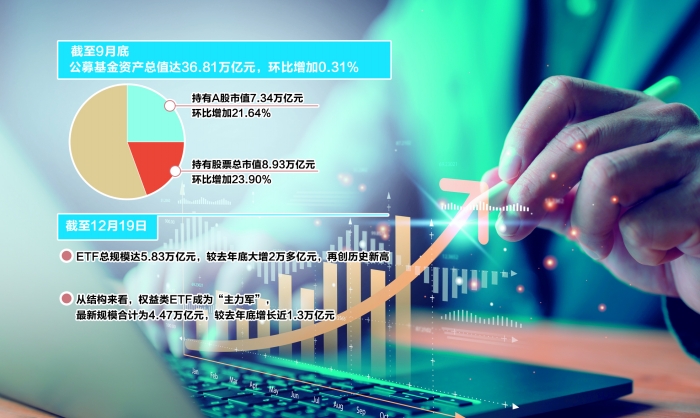
Group 1 - The core viewpoint of the articles highlights the significant growth and influence of public funds, particularly ETFs, in the Chinese capital market, with total public fund assets nearing 37 trillion yuan and ETF assets reaching 5.8 trillion yuan, marking a substantial increase over the past year [2][3] - ETFs have experienced explosive growth, with their total scale increasing by over 2 trillion yuan since the end of last year, establishing a new historical high [3] - Equity ETFs have emerged as the main force, with a total scale of 4.47 trillion yuan, reflecting a growth of nearly 1.3 trillion yuan since the end of last year, driven by regulatory encouragement for long-term capital to enter the market [4][5] Group 2 - The rapid growth of public funds has led to an increase in their market influence, with total public fund assets reaching 36.81 trillion yuan, a 0.31% increase, and stock holdings valued at 8.93 trillion yuan, a 23.90% increase [7] - The presence of ETFs in the top ten shareholders of several popular technology companies indicates their growing impact on listed companies, with significant capital flows affecting stock prices [7] - The number of ETFs with over 100 billion yuan in scale has expanded significantly, from 44 to 119, indicating a trend towards larger ETF products in the market [8] Group 3 - The China Securities Regulatory Commission has initiated policies to promote the high-quality development of public funds, encouraging innovation in equity fund products and the development of various index funds [9] - Public funds are becoming core value discoverers in the capital market, with a notable shift in the top holdings of active equity funds towards technology sector stocks [9][10] - The rapid growth of public funds is reshaping the A-share market's ecology and structure, injecting long-term stable capital into the market, which enhances overall stability and pricing efficiency [10]
股票型ETF月内净申购超400亿份 宽基ETF受资金青睐
Zheng Quan Ri Bao· 2025-12-22 16:17
Group 1 - Since December, there has been a significant inflow of funds into equity markets through stock ETFs, with net subscriptions exceeding 40 billion shares by December 22 [1][2] - The number of ETFs in the market reached 1,386, an increase of over 300 since the beginning of the year, with total ETF shares at 33.5 trillion, reflecting a 26.25% growth, and total ETF assets at 5.83 trillion yuan, a 56.24% increase [2] - Stock ETFs have seen the highest net subscriptions, with 40.096 billion shares in December, followed by cross-border ETFs with 32.789 billion shares [2] Group 2 - Wide-base ETFs are particularly favored by investors, with net inflows exceeding 11.137 billion yuan in December [4] - Key wide-base indices such as the CSI A500 and CSI 500 have attracted significant investment, with major fund houses leading in net inflows [4] - The appeal of wide-base ETFs is attributed to their valuation advantages and the expectation of policy support, which is expected to attract long-term capital [4][3] Group 3 - The development of ETFs has been supported by government policies aimed at enhancing market quality and promoting index-based investment [3] - The establishment of a fast-track approval process for ETFs is part of the broader regulatory framework to support the growth of the ETF market [3] - The anticipated rollout of personal pension systems in December 2024, which will include index funds, is expected to provide stable incremental capital to the market [4]
从“重规模”转向“重回报” 公募基金讲述高质量发展叙事
Zheng Quan Ri Bao· 2025-12-22 16:17
Core Insights - The public fund industry is transitioning towards high-quality development, with a focus on performance over scale, as evidenced by regulatory reforms and market dynamics [1][2][3] Group 1: Industry Transformation - Regulatory bodies have introduced a series of new rules aimed at shifting the focus from "scale" to "returns," including a floating management fee mechanism linked to fund performance [2] - The investment process is being standardized to prevent "style drift," ensuring that performance benchmarks are clear and consistent [2][3] - The fee structure is being adjusted to lower costs for investors, with measures to reduce subscription and service fees, thereby enhancing overall returns [3] Group 2: Fund Size and Growth - The total size of the public fund industry is approaching 37 trillion yuan, reflecting robust growth and resilience [4] - Equity funds continue to play a crucial role, serving as a primary tool for investors to engage with the equity market and benefit from economic transitions [4] - Fixed-income products are maintaining stability, complementing equity funds and enhancing portfolio risk management [4] Group 3: ETF Market Expansion - The ETF market has seen significant growth, with total assets increasing from 3.73 trillion yuan to 5.83 trillion yuan, marking a 56% increase [7] - The diversity of ETF products has expanded, with bond ETFs and cross-border ETFs gaining traction, indicating a shift towards more sophisticated investment options [7][8] Group 4: Performance of Equity Funds - Equity funds have shown strong performance, with many achieving net value growth rates exceeding 200%, driven by themes like technology and consumer recovery [9][10] - The issuance of new equity funds has surged, with over 1.16 trillion yuan raised, reversing previous trends dominated by bond funds [10] Group 5: Technological Investment Trends - The focus on technology investments, particularly in AI, has become a defining theme, with several funds achieving over 100% net value growth [11][12] - The rise of technology-themed funds has led to increased investor interest and significant fundraising success [11] Group 6: Personal Pension Products - The personal pension fund market has expanded significantly, with over 302 products available and a 65% increase in management scale [13] - Investment returns for personal pension funds have improved, with over 90% of products showing positive net value growth since inception [13] Group 7: Fund Distribution and Dividends - The public fund industry has experienced a "dividend harvest" year, with total dividends exceeding 230 billion yuan, reflecting a shift towards enhancing investor returns [15][16] - Fixed-income funds have been the primary contributors to dividends, while equity funds have also seen significant increases in dividend payouts [15] Group 8: REITs Market Development - The public REITs market has seen substantial growth, with 78 products listed and a total market value exceeding 210 billion yuan [17][18] - The diversity of underlying assets in REITs has increased, with new categories being introduced to enhance market depth [17] Group 9: International Expansion - The public fund industry is accelerating its international presence, with over 20 subsidiaries established abroad and significant QDII investment quotas approved [20] - This expansion reflects a strategic move towards global asset allocation and product innovation, enhancing the industry's competitive edge [20]
年内ETF发行数量份额均创历史新高
Zheng Quan Ri Bao· 2025-12-22 16:13
融智投资FOF基金经理李春瑜对《证券日报》记者表示:"这是多种因素共同推动的结果。其一,政策 支持力度持续加大,ETF产品审批流程不断优化;同时,指数化投资的理念日益普及,再加上市场整体 回暖带来的赚钱效应,都促使越来越多的资金流入ETF市场。其二,作为一种投资工具,ETF产品本身 就具备费率低、风险分散、交易便捷、透明度高等特点,因此无论对机构还是个人投资者,都展现出持 续吸引力。其三,ETF产品种类不断丰富,逐步向行业主题、跨境资产、债券等多元化方向拓展,更好 地满足了不同投资者的配置需求。其四,随着长期资金的持续流入,头部ETF产品的规模和流动性进一 步放大,形成'强者恒强'的良性循环,吸引更多资金跟随入场。" 今年以来,ETF市场产品发行火热。 公募排排网最新统计数据显示,按认购起始日统计,截至12月21日,年内新发行的ETF产品数量多达 351只,发行总份额高达2554.55亿份。这组数据刷新了历史纪录,也反映出随着A股市场投资生态的演 进,以及居民资产配置结构的变迁,ETF市场正迎来爆发式增长。 对于科技类ETF产品的"吸金力"较强,李春瑜认为,此类产品紧密契合新质生产力发展方向,重点布局 了人工 ...