
流动性风险

Search documents
广发聚源LOF: 广发聚源债券型证券投资基金(LOF)2025年中期报告
Zheng Quan Zhi Xing· 2025-08-29 09:57
Core Viewpoint - The report provides a comprehensive overview of the performance and management of the Guangfa Juyuan Bond Fund (LOF) for the first half of 2025, highlighting its investment strategy, financial performance, and compliance with regulations [1][10][12]. Fund Overview - Fund Name: Guangfa Juyuan Bond Fund (LOF) - Fund Manager: Guangfa Fund Management Co., Ltd. - Fund Custodian: Agricultural Bank of China Co., Ltd. - Total Fund Shares at Reporting Period End: 12,822,007,459.38 shares [2][4]. Investment Strategy - The fund primarily invests in fixed-income securities and does not engage in direct stock purchases or initial public offerings. The investment strategy involves comprehensive analysis of macroeconomic conditions, interest rate trends, and credit risks to optimize the bond portfolio [2][12]. Financial Performance - For the reporting period (January 1, 2025, to June 30, 2025): - Realized Income: - Class A: 63,388,704.71 CNY - Class B: 168,333,682.59 CNY - Class C: 8,174,702.29 CNY - Profit: - Class A: 20,800,429.93 CNY - Class B: 51,968,608.72 CNY - Class C: 530,390.56 CNY - Net Asset Value at Period End: - Class A: 4,503,643,502.30 CNY - Class B: 10,447,663,002.99 CNY - Class C: 455,766,105.57 CNY [4][12][16]. Performance Metrics - Net Value Growth Rate for the reporting period: - Class A: 0.59% - Class B: 0.59% - Class C: 0.39% - Cumulative Net Value Growth Rate: - Class A: 53.64% - Class B: 9.12% - Class C: 46.44% [5][12]. Market Conditions - The bond market experienced increased volatility in the first half of 2025, with short-term interest rates rising initially, followed by a correction in long-term rates. The market showed signs of recovery by the end of June, influenced by U.S. tariffs and central bank liquidity measures [11][12]. Compliance and Governance - The fund management strictly adheres to relevant laws and regulations, ensuring that all operations are compliant and that the interests of fund shareholders are protected. The investment decision-making process is supported by a robust internal control system [10][15].


ST华闻持续亏损三年半,资产负债率达82%
Bei Ke Cai Jing· 2025-08-26 07:33
Core Viewpoint - ST Huawen (stock code 000793) is facing severe liquidity issues, with significant losses, high debt levels, and restricted assets impacting its operations [2][6]. Financial Performance - In the first half of 2025, ST Huawen reported revenue of approximately 135 million, a year-on-year decline of 22.5% [2]. - The net profit attributable to shareholders was approximately -76.41 million, with a cumulative loss exceeding 2.5 billion over three and a half years [2]. - The net cash flow from operating activities was approximately -63.68 million, a year-on-year decline of 418.79% [2]. - Total liabilities exceeded 2 billion, with a debt-to-asset ratio rising to 82%, an increase of 3.03% from the end of the previous year [2]. Asset Restrictions - ST Huawen has over 1.8 billion in restricted assets, including multiple equity stakes, real estate, and land that are pledged or frozen [2][4]. - The company reported that restricted cash amounted to approximately 898,940, primarily due to litigation-related frozen bank accounts [3]. - The value of restricted fixed assets was approximately 1.44 billion, mainly used for mortgage loans [4]. Business Challenges - The company cited industry adjustments and liquidity constraints as key factors affecting its business development [3]. - Revenue from various segments, including information dissemination, printing, and video services, has seen a comprehensive decline [3]. - ST Huawen is under pre-restructuring proceedings due to its inability to repay debts, with a court decision pending on formal restructuring [6]. Regulatory Issues - ST Huawen was fined 2.5 million for inflating revenue through improper accounting practices, affecting multiple financial reports [8]. - The inflated revenue figures represented significant percentages of the reported income for the respective years [8].

我国债券市场流动性风险分析——基于多级交易网络的视角
Sou Hu Cai Jing· 2025-08-22 15:58
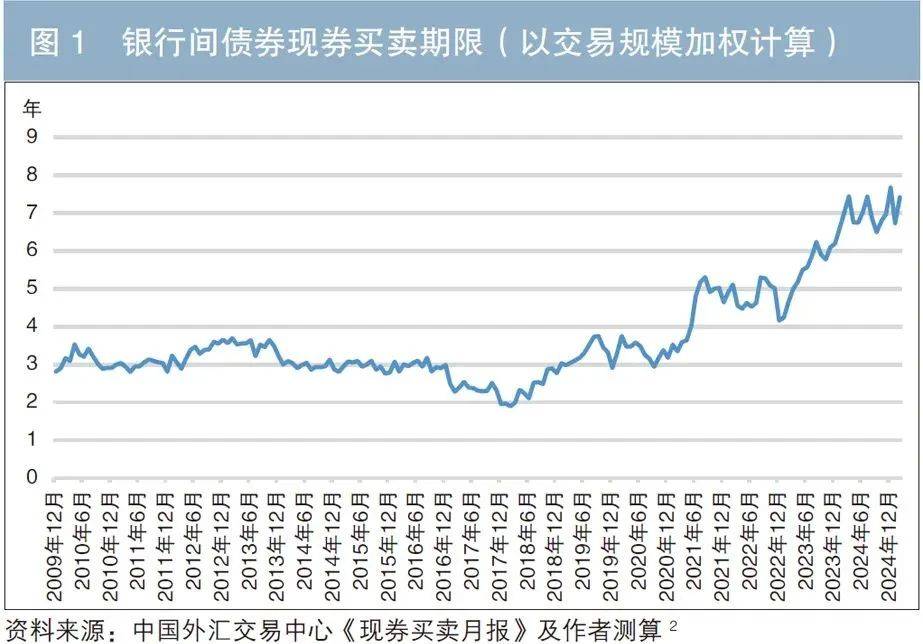
Group 1 - The bond market is becoming a core area for financial stability in China, driven by the evolution of the economic development stage and structural changes in financing models [1][2][5] - As of March 2025, the proportion of government and corporate bonds in the total social financing scale has steadily increased, nearing 30% [2] - The bond market has expanded significantly, with the total issuance in 2024 reaching 79.6 trillion yuan, a 7.3-fold increase over the past decade [3] Group 2 - Liquidity is a key element for financial stability, and the stability of the bond market heavily relies on the stability of funding sources from various investors [6][11] - The relationship between liquidity and financial stability is highlighted, with liquidity risk being a significant source of financial instability [9][11] - The bond market's unique trading characteristics necessitate a new analytical framework for assessing vulnerability and risk transmission mechanisms [1][27] Group 3 - A multi-level network structure for bond trading has been proposed, illustrating the interconnections between different market participants and the liquidity transmission paths [12][16] - The structure includes large banks, small banks, and non-bank institutions, emphasizing the importance of short-term funding sources like repurchase agreements [16][17] - The self-evolving characteristics of this network structure demonstrate procyclical behavior, where rising bond prices lead to increased risk appetite and further investment [19][20] Group 4 - Various case studies illustrate the impact of policy adjustments on liquidity risk transmission within the bond market, highlighting the interconnectedness of different financial institutions [21][26] - The transmission paths show that large banks play a crucial intermediary role in liquidity provision, while non-bank institutions represent a potential weak link [26] - The analysis emphasizes the need for coordinated monetary and fiscal policies to maintain stability in the bond market [27]

流动性风险显现?美财政部加大发行短期国债 资金撤离美联储逆回购工具
Zhi Tong Cai Jing· 2025-08-15 23:14
Group 1 - The U.S. Treasury is increasing the issuance of short-term government bonds to meet financing needs, leading to a shift in market liquidity as funds flow out of the Federal Reserve's overnight reverse repurchase agreement (RRP) tool into the more attractive Treasury market [1] - The usage of the RRP tool has significantly decreased, with only $28.82 billion being used by 14 institutions, marking a new low since April 2021, compared to a record high of $2.6 trillion in December 2022 [1] - In July, the U.S. Treasury issued a net increase of $212 billion in Treasury bonds, with approximately two-thirds being absorbed by money market funds, which are the largest users of the RRP [1] Group 2 - If RRP funds are exhausted, the next potential source of funds will be the $3.32 trillion reserves held by banks at the Federal Reserve, but a significant decline in reserves could lead to market instability [2] - Citigroup forecasts that bank reserves may drop to $2.8 trillion by the end of the year, with the possibility of further decline to $2.7 trillion, raising concerns about liquidity [2] - Wells Fargo warns that the upcoming weeks will be critical for the dollar repo market, especially during the corporate tax payment period in mid-September, which could see over $260 billion in net new Treasury supply [2] Group 3 - Some analysts believe that the market will not experience severe shocks in the short term, as the asset size of money market funds can continue to grow and absorb more short-term government bonds [3] - Data shows that $61.4 billion has flowed into Treasury-related ETFs in the third quarter, nearly double the amount from the same period last year, indicating strong overall demand [3] - Deutsche Bank warns that continued pressure on the financing market could spill over into the U.S. stock and corporate bond markets, especially with the S&P 500 index remaining at high levels [3]
*ST天茂信披违规引连锁反应:立案调查、股价震荡及终止上市
2 1 Shi Ji Jing Ji Bao Dao· 2025-08-14 13:29
Core Viewpoint - *ST Tianmao has faced a series of challenges since 2025, including delayed annual reports, stock price drops, and plans to voluntarily delist, raising concerns about investor rights and company transparency [1][2][4]. Group 1: Disclosure Issues - On April 29, 2025, *ST Tianmao announced it could not release its 2024 annual report and Q1 2025 report on time, citing the need for further information [2]. - The stock price fell to 3.04 yuan per share, marking the largest single-day drop in three months, reflecting investor concerns over the company's disclosure practices [2]. Group 2: Financial Performance and Liquidity Concerns - The company is primarily reliant on its subsidiary, Guohua Life, which is facing significant operational pressures, with a projected loss of 500 million to 750 million yuan for the full year of 2024 [3]. - Guohua Life reported a high surrender payment of 20.6 billion yuan in 2023, with compensation expenses surging to 21.822 billion yuan in the first three quarters of 2024, indicating increasing liquidity risks [3]. Group 3: Delisting Plans - On August 14, 2025, *ST Tianmao announced plans to voluntarily withdraw its A-shares from the Shenzhen Stock Exchange due to significant uncertainties affecting the company [4]. - A shareholder meeting is scheduled for August 25, 2025, to discuss the delisting proposal, with stock trading suspended from August 14, 2025 [4].

外汇交易有哪些常见风险?
Sou Hu Cai Jing· 2025-08-12 06:02
Group 1: Core Insights - Foreign exchange trading is a significant financial activity that attracts numerous investors, but it is subject to various risks that require careful understanding and response [1][2] - Exchange rate fluctuation risk is prominent in foreign exchange trading, influenced by factors such as economic conditions, monetary policy, and geopolitical situations [1][2] - Political and policy risks can greatly impact the foreign exchange market, with changes in government and economic policies affecting currency values [1][2] Group 2: Types of Risks - Market manipulation risk affects the fairness and rationality of foreign exchange trading, as some participants may attempt to influence exchange rates through deceptive practices [2] - Credit risk is prevalent in foreign exchange trading, particularly in derivatives, where counterparty defaults can lead to significant losses for investors [2] - Liquidity risk poses a challenge in foreign exchange trading, with varying liquidity levels across different currency pairs, which can lead to difficulties in executing trades at desired prices [3] Group 3: Leverage and Its Implications - Leverage risk is common in foreign exchange trading, allowing investors to amplify their potential profits but also significantly increasing their risk exposure [3]
正品控股港股IPO:对最大客户牛奶公司存在重大依赖风险 债台高筑仍持续向实控人“清仓式”分红
Xin Lang Zheng Quan· 2025-08-11 05:32
Core Viewpoint - Zhengpin Holdings has submitted its listing application to the Hong Kong Stock Exchange, aiming to raise funds for business expansion and marketing efforts, despite facing significant reliance on a single customer and liquidity risks [1][4]. Financial Performance - For the fiscal years 2023, 2024, and 2025, Zhengpin Holdings reported revenues of HKD 43.19 million, HKD 110 million, and HKD 130 million, with net profits of HKD 11.31 million, HKD 35.48 million, and HKD 36.26 million respectively. The growth rate for net profit in 2025 was only 2.18%, indicating insufficient growth momentum [4][11]. - The company has a significant dependency on a single customer, Milk Company, which accounted for over 70% of its sales during the reporting period [4][6]. Customer Dependency - Zhengpin Holdings' revenue from its top five customers was HKD 39.1 million, HKD 98 million, and HKD 108.6 million, representing 90.6%, 89.4%, and 83.4% of total revenue respectively. The largest customer, Milk Company, contributed HKD 38.5 million, HKD 84 million, and HKD 97.1 million, accounting for 89.1%, 76.7%, and 74.5% of total revenue [4][5]. Liquidity and Debt Issues - As of June 2025, Zhengpin Holdings had total liabilities of HKD 613 million and total assets of HKD 842 million, resulting in a debt-to-asset ratio of 72.81%. The current and quick ratios were below the theoretical safety values at 0.92 and 0.86 respectively [11]. - The company’s cash reserves were critically low, with only HKD 81,000 remaining, while interest-bearing loans exceeded HKD 31.48 million, indicating severe short-term repayment pressure [13][14]. Dividend Policy - Zhengpin Holdings has engaged in a "clearance-style" dividend policy, distributing a total of HKD 61.7 million to its controlling shareholder, Zhang Yunyu, from 2023 to 2025, which accounted for 74.29% of the net profit during that period [1][14]. Marketing and Compliance Issues - The company has faced challenges in maintaining brand recognition and reputation, necessitating increased advertising and promotional expenditures, which rose from HKD 1.49 million in 2023 to HKD 3.64 million in 2025 [9]. - Zhengpin Holdings has received warnings from the Hong Kong Department of Health regarding potential violations of advertising regulations, which could lead to fines and impact the company's reputation [9][10].
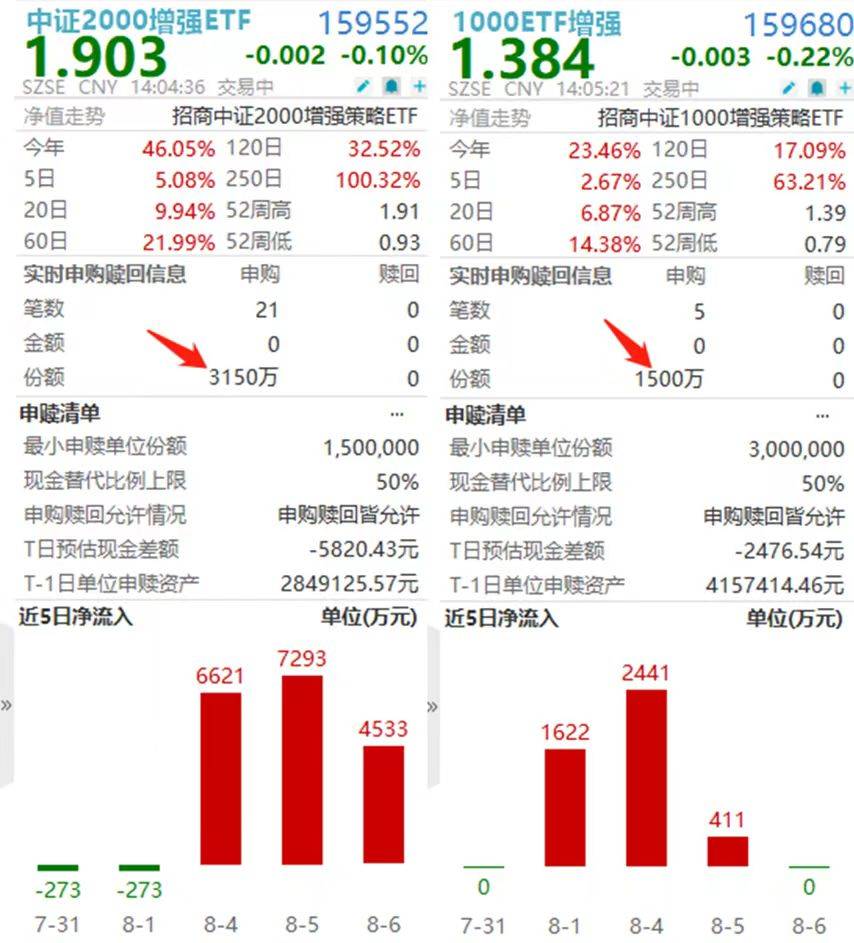
“小盘双雄”联袂揽金!中证2000增强ETF(159552)、1000ETF增强(159680)盘中合计揽金超8000万
Sou Hu Cai Jing· 2025-08-07 06:32
Core Viewpoint - The A-share market is experiencing fluctuations and consolidation, with significant inflows into small-cap ETFs driven by favorable policies and market conditions [1] Group 1: Market Performance - As of August 7, at 14:14, the 1000ETF Enhanced (159680) and the CSI 2000 Enhanced ETF (159552) fell by 0.29% and 0.16% respectively [1] - During the trading session, both ETFs saw a combined net inflow exceeding 80 million, with a total net inflow of over 200 million in the past five days [1] Group 2: Investment Strategy - The ongoing release of policies supporting specialized and innovative enterprises is enhancing the performance of quantitative enhancement strategies in small-cap stock investments [1] - The high volatility in the market is contributing to liquidity premiums, which is driving explosive growth in small-cap ETFs [1] - Investors are advised to adopt a phased investment strategy to manage risks, as some small-cap stock valuations are reaching historically high levels due to continuous capital inflows [1]
奥克斯IPO前突击分红:郑坚江家族狂揽36亿,现金流骤降
Xin Lang Cai Jing· 2025-08-06 09:56
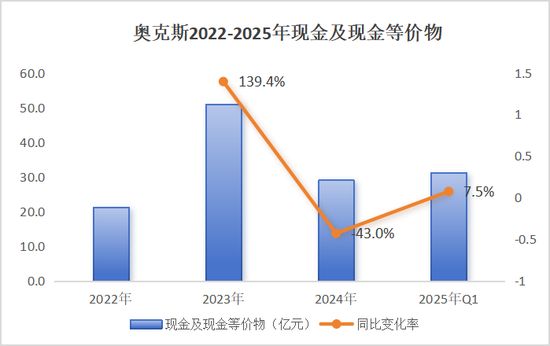
Group 1 - The core point of the article is that Aux, a major air conditioning company in China, is attempting to go public in Hong Kong after previous unsuccessful attempts in 2016 and January 2025 [1] Group 2 - Aux is the fourth largest air conditioning company in China, holding a market share of 7.3%. Its main products are household and central air conditioners, with the brand name Aux [2] - In Q1 2025, Aux's revenue from household air conditioners and central air conditioners accounted for 89.5% and 9.3% of total revenue, respectively. Overseas revenue made up 57.1% of total revenue, while domestic revenue accounted for 42.9% [2] Group 3 - Aux's revenue and profit have been growing, with revenues of 19.528 billion, 24.832 billion, and 29.759 billion from 2022 to 2024, reflecting a compound annual growth rate of 23.4%. Net profits for the same period were 1.442 billion, 2.487 billion, and 2.910 billion [3] - However, the growth rate of revenue and profit has begun to slow, with 2024 revenue and profit growth rates at 19.8% and 17.0%, down from 27.2% and 72.5% in 2023 [3] Group 4 - Aux has maintained a high debt-to-asset ratio, with figures of 88.3%, 78.8%, and 84.1% from 2022 to 2024. As of Q1 2025, the ratio was 82.5%, significantly higher than Midea's 61.9% and Gree's 62.7% [3] - In 2024, Aux declared a one-time dividend of 3.7935 billion, which accounted for 70.3% of the total profits for 2023 and 2024 [3] Group 5 - The large dividend payout has led to a significant decrease in cash and cash equivalents, which fell by 43% from 5.103 billion at the end of 2023 to 2.908 billion at the end of 2024, weakening Aux's debt repayment ability [4] - As of May 31, 2025, Aux's total current liabilities amounted to 21.37 billion, including 1.85 billion in interest-bearing bank loans, with 1.49 billion of these loans maturing in 2025 [4] Group 6 - Aux's net asset value decreased from 4.242 billion at the end of 2023 to 3.836 billion at the end of 2024, primarily due to the 3.79 billion dividend [5] - The company reported a net current liability situation, attributed to the reduction in current assets from dividend payouts and investments in fixed assets, intangible assets, and long-term capital assets [5]
银行理财有哪些常见风险?
Sou Hu Cai Jing· 2025-08-05 17:18
Core Viewpoint - Bank wealth management serves as a common investment method, providing investors with opportunities to participate in financial markets and achieve asset preservation and appreciation. However, understanding the common risks associated with bank wealth management is crucial for investors [1] Market Risk - Market risk is a significant risk faced by bank wealth management products, influenced by changes in financial markets such as interest rates, exchange rates, and stock and bond market fluctuations. Interest rate risk is a key component; when market interest rates rise, the attractiveness of fixed-income wealth management products declines, potentially lowering their prices. Conversely, when market interest rates fall, the performance of wealth management products may improve. Exchange rate risk mainly affects wealth management products involving foreign exchange, where fluctuations can lead to losses during currency conversion. Additionally, volatility in stock and bond markets can impact related wealth management products, particularly those invested in stocks or equity funds, which may face asset value depreciation during stock market downturns [2] Credit Risk - Credit risk refers to the risk of default or deterioration in the credit status of the entities in which wealth management products invest, leading to potential losses of expected returns or principal for investors. Funds from bank wealth management products may be directed towards various entities, such as corporations and government agencies. If a corporation performs poorly and cannot repay its debts, or if a government faces fiscal difficulties and fails to meet its debt obligations, the returns on wealth management products may be negatively affected. Banks conduct credit assessments and screenings of investment targets when issuing wealth management products, but even with rigorous evaluations, credit risk cannot be entirely eliminated [3] Liquidity Risk - Liquidity risk manifests when investors cannot timely liquidate wealth management products when needed or suffer losses during the liquidation process. Some bank wealth management products have fixed investment terms, preventing investors from redeeming funds early during the product's duration. Even if early redemption is allowed, it may incur fees or be redeemed at prices lower than the purchase price, reducing actual returns for investors. Furthermore, during periods of overall market liquidity stress, banks may face funding pressures, making it difficult to meet investors' early redemption requests, thereby exacerbating liquidity risk [4] Operational Risk - Operational risk encompasses losses arising from inadequate or problematic internal processes, human errors, system failures, or external events during the operation of wealth management products. For instance, bank staff may fail to adequately explain the risk terms and return structures of products during the sales process, leading to misjudgment by investors. In the operational phase, if a bank's internal risk management system malfunctions, it may miss optimal investment opportunities or fail to effectively control risks. Additionally, external factors such as cyberattacks or natural disasters can disrupt normal bank operations, negatively impacting the investment returns of wealth management products [5] Policy Risk - Policy risk arises from changes in national macroeconomic policies and financial regulatory policies. Adjustments in government fiscal and monetary policies can have widespread effects on financial markets. For example, changes in tax policies may affect the return levels of wealth management products, while loose monetary policies may lead to declining market interest rates, impacting the yields of fixed-income wealth management products. Changes in financial regulatory policies are also significant; adjustments by regulatory agencies regarding banks' business scopes and risk management requirements may compel banks to modify the design and investment strategies of wealth management products, potentially affecting their return and risk characteristics, leading to discrepancies between actual investment returns and expectations [6]