
第四次工业革命

Search documents
一键布局硬科技投资机遇 长城上证科创板综合指数基金即将发行
Xin Lang Ji Jin· 2025-08-11 03:16
Core Viewpoint - The A-share market is experiencing a resurgence, particularly in the technology growth sector, driven by supportive policies for technological innovation and increased capital inflow [1][2] Group 1: Market Performance - The ChiNext Composite Index (科创综指) has a high market capitalization coverage of 97%, including various types of securities across 16 first-level and 44 second-level industries, reflecting significant representation of the technology sector [1] - Since its base date on December 31, 2019, the ChiNext Composite Index has achieved a cumulative increase of 32.87%, outperforming major indices like the ChiNext Index (30.06%) and CSI 300 (-0.15%) [2][3] - The index has shown a remarkable rebound of 74.52% since September 24, 2024, indicating strong potential for high-elasticity investors [2] Group 2: Growth Potential - The index focuses on high R&D investment and growth-oriented companies, with 42% of its constituents classified as "little giant" enterprises and 86% from strategic emerging industries [2] - R&D expenses for ChiNext companies are projected to account for 11% of total revenue by the end of 2024, with R&D personnel making up 26% of the workforce, significantly higher than the overall A-share market [2] Group 3: Investment Opportunities - Longcheng Fund is launching the Longcheng SSE Sci-Tech Innovation Board Composite Index Fund on August 13, providing investors with a convenient tool to access the entire industry chain of the Sci-Tech Innovation Board [1] - The fund aims to cater to investors looking to allocate resources into "hardcore assets" within the technology sector, amidst favorable policies and rapid industry development [2]
越共中央召开全国知识分子、科学家和文艺工作者座谈会
Shang Wu Bu Wang Zhan· 2025-08-08 17:30
Core Viewpoint - The Vietnamese Communist Party emphasizes the crucial role of intellectuals, scientists, and artists in national development and stability, especially in the context of rapid global changes and technological advancements [1][2]. Group 1: Importance of Intellectuals and Scientists - The Vietnamese leadership acknowledges the significant contributions of intellectuals, scientists, and artists to the nation's historical development [1]. - The current era is characterized by knowledge as a key resource for development, necessitating the active participation of these groups to adapt to changes brought by the Fourth Industrial Revolution and digital transformation [1]. Group 2: Focus Areas for Development - Intellectuals, scientists, and artists are encouraged to focus on key areas such as technology, education, healthcare, high-tech agriculture, digital economy, digital society, green energy transition, and circular economy to support sustainable national development [2]. Group 3: Ethical Standards and Responsibilities - There is a strong emphasis on the need for these professionals to uphold ethical standards, integrity, and social responsibility, particularly in an era where misinformation and artificial intelligence can create false content [2]. - The qualities of integrity and honesty are highlighted as essential for defending truth and building a healthy society [2]. Group 4: Support from the Government - The Vietnamese government is committed to creating conditions for intellectuals, scientists, and artists to fully utilize their talents and creativity for national development [2]. - There is confidence that these groups will continue to lead and inspire the nation towards a prosperous future [2].
云天励飞陈宁:AI推理芯片是中国的大机遇
Shang Hai Zheng Quan Bao· 2025-08-07 18:28
Group 1 - The core viewpoint is that AI inference chips are crucial for the advancement of AI technology and the realization of a new era in artificial intelligence, particularly as the industry transitions from training to inference applications [2][5][6] - The company plans to focus on AI chip development and ecosystem layout to establish a solid foundation for the era of Artificial General Intelligence (AGI) [2][10] - The global AI inference market is projected to grow significantly, with an estimated market size of $106.15 billion in 2025 and $254.98 billion by 2030, reflecting a compound annual growth rate (CAGR) of 19.2% from 2025 to 2030 [5][6] Group 2 - The transition from AI training to inference is expected to occur around 2025, marking a shift towards application-oriented AI, with the inference market anticipated to surpass the training market in size [5][6][8] - The company has developed a series of AI chips, including the Edge10, which supports various large model deployments and is aimed at consumer and enterprise applications [10][12] - The company has established a comprehensive product matrix over the past 11 years, including multiple generations of neural network processing chips, to support a wide range of AI applications [9][11] Group 3 - The company emphasizes the importance of AI inference chips in driving the fourth industrial revolution and believes that AI technology will redefine all electronic products in the next five years [7][8] - The company has identified two major opportunities for China in the AI sector: the development of AI inference chips and the application of AI technology across various industries [8][9] - The company has faced challenges in production capacity and ecosystem development but sees significant market opportunities in the AI inference chip sector [9][12]



越南召开国家半导体产业发展指导委员会第二次会议
Shang Wu Bu Wang Zhan· 2025-08-06 16:07
范要求与会代表重点分析半导体产业人才培养、基础设施建设、招商引资、资源动员、生态体系构 建等领域成效与不足,探索"政府-院校-企业"合作模式,推动越南半导体产业取得突破性发展。需明确 亟待解除的瓶颈和核心驱动力,提出强化国家协同效应的解决方案,进一步促进半导体产业发展,为越 南实现今年经济增长8.3%-8.5%及后续年度两位数经济增长目标注入强大动力。 (原标题:越南召开国家半导体产业发展指导委员会第二次会议) 越通社8月4日报道,越南总理、国家半导体产业发展指导委员会主任范明政主持召开指委会第二次 会议,评估第一次会议结论落实情况,部署推动半导体产业未来发展重点任务。 范表示,以半导体、人工智能、云计算、物联网等为核心的第四次工业革命蓬勃发展,为越南等世 界各国带来发展机遇。目前,越南正积极落实半导体产业发展相关决议、计划,包括中央政治局关于科 技发展与数字化转型的第57号决议、国会和政府关于《越南半导体产业发展战略》、《半导体人才培养 计划》等,取得初步成效,但仍面临诸多挑战。 ...
ETF日报|国防军工、商业航天携手猛拉,159231涨逾3%刷新收盘新高!银行王者归来,农业银行续创历史
Sou Hu Cai Jing· 2025-08-04 13:31
Market Overview - On August 4, A-shares experienced a rebound after an initial decline, with all three major indices closing higher, driven by strong performance in the banking sector and a recovery in thematic concepts [1] - The total trading volume in the two markets reached 1.5 trillion yuan, with over 3,800 stocks rising [1] Sector Performance - The defense and aerospace sectors showed significant gains, with the General Aviation ETF (159231) rising by 3.29%, reaching a new closing high since its listing [1][4] - The low-altitude economy in China has surpassed 506 billion yuan in 2023, with a year-on-year growth rate of 34%, and is projected to reach 3.5 trillion yuan by 2035, presenting a substantial investment opportunity [2][6] Fund Flows - The defense industry ETF (512810) saw a net inflow of 9.739 billion yuan, ranking second among all sectors, indicating strong investor interest [2] - The General Aviation ETF has accumulated a total increase of 21.63% since its launch, reflecting robust market sentiment [4] Investment Opportunities - Analysts suggest that the military industry sector is showing signs of recovery, with catalysts expected to drive performance in the first half of 2025 [3] - The low-altitude economy is anticipated to continue its growth trajectory, supported by government policies and technological advancements [6] Banking Sector Insights - The banking sector saw a strong performance, with the Agricultural Bank of China reaching a new high, and several banks, including Qingdao Bank and Postal Savings Bank, showing significant gains [16][18] - The central bank's commitment to maintaining a moderately loose monetary policy is expected to benefit the banking sector [18] - Recent data indicates that several listed banks have reported positive growth in net profit for the first half of the year, with asset quality remaining stable [19][20] ETF Highlights - The banking ETF (512800) has become the largest and most liquid among the 10 banking ETFs in the market, with a fund size exceeding 14.4 billion yuan [22] - The General Aviation ETF and its linked funds provide an effective tool for investors to capture opportunities in the burgeoning low-altitude economy [9]

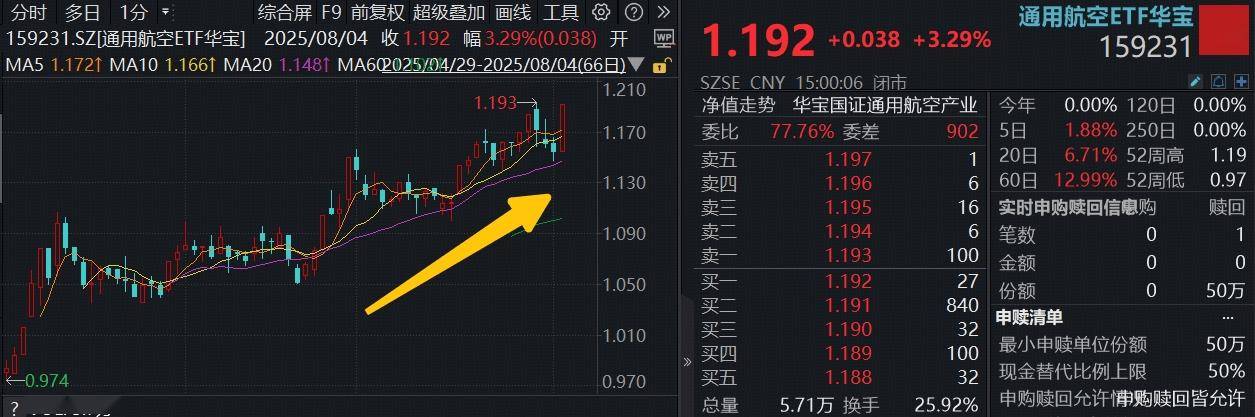
万亿赛道“振翅高飞”!低空经济三股涨停封板,通用航空ETF华宝(159231)劲涨3.29%
Xin Lang Ji Jin· 2025-08-04 12:23
Core Viewpoint - The low-altitude economy and military aviation sectors are experiencing significant growth, with the Huabao General Aviation ETF (159231) reaching a record high since its listing, reflecting a 21.63% increase since April 29 [1][4]. Group 1: Market Performance - The Huabao General Aviation ETF closed up 3.29%, marking a new high since its inception [1]. - Key stocks in the sector saw substantial gains, with Aileda hitting a 20% limit up, and other companies like Lijun Co. and Aerospace Electronics also reaching near 10% increases [2][3]. Group 2: Industry Outlook - The global manufacturing sector is undergoing a transformation, with PwC predicting that by 2035, manufacturing will contribute over $34 trillion to global GDP [4]. - The Chinese low-altitude economy market is expected to reach a market size of 1.5 trillion yuan by 2025 and 3.5 trillion yuan by 2035, driven by strong government investment and policy support [4][5]. Group 3: Strategic Developments - The establishment of a leadership group by the Civil Aviation Administration of China for general aviation and low-altitude economy indicates a commitment to policy development [4][5]. - The release of the "Low Altitude Economy Infrastructure Framework Guidelines (2025 Edition)" by the China Civil Airports Association outlines 21 core indicators for low-altitude infrastructure, marking a significant step in systematic planning [5]. Group 4: Investment Opportunities - The Huabao General Aviation ETF covers a wide range of sectors, including military and civilian aviation, with over 46% of its holdings in state-owned enterprises and more than 20% in major military groups [6]. - The ETF's newly launched connection funds provide an accessible investment tool for capturing opportunities in the burgeoning general aviation industry [7].



从质疑到狂欢!AI支出引爆科技股 七巨头年内投资近4000亿美元
Zhi Tong Cai Jing· 2025-08-04 03:06
Group 1 - The core narrative around technology companies investing heavily in artificial intelligence (AI) has shifted positively, with major firms like Microsoft, Meta, and Alphabet committing billions to maintain a competitive edge in the AI race [1][2] - Microsoft’s stock surged as its market capitalization surpassed $4 trillion, driven by a record $30 billion capital expenditure guidance and strong revenue growth in its Azure cloud computing business, indicating the lasting potential of its AI initiatives [1] - Meta's CEO Mark Zuckerberg announced a $2 billion increase in annual capital expenditure expectations to a range of $66-72 billion, highlighting the company's commitment to advancing AI technology, which resulted in a 13% stock price increase [2] Group 2 - Alphabet's quarterly report showcased a 32% growth in its cloud business, prompting an increase in its 2025 capital expenditure guidance to $75 billion, primarily for AI infrastructure [2] - Amazon's capital expenditure for the second quarter reached $31.4 billion, with expectations to maintain this investment level, projecting a total annual expenditure of $118 billion, as it supports AI competitor Anthropic [2] - The competition for top AI talent has intensified, with Zuckerberg leading the charge by investing billions to attract engineers and researchers from rivals like OpenAI, Apple, and Google, contributing to a total investment nearing $400 billion among the four major companies this year [2][3]




得看广东!好的AI+生态什么样?18家AI应用企业这样说
Nan Fang Du Shi Bao· 2025-07-30 14:14
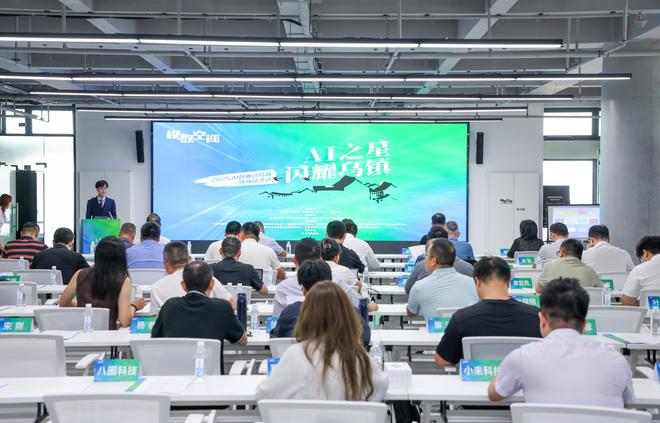
Core Insights - The AI entrepreneurship environment in Guangdong is thriving, supported by favorable policies and a collaborative ecosystem [4][5][6] - The recent AI competition event showcased 18 innovative AI applications across various sectors, highlighting the potential of "AI+" [2][3][7] - Experts express optimism about the future of AI in Guangdong, emphasizing the integration of hardware and software, as well as the region's strong manufacturing base [8][6] Group 1: Event Overview - The AI competition event took place in Zhuhai, featuring 18 AI companies presenting their innovative applications [1][2] - The selected AI applications will have opportunities for display and industry connections during significant events in Wuzhen [1][2] - The atmosphere at the event was filled with enthusiasm for AI innovation and entrepreneurship [1][3] Group 2: Industry Insights - Participating companies highlighted the advantages of Guangdong, including a robust industrial foundation, policy support, and geographical benefits [5][6] - The event showcased AI applications in diverse fields such as education, entertainment, tourism, healthcare, and elder care, demonstrating the versatility of AI technology [3][7] - Experts noted that the integration of AI with everyday products is a growing trend, with potential applications in health, education, and emotional support [7][8] Group 3: Expert Opinions - Industry leaders believe that Guangdong's AI ecosystem is characterized by the integration of hardware and software, collaboration between domestic and international markets, and government support [8][6] - The event's judges were impressed by the practical applications of the showcased products, indicating a strong market alignment [7] - Experts foresee a shift from functional to emotional AI products, particularly in areas like elder companionship [7][8]
围绕国家发展所需 培养拔尖创新人才
Ke Ji Ri Bao· 2025-07-28 01:01
Core Viewpoint - The emergence of new research-oriented universities in China, such as Ningbo Oriental University of Technology, is aimed at cultivating top innovative talents to meet national development needs [2][4]. Group 1: Characteristics of New Research-Oriented Universities - New research-oriented universities are characterized by being small yet specialized, having a high starting point, being internationalized, and focusing on innovation and entrepreneurship [2][3]. - These universities have developed in response to the upgrading of national development strategies, the commercialization and marketization of higher education, and changes in the international educational environment [2][3]. Group 2: Educational Approach and Curriculum - New research-oriented universities emphasize a research-based approach to education, aligning closely with market development needs and focusing on technology innovation [4]. - For instance, Ningbo Oriental University of Technology offers a flexible curriculum where students can choose their majors after the first year, promoting interdisciplinary learning and creativity [4][5]. - The universities also incorporate a dual mentorship system, providing both general education and specialized academic guidance to enhance students' overall development [4][5]. Group 3: Economic and Social Impact - New research-oriented universities possess strong economic foundations and favorable working environments, which help attract high-end talent and foster entrepreneurship among academic staff and graduates [6]. - The establishment of these universities addresses the imbalance in the supply and demand for high-quality applied talents in China, as more high-scoring students are choosing universities based on personal interests and career prospects rather than solely on prestige [6].
Wedbush:AI云计算支出带来增长浪潮 美股科技股将迎来强劲二季报
智通财经网· 2025-07-17 03:38
Core Viewpoint - The technology sector is expected to show strong earnings performance in Q2, driven primarily by spending in cloud computing and artificial intelligence [1] Group 1: Technology Sector Outlook - Wedbush recommends five major tech stocks for the second half of the year: Nvidia (NVDA.US), Meta (META.US), Microsoft (MSFT.US), Palantir (PLTR.US), and Tesla (TSLA.US) [1] - Analysts believe that the upcoming earnings season will be robust, with a strong performance anticipated from major tech companies [1] - The "AI revolution" is accelerating growth in semiconductors, software, and both enterprise and consumer sectors [1] Group 2: Future Growth Projections - Analysts predict a significant growth wave from $2 trillion in spending on AI technology and applications by enterprises and governments over the next three years [1] - The current period is seen as a "golden age" for technology stocks, with expectations of a substantial rise in tech stocks by the second half of 2025 [2] - 2025 is identified as a turning point for generative AI development, with companies transitioning from concept to large-scale application [2] Group 3: Economic and Strategic Factors - Analysts expect a softening of the Trump administration's hardline stance on tariffs, leading to comprehensive trade agreements that will not significantly impact large tech companies [2] - Nvidia's recent decision to resume sales of its H20 chips to China is viewed as a strategic positive for the tech industry [2] Group 4: Ecosystem Impact of AI Investment - In the early stages of AI application, Nvidia chips and cloud computing products are primarily utilized, with an estimated return of $8 to $10 for every $1 invested in Nvidia products across the tech ecosystem [3]


