
红利投资

Search documents
大盘震荡,红利护航,红利国企ETF(510720)涨0.8%,关注上市以来连续分红18个月,可月月评估分红的红利国企ETF
Sou Hu Cai Jing· 2025-10-23 02:56
Group 1 - The current preference for dividend stocks is driven by risk aversion due to external shocks and the diminishing catalysts following a high technology slope [1] - A phase of "rebalancing" is expected in October, where dividend and cyclical stocks may temporarily outperform, but the core drivers of the bull market remain intact [1] - The market is characterized by a "conflicted period," with risk-averse logic dominating under low trading volumes, while stable dividend stocks, gold, and optimized high-dividend varieties provide defensive value as core holdings [1] Group 2 - The Dividend State-Owned Enterprise ETF (510720) tracks the State-Owned Dividend Index (000151), which selects stocks with high dividend characteristics, stable dividends, and good liquidity, primarily covering traditional sectors like finance, energy, and industry [1] - The Dividend State-Owned Enterprise ETF (510720) has achieved monthly dividends since its listing, marking 18 consecutive months of dividends, making it one of the few ETFs to consistently distribute dividends since inception [1] - Investors are encouraged to consider buying on dips, as the ETF's dividend distribution is noteworthy [1]
畅力资产宝晓辉:真正的红利投资更多看其分红水平
Zhong Zheng Wang· 2025-10-21 13:52
Core Viewpoint - Dividend assets should be viewed as "a hen that lays eggs" rather than short-term speculative stocks, emphasizing the importance of stable annual dividends over potential stock price fluctuations [1] Summary by Categories Investment Philosophy - Investors should focus on the annual dividend levels of dividend assets instead of overly emphasizing potential stock price increases [1] - A mindset of "earning slow money and obtaining dividends" is recommended for investing in dividend assets [1] Market Outlook - The long-term logic driving the strength of A-share dividend assets is expected to persist [1]
年线即将转涨,红利指数“V字”反弹,这些成分股“扛旗”修复
Feng Huang Wang· 2025-10-20 10:19
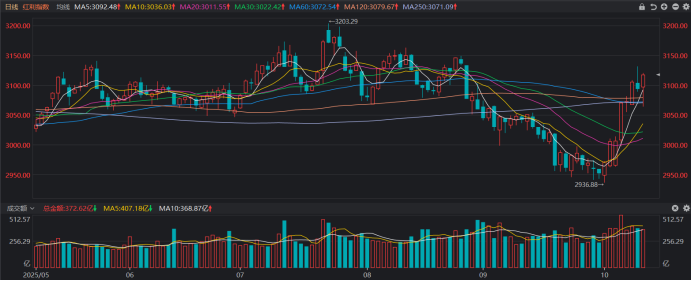
Core Insights - The Dividend Index has shown a significant recovery, rising nearly 6% over the past 8 trading days and reaching its highest closing point since August 27, with the year-to-date decline narrowing from 7.8% to 2.6% [1][3] Industry Performance - The coal sector has been a major driver of the recent recovery in the Dividend Index, with an average increase of 12.67% among coal stocks, while other sectors like banking and oil & gas also saw gains of 6.36% and 4.78% respectively [3][6] - Among the 12 sectors represented in the Dividend Index, 7 sectors had an average increase of over 1%, indicating broad-based support for the index's recovery [3] Individual Stock Performance - Eight stocks within the Dividend Index have increased by over 10% in the past 8 days, including Shanxi Coal International and Yanzhou Coal Mining, with respective gains of 17.98% and 16.38% [6][7] - Agricultural Bank of China and Shanghai Bank also performed well, with increases of 16.19% and 10.79% respectively [7] Financing Activity - As of October 17, 20 stocks within the Dividend Index saw net purchases from margin traders, with Agricultural Bank of China and Yanzhou Coal Mining receiving significant inflows of 154 million and 135 million respectively [6] Valuation Metrics - The Dividend Index's price-to-earnings ratio and price-to-book ratio have improved significantly, currently standing at 8.03 times and 0.78 times, respectively, indicating a recovery in valuation [8] - The dividend yield has decreased to 4.25%, marking a new low for the year and reflecting a decline from the peak of 6.91% recorded on May 6 [8][10] ETF Market Trends - The number of shares in Dividend-related ETFs has increased, with 16 out of 21 ETFs showing growth in shares, particularly the Dividend Low Volatility ETF, which saw a 13.9% increase [10][11] - The largest Dividend Low Volatility ETF has reached a record high in shares this month, while the second-largest Dividend ETF experienced a decline of 5.7% [11]

超5400次分红,1830亿!四大投资策略教你抢到这波公募“红包雨”
Xi Niu Cai Jing· 2025-10-17 01:54
Core Insights - Public funds have distributed a total of 183.05 billion yuan in dividends to investors as of September 30, 2023, with over 2,900 funds participating, marking a nearly 30% increase compared to the same period last year [4][6] - The surge in dividend payouts is attributed to regulatory improvements in the dividend mechanism, encouraging both listed companies and funds to enhance their dividend distribution [4][5] - Equity funds, particularly ETFs, have significantly contributed to the dividend distribution, with six out of the top ten funds by dividend amount being ETFs [2][4] Fund Performance and Trends - The total number of dividend distributions reached 5,404 this year, indicating a shift towards more frequent payouts, especially among dividend-related ETFs [3][4] - Passive index funds, particularly those focusing on high dividend yield companies, have the largest share of dividend distributions among equity funds [4][6] - Companies that consistently provide high dividends typically exhibit stable earnings and strong cash flow, allowing them to return a significant portion of profits to shareholders [4][5] Investment Strategies - Investors can utilize dividend index funds for diversified investment strategies, including regular cash flow, long-term compounding, high growth, and low volatility strategies [7][9] - Specific ETFs, such as the Dividend Value ETF and the Hang Seng Dividend Low Volatility ETF, cater to investors seeking regular cash flow, while others focus on reinvesting dividends for long-term growth [9][10] - The combination of high dividend yield and low volatility in certain ETFs provides a stable investment option, with historical data showing consistent positive returns even during market fluctuations [10][11]

中泰资管天团 | 王桃:90后的我,怎么就心甘情愿上了红利投资这趟车
中泰证券资管· 2025-10-16 11:33
Core Viewpoint - The article emphasizes the importance of "margin of safety" in dividend investing, suggesting that it is a prudent approach to navigate uncertainties in both investment and life [1][2]. Group 1: Dividend Investment Strategy - The selection criteria for dividend stocks include both long-term and current high dividend yields, which inherently provide a higher probability of safety margin [1]. - Long-term high dividend stocks are identified through in-depth research, indicating strong profitability and willingness to distribute dividends, typically found in mature companies with reduced capital expenditure needs [1]. - Current high dividend yields often correlate with lower valuations, allowing for the identification of suitable investment targets even under pessimistic long-term profitability assumptions [1]. Group 2: Risk Management and Investment Approach - The company sets buy prices with a margin of safety and establishes detailed observation and exit indicators, focusing on changes that could impact long-term profitability [2]. - Monitoring cost advantages relative to peers is crucial for assessing long-term profitability, and adjustments to investment strategies are made accordingly [2]. Group 3: Market Conditions and Performance - The article acknowledges the challenges faced during recent market downturns, highlighting that while external performance metrics may show declines, internal rates of return on holdings may actually improve [4]. - The current market conditions serve as a test for the commitment to dividend investing, prompting a reflection on whether the appeal lies in the strategy itself or merely in short-term gains [5]. Group 4: Investment Philosophy - The essence of investing is framed as a partnership with time and a focus on value creation rather than chasing price fluctuations, reinforcing the notion that short-term performance is less significant compared to long-term goals [5].

高股息资产在市场震荡期中更显防御优势,国企红利ETF(159515)红盘上扬
Xin Lang Cai Jing· 2025-10-15 02:40
Core Insights - The China State-Owned Enterprises Dividend Index (000824) has shown a positive trend, with a 0.30% increase as of October 15, 2025, reflecting a shift in investment logic from offshore markets dominated by foreign capital to onshore markets led by domestic capital [1] - High dividend strategies, particularly those involving quality central enterprises, are becoming a core pillar for stabilizing market valuation systems due to their robust profitability and consistent dividend payouts [1] - Dividend investment is viewed as a long-term allocation strategy that transcends style rotations in the A-share market, offering stable cash flow and value appreciation opportunities [1] Index Performance - The China State-Owned Enterprises Dividend Index comprises 100 listed companies selected for their high cash dividend yields and stable dividends, representing the overall performance of high dividend yield securities among state-owned enterprises [2] - As of September 30, 2025, the top ten weighted stocks in the index include COSCO Shipping Holdings (601919), Jizhong Energy (000937), and Lu'an Environmental Energy (601699), with the top ten stocks accounting for 17.15% of the index [2] Stock Performance - Notable stock performances include: - COSCO Shipping Holdings (601919) decreased by 1.01% with a weight of 2.36% - Jizhong Energy (000937) decreased by 0.16% with a weight of 2.00% - Nanjing Steel (600282) increased by 2.62% with a weight of 1.23% [3]
请打开你的对数坐标轴
雪球· 2025-10-11 05:23
↑点击上面图片 加雪球核心交流群 ↑ 风险提示:本文所提到的观点仅代表个人的意见,所涉及标的不作推荐,据此买卖,风险自负。 作者: 张翼轸 做投资,核心是收益率,而不是投资标的绝对价格的变动,也正因此,普通的坐标轴会产生极大误导的。 于是,就有了对数坐标轴,在对数坐标轴上,相同的百分比涨幅,是等距的。从 10 到 100,和从 100 到 1000,在坐标轴上的距离是相等的。 当我们在观察一个标的的长期走势时,这两个坐标轴会带给我们完全不同的直观感受。 举个最经典的例子。在 2006-2007 年的牛市中,在差不多 3500 点前后,不少价值投资者就开始离场了。 来源:雪球 前几天针对中证红利指数做了一个对数回归,很是凸显了红利投资的可爱。 当然也有细心的读者问,这里面对数化起到了什么作用。 突然想到这是个好问题,甚至某种程度上,对数坐标轴会影响一个长期投资者的投资观。所以,在此展开聊聊。 当你打开一个行情软件,无论是电脑上的还是手机上,一般情况下,默认的都是"普通坐标轴"。 什么是普通坐标轴? 其实就是我们正常世界中的坐标轴,类似我们用的直尺,刻度是等距的,从 100 到 200,与 200 到 300,在 ...

欧洲化工停产亏惨,铜矿停产缺25万吨,中国企业却捡了大便宜
Sou Hu Cai Jing· 2025-09-28 10:01
Group 1: Chemical Industry - The chemical industry is experiencing a significant transformation, with a recent policy aimed at stabilizing growth by restricting new capacity and promoting the renovation of old equipment, referred to as the "anti-involution policy" [7] - The global chemical industry is facing challenges, particularly in Europe where production rates are below 75% due to high energy costs, creating opportunities for Chinese chemical companies to benefit from lower production costs [7] - Chemical sector valuations and profits are at historical lows, providing ample room for profit recovery driven by policy changes, with some companies now offering dividends comparable to those in the coal industry [9] Group 2: Green Energy - The green energy sector is becoming profitable without government subsidies, with competitive pressures leading to lower generation costs than coal power [11] - However, green energy companies face challenges from low coal prices, which allow coal power companies to undercut prices, slowing profit growth for green energy [11] - Future opportunities for green energy may arise from increased demand from data centers and potential rises in coal prices or electricity costs [11] Group 3: Resource Sector - A recent incident at the world's second-largest copper mine has resulted in a projected supply shortage of 250,000 tons by 2025, potentially leading to greater price increases [13] - The initiation of a rate-cutting cycle by the Federal Reserve, combined with increased demand for gold from central banks, is creating a new allocation cycle for resource assets [14] - Resource prices are volatile, but there are opportunities for stable investments in dividend-paying sectors as the economy has not fully recovered [14] Group 4: Market Signals - The recent decline in the dividend index is linked to rising long-term deposit rates, with the 10-year government bond yield reaching 1.83% on September 25, reducing the attractiveness of dividend stocks [3] - The gaming industry has shown resilience, with a 4% increase in stock prices and a 21% increase in game licenses issued this year compared to last year, indicating a strong consumer spending trend [5] - The market is currently characterized by mixed signals, with opportunities in the chemical sector supported by policy and reduced foreign capacity, while green energy and resource sectors are influenced by external factors [16][17]

新时代·新基金·新价值——北京公募基金高质量发展在行动 | 锻造主动管理价值 守护投资者至上初心
Zhong Guo Zheng Quan Bao· 2025-09-24 23:43
Core Viewpoint - The article emphasizes the importance of active management in the mutual fund industry, highlighting the need for professional commitment and a focus on long-term value creation amidst market challenges and regulatory reforms [1][3]. Group 1: Active Management - Active management has faced significant challenges since 2021, with performance pressures and a shift in market preference towards passive investment strategies [2]. - Despite these challenges, the company has chosen to remain committed to active management, focusing on deep research and capturing value from economically vital companies [2][4]. - The recent regulatory reforms and policies from the Chinese government have created a favorable environment for the resurgence of active management [3]. Group 2: Talent Development and Research - The company places a strong emphasis on talent development, with a research team of 65 members and an average industry experience of nearly 8 years, including 17 senior fund managers with over 10 years of experience [5]. - A structured research hierarchy is in place to ensure effective knowledge transfer and continuous improvement in investment strategies [6]. - The company promotes a culture of communication and collaboration among research and investment teams to enhance the efficiency of research-to-investment conversion [7]. Group 3: Performance and Strategy - Performance is viewed as the lifeline of mutual funds, with the company committed to driving growth through strong investment returns rather than relying on high fees [8]. - The company actively participates in innovative product trials and has adopted a floating fee structure to align interests with investors [9]. - The company emphasizes a long-term focus on core competencies and responsibility, which has been crucial for its steady development over the past 20 years [9]. Group 4: Future Outlook - The mutual fund industry is expected to evolve with balanced development, combining both index and active management strategies to uncover investment opportunities [10]. - The company aims to continue its commitment to active management, supported by research and performance, to contribute to the high-quality development of the Chinese economy [10].
华商基金总经理王小刚: 锻造主动管理价值 守护投资者至上初心
Zhong Guo Zheng Quan Bao· 2025-09-24 22:25
Core Viewpoint - The article emphasizes the importance of active management in the mutual fund industry, highlighting the need for professional commitment and a focus on long-term value creation amidst market challenges [1][2][4]. Group 1: Active Management Strategy - Active management has faced significant challenges since 2021, with performance pressures and a shift in market preference towards passive investment strategies [2][3]. - 华商基金 has chosen to remain committed to active management, focusing on deep research and capturing value from economically vital companies rather than chasing short-term trends [2][3]. - The company has diversified its active equity styles, enhancing its product offerings to include various strategies such as growth, balanced, value, and cyclical investments [3]. Group 2: Regulatory Environment and Industry Reform - Recent regulatory reforms, including the Central Political Bureau's meeting and the State Council's opinions, have encouraged the development of high-quality mutual funds and supported active management [3][9]. - The China Securities Regulatory Commission has introduced policies to promote the innovation and development of actively managed equity funds, creating a favorable environment for 华商基金's strategic changes [3][9]. Group 3: Talent Development and Research Infrastructure - 华商基金 emphasizes the importance of talent development in active management, with a research team of 65 members and an average experience of nearly 8 years [6]. - The company has established a structured talent development system, ensuring a clear growth path for researchers and fund managers [6][7]. - A robust research platform, "华商金海螺," has been developed to integrate and digitize research data, enhancing the efficiency of the investment process [7]. Group 4: Performance and Investor Relations - Performance is identified as the lifeline of mutual funds, with 华商基金 focusing on generating returns to drive growth rather than relying on high fees [8]. - The company has adopted a floating fee structure linked to performance, aligning its interests with those of investors [9]. - 华商基金 prioritizes investor engagement, especially during market downturns, promoting a rational investment approach and guiding investors towards long-term value [9]. Group 5: Future Outlook - The mutual fund industry is expected to evolve with the ongoing technological revolution and AI advancements, leading to a balanced development of both index and active management strategies [10]. - 华商基金 aims to continue its commitment to active management, leveraging research and performance to create sustainable returns for investors while contributing to China's economic development [10].