自由现金流策略

Search documents
[6月5日]指数估值数据(自由现金流指数有效果吗;红利专题估值表更新;百分位估值表更新)
银行螺丝钉· 2025-06-05 13:50
Core Viewpoint - The article discusses the current market trends, focusing on the performance of various stock indices, particularly in the context of value and dividend strategies, as well as the recent developments in the Hong Kong stock market. Group 1: Market Performance - The market opened slightly lower but closed higher, with minor fluctuations, maintaining a 5-star rating close to 4.9 stars [1] - Large, medium, and small-cap stocks experienced slight increases with similar growth rates [2] - Recently strong sectors like dividend and value styles, as well as pharmaceuticals, have seen declines [3] Group 2: Hong Kong Stock Market - The Hong Kong stock market remains strong, outperforming A-shares by approximately 20% since the Chinese New Year [4] - The technology sector in Hong Kong has led the gains, with significant earnings growth driving index increases [4] - The Hang Seng Technology Index has returned to normal valuation levels, currently around 5200 points, compared to its previous range of 4800-4900 points [4] Group 3: Value and Dividend Strategies - Value styles often have a high allocation to the financial sector, with the CSI Dividend Index comprising about 25% financial stocks [6] - Not all value styles have high financial sector allocations; for instance, small-cap value indices have lower financial exposure [7] - New indices focusing on free cash flow have emerged, which do not consider financial stocks in their selection process [10][13] Group 4: Free Cash Flow Strategy - The effectiveness of free cash flow strategies is debated, with historical backtesting showing high returns, but concerns about over-optimization exist [14][15] - The free cash flow ratio is defined as free cash flow divided by enterprise value, similar to dividend yield metrics [16][18] - Current valuations for free cash flow indices are around 32%, indicating they are near undervalued territory [21] Group 5: Dividend Index Valuations - The article provides a summary of various dividend indices and their valuation metrics, including earnings yield, price-to-earnings ratio, and dividend yield [22][24] - Specific indices such as the Shanghai Dividend Index and the CSI Dividend Index are highlighted with their respective metrics [23][24] Group 6: Investment Opportunities - The article emphasizes the importance of identifying undervalued investment opportunities, particularly during market downturns [36] - It encourages a strategy of patience and discipline in pursuing low-valuation investments for potential future gains [36]

自由现金流指数获持续关注,鹏华中证全指自由现金流ETF 5月19日发行
Zhong Guo Jing Ji Wang· 2025-05-19 01:17
Core Viewpoint - The increasing focus on free cash flow theme products by public funds and the emergence of related ETFs signify a growing trend in the market, with the launch of the Penghua CSI All Share Free Cash Flow ETF aimed at providing investors with new tools to capitalize on high cash flow quality companies [1][2]. Group 1: Market Trends - Public funds are actively increasing their investment in free cash flow theme products, with eight ETFs already listed as of May 15 [1]. - The ongoing application for more free cash flow-related products indicates a rich product spectrum emerging in the market [1]. Group 2: Investment Strategy - The free cash flow strategy is gaining traction due to rising market uncertainties, leading investors to prioritize companies' real profitability and financial stability [2]. - Free cash flow is becoming a key standard for selecting quality companies, as it reflects the company's fundamental changes more accurately than dividend yield [2]. - This strategy is particularly appealing in the context of low global interest rates and China's economic transformation, offering both defensive and growth attributes [2]. Group 3: ETF Details - The Penghua CSI All Share Free Cash Flow ETF tracks the CSI All Share Free Cash Flow Index, which includes 100 companies with high free cash flow rates [3]. - The index is heavily weighted towards large and mid-cap stocks, with over 40% of its components being companies with a market capitalization exceeding 500 billion [3]. - Historical performance of the index shows an annualized return of 19.45% since 2014, significantly outperforming other indices [3]. Group 4: Investment Logic - The free cash flow strategy embodies a clear value style, which, when balanced with growth strategies, can capture investment opportunities from both economic growth and stable value [3]. - A combination of the CSI All Share Free Cash Flow Total Return Index and the China Government Bond Index could enhance returns, achieving an annualized return of 6.74% [3]. - The Penghua Fund aims to meet institutional investors' demand for quality underlying assets by launching this ETF, focusing on companies with abundant free cash flow [3].
自由现金流策略受关注 公募机构持续布局
Zheng Quan Ri Bao· 2025-05-14 16:13
Group 1 - The first batch of CSI All Share Free Cash Flow ETFs is set to be listed, with two public fund companies announcing their launch on May 16 [1] - The free cash flow strategy is gaining market attention due to its ability to select companies with strong risk resistance and stable operating performance, which tend to perform steadily during market fluctuations [1][4] - Investors are expected to continue increasing their demand for securities with good cash flow performance, driven by regulatory encouragement for companies to focus on free cash flow quality and returns [1][4] Group 2 - Free cash flow is defined as the cash net amount available for discretionary use after capital expenditures, reflecting a company's ability to generate cash [2] - The CSI All Share Free Cash Flow ETF tracks an index that selects 100 listed companies with high free cash flow rates, aiming to represent the overall performance of companies with strong cash flow generation capabilities [2] - As of May 14, eight ETFs have been established, with personal investors holding over 70% of the fund shares in these products, and some products having personal investor holdings exceeding 95% [2] Group 3 - Personal investors frequently appear in the top ten fund share holder lists of multiple CSI All Share Free Cash Flow ETFs, indicating strong interest from this demographic [3] - Public fund companies are actively applying for related connection funds while promoting the issuance and listing of the CSI All Share Free Cash Flow ETFs [3] Group 4 - The development of index-based investment is thriving, with various free cash flow indices being launched, which has sparked widespread market interest in the free cash flow strategy [4] - The appeal of the free cash flow strategy lies in its ability to select companies with strong risk resistance and stable performance, making it suitable for long-term investment [4] - Companies with sustained positive free cash flow are likely to have healthy and mature business models, which can better withstand economic cycles and provide shareholder returns over the long term [4]
节后首日市场情绪回暖 ,现金流ETF(159399)涨超0.3%,成交额超2.2亿元
Mei Ri Jing Ji Xin Wen· 2025-05-06 03:40
受到五一期间美股和港股表现带动,今日A股高开高走,市场情绪显著回暖。现金流ETF(159399)涨 超0.3%,成交额超2.2亿元,盘中资金持续流入。机构指出,市场震荡期叠加无风险收益率下行的宏观 背景下,红利类资产显现出较高的配置价值。 从中长期看,红利类资产仍然值得关注。招商证券指出,当前重视自由现金流策略的原因在于:一方 面,中国经济进入高质量增长阶段,上市公司增速波动降低,投资回归到获取自由现金流这一本质;另 一方面,自由现金流策略在经济环境承压时,具有长期收益更高、增长弹性更强的优势。 可重点关注现金流ETF(159399),标的指数富时现金流指数2016年至2024年连续9年跑赢中证红利指 数和沪深300指数。该基金可月月评估分红,有望成为投资者兼顾现金流需求与投资获得感的新选择。 此外,"大中市值+央国企+充裕现金流"有望为全年投资主线之一。现金流 ETF(159399)的标的指数 聚焦大中市值,标的指数央国企占比高于同类现金流指数,感兴趣的投资者可持续关注。 注:指数/基金短期涨跌幅及历史表现仅供分析参考,不预示未来表现。市场观点随市场环境变化而变 动,不构成任何投资建议或承诺。文中提及指数仅 ...
【利得基金】底仓配置:两类能涨抗跌的指数
Sou Hu Cai Jing· 2025-04-30 19:30
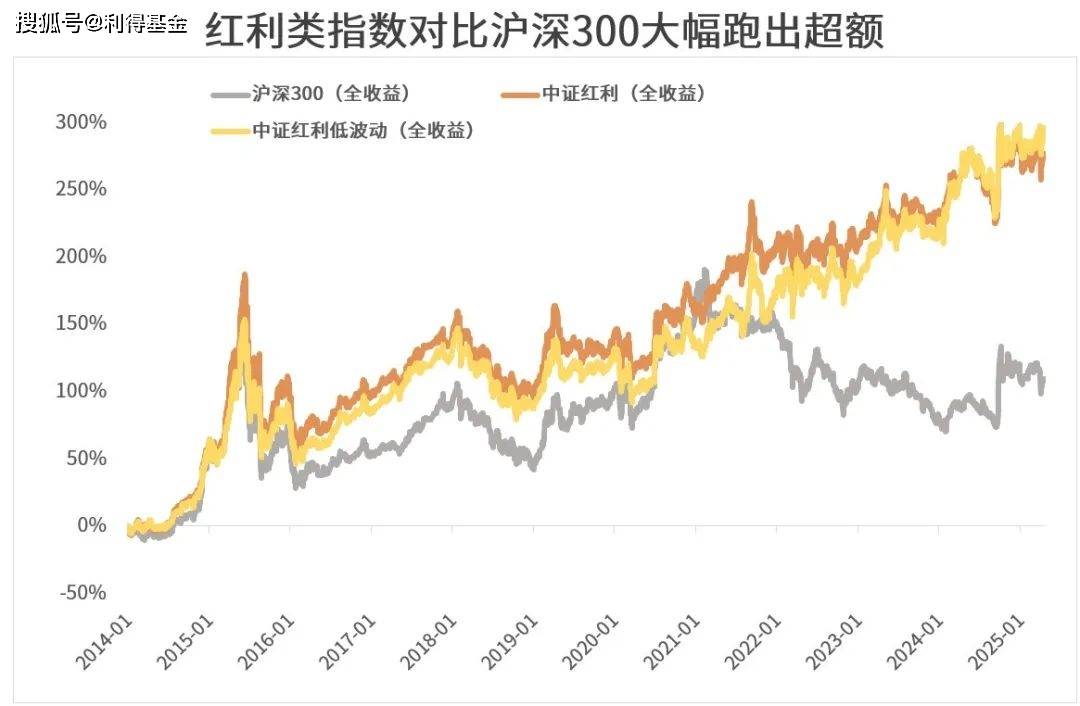
Core Viewpoint - The recent cautious sentiment in the market has led investors to focus on defensive indices that can effectively manage portfolio drawdowns while capturing structural opportunities [1][2]. Dividend Indices - Since 2021, dividend indices characterized by high dividend yields and stable payouts have attracted significant capital [2]. - The CSI Dividend Total Return Index has achieved a cumulative return of 276.45% since 2014, outperforming the CSI 300 Total Return Index, which recorded a gain of 108.54% during the same period [2][4]. - The index has shown a strong ability to "weather bull and bear markets," with a positive return probability of 73% over 11 years, compared to 55% for the CSI 300 [4]. Low Volatility Dividend Index - The Low Volatility Dividend Index has enhanced its annualized return to 13.29% by incorporating a low volatility factor, achieving a cumulative return of 294.21% [4][5]. - This strategy has a single-year win rate of 91%, providing a better option for risk-averse investors [4]. Free Cash Flow Indices - Free cash flow is a critical metric for assessing a company's ability to generate real earnings after maintaining operations and capital expenditures [5]. - The National Free Cash Flow Index has achieved an annualized return of 19.03% since 2014, with a cumulative return of 578.83%, significantly outperforming the CSI 300's annualized return of 6.91% [5][9]. - Even during the volatile period from 2021 to 2023, the index recorded a cumulative increase of 103.74% [5]. Strategy Comparison - In a low-interest-rate environment, both dividend and free cash flow strategies have become focal points for investors seeking stable and potential investment directions [9][10]. - Dividend strategies tend to select mature companies with lower growth expectations, while free cash flow strategies can identify companies with both cash flow generation and reinvestment capabilities [10]. Index Performance Summary - The performance of various indices from 2014 to 2024 shows that the CSI Dividend Index and the National Free Cash Flow Index have consistently outperformed the CSI 300 in terms of cumulative returns and annualized returns [8][12]. - The positive return probabilities for these indices are notably higher, with the Low Volatility Dividend Index achieving a 91% win rate [8][12]. Conclusion - For investors seeking stable dividends, the CSI Dividend Index is a suitable choice, while those willing to accept some volatility for potentially higher long-term returns may find the Free Cash Flow Index more appealing [12].
华泰柏瑞中证全指自由现金流ETF(563390)今日上市
Xin Lang Ji Jin· 2025-04-30 01:17
Core Viewpoint - The launch of the Huatai-PB CSI All Share Free Cash Flow ETF (code 563390) on the Shanghai Stock Exchange provides investors with a diversified option to participate in a strategy focused on companies with high free cash flow rates, amidst a market characterized by uncertainty [1][2]. Group 1: ETF Overview - The ETF aims to track the CSI All Share Free Cash Flow Index, which includes 100 companies with high free cash flow rates, enhancing representation of high cash flow generating companies in the A-share market [1]. - The ETF employs a full replication method to closely follow the index, which is designed to mitigate individual stock risk and improve overall representation [1]. Group 2: Selection Criteria - The index introduces a stringent selection criterion requiring companies to have positive net cash flow from operating activities for five consecutive years and to rank in the top 80% for earnings quality, ensuring the inclusion of firms with sustainable profitability and growth potential [2]. - The index has demonstrated strong performance, with a cumulative increase of 572.17% since its inception on December 31, 2013, and an annualized return of 18.9%, significantly outperforming the broader market index [2]. Group 3: Sector Composition - The index features a diverse sector composition, focusing on traditional cyclical sectors while also incorporating rapidly growing consumer and growth sectors, which helps in managing cyclical volatility [2]. - The top five sectors by weight in the index are Energy, Industrials, Consumer Discretionary, Materials, and Consumer Staples, indicating a balanced approach to sector exposure [2]. Group 4: Dividend Characteristics - The index has a high concentration of central state-owned enterprises, accounting for 73.73% of its constituents, and offers a dividend yield of 4.73%, which is higher than similar cash flow strategy indices [2]. - To align with its high dividend characteristics, the ETF has a monthly dividend assessment mechanism, allowing for up to 12 distributions per year [2]. Group 5: Market Context - As the Chinese economy transitions to a new normal, companies are expected to shift focus from capital expansion to stable cash flow generation, making the index a potential avenue for long-term capital appreciation [2]. - Companies with strong cash flow are likely to exhibit better risk resilience, positioning them as ideal core holdings during market fluctuations [2].
国信证券晨会纪要-20250428
Guoxin Securities· 2025-04-28 03:12
Macro and Strategy - The macroeconomic weekly report indicates that the high-frequency indicators have improved on a month-on-month basis, with a rise in real estate sentiment [10][12] - The high-tech manufacturing macro report shows that the diffusion index remains stable, with certain sectors like pharmaceuticals and semiconductors experiencing increased activity [10][11] Industry and Company - The real estate sector shows narrow fluctuations in sales data, with a cumulative transaction area of new residential properties in 30 cities increasing by 2% year-on-year [28][29] - The agricultural sector reports increased supply pressure for eggs, while beef prices remain strong despite the off-season [30] - The pharmaceutical industry is highlighted for its strong performance at the ASCO annual meeting, with several domestic innovative drugs selected for oral presentations [3] - The financial sector, particularly securities firms, is focusing on fixed income as a base while enhancing equity investments, with a reported revenue of 362.39 billion yuan for 2024, up 7.7% year-on-year [24][25] Market Trends - The U.S. stock market has seen a significant rebound, with the S&P 500 rising by 4.6% and the Nasdaq by 6.7%, driven by technology giants [19][20] - The Hong Kong market has also shown resilience, with the Hang Seng Index increasing by 2.7%, supported by strong performances in the pharmaceutical and electronics sectors [22] Investment Strategies - The report discusses the potential of a free cash flow strategy in the Hong Kong market, indicating that it has shown significant effectiveness and can yield excess returns [17][18] - The real estate investment strategy suggests that upcoming policies aimed at stabilizing the market will provide opportunities for investment in specific companies [30]
大盘震荡下探,现金流ETF(159399)跌0.3%,平安证券称现金流策略适合作为底仓配置
Mei Ri Jing Ji Xin Wen· 2025-04-28 02:36
注:指数/基金短期涨跌幅及历史表现仅供分析参考,不预示未来表现。市场观点随市场环境变化 而变动,不构成任何投资建议或承诺。文中提及指数仅供参考,不构成任何投资建议,也不构成对基金 业绩的预测和保证。如需购买相关基金产品,请选择与风险等级相匹配的产品。基金有风险,投资需谨 慎。 每日经济新闻 (责任编辑:董萍萍 ) 【免责声明】本文仅代表作者本人观点,与和讯网无关。和讯网站对文中陈述、观点判断保持中立,不对所包含内容 的准确性、可靠性或完整性提供任何明示或暗示的保证。请读者仅作参考,并请自行承担全部责任。邮箱: news_center@staff.hexun.com 今日,沪指低开低走,黄金、煤炭、地产、医药跌幅靠前,现金流ETF(159399)跌0.3%,成交额 超7000万元。截至4月25日,该ETF基金规模超34亿元居同类首位。 现金流ETF是以自由现金流作为选股因子的Smart Beta ETF,紧密跟踪富时中国A股自由现金流聚焦 指数,剔除金融和地产行业,优选自由现金流率最高的50只股票,为投资者筛选出了一批A股市场中的 "现金牛" 企业,为长期投资收益奠定了坚实基础。 国泰海通证券表示,全球金融风波 ...
港股选股策略研究:自由现金流策略初探
Guoxin Securities· 2025-04-25 04:35
Core Insights - The report highlights the emergence of free cash flow (FCF) strategies as a new value blue-chip strategy in the Hong Kong stock market, with significant potential for application [3][4] - The FCF strategy is characterized by a selection logic based on the free cash flow ratio (FCF/enterprise value), which combines value and quality metrics, making it a dual-focused investment approach [3][4] Free Cash Flow Strategy Exploration - The report discusses the introduction of FCF strategy products in both A-share and Hong Kong markets, noting that the core selection logic remains the free cash flow ratio [9][10] - In the U.S. market, several ETFs utilize free cash flow as a selection criterion, indicating a broader acceptance of this strategy [11][13] Effectiveness of the FCF Factor in Hong Kong - The FCF factor has shown significant effectiveness in generating excess returns and possesses a unidirectional characteristic when tested in the Hong Kong market [4][5] - The "Hong Kong FCF30" strategy, based on TTM (Trailing Twelve Months) data, has achieved an annualized excess return of 8% and an annualized alpha of 9% over a 23-year backtest [4][5] Breakdown of the FCF30 Strategy - The FCF30 strategy demonstrates strong stock selection capabilities, although it lacks notable mid-level allocation ability [5] - The strategy consistently generates excess returns across most sectors, with the exception of the materials sector, which presents an opportunity for further optimization [5] Performance Analysis of A-share and U.S. Markets - The A-share FCF strategy has outperformed benchmarks over the long term, indicating its effectiveness and stability [43] - In contrast, the U.S. market's FCF strategies have shown less consistent long-term effectiveness, with varying performance across different ETFs [46][47] Construction of the FCF Strategy in Hong Kong - The report outlines the methodology for constructing the FCF strategy, including backtesting from 2002 to 2024, using the Hang Seng Composite Index as a benchmark [50][52] - The effectiveness of the strategy is validated through net value trends, showing that higher free cash flow ratios lead to significantly better performance compared to lower ratios [55]
现金为王的时代,如何把握“真金白银”投资机遇?
Sou Hu Cai Jing· 2025-04-18 04:17
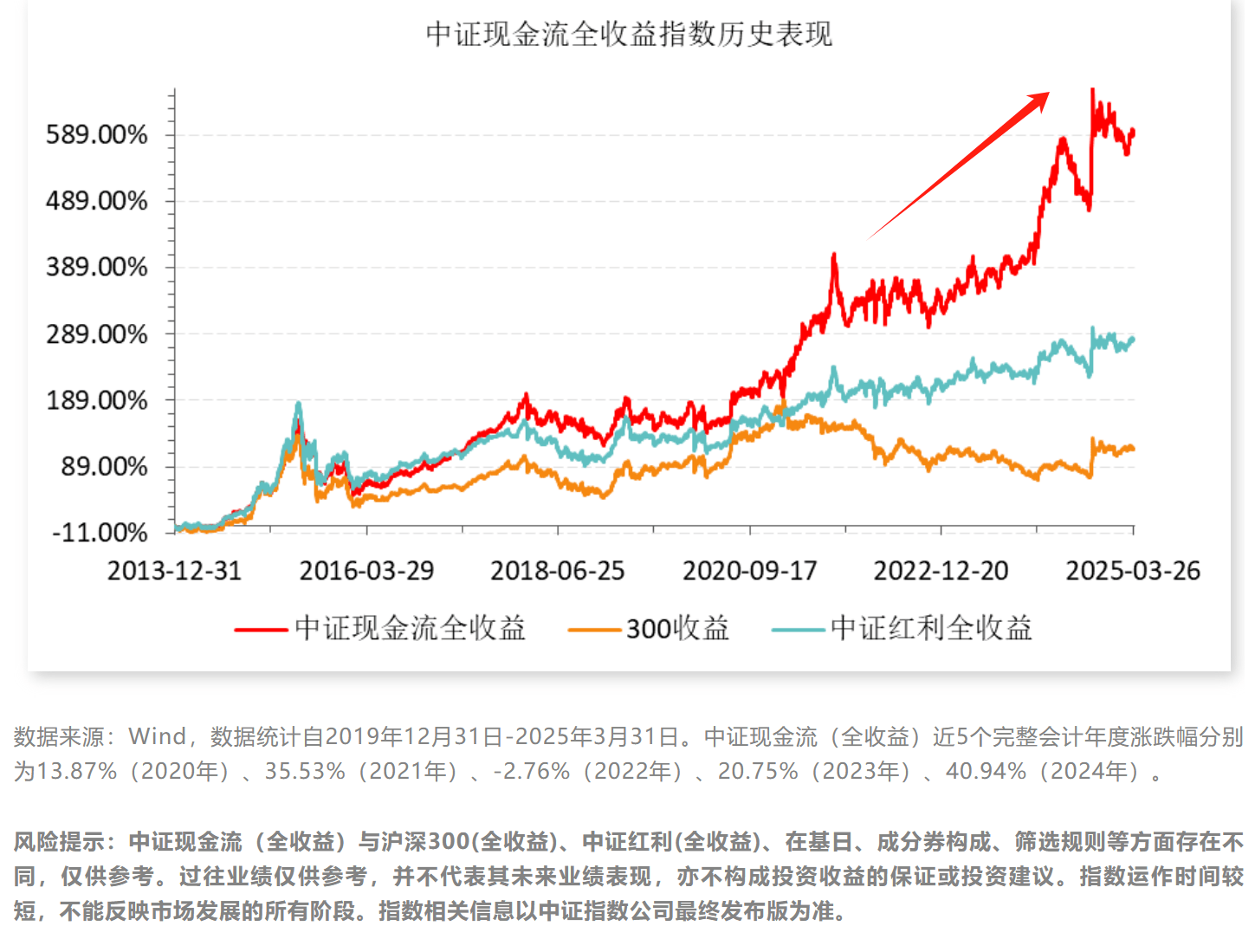
Core Viewpoint - The stability of cash flow, rather than the scale of assets, is crucial for quality of life and investment success, especially in uncertain market conditions [1] Group 1: Cash Flow Index ETFs - A new batch of cash flow index ETFs has emerged, focusing on companies that generate real cash flow, serving as a strategy to navigate market volatility [1] - The China Securities Cash Flow Total Return Index has achieved a remarkable annual return of 40% in a turbulent market [2] Group 2: Investment Strategies - The free cash flow strategy is based on three winning logic points: 1. It focuses on real profitability by looking beyond financial statements, as free cash flow is based on actual cash inflows and outflows [4] 2. It combines high dividend yields with growth potential, providing a dual revenue engine [5] 3. It employs a dynamic rebalancing mechanism to capture undervalued stocks, allowing for timely adjustments to the index [9] Group 3: Performance Metrics - The index demonstrated resilience during bear markets, with a mere 2.76% decline in 2022 when the CSI 300 fell by 21.6% [6] - In bull markets, it outperformed with a 40.94% increase in 2024, achieving an excess return of 27 percentage points [6] - Since its inception in 2013, the index has accumulated a total return of 587.53% [6] Group 4: Index Composition - The index employs a "barbell strategy," including both cash-rich cyclical leaders like coal and petrochemicals, and high ROE growth sectors such as home appliances and automobiles [7] - The top ten constituent stocks, including China Shenhua and Midea Group, account for over 60% of the index, providing stable dividends while retaining growth potential [7] Group 5: Future Outlook - The market is expected to reassess value anchors, with state-owned enterprises facing value re-evaluation as cash flow assets become essential for risk-averse investments [9] - The upcoming issuance of the China Securities Cash Flow ETF may capture more certainty in the era of cash being king [9]