节能减排

Search documents
优彩资源:公司目前有两个正式实施的项目
Zheng Quan Ri Bao Wang· 2025-11-12 08:44
Core Viewpoint - Youcai Resources (002998) is implementing two formal projects, one of which is an organic heat carrier boiler carbon reduction and enhancement transformation project that uses biomass fuel instead of natural gas for heating, aligning with national development plans and industry policies, contributing to energy structure optimization and reduction of emissions and consumption, thereby enhancing the company's competitiveness [1] Group 1 - The organic heat carrier boiler project is expected to save fuel costs of 23.549 million yuan annually, reduce total cost expenses by 19.8547 million yuan, and generate an additional net profit of 14.9939 million yuan, demonstrating significant cost-saving economic benefits [1] - The project has a total construction period of one year and is progressing according to the expected schedule [1] - The initiative is in line with industry trends and supports the company's strategic goals for sustainable development [1]

节能风电拟定增募资不超36亿投向7个项目
Zheng Quan Shi Bao· 2025-11-06 17:47
Core Viewpoint - The company plans to raise up to 3.6 billion yuan through a private placement to fund seven projects, including a 500,000 kW green power supply project in Inner Mongolia, which will enhance its wind power capacity and operational efficiency [1][2]. Group 1: Fundraising and Project Investment - The funds raised will be entirely allocated to wind power project investments, which will help increase the company's overall installed capacity and profitability [2]. - The fundraising aligns with the company's strategic development plan, reinforcing its core business advantages and enhancing its competitive edge in the wind power sector [2]. - The company aims to optimize its financial structure and meet the growing demand for funds due to ongoing business expansion [2]. Group 2: Financial Performance and Capacity Expansion - As of September 30, 2025, the company's total installed capacity reached 6.26216 million kW, with operational capacity at 6.14216 million kW [1]. - The company reported a debt-to-asset ratio of 58.69% as of September 30, 2025, indicating a gradual increase in debt levels alongside rapid development [2]. - The implementation of the fundraising projects is expected to enhance the company's operational performance and risk resilience over the long term [3].

节能风电拟定增募资不超36亿元,进一步巩固主业优势
Zheng Quan Shi Bao Wang· 2025-11-06 11:40
节能风电称,公司本次发行募集资金拟全部用于风电项目投资建设,有助于提高公司整体装机规模,进 而提高公司的盈利能力。本次发行是公司既定发展战略的具体实施,有利于进一步巩固公司主业优势, 增强公司主业核心竞争力,对实现公司可持续发展具有重要意义。 节能风电(601016)11月6日晚公告,公司拟定增募资不超36亿元,扣除发行费用后的募集资金净额拟 用于投资中节能察右前旗(兴和县)50万千瓦工业园区绿色供电项目(察右前旗部分)等7个项目。 节能风电的主营业务是风力发电的项目开发、建设及运营,公司主要产品为所发电力,用途为向电网供 电,满足经济社会及国民用电需求。截至2025年9月30日,公司累计装机容量626.216万千瓦,权益装机 容量602.786万千瓦,运营装机容量614.216万千瓦。 节能风电多措并举拓展项目开发路径,加大力度扩充主营业务项目增量,进一步增强了公司风电资源储 备,是公司战略布局进一步优化和资源拓展持续发力的重要成果。截至2025年第三季度报告披露日,公 司本年新增备案及取得建设指标项目容量123.375万千瓦(含独立储能),约占公司2025年三季度末运营装 机容量的20.09%。 众所周知 ...
构建有色金属行业央企ESG评价体系:核心为绿色矿山和安全生产
Shenwan Hongyuan Securities· 2025-11-06 08:13
Investment Rating - The report rates the industry as "Overweight" indicating a positive outlook for the sector compared to the overall market performance [38]. Core Insights - The non-ferrous metals industry is crucial for manufacturing, characterized by high energy consumption and emissions, with a focus on energy saving, low carbon, and environmental protection as key industry goals [4][10]. - Recent policies emphasize the need for green development and pollution control, with specific targets set for energy efficiency and carbon emissions reduction during the 14th Five-Year Plan [4][10]. - The establishment of an ESG evaluation system for central enterprises in the non-ferrous metals sector includes new indicators focusing on green mining and safety production, reflecting the industry's commitment to sustainability [4][15]. Summary by Sections 1. ESG Policies in the Non-Ferrous Metals Industry - The industry is a key focus for energy saving and low carbon initiatives, with multiple government policies guiding its development [10][11]. - Recent policies include the "14th Five-Year Plan for Energy Saving and Emission Reduction" and the "Implementation Plan for Carbon Peaking in the Non-Ferrous Metals Industry" [10][12]. 2. ESG Evaluation System for Central Enterprises - The ESG evaluation system includes five main categories of indicators, with a total of 17 primary indicators and 52 secondary indicators [15][20]. - New indicators specific to the non-ferrous metals industry include "Green Mining," "Green Energy Use," and "Emission Reduction Measures," which are designed to enhance the evaluation framework [15][18][19]. 3. Environmental Indicators - The environmental indicators focus on energy management, pollution control, and biodiversity, with specific targets for reducing energy consumption and carbon emissions [22][24]. - The report highlights the importance of integrating climate governance into corporate strategies, with a comprehensive set of indicators to measure performance [22][24]. 4. Social Responsibility Indicators - The social indicators reflect the industry's commitment to safety and social responsibility, with a focus on preventing accidents and ensuring worker health [25][27]. - The inclusion of "Safety Production" as a key indicator emphasizes the need for rigorous safety standards in the industry [25][27]. 5. Governance Indicators - Governance indicators are essential for sustainable development, focusing on corporate governance structures and mechanisms [28][29]. - The evaluation system includes measures for stakeholder communication and compliance with anti-corruption standards [28][29].
为企业“降本” 为环境“增绿”——江苏“微电网”建设见闻
Xin Hua She· 2025-11-06 01:54
Core Insights - The microgrid project in Jiangsu Province enhances energy efficiency and reduces costs for enterprises while promoting the use of renewable energy and lowering carbon emissions [1][2] Group 1: Microgrid Project Overview - The microgrid project in Wujin National High-tech Industrial Development Zone includes 1610 kW of rooftop distributed photovoltaic systems and 92 kW of photovoltaic carports, increasing green electricity supply [1] - The project features a 6045 kW/10660 kWh energy storage system, enabling peak shaving and valley filling, along with 43 charging piles for new energy vehicles [1] - The project is expected to save over 3.6 million yuan in energy and operational costs annually and reduce carbon dioxide emissions by over 1000 tons [1] Group 2: Broader Impact in Jiangsu - Jiangsu has established 86 microgrid pilot projects across various applications, including parks and enterprises, to promote efficient use of renewable energy [2] - The microgrid technology innovation and application in Jiangsu aim to enhance the intelligence of microgrid systems and accelerate the construction of a clean, low-carbon, safe, and efficient energy system [2] - The implementation of industrial microgrid projects, such as at Huayi Bearing Technology, has led to significant economic benefits and energy savings [2]
AI为全球节能减排注入智慧动能
Ke Ji Ri Bao· 2025-11-04 23:53
Group 1: AI's Energy Consumption and Impact - The International Energy Agency reports that AI data centers consumed approximately 1.5% of global electricity in the previous year, with expectations to double by 2030, potentially increasing fossil fuel usage and greenhouse gas emissions [1] - AI is not only a consumer of energy but also a potential driver for energy efficiency and pollution reduction, with scientists exploring ways to utilize AI for smarter energy use [1] Group 2: Enhancing Building Energy Efficiency - AI can significantly improve building energy efficiency by automatically adjusting lighting, ventilation, heating, and cooling systems based on various factors such as weather data and electricity usage [2] - Automated temperature control systems can reduce energy consumption by 10% to 30% in buildings [3] Group 3: Optimizing Energy Distribution - AI-driven smart grids can optimize energy distribution, reduce waste, and enhance efficiency, while machine learning can improve renewable energy technologies like solar panels and wind turbines [4] - AI can also plan efficient charging solutions for electric vehicles and manage excess energy storage in homes equipped with solar panels [4] Group 4: Reducing Methane Emissions - Methane accounts for approximately 30% of current greenhouse gas emissions contributing to global warming, and reducing methane emissions is a key strategy to mitigate climate change [5] - Geminus AI utilizes deep learning to help oil and gas companies reduce methane emissions and energy consumption during extraction and refining processes, achieving results in seconds compared to traditional methods that take about 36 hours [5][6] Group 5: Exploring Geothermal Resources - Geothermal energy, a clean energy technology, is gaining attention for its potential to generate electricity by harnessing the Earth's natural heat [7] - Zanskar, a U.S. geothermal startup, uses AI models to identify overlooked geothermal hotspots and has successfully restored power to a previously underperforming geothermal plant [8] Group 6: Reducing Traffic Pollution - Google is leveraging AI and Google Maps data to optimize traffic signal timing, improving vehicle flow and reducing traffic pollution through the "Green Light Project," which has been implemented in 20 cities across four continents [9] - The project aims to reduce frequent stops by 30%, leading to a corresponding 10% decrease in pollutant emissions and improving urban air quality [9]

每周股票复盘:确成股份(605183)安徽公司生物质二氧化硅产销量稳步增长
Sou Hu Cai Jing· 2025-11-01 23:15
Core Viewpoint - The company has shown steady growth in its biomass (rice husk) silica production and sales, with significant contributions to revenue in the first three quarters of the year. Future projects are expected to enhance production capacity and align with global energy-saving policies. Group 1: Company Performance - As of October 31, 2025, the company's stock price closed at 19.31 yuan, down 3.45% from the previous week, with a total market capitalization of 8.031 billion yuan, ranking 4th in the rubber sector and 2284th in the A-share market [1] - The company has achieved nearly two years of stable commercial supply of biomass (rice husk) silica, contributing significantly to growth in the first three quarters [4] - The company’s average product price remains relatively stable despite fluctuations in raw material prices, which are influenced by sales structure and procurement decisions [3] Group 2: Project Developments - The company is actively working on the "10,000 tons per year (5,000 tons in the first phase) biomass (rice husk) silica comprehensive utilization project" in Jiangsu, currently in the process of handling preliminary land procedures [1] - The silica microsphere project is expected to start contributing to production capacity in the second half of 2026 [4] - The company is exploring additional opportunities for silica capacity expansion, focusing on technological improvements and product structure enhancement [3] Group 3: Market Trends - The sales of silica used in toothpaste have shown significant growth this year, marking it as a key growth point for the company moving forward [4] - The company has implemented measures to manage foreign exchange rate fluctuations, including forward contracts and options, to mitigate impacts on profit and loss [5]

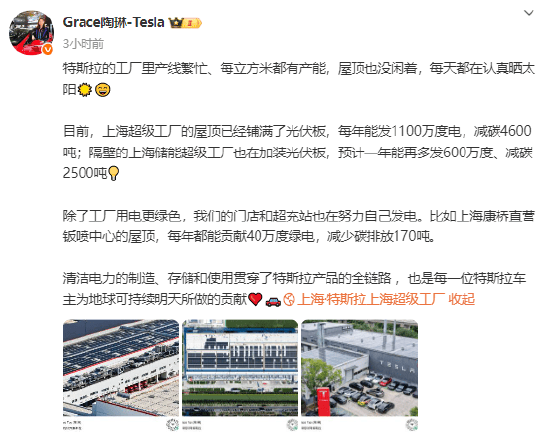
特斯拉副总裁陶琳:特斯拉上海超级工厂屋顶已铺满光伏板,每年发1100万度电,减碳4600吨!隔壁储能超级工厂也在加装光伏板
Sou Hu Cai Jing· 2025-10-28 10:00
Core Insights - Tesla's Shanghai Gigafactory has installed solar panels on its roof, generating 11 million kWh of electricity annually and reducing carbon emissions by 4,600 tons [1] - The adjacent Shanghai energy storage facility is also adding solar panels, expected to generate an additional 6 million kWh and reduce carbon emissions by 2,500 tons per year [1] - Tesla's stores and supercharging stations are also working towards self-generation of electricity, with the Shanghai Kangqiao direct sales body shop contributing 400,000 kWh of green electricity annually, reducing carbon emissions by 170 tons [1]


全长110公里!“超级暖气管”全线贯通
中国能源报· 2025-10-27 12:19
Core Points - The "Liaohe into Jinan" project has successfully completed the northern line, marking the longest and largest heat supply pipeline in China, with a total length of 110 kilometers and a diameter of 1.6 meters [1][3] - The project utilizes waste heat from the Xinyuan Power Plant in Liaocheng to provide clean heating to Jinan, significantly reducing coal consumption and carbon emissions during the heating season [3][5] - The southern line of the project is expected to be completed by the end of the year, bringing the total length of the north-south lines to approximately 150 kilometers, capable of heating 1 million square meters [5] Summary by Sections - **Project Overview**: The "Liaohe into Jinan" project aims to convert waste heat from Liaocheng's power plant into a clean heating source for Jinan, addressing the city's increasing heating demand and energy structure adjustment [3][7] - **Environmental Impact**: The project is projected to reduce coal consumption by 1.2989 million tons and cut carbon dioxide emissions by 3.564 million tons each heating season, equivalent to the carbon sequestration of four Saihanba forests in a year [5] - **Construction Challenges**: The project spans three cities and five counties, passing through 140 natural villages, with significant construction challenges, particularly the southern line's tunnel under the Yellow River, which required overcoming high water pressure and complex geological conditions [5][7] - **Future Developments**: By the end of the year, all 54 coal-fired heating boilers in Jinan's main urban area will be shut down, further enhancing the city's environmental sustainability [7]

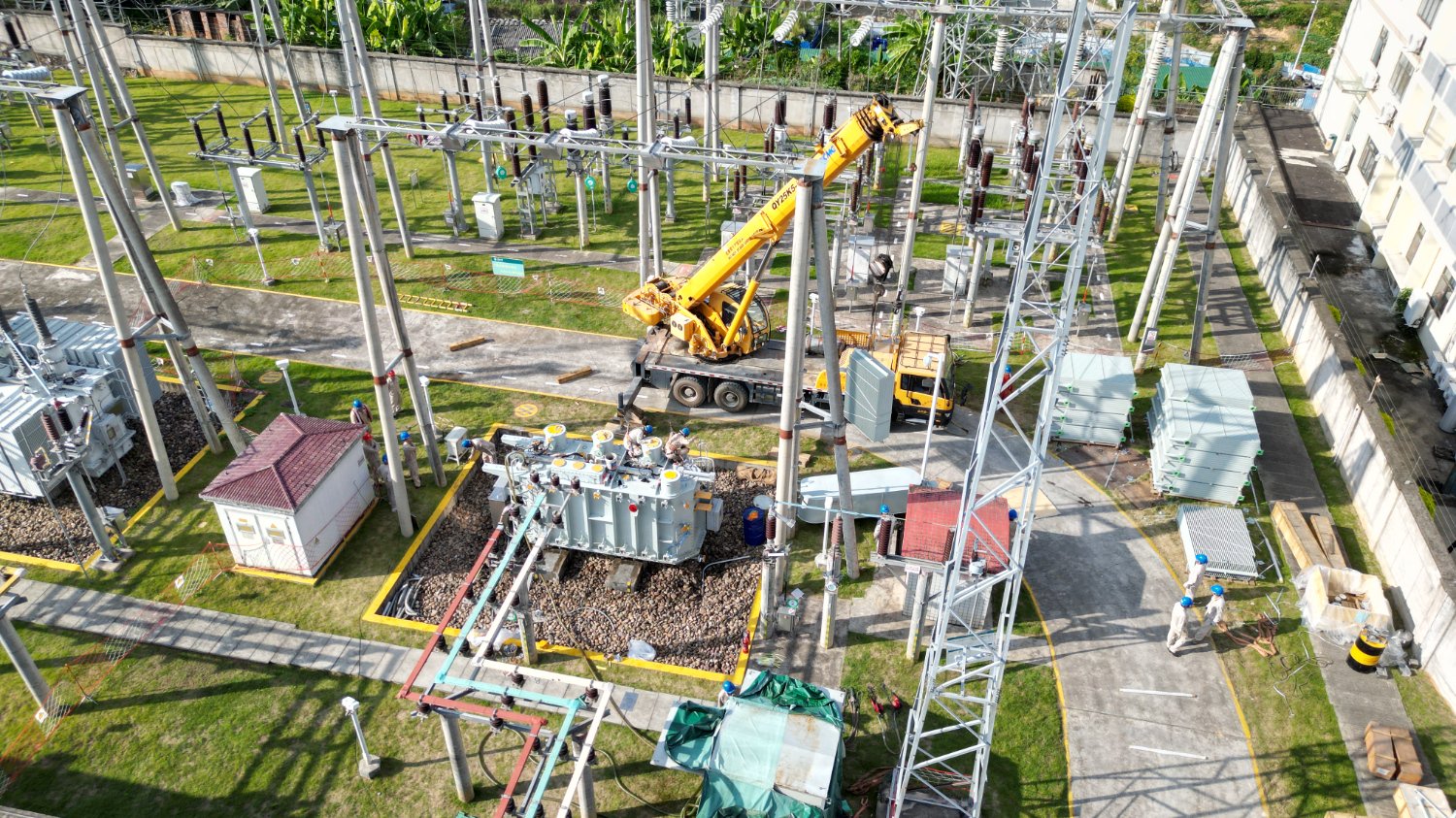
110千伏超一级能效变压器在三明尤溪投运
Zhong Guo Jin Rong Xin Xi Wang· 2025-10-25 11:56
Core Viewpoint - The successful commissioning of the 110 kV ultra-high efficiency transformer at the Shentai Substation in Sanming marks a significant advancement in energy-saving technology within China's power sector, contributing to the country's green and intelligent grid development [1][3][5]. Group 1: Project Overview - The project is a national key energy-saving transformation initiative, developed collaboratively by State Grid Fujian Electric Power Research Institute and China Electric Power Research Institute, with on-site installation and debugging managed by State Grid Sanming Power Supply Company [3][4]. - The transformer utilizes a 0.20 mm ultra-thin oriented silicon steel, which is significantly thinner than the traditional 0.23 mm silicon steel, leading to reduced energy consumption and improved power transmission efficiency [3][4]. Group 2: Environmental Impact - The new transformer is projected to save approximately 5.5 million kWh of electricity over its 30-year lifespan, equivalent to the annual electricity consumption of 5,000 households, while also reducing coal consumption by 1,600 tons and cutting CO2 emissions by 4,400 tons, comparable to planting 240,000 trees [4]. - The reduction in grid losses will help stabilize power supply costs, providing tangible "green dividends" [4]. Group 3: Implementation and Collaboration - The project involved extensive collaboration during the design phase, ensuring that material specifications and performance requirements were aligned with local operational conditions [4]. - State Grid Sanming Power Supply Company maintained strict oversight throughout the installation and debugging processes, ensuring quality control and adherence to project specifications [4][5]. Group 4: Strategic Importance - This initiative represents a practical step towards building an environmentally friendly power grid and contributes to the establishment of a new energy system in China, serving as a replicable model for nationwide green and low-carbon transformation efforts [5].