AI大模型

Search documents
海康威视业绩逆转经营现金流增426% 提升股东回报年内斥资121亿分红回购
Chang Jiang Shang Bao· 2025-10-19 23:31
Core Viewpoint - Hikvision has achieved a turnaround in its operating performance, with a slight increase in revenue and a significant increase in net profit for the first three quarters of 2025 [2][4][6]. Financial Performance - For the first three quarters of 2025, Hikvision reported revenue of approximately 658 billion yuan, a year-on-year increase of 1.18%, marking a historical high for the same period [4][6]. - The net profit attributable to shareholders reached approximately 93 billion yuan, showing a year-on-year increase of about 15% [2][4]. - In Q3 2025, the net profit growth exceeded 20%, the fastest quarterly growth since early 2024 [2][8]. Cash Flow and Financial Health - The operating cash flow for the first three quarters of 2025 was 136.97 billion yuan, a remarkable increase of 426% year-on-year [13]. - Accounts receivable decreased by approximately 6 billion yuan compared to the previous year [13]. - The financial expenses for the first three quarters were -6.34 billion yuan, a year-on-year increase of 376.69% [14]. Shareholder Returns - In 2025, Hikvision distributed a total of 121 billion yuan in dividends and share buybacks, including 64.30 billion yuan in dividends for the 2024 fiscal year and 36.60 billion yuan in interim dividends [14]. Research and Development - R&D investment remained stable at around 87 billion yuan for the first three quarters of 2025, reflecting the company's commitment to innovation [11][12]. - The company has developed over 30,000 smart IoT products, maintaining its leadership in the security industry [11]. Business Growth and Strategy - The company is actively leveraging breakthroughs in AI and digitalization to drive business growth and expand into new markets [8][10]. - The revenue from innovative business segments reached 117.66 billion yuan in the first half of 2025, a year-on-year increase of 13.92% [9][10].


展示前沿科技成果千余项,第八届长三角科交会闭幕
Guo Ji Jin Rong Bao· 2025-10-19 22:17
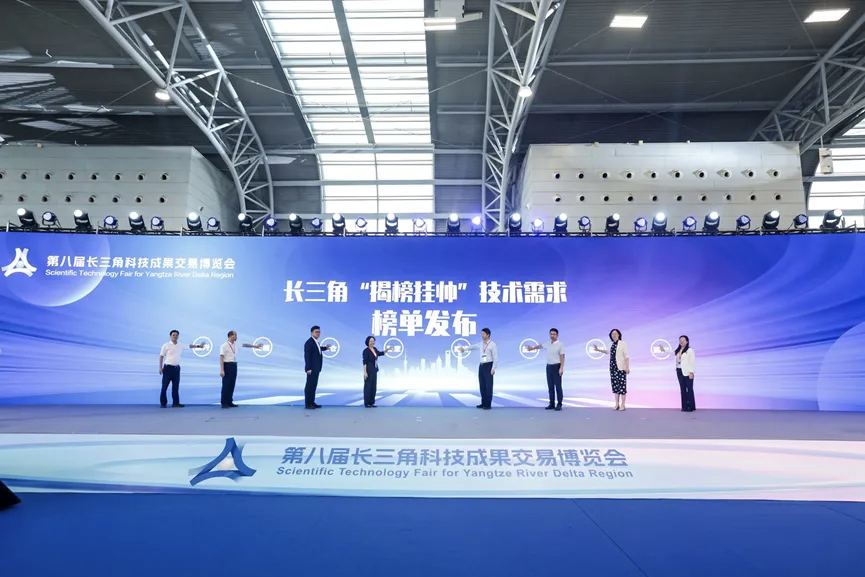
Core Insights - The 8th Yangtze River Delta Science and Technology Achievements Trading Expo concluded, showcasing over 1,000 cutting-edge technological achievements and attracting 6,000 visitors, highlighting the synergy between "science and innovation + industry" for regional integration and industrial innovation [1] - The expo focused on future industrial tracks, featuring five major exhibition areas covering advanced materials, intelligent manufacturing, quantum information, and aerospace technology, serving as a "showcase" and "testing ground" for technological innovation in the Yangtze River Delta [1] - Various technology service institutions participated deeply, facilitating technology transactions and investment matching, effectively breaking down information barriers and promoting efficient flow and allocation of innovation resources within the region [1] Group 1 - Nantong showcased nearly 30 cutting-edge innovative exhibits, including ultra-low temperature containers and semiconductor products, reflecting the city's commitment to high-quality development and creating a business environment aligned with Shanghai [2] - Taicang has participated in the expo for the eighth time, organizing 10 companies and several research institutions to display their innovations, emphasizing collaboration in technology resource sharing and achievement transformation [2] - The Yangtze River Delta National Technology Innovation Center exhibited over 50 high-tech products, focusing on common technology research and market-oriented product development to drive industrial growth [3] Group 2 - Since the beginning of the year, cities like Jiading, Nantong, and Taicang have engaged in extensive cooperation through the expo platform, addressing over 680 enterprise technology demands and facilitating the market transformation of over 300 technological achievements [5] - The expo promotes a "3+365" technology service system, enhancing regional technological sourcing capabilities and global influence through continuous science and technology exchange and cooperation [6]
海康威视(002415):归母净利润与现金流超预期,经营质量持续提升
Western Securities· 2025-10-19 13:19
Investment Rating - The investment rating for the company is "Buy" [6]. Core Insights - The company reported a revenue of 657.58 billion yuan for the first three quarters of 2025, representing a year-on-year increase of 1.18%, and a net profit attributable to the parent company of 93.19 billion yuan, up 14.94% year-on-year [1][6]. - The company is actively seeking domestic business opportunities related to its main operations while maintaining stable and rapid growth in overseas and innovative businesses [1]. - The company has implemented a profit-centered operational strategy, focusing on shareholder returns, with a significant increase in cash flow from operating activities, reaching 136.97 billion yuan, a 426% year-on-year increase [2][3]. Summary by Sections Business Performance - Domestic main operations are adjusting organizational structure and resource allocation based on macroeconomic conditions, targeting sectors like transportation, electronics, petrochemicals, and power [1]. - Overseas revenue growth has slowed down, but most regions outside the U.S., Canada, and India still maintain double-digit growth [1]. - Innovative businesses, including robotics and automotive electronics, have seen high revenue growth driven by demand in downstream industries [1][3]. Financial Metrics - For Q3 2025, the company achieved a revenue of 239.40 billion yuan, a 0.66% increase year-on-year, with a gross margin of 45.67%, up 1.65 percentage points [2]. - The net profit for Q3 2025 was 36.62 billion yuan, reflecting a 20.31% year-on-year increase, significantly outpacing revenue growth [2]. - The company has completed a mid-term cash dividend of 36.66 billion yuan and has repurchased shares worth 20.28 billion yuan over the past 12 months, totaling 121.25 billion yuan in shareholder returns [2]. Future Outlook - The company is expected to generate revenues of 950.36 billion yuan, 1022.84 billion yuan, and 1121.42 billion yuan for 2025, 2026, and 2027 respectively, with net profits projected at 140.40 billion yuan, 155.57 billion yuan, and 173.44 billion yuan [3]. - The outlook remains positive due to anticipated recovery in domestic market demand and opportunities in AI and digitalization [3].
调研速递|海康威视接受超200家机构调研,三季度业绩亮点多
Xin Lang Zheng Quan· 2025-10-18 14:18
Core Insights - Hikvision held a performance briefing on October 18, 2025, with over 200 institutions participating, discussing operational performance, AI model advancements, and future development strategies [1] Group 1: Operational Performance - In Q3 2025, Hikvision reported revenue of 23.976 billion, a year-on-year increase of 0.66%, with a gross margin of 45.67%, up 1.65 percentage points [2] - The net profit attributable to shareholders reached 3.662 billion, reflecting a year-on-year growth of 20.31% [2] - Operating cash flow net amount reached 13.697 billion, a significant increase of 426%, marking a record high for the period [2] - The company has distributed a total of 12.125 billion in cash dividends and buybacks over the past 12 months [2] Group 2: AI Model Progress - Hikvision is advancing both self-developed multi-modal perception models and open-source language models, with applications in intelligent customer service and fault diagnosis [3] - The self-developed models have been iteratively upgraded across multiple products, gaining attention at industry exhibitions [3] - The commercialization strategy involves leveraging an AI open platform and sales network to facilitate product deployment [3] Group 3: Q&A Highlights - The company discussed its "Lighthouse Factory" initiative, emphasizing its advantages in industrial AI and the potential for product enhancements in production and quality control [4] - Growth in overseas business is driven by demand across different regions, products, and channels, while capabilities in personnel, IT, and organizational management need strengthening [4] - The company aims to balance stakeholder interests by improving management efficiency and operational quality [4] - Future strategies include enhancing sales efficiency through AI applications and adjusting revenue strategies based on market conditions [4] - The management approach focuses on a profit-centered strategy, assessing product lines, regions, and receivables systematically [4]
把“废铁”卖上市!中国最大事故车平台博车网冲击港股
Sou Hu Cai Jing· 2025-10-18 14:12
Core Viewpoint - The rise of the accident car trading platform, BoChe Wang, marks a significant development in a niche market that has been overlooked, as it prepares for an IPO on the Hong Kong Stock Exchange, potentially becoming the first auction company for accident cars in the region [1] Group 1: Industry Pain Points and Opportunities - The accident car industry operates in a gray area of the used car market, often associated with safety hazards and pricing traps for consumers, while dealers face challenges in selling low-cost accident cars due to information asymmetry [3] - Accident cars are typically priced 30%-70% lower than normal used cars, providing budget-conscious consumers with high-value options and promoting resource recycling [3] - BoChe Wang aims to disrupt the industry by utilizing technology, including its proprietary "E-Pricing" and "E-Value" systems, to minimize pricing errors to within 5% and connect with over 95% of insurance companies and 42,000 repair shops nationwide [3] Group 2: Founder and Vision - The founder of BoChe Wang, Chen Jianpeng, has a remarkable background, having entered Tsinghua University at 16 and previously worked as an engineer at Unisplendour Group, but was motivated to reshape the industry after a negative experience with accident car trading [4] - Since its inception in 2014, BoChe Wang has focused on developing valuation systems and providing comprehensive solutions for insurance companies, gaining traction in a market that has seen competitors struggle [4] Group 3: Technology and Market Position - BoChe Wang's competitive edge lies in its two core systems: E-Pricing for accurate pricing based on historical data and damage parameters, and E-Value for transaction decision support, which have significantly improved industry efficiency [4] - By 2023, BoChe Wang achieved a market share of 31.3%, surpassing the combined market share of its second to fifth competitors, with an annual transaction volume exceeding 75,000 [4] Group 4: Financial Performance and IPO Implications - Despite the high potential of the accident car platform, BoChe Wang has faced financial challenges, reporting cumulative losses exceeding 300 million yuan from 2022 to 2024, with adjusted net profits increasing from 11.16 million yuan to 51.3 million yuan [5] - The IPO is seen as a potential solution to alleviate financial pressures and support technological upgrades and market consolidation, although the unique nature of the accident car industry requires ongoing market education and trust rebuilding [6] - The environmental aspect of BoChe Wang's business model, which focuses on recycling resources, may resonate with investors in the context of rising ESG principles [6]

海康威视前三季度净利增14.94%,AI大模型成增长新引擎
Zheng Quan Shi Bao· 2025-10-18 12:35
Core Insights - Hikvision reported a revenue of 65.758 billion yuan for the first three quarters of 2025, a year-on-year increase of 1.18%, and a net profit attributable to shareholders of 9.319 billion yuan, up 14.94% [1] - The company aims to continue its "profit-centered" strategy while investing in AI large models and digitalization, focusing on long-term growth [1][2] - Operating cash flow increased by 426%, reaching 13.697 billion yuan, which is 1.47 times the net profit attributable to shareholders, marking a historical high for the company [2] Financial Performance - As of the end of Q3, accounts receivable and notes receivable totaled 35.969 billion yuan, a decrease of 1.288 billion yuan from June and a significant drop of 4.664 billion yuan from the beginning of the year [2] - The company has returned 12.124 billion yuan to shareholders over the past 12 months through cash dividends and share buybacks [2] - Since its listing in 2010, Hikvision has accumulated a net profit of approximately 138 billion yuan and distributed around 68.5 billion yuan in cash dividends, achieving a dividend payout ratio of about 50% [2] AI Development - The State Council recently issued opinions on implementing "Artificial Intelligence+" actions, promoting the integration of AI across various industries [3] - Hikvision is actively adjusting its organizational structure and resource allocation to seize business opportunities in sectors like transportation, electronics, and energy [3] - The company is investing heavily in AI large model technologies, which are becoming a new engine for its capabilities and a key to entering various industries [3][4] Operational Efficiency - AI large models are being implemented in Hikvision's factories for quality control and operational efficiency, achieving over 99% accuracy in identifying production errors [4] - The Hikvision Guanlan large model has been successfully applied in industries such as manufacturing, transportation, and energy, leading to significant improvements in operational efficiency [5] - For instance, the use of AI in industrial quality inspection has increased detection efficiency by 80%, while traffic signal control has improved accuracy by 16%-25% [5][6] Commercialization Strategy - Hikvision supports a rich array of AI products through an open AI platform, complemented by training and tools to facilitate faster implementation [6] - The company's extensive sales network ensures that even users in remote areas can quickly adopt its AI large model products [6]
着急上市的智谱和六小龙,得证明自己能赚钱
凤凰网财经· 2025-10-18 10:10
Core Viewpoint - The article discusses the recent restructuring and layoffs at Zhipu, an AI unicorn preparing for an IPO, highlighting the challenges faced by the company and the broader "six little dragons" in balancing technology development and commercialization [2][3][11]. Group 1: Company Restructuring and Layoffs - Zhipu has undergone significant layoffs, particularly in its R&D center, with some teams experiencing over 50% reduction in staff [4][6]. - The restructuring indicates a shift from a centralized product development model to a more decentralized approach, where individual business units will develop solutions based on client needs [6][9]. - The layoffs are seen as a move to improve efficiency and align with the company's IPO preparations, as the company aims to present a more favorable financial picture [10][11]. Group 2: IPO Preparation - Zhipu is simultaneously preparing for listings on both A-shares and Hong Kong stocks, with a valuation reaching 40 billion RMB following several rounds of strategic investments from state-owned enterprises [11][12]. - The company is expected to face challenges in demonstrating profitability, as it reported a revenue of 300 million RMB in 2024 but incurred losses of approximately 2 billion RMB [14][17]. - The recent changes in listing regulations in both A-shares and Hong Kong may provide a more accessible pathway for unprofitable tech companies to go public [14][15]. Group 3: Market Position and Competition - Zhipu has secured significant contracts with state-owned enterprises, including a project worth over 60 million RMB with Hangzhou Urban Investment [7][20]. - The company is positioned as a competitor in the AI market, with OpenAI recognizing it as a potential challenger in global markets [7][16]. - Despite its achievements, Zhipu faces intense competition from larger tech firms that have more diversified revenue streams, making it difficult for startups focused solely on model technology to sustain growth [20][24]. Group 4: Future Outlook - The article suggests that Zhipu, like other startups in the AI sector, must continue to innovate and adapt its business model to survive in a competitive landscape dominated by larger players [19][25]. - The focus on model-driven business strategies may limit Zhipu's ability to scale effectively without additional revenue sources [26]. - The ongoing need for cost-cutting measures and efficiency improvements is likely to persist as the company navigates its IPO and seeks to establish a more sustainable business model [18][25].

海康威视:前三季度现金流同比增长426% AI大模型落地提速
Zhong Zheng Wang· 2025-10-18 09:12
Core Viewpoint - Hikvision reported steady growth in revenue and net profit for the third quarter of 2025, indicating a positive financial performance amidst ongoing organizational adjustments and a focus on AI integration [1][2]. Financial Performance - For the first three quarters of 2025, Hikvision achieved a total revenue of 65.758 billion yuan, a year-on-year increase of 1.18%, and a net profit attributable to shareholders of 9.319 billion yuan, up 14.94% [1]. - In the third quarter alone, the company generated revenue of 29.040 billion yuan, reflecting a 0.66% year-on-year growth, with a gross margin of 45.67%, an increase of 1.65 percentage points [1]. - The net profit for the third quarter was 3.662 billion yuan, marking a 20.31% increase year-on-year [1]. Cash Flow and Shareholder Returns - By the end of the third quarter, accounts receivable and notes receivable totaled 35.969 billion yuan, a decrease of 1.288 billion yuan from June and a significant drop of 4.664 billion yuan from the beginning of the year [2]. - The net cash flow from operating activities for the first three quarters was 13.697 billion yuan, a remarkable increase of 426%, which is 1.47 times the net profit attributable to shareholders [2]. - Over the past 12 months, the company returned 10.096 billion yuan in cash dividends and conducted a buyback of 2.028 billion yuan, totaling 12.125 billion yuan [2]. - Since its listing in 2010, Hikvision has accumulated a net profit of approximately 138 billion yuan and cash dividends of about 68.5 billion yuan, with a dividend payout ratio of around 50% [2]. AI Integration and Industry Applications - Hikvision is actively integrating AI technology across various industries, focusing on sectors such as transportation, electronics, petrochemicals, and smart commerce [3]. - The company has made significant investments in AI model technologies, which have been deployed in its own factories for quality inspection, intelligent customer service, and other applications, achieving over 99% accuracy in certain scenarios [3]. - The AI model has shown substantial improvements in operational efficiency, such as an 80% increase in efficiency for circuit board welding defect detection and a reduction of over 1.2 million yuan in annual costs for a 300MW offshore wind farm [3]. Future Strategy - The company plans to maintain a profit-centered operational strategy, focusing on AI model investments and digitalization of scenarios, while adhering to a long-term approach to enhance performance for employees and shareholders [4].
三箭齐发激活营收增长,方正电机多元布局成果加速兑现
Quan Jing Wang· 2025-10-17 11:19
Core Viewpoint - The rapid development of artificial intelligence and a complete supply chain is driving significant innovation in China's future industries, particularly in electric vehicles and humanoid robots, leading to a new pattern of industrial upgrading. Group 1: Company Overview - Fangzheng Electric (002196) has established competitive advantages across multiple fields and is actively expanding new growth curves, particularly in micro-special motors, controllers, and electric vehicle drive systems [1][2]. - The company has a leading position in the micro-special motor and controller market, with a global market share of approximately 75% in household sewing machine motors and has successfully entered the supply chains of major international clients in the electric tool motor business [2]. Group 2: Financial Performance - In the first half of 2025, Fangzheng Electric's micro-special motor business revenue grew by 9.11%, while overall profitability increased by 20.47% [2]. - The company's electric vehicle drive motor shipments reached 463,600 units in a single quarter, with a historical cumulative total exceeding 3.56 million units, covering over 40 popular vehicle models [3]. Group 3: Market Trends - The global electric tool market is projected to grow from $29.69 billion in 2025 to $40.95 billion by 2032, with a steady CAGR of 4.7% from 2025 to 2032 [1]. - The Chinese passenger car market for new energy vehicles is expected to exceed 23 million units by 2028, with a CAGR of 22.8% [3]. Group 4: Product Development - Fangzheng Electric's subsidiary, Shanghai Haineng Automotive Electronics, has developed a series of automotive engine control systems and is actively engaging in new product development, including controllers for hydrogen and methanol engines [4]. - The company is advancing its humanoid robot joint module development, with 18 patents filed and 9 authorized, indicating progress towards mass production [5]. Group 5: Industry Outlook - The electric tool, new energy vehicle, and humanoid robot sectors are all entering demand inflection points, positioning Fangzheng Electric at the intersection of "Made in China" and "Intelligent Manufacturing" [6]. - With global liquidity returning to a loose state and inventory cycles improving, Fangzheng Electric is expected to experience a resonance of traditional business recovery and explosive growth in emerging sectors [6].

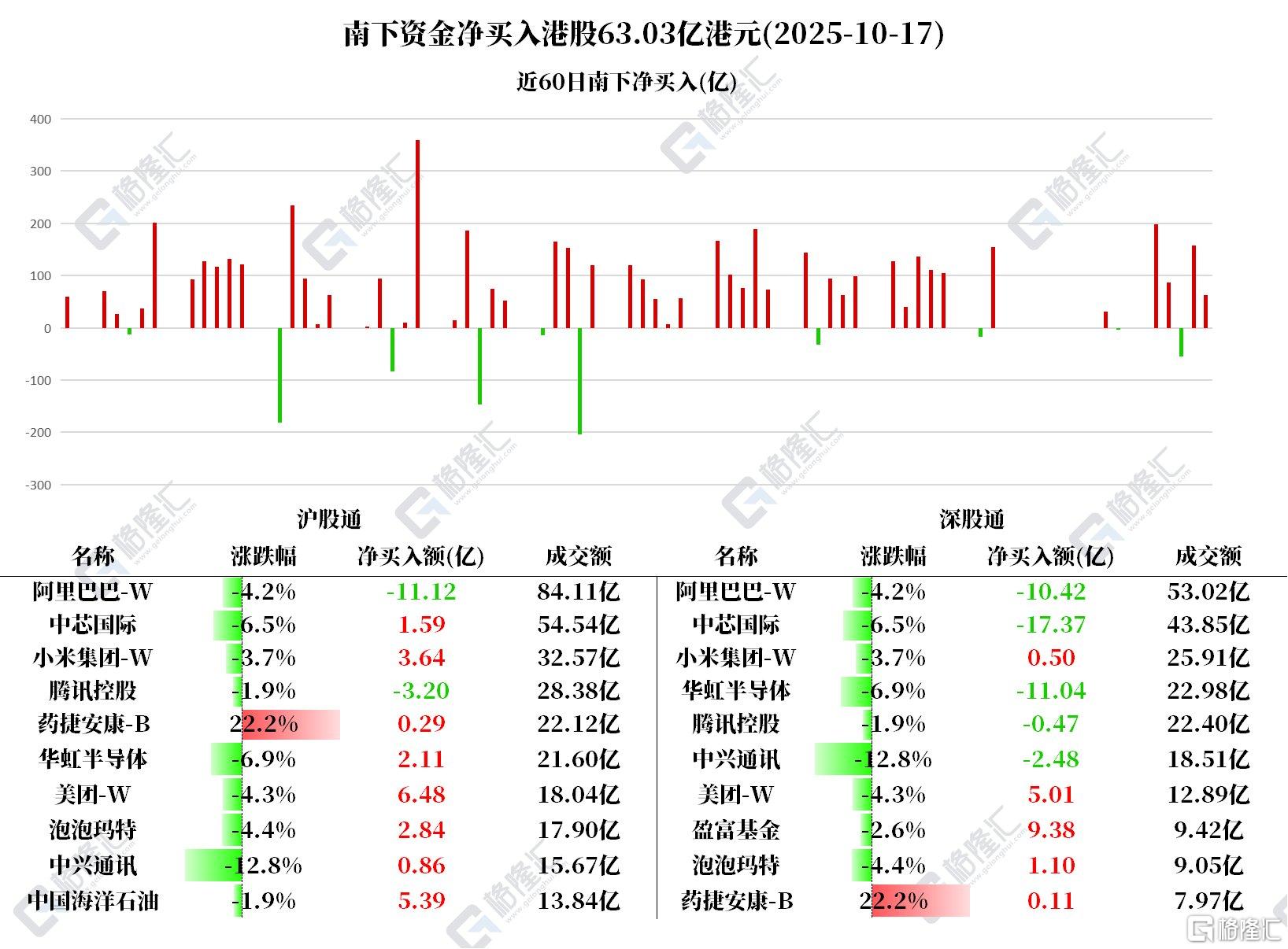
资金动向 | 北水抛售阿里超21亿港元,连续10日加仓小米!
Ge Long Hui· 2025-10-17 10:44
Core Insights - Southbound funds net bought Hong Kong stocks worth 6.303 billion HKD on October 17, with significant purchases in Meituan, the Tracker Fund, and CNOOC, while Alibaba and SMIC saw substantial net sell-offs [1][4]. Group 1: Stock Performance - Meituan saw a net buy of 1.149 billion HKD, with a price increase of 4.3% [1][4]. - Xiaomi Group had a net buy of 414 million HKD, with a price decrease of 3.7% [1][4]. - Alibaba experienced a net sell of 2.153 billion HKD, with a price drop of 4.2% [1][4]. - SMIC faced a net sell of 1.578 billion HKD, with a price decline of 6.5% [1][4]. - Continuous net buying of Xiaomi for 10 days totals 7.40256 billion HKD, and 4 days for Pop Mart totals 1.46812 billion HKD [4]. Group 2: Company Developments - Meituan announced a "Service Retail Assistance Fund" plan, allocating 1.2 billion HKD to support over 120,000 quality service retailers [6]. - Xiaomi's founder highlighted AI models as a future trend in smart connected vehicles, emphasizing the integration of various sensors for enhanced user interaction [6]. - UBS maintains a "Buy" rating for Pop Mart, predicting that upcoming sales data and new product launches will act as short-term catalysts [7]. - Alibaba's revenue forecast for FY26Q2 is 126.9 billion CNY, with a year-on-year growth of 11.6% [7]. - Semiconductor companies like SMIC and Huahong Semiconductor are facing market concerns about AI investment bubbles, but overall sentiment remains optimistic [8]. Group 3: Regulatory and Market Environment - The FCC has removed millions of Chinese electronic products from major e-commerce platforms, affecting companies like ZTE [9]. - The market is closely monitoring the FCC's potential expansion of bans on devices containing components from blacklisted companies [9].