
生成式AI

Search documents
【钛晨报】增强消费品供需适配性,国常会重磅部署;苹果CEO库克被曝或于明年卸任;宇树科技IPO辅导完成
Tai Mei Ti A P P· 2025-11-16 23:38
Group 1 - The State Council meeting emphasized enhancing the adaptability of supply and demand as a key measure to unleash consumption potential and facilitate economic circulation [3][4] - The shift in policy focus is moving from merely stimulating consumption or expanding production to achieving a higher level of dynamic balance and positive interaction between supply and demand [3][4] - The meeting outlined new measures to lead industrial upgrades through consumption upgrades, accelerate innovation in new technologies and models, and support enterprises in expanding high-quality consumer goods supply [4][16] Group 2 - The meeting highlighted the importance of precise matching of consumer demand with supply capabilities to reduce resource waste and improve market efficiency [3][4] - It was noted that enhancing supply-demand adaptability plays a bridging role in connecting production and consumption, promoting industrial and consumption upgrades [3][4] - The focus will be on developing flexible manufacturing facilities to efficiently respond to personalized consumer needs and creating new consumption scenarios and business formats [4] Group 3 - The financial sector is expected to play a crucial role in guiding capital to areas that create long-term value, requiring inclusivity and efficient resource allocation [5] - The potential of generative AI to reshape the financial industry is highlighted due to its data-intensive nature and the significant proportion of language-related tasks [5] - The investment plans of major companies like Hyundai and Samsung indicate a strong commitment to expanding their operations in electric vehicles and semiconductors, respectively, with significant financial commitments [13][14]

AI「逼宫」库克?苹果秘密计划曝光,接班人竟是M芯片之父
3 6 Ke· 2025-11-16 23:20
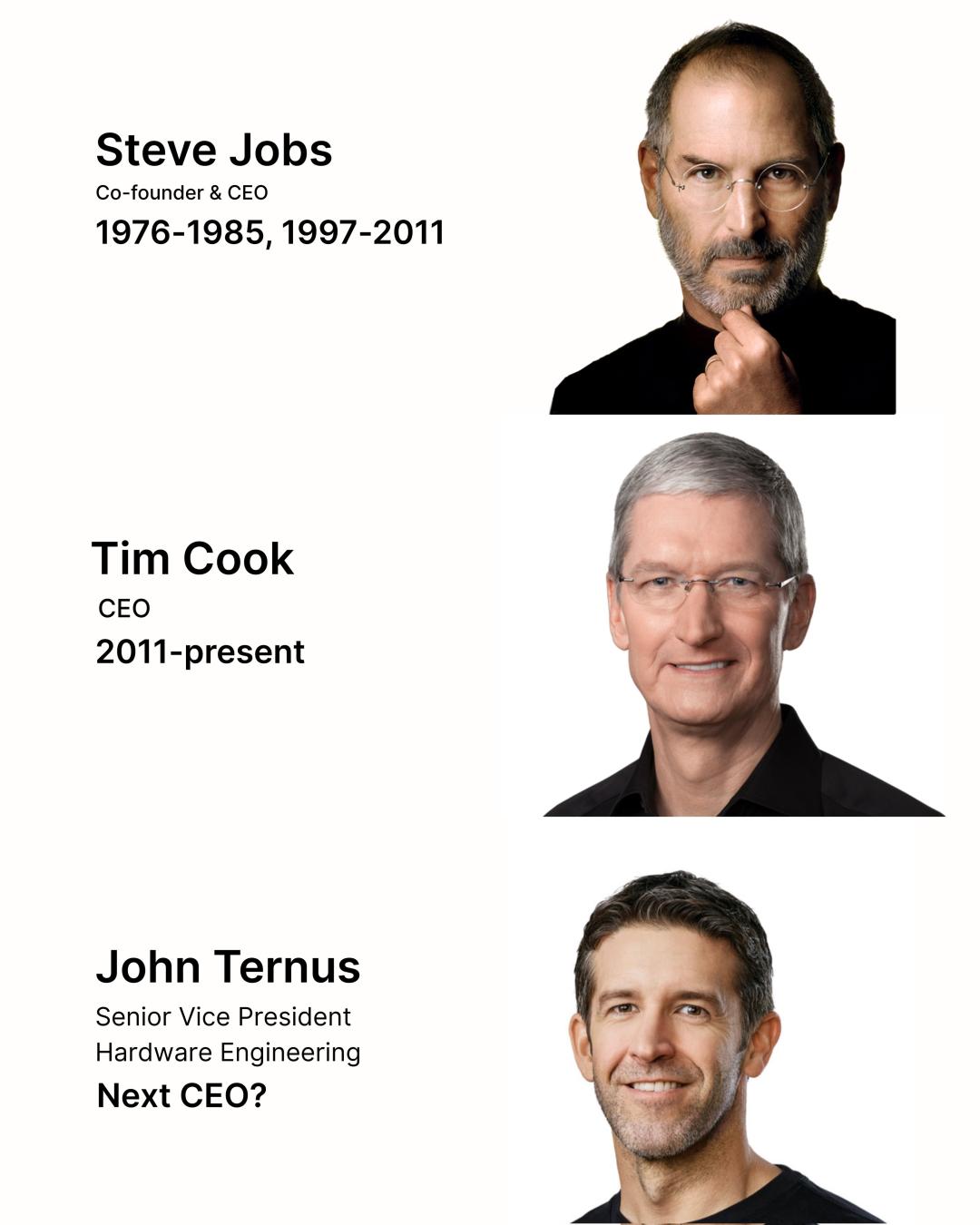
Core Insights - Apple is reportedly preparing for a leadership transition, with CEO Tim Cook expected to step down in 2026, raising questions about the company's future direction in an AI-dominated landscape [1][9][20] - John Ternus, the current Senior Vice President of Hardware Engineering, is a leading candidate to succeed Cook, having played a significant role in the development of Apple's M-series chips and various product lines [7][10][12] - Concerns among board members about Cook's ability to navigate Apple through an AI-centric era have intensified, with calls for a product-focused CEO rather than one focused on logistics [9][20] Leadership Transition - Tim Cook, who has been with Apple for 14 years, has transformed the company from a hardware manufacturer to a highly industrialized entity, increasing its market value from approximately $350 billion in 2011 to $4 trillion [15][17] - The board is considering a detailed succession plan, favoring internal candidates, with Cook expressing a strong preference for promoting from within [29] John Ternus Profile - John Ternus, 50, has been with Apple since 2001 and has risen through the ranks, becoming a key figure in product launches and hardware engineering [10][12][14] - His leadership in the development of Apple's custom M-series chips has been pivotal, and he is seen as a potential innovator who could lead Apple into a new chapter [1][12] AI and Innovation Concerns - Apple has been perceived as lagging behind competitors like Microsoft and Alphabet in the AI space, with analysts highlighting the need for a clear AI strategy [19][22] - The company's focus has been more on device-side machine learning rather than developing a comprehensive AI assistant, which has raised concerns about its innovation trajectory [22][24]

前瞻全球产业早报:全球数据中心投资首次超过石油支出
Qian Zhan Wang· 2025-11-16 23:11
商务部等四部门:严格以改装车名义出口车辆的许可证申领条件 商务部、工业和信息化部、公安部、海关总署发布关于进一步加强二手车出口管理工作的通知。其中提到, 各地商务主管部门要指导改装车出口企业准确填写车辆底盘品牌、改装车品牌、车辆型号等信息,提交改装 真实性证明材料(附件2)。对无法证明改装真实性,同类改装车产品未列入工业和信息化部《道路机动车 辆生产企业及产品公告》、不具备有效的国家强制性产品认证的产品,不予发放出口许可证。 国家统计局:服务消费增长日益成为居民消费的重要增长点 11月14日,国家统计局新闻发言人、总经济师、国民经济综合统计司司长付凌晖在国新办新闻发布会上表 示,我国居民消费正在加快转型,服务消费增长日益成为居民消费的重要增长点。在国庆中秋假日的因素带 动下,10月份的服务消费持续较快增长,1—10月份服务零售额比1—9月份是加快0.1个百分点,高于同期商 品零售额的增速是0.9个百分点。从结构看,一是文旅服务增势较好,二是信息服务较快增长,数字影音、 网络娱乐等服务需求持续扩大。此外,假期期间居民外出就餐增加。从新兴消费看,数字消费和绿色消费在 持续壮大。付凌晖表示,我国正处在消费结构升级的 ...

腾讯研究院AI速递 20251117
腾讯研究院· 2025-11-16 16:01
Group 1: openEuler and AI Operating Systems - openEuler community has launched a new 5-year development plan, with the first AI-focused supernode operating system (openEuler 24.03 LTS SP3) set to be released by the end of 2025, involving over 2,100 member organizations and more than 23,000 global contributors [1] - The operating system features global resource abstraction, heterogeneous resource integration, and a global resource view, aimed at maximizing the computational potential of supernodes and accelerating application innovation [1] - The Lingqu Interconnection Protocol 2.0 will contribute support for supernode operating system plugins, providing key capabilities such as unified memory addressing and low-latency communication for heterogeneous computing [1] Group 2: Google and AI Models - Google CEO's cryptic response with two thoughtful emojis hints at the anticipated launch of Gemini 3.0 next week, with 69% of netizens betting on the release of this next-generation AI model, which is expected to be a significant turning point for Google [2] - Early testing reveals that Gemini 3.0 can generate operating systems and build websites in seconds, showcasing impressive front-end design capabilities, leading to its label as the "end of front-end engineers" [2] - Warren Buffett has invested $4.3 billion in Google stock, with high expectations for Gemini 3.0's performance, which will determine Google's potential to challenge for AI leadership [2] Group 3: Gaming AI Developments - Google DeepMind has introduced SIMA 2, an AI agent capable of playing games like a human by using virtual input devices, overcoming the limitations of simple command following and demonstrating reasoning and learning abilities [3] - SIMA 2 can tackle new games without pre-training and understands multimodal prompts, enhancing its self-improvement through self-learning and feedback from Gemini [3] - The system employs symbolic regression methods and integrates Gemini as its core engine, aiming to serve as a foundational module for future robotic applications, though it still faces limitations in complex tasks [3] Group 4: Long-term Memory Operating Systems - The EverMemOS, developed by Chen Tianqiao's team, has achieved high scores of 92.3% and 82% on LoCoMo and LongMemEval-S benchmarks, significantly surpassing state-of-the-art levels [4] - Inspired by human memory mechanisms, the system features a four-layer architecture (agent layer, memory layer, index layer, interface layer) and employs "layered memory extraction" to address challenges in pure text similarity retrieval [4] - An open-source version is available on GitHub, with a cloud service version expected to be released later this year, aimed at providing enterprises with data persistence and scalable experiences [4] Group 5: AI Wearable Technology - Sandbar has launched the Stream smart ring, priced at $249-$299, which eliminates health monitoring features to focus on AI voice interaction capabilities [5] - The ring uses a "fist whisper" interaction method to activate recording and dynamically switch between multiple large models, but has a battery life of only 16-20 hours, which is inferior to traditional smart rings [5] - The accompanying iOS app utilizes ElevenLabs to generate voice models that mimic user voices, ensuring end-to-end encryption of data without storing original audio, although privacy and value propositions remain questionable [5] Group 6: NotebookLM and Research Tools - Google NotebookLM has introduced the Deep Research feature, which can automatically gather multiple relevant web sources and organize them into a contextual list, creating a dedicated knowledge base within minutes [7] - The system supports processing of 25 million tokens in context, ensuring that all responses are based on user-provided sources with citation, enhancing verifiability and reducing AI hallucination issues [7] - Its video overview feature can convert documents, web pages, and videos into interactive videos, with Google committing not to use personal data for model training [7] Group 7: AI in Physics - A team from Peking University has developed the AI-Newton system, which employs symbolic regression methods to rediscover fundamental physical laws without prior knowledge [8] - The system is supported by a knowledge base consisting of symbolic concepts, specific laws, and universal laws, identifying an average of about 90 physical concepts and 50 general laws in test cases [8] - AI-Newton demonstrates progressive and diverse characteristics, currently in the research phase, but offers a new paradigm for AI-driven autonomous scientific discovery, with potential applications in embodied intelligence [8] Group 8: OpenAI's Research on Explainability - OpenAI has released new research on explainability, proposing sparse models with fewer neuron connections but more neurons, making the internal mechanisms of the model easier to understand [9] - The research team identified the "minimal loop" for specific tasks, quantifying explainability through geometric averages of edge counts, finding that larger, sparser models can generate more powerful but simpler functional models [9] - The paper's communication author, Leo Gao, is a former member of Ilya's super alignment team, but the research is still in early stages, with sparse models being significantly smaller and less efficient than cutting-edge models [9] Group 9: Elon Musk's AI Vision - Elon Musk is advancing xAI on the X and Tesla platforms, with the Colossus supercomputer data center deploying 200,000 H100 GPUs in 122 days for training Grok-4 and the upcoming Grok-5 [10] - xAI follows a "truth-seeking, no taboos" approach, allowing AI to generate synthetic data to reconstruct knowledge systems, aiming to create a "Grok Encyclopedia," with Tesla's next-generation AI5 chip expected to enhance performance by 40 times [10] - Grok is set to be integrated into Tesla vehicles, with Musk predicting that by 2030, AI capabilities may surpass those of all humanity, while xAI plans to open-source the Grok-2.5 model and release Grok-3 in six months [10]


AI抢饭碗!美国职场进入淘汰制,实习成奢侈品,2026届学生慌了
Sou Hu Cai Jing· 2025-11-16 11:48
当大规模裁员潮、AI替代风暴与经济疲软形成共振,2026届毕业生正遭遇一场 "三重危机" 叠加的就业 寒冬,找工作从 "双向选择" 沦为 "生死竞速"。 巨头裁员潮蔓延 企业裁员的触角正从科技行业向全领域延伸。 继亚马逊、UPS 宣布大规模减员后,威瑞森通信(Verizon)计划一周内裁撤1.5万个岗位,创下公司史 上最大规模裁员纪录。 传统制造业同样未能幸免,福特汽车宣布2026年初将关闭德国科隆工厂部分生产线,裁员1000 人,累 计欧洲裁员规模将达4000人。 美国银行数据显示,仅科技行业就已砍掉8.9万个岗位,其中2.7万个直接被AI替代。 距离2026年春季毕业季尚有半年,美国高校的求职氛围已降至冰点。 美国全国高校与雇主协会(NACE)对183家企业的最新调查显示,52%的雇主将明年春招评级为 "糟糕 或一般",这是自2020年疫情以来最悲观的预期。 更令人揪心的是,纽约联储数据显示,今年6月美国应届生失业率飙至4.8%,不仅高于4.3%的整体失业 率,更创下四年来同期峰值。 裁员背后企业用人策略发生根本转变。NACE调查显示,雇主更倾向于招聘有经验的求职者填补空缺, 而非从零培养应届生。 曾任职 ...


10人团队千万融资,这个原生AI产品要做“人人可用的数据Agent”丨对话ChatExcel
量子位· 2025-11-16 01:30
Core Insights - The article emphasizes the urgency for AI products to incorporate Agent elements, as users are increasingly likely to abandon products lacking these features [4][5]. - ChatExcel is highlighted as a pioneering AI DataAgent that simplifies data processing through natural language interactions, targeting a broad user base rather than just elite professionals [10][15]. Group 1: Market Trends and User Needs - The rise of Agent products reflects a market demand for solutions that address real user pain points, particularly in data processing [5][6]. - Data processing is identified as a critical challenge for many workers, with the need for 100% accuracy in handling complex datasets [6][68]. - ChatExcel's approach to data processing through conversational AI has attracted a significant user base, with nearly one million users reported [23][14]. Group 2: Product Features and Capabilities - ChatExcel offers a comprehensive suite of features, including multi-modal data input, intelligent dialogue interaction, and the ability to handle various data formats [11][13]. - The product's architecture supports complex data processing tasks, including handling large files and integrating with enterprise databases [13][10]. - ChatExcel's iterative development strategy focuses on expanding its capabilities from simple Excel processing to more complex data analysis and reporting functions [16][61]. Group 3: Business Model and Growth Strategy - The company has successfully secured angel funding and formed partnerships with major tech firms, enhancing its market presence [14][15]. - ChatExcel prioritizes user engagement metrics such as usage rates and customer satisfaction over sheer user numbers, indicating a focus on quality interactions [15][23]. - The product's pricing model is designed to be accessible, with various subscription options to cater to different user needs [122]. Group 4: Competitive Landscape and Future Outlook - The competitive landscape is characterized by a mix of established BI tools and emerging AI solutions, with ChatExcel positioning itself as a user-friendly alternative [104][113]. - The company aims to leverage partnerships to amplify its reach and user engagement, aspiring to have a network of partners rather than just a large user base [17][110]. - Future developments will focus on enhancing the product's capabilities and expanding its application across various data processing scenarios [108][109].

全球半导体销售额连续23个月增长
日经中文网· 2025-11-16 00:33
Core Insights - The global semiconductor sales in September increased by 25.1% year-on-year, reaching $69.47 billion, marking the 23rd consecutive month of growth [2] - The strong demand for generative AI in the U.S. market contributed to a 30% year-on-year increase in sales [2] - September sales grew by 7.0% compared to August [4] Regional Performance - Sales in the Americas reached $22.52 billion, up 30.6% year-on-year [6] - European sales amounted to $4.69 billion, reflecting a 6.0% year-on-year increase [6] - China's sales were $18.69 billion, with a year-on-year growth of 15.0% [6] - Sales in the Asia-Pacific region, excluding Japan and China, surged by 47.9% to $19.78 billion [6] - Japan's sales declined by 10.2% to $3.78 billion, attributed to a lower number of domestic companies involved in semiconductor assembly [6] Market Composition - Although specific sales category data was not disclosed, it is estimated that memory and logic semiconductors constitute a significant portion of the sales [6] - The price of dynamic random-access memory (DRAM) continues to rise in bulk transactions [6]
印度迎来 AI调工具“0元购”时代!OpenAI、谷歌等巨头内心 os:别急,先让他们上瘾,我们再来收费
AI前线· 2025-11-15 05:32
Core Viewpoint - Major tech companies are aggressively providing free AI tools to Indian developers, indicating a strategic investment in India's digital future and a bid to capture a large user base [3][14][31]. Group 1: Company Initiatives - Perplexity AI partnered with Airtel to offer its Pro version for free for one year, valued at approximately 17,000 INR (about 1,365 RMB) [4][10]. - Google collaborated with Jio to provide Gemini Pro for free for 18 months, valued at around 35,000 INR (about 2,810 RMB) [4][10]. - OpenAI announced a free one-year access to ChatGPT "Go" for millions of Indian users, starting from November 4, 2025, which includes advanced features typically requiring payment [6][8]. Group 2: Market Dynamics - The competition among tech giants in India is intensifying, with a focus on attracting young users aged 18 to 25 [4][13]. - Perplexity's downloads in India surged by 600% in Q2, reaching 2.8 million, while OpenAI's ChatGPT saw a 587% increase, totaling 46.7 million downloads [11]. Group 3: Strategic Insights - Analysts suggest that these free offerings are not acts of generosity but calculated investments aimed at making Indian users addicted to generative AI before introducing paid services [14]. - India's large and youthful user base, along with its open digital market, presents a significant opportunity for global tech companies to train their AI models [14][16]. Group 4: Regulatory Environment - As of April 2024, 95.15% of Indian villages have access to 3G/4G networks, with internet users increasing from 251.59 million in March 2014 to 954.4 million in March 2024 [16]. - The lack of specific AI regulations in India allows companies to bundle free AI tools with telecom packages, a strategy that would face challenges in more regulated markets like the EU [25][28]. Group 5: User Perspectives - Users express concerns about data privacy and the potential for companies to exploit their data in exchange for free services [19][22]. - Some users view the free services as a strategy to create dependency on AI tools, predicting that companies will eventually charge high fees once they establish a dominant market position [32][33].

AAAI 2026|教会视频扩散模型「理解科学现象」:从初始帧生成整个物理演化
机器之心· 2025-11-15 01:37
Core Insights - The article discusses the limitations of existing video generation models like Stable Diffusion and CogVideoX in accurately simulating scientific phenomena, highlighting their tendency to produce physically implausible results [2][3] - A new framework proposed by a research team from Dongfang University and Shanghai Jiao Tong University aims to enable video diffusion models to learn "latent scientific knowledge," allowing them to generate scientifically accurate video sequences from a single initial frame [3][4] Methodology - The proposed method consists of three main steps: latent knowledge extraction, pseudo-language prompt generation, and knowledge-guided video generation [8] - The first step involves extracting "latent scientific knowledge" from a single initial image, which is crucial for inferring subsequent dynamic evolution [9] - The second step generates pseudo-language prompts by leveraging the CLIP model's cross-modal alignment capabilities, allowing the model to "understand" the underlying structural rules in the initial image [10] - The third step integrates these pseudo-language prompts into existing video diffusion models, enabling them to simulate scientific phenomena while adhering to physical laws [11] Experimental Results - The research team conducted extensive experiments using fluid dynamics simulation data and real typhoon observation data, demonstrating that the new model generates videos that are not only visually superior but also more scientifically accurate [13][18] - The model was tested on various fluid simulation scenarios, including Rayleigh-Bénard Convection, Cylinder Flow, DamBreak, and DepthCharge, as well as real satellite data from four typhoon events [13][18] - Quantitative evaluations showed significant improvements in physical consistency metrics, with the new model outperforming mainstream methods in all tested scenarios [18] Future Implications - This research represents a meaningful exploration of generative AI in scientific modeling, suggesting that AI can evolve from merely visual generation to understanding and simulating physical processes [19][20] - The potential applications of this technology could extend to meteorological forecasting, fluid simulation, and Earth system modeling, positioning AI as a valuable tool for scientists [20]

英唐智控(300131) - 2025年11月14日投资者关系活动记录表
2025-11-14 12:02
Group 1: Company Overview and Business Strategy - The main business of Ying Tang Intelligent Control includes electronic component distribution, chip design and manufacturing, and software R&D and sales [2][3] - The company aims to integrate its own R&D capabilities with overseas products and technologies to better meet domestic market demands and shorten product launch cycles [3] Group 2: Acquisition Details - The two targeted companies for acquisition, Guanglong Integrated Technology and Aojian Microelectronics, have strong technical and market synergies with Ying Tang [3][4] - Guanglong Integrated has a comprehensive product line including optical switches and optical protection modules, and is a leading player in the optical switch market [4] - Aojian Microelectronics specializes in power management analog chips and temperature sensors, with significant applications in consumer electronics and communication sectors [5] Group 3: Market Demand and Growth Potential - The demand for optical switches is expected to grow rapidly due to the surge in high-end computing needs driven by generative AI and cloud computing [4] - Aojian Microelectronics anticipates rapid business growth due to the vast market demand for its analog chips [5] Group 4: Product Development and Orders - The company has received significant orders for its MEMS micro-mirror products, particularly in the automotive LiDAR and laser projection sectors [6][7] - The company has successfully launched its first automotive-grade TDDI/DDIC chips and is making progress in OLED DDIC products, with mass production expected by Q1 2026 [7] Group 5: Financial Performance and R&D Investment - The storage chip business has seen rapid growth compared to the previous year, with a diverse range of products including DRAM and NAND flash [9] - R&D expenses increased by 90.06% year-on-year, primarily focused on display chip development, which is expected to strengthen the company's long-term performance [10]
