
人民币汇率

Search documents
人民币汇率能否升破7
2025-09-02 00:42
Summary of Key Points from the Conference Call Industry Overview - The discussion revolves around the Chinese currency, Renminbi (RMB), and its exchange rate dynamics against the US dollar, particularly focusing on the implications of recent monetary policy adjustments by the People's Bank of China (PBOC) [2][3][5]. Core Insights and Arguments 1. **PBOC's Policy Adjustments**: The PBOC has raised the RMB's central parity rate by over 1,000 basis points to stabilize market expectations and prevent significant fluctuations in the exchange rate [2][3]. 2. **Stability in US-China Negotiations**: The PBOC aims to avoid large-scale depreciation or appreciation of the RMB to maintain stability during critical negotiations with the US, particularly ahead of the APEC meeting [2][3]. 3. **Market Reactions**: The market has responded to the PBOC's guidance, with the spot exchange rate aligning with the central parity, allowing exporters time to hedge against risks [2][3][4]. 4. **Carry Trade Resurgence**: A new wave of carry trades has emerged in the RMB market, driven by low volatility and favorable interest rate differentials, further supporting RMB appreciation [4][6]. 5. **Future Exchange Rate Trends**: The RMB's future trajectory will depend on the central parity adjustments. If it falls below 7.10, it may signal accelerated appreciation, although the process is expected to be gradual [5][12]. 6. **Impact of Exporters**: Exporters play a crucial role in the foreign exchange market, holding approximately $421.1 billion in pending settlements, which could influence RMB appreciation if they convert their dollar holdings [8][9][11]. 7. **Risk Management by Exporters**: Exporters have become more cautious in managing foreign exchange risks, with 30% of their pending settlements hedged against currency fluctuations, a significant improvement from previous years [10][11]. 8. **Potential for Exchange Rate Peaks**: If the spot exchange rate drops below 7.10, it could trigger a wave of conversions from dollars to RMB, leading to further appreciation [11][12]. 9. **Long-term Outlook**: The RMB is expected to appreciate gradually over the next few months, with market expectations aligning with a long-term upward trend against the backdrop of a depreciating dollar [12][13]. 10. **Cross-Border Capital Flows**: The RMB's appreciation may attract cross-border capital back into Chinese financial assets, despite short-term volatility [14][18]. Other Important but Overlooked Content - **Volatility Trends**: Recent increases in volatility (3.5% to 4%) could lead to forced unwinding of carry trades, potentially pushing the RMB higher [7][16]. - **Market Sentiment**: The sentiment around the RMB's appreciation is influenced by broader market conditions, including the performance of the US dollar and the PBOC's ongoing policy adjustments [5][17]. - **Technical Factors**: Technical aspects such as settlement and carry trades will also play a role in shaping the RMB's future exchange rate movements [5][12].
张瑜:一条主线、两个交易因素、罕见的政策推动——对近期人民币汇率走势的思考
一瑜中的· 2025-09-01 16:55
Core Viewpoint - The article discusses the recent trends in the RMB exchange rate, highlighting similarities with the macroeconomic context of late 2018 to mid-2019, including low domestic PMI, rising RMB assets, and improved expectations for Sino-US relations [2][8]. Group 1: Main Line, Trading Factors, and Policy Push - The RMB exchange rate trend is primarily driven by fundamental economic data, particularly exports and PMI [4][15]. - Currently, there is marginal improvement in the net settlement rate, but the domestic manufacturing PMI remains low, indicating a need for further confirmation of trend improvement [5][15]. - Two uncertain factors that may amplify exchange rate fluctuations are identified: the potential release of accumulated settlement and the emotional changes stemming from Sino-US interactions [6][21]. Subgroup: Accumulated Settlement Release - The estimated accumulated settlement as of July is approximately between $743.3 billion and $892.6 billion, with a median of around $818 billion [22][23]. - The average weighted exchange rate cost of these accumulated settlements is estimated to be between 7.02 and 7.17, with significant amounts concentrated around the 6.9 to 7.2 range [23]. - The exchange rate of 7.0 is highlighted as a critical threshold, where approaching this level may lead to accelerated settlement and increased volatility [23]. Subgroup: Emotional Changes from Sino-US Contact - The recent strengthening of the RMB is supported by improved expectations regarding Sino-US relations, with historical parallels drawn to the period from November 2018 to June 2019 [30][31]. - The current macroeconomic context shares similarities with the past, including low PMI and a rebound in A-shares, suggesting potential for further RMB appreciation [31][32]. Subgroup: Policy Intent - The article notes a rare occurrence where the counter-cyclical factor remains significant during a period of RMB appreciation, indicating policy support for the strengthening trend [9][35]. - The counter-cyclical factor shadow has shown significant activity, particularly since the Geneva trade talks, suggesting a policy-driven influence on the exchange rate [35][38]. Group 2: Comprehensive Assessment of RMB Exchange Rate - The current valuation of the RMB against the USD is considered relatively high compared to the fitted midpoints based on Sino-US interest rate differentials, while the CFETS RMB index remains slightly undervalued [40][41]. - The RMB's valuation against a basket of currencies is deemed reasonable, with potential for appreciation based on export competitiveness [40][41]. Subgroup: Three Aspects of the Current Exchange Rate - The bank's customer settlement surplus has expanded, indicating improved settlement fundamentals [48]. - Both resident and enterprise expectations have shown signs of recovery, with residents' expectations reflected in the implied exchange rate of gold and enterprises' expectations indicated by the net settlement rate [50][52]. - Trading volumes in the onshore foreign exchange market have increased, suggesting heightened market sentiment and potential for RMB appreciation [56]. Subgroup: Policy Impact - The counter-cyclical factor shadow has increased friction on the depreciation side, indicating a policy stance aimed at stabilizing the RMB [59].


人民币汇率:为何加速升值
Haitong Securities International· 2025-09-01 13:34
Group 1: Currency Appreciation Dynamics - The current appreciation of the RMB is primarily driven by holders of foreign exchange (cross-border capital, foreign trade enterprises), while domestic investors remain cautious, as evidenced by the high "Shanghai gold premium" [1] - The RMB exchange rate has experienced two phases: the first phase from April to June was characterized by a collapse in USD credit, while the second phase in July and August saw a return to the significance of the USD-CNY interest rate differential [6] - The report highlights a persistent "three-price divergence" among the gold purchasing power parity, offshore price, and central bank's middle rate, indicating differing expectations between foreign and domestic investors [10] Group 2: Investor Behavior and Central Bank Management - Foreign investors are more focused on the volatility of USD assets and investment returns, leading to increased demand for RMB assets during the USD credit deterioration [16] - Domestic investors, who are typically currency exchangers, are more sensitive to USD yields, which explains the high "Shanghai gold premium" during the USD credit collapse [20] - The central bank has successfully managed expectations by adjusting its operations in the swap market and guiding the middle rate, which has led to increased optimism among domestic investors [22] - The report anticipates that the central bank's guidance may lead the offshore price to rise to a range of 7.0-7.1 [22]
国泰海通|宏观:人民币汇率:为何加速升值
国泰海通证券研究· 2025-09-01 13:18
Core Viewpoint - The current trend of RMB appreciation is primarily driven by holders of foreign exchange (cross-border capital, foreign trade enterprises), while domestic investors remain relatively cautious, as evidenced by the high "Shanghai gold premium" [1][3]. Group 1: RMB Exchange Rate Dynamics - The RMB exchange rate has experienced two phases: the first phase from April to June was characterized by a collapse in dollar credit, where the US-China interest rate differential had an inverse relationship with the RMB exchange rate; the second phase from July to August saw a return to the significance of the US-China interest rate differential due to expectations of US interest rate cuts [9]. - The RMB exchange rate is currently showing a "three-price divergence," indicating a persistent discrepancy among the "gold purchasing power parity" reflecting domestic expectations, the offshore price reflecting market expectations, and the central bank's middle price reflecting its stance [9]. Group 2: Investor Behavior - Holders of foreign exchange (foreign capital, foreign trade enterprises) are the main drivers of the current RMB appreciation, while currency exchangers (domestic investors) are more cautious about the trend [9]. - Domestic investors, who are currency exchangers, are more concerned with dollar yields and are less sensitive to dollar credit, which is reflected in the high correlation between gold purchasing power parity and US Treasury yields [9]. Group 3: Central Bank's Role - The central bank's management of exchange rate expectations has become crucial, as the pricing logic of the RMB exchange rate is expected to become more complex by 2025, with the US-China interest rate differential no longer being as effective as in previous years [3]. - The central bank has successfully demonstrated expectation management, leading to increased optimism among domestic investors and a breakthrough at the key level of 7.15, with expectations that the offshore price may rise to the range of 7.0-7.1 [3][9].

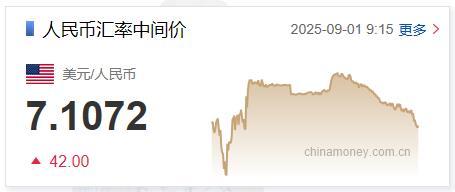
9月1日人民币对美元中间价报7.1072元 下调42个基点
Zhong Guo Xin Wen Wang· 2025-09-01 07:39
来源:中国新闻网 编辑:张澍楠 本文为转载内容,授权事宜请联系原著作权人 中新经纬版权所有,未经书面授权,任何单位及个人不得转载、摘编或以其它方式使用。 关注中新经纬微信公众号(微信搜索"中新经纬"或"jwview"),看更多精彩财经资讯。 图片来源:中国外汇交易中心网站 9月1日人民币对美元中间价报7.1072元 下调42个基点 中新网9月1日电 据中国外汇交易中心网站消息,中国人民银行授权中国外汇交易中心公布,2025年9月 1日银行间外汇市场人民币汇率中间价为:1美元对人民币7.1072元,下调42个基点。 广告等商务合作,请点击这里 ...
显微镜下的中国经济(2025年第33期):人民币中间价为何加速升值
CMS· 2025-09-01 07:36
近期人民币汇率加速升值,中间价和 CNH 上周均回到 7.10 附近,CNY 回到 7.13 附近。年内汇率存在破 7 的可能性。 张一平 S1090513080007 zhangyiping@cmschina.com.cn 张静静 S1090522050003 zhangjingjing@cmschina.com.cn 定期报告 相关报告 1、《人民币何时破 7?——宏 观与大类资产周报》2025-08-31 2、《港股上市央国企动态系列 报告之 1——东风集团股份宣布 私有化退市,港股央国企推进 战略整合》2025-08-31 3、《美联储独立性或受挑战; 特朗普关税再被判违法——— 国际时政周评》2025-08-31 敬请阅读末页的重要说明 证券研究报告 | 宏观定期报告 2025 年 09 月 01 日 人民币中间价为何加速升值 显微镜下的中国经济(2025 年第 33 期) 频率:每周 上周美元兑人民币汇率中间价升值至 7.10 附近,环比升值 0.4%,而年初至 今中间价升值幅度为 1.2%,换句话说,上周中间价的升值幅度约为年初至 今的三分之一左右。受中间价加速升值的影响,上周美元兑人民币即期汇 ...
人民币市场汇价(9月1日)
Sou Hu Cai Jing· 2025-09-01 02:13
新华社北京9月1日电 中国外汇交易中心9月1日受权公布人民币对美元、欧元、日元、港元、英镑、澳 元、新西兰元、新加坡元、瑞士法郎、加元、澳门元、林吉特、卢布、兰特、韩元、迪拉姆、里亚尔、 福林、兹罗提、丹麦克朗、瑞典克朗、挪威克朗、里拉、墨西哥比索及泰铢的市场汇价。 100美元 710.72人民币 100欧元 831.29人民币 100日元 4.8340人民币 100港元 91.174人民币 100英镑 960.61人民币 100澳元 465.42人民币 100新西兰元 419.63人民币 100新加坡元 554.1人民币 100瑞士法郎 887.82人民币 100加元 517.74人民币 100人民币113.04澳门元 100人民币59.319马来西亚林吉特 100人民币1123.18俄罗斯卢布 100人民币248.17南非兰特 100人民币19531韩元 100人民币51.622阿联酋迪拉姆 100人民币52.745沙特里亚尔 100人民币4769.15匈牙利福林 100人民币51.259波兰兹罗提 100人民币89.81丹麦克朗 100人民币132.96瑞典克朗 100人民币141.46挪威克朗 100 ...
人民币对美元中间价调贬42基点报7.1072
Sou Hu Cai Jing· 2025-09-01 02:13
北京商报讯(记者 廖蒙)9月1日,中国人民银行授权中国外汇交易中心公布,当日银行间外汇市场人 民币汇率中间价为1美元对人民币7.1072元,相较前一交易日中间价7.1030元,调贬42基点。刚刚过去的 8月里,人民币中间价累计升值464基点。 同日,在岸人民币对美元、离岸人民币对美元汇率小幅走贬。截至当日9时35分,在岸人民币对美元报 7.1327,日内贬值幅度为0.03%;离岸人民币对美元报7.1280,日内贬值幅度为0.09%。 ...
宏观:人民币汇率何时破7?
2025-09-01 02:01
Summary of Key Points from Conference Call Industry Overview - The discussion primarily revolves around the **Chinese currency (RMB) exchange rate** and its implications for the **Chinese asset market**. The analysis includes macroeconomic factors, particularly the influence of the **US dollar index** and **Producer Price Index (PPI)** on the RMB's performance. Core Insights and Arguments 1. **RMB Exchange Rate Trends**: The RMB exchange rate exhibits both **trend and cyclical characteristics**. Long-term depreciation is influenced by the US dollar index, while short-term fluctuations align with it. The RMB's actual effective exchange rate is expected to strengthen if the PPI rebounds significantly, which is anticipated in Q2 2026 [1][3][7]. 2. **Impact of PPI on RMB**: A significant rebound in China's PPI is crucial for enhancing market interest in Chinese assets and providing a basis for the RMB's appreciation. The PPI is expected to turn positive in 2026, which will improve the competitive landscape for Chinese enterprises [7][9][10]. 3. **Potential for RMB Appreciation**: The RMB is projected to appreciate significantly against a basket of currencies in 2026, with a potential entry into the "6 era" (6.1 to 6.9 range) depending on the US dollar's performance and PPI trends [11][14][15]. 4. **Foreign Investment and RMB**: The RMB's exchange rate against the USD is a critical observation point, as foreign capital inflows are necessary for the revaluation of Chinese assets. The lack of foreign investment in recent years has hindered this process [2][19]. 5. **Market Style Shift**: The asset style in China is expected to shift from long-duration assets to short-duration assets, focusing more on profitability rather than valuation. Growth sectors such as technology, consumer demand, and cyclical assets are likely to perform well [16][18]. 6. **Federal Reserve's Role**: The anticipated interest rate cuts by the Federal Reserve could catalyze RMB appreciation. The divergence in monetary policies between China and the US may alleviate the interest rate spread, supporting the RMB's strength [12][13][17]. 7. **Current Market Dynamics**: The A-share market has been buoyed by liquidity rather than earnings, with significant support from the central bank. The market is expected to continue its upward trajectory, driven by sectors aligned with the five-year planning cycle, particularly in technology and consumption [19][20][21]. Other Important but Overlooked Content 1. **Liquidity and Market Support**: The central bank's support through increased debt to financial companies has been crucial in stabilizing the market. However, the actual inflow of funds from residents into the stock market remains limited [20][24]. 2. **Investor Behavior**: Historical trends indicate that even in favorable conditions (low interest rates and high returns), significant capital inflows into the stock market have not materialized, suggesting a cautious investor sentiment [27][34]. 3. **Economic Indicators**: The relationship between savings rates and deposit growth is critical. A potential increase in the savings rate could signal a shift in risk appetite among investors, which may influence market dynamics [33][34]. This summary encapsulates the key points discussed in the conference call, focusing on the implications of the RMB exchange rate and the broader economic context affecting Chinese assets.
人民币对美元中间价报7.1072 调贬42个基点
Zhong Guo Jing Ji Wang· 2025-09-01 01:23
Core Points - The central exchange rate of the Chinese yuan against the US dollar is reported at 7.1072, which represents a depreciation of 42 basis points compared to the previous trading day [1] - The previous day's exchange rate was 7.1030 for the yuan against the US dollar [1] Exchange Rate Summary - As of September 1, 2025, the exchange rates are as follows: - 1 USD = 7.1072 CNY - 1 EUR = 8.3129 CNY - 100 JPY = 4.8340 CNY - 1 HKD = 0.91174 CNY - 1 GBP = 9.6061 CNY - 1 AUD = 4.6542 CNY - 1 NZD = 4.1963 CNY - 1 SGD = 5.5410 CNY - 1 CHF = 8.8782 CNY - 1 CAD = 5.1774 CNY - 1 MOP = 1.1304 CNY - 1 MYR = 0.59319 CNY - 1 RUB = 11.2318 CNY - 1 ZAR = 2.4817 CNY - 1 KRW = 195.31 CNY - 1 AED = 0.51622 CNY - 1 SAR = 0.52745 CNY - 1 HUF = 47.6915 CNY - 1 PLN = 0.51259 CNY - 1 DKK = 0.8981 CNY - 1 SEK = 1.3296 CNY - 1 NOK = 1.4146 CNY - 1 TRY = 5.78058 CNY - 1 MXN = 2.6247 CNY - 1 THB = 4.5391 CNY [2]