
中长期资金入市

Search documents
里程碑!期货公司客户权益突破2万亿,保险机构增幅最显著
券商中国· 2025-12-21 04:42
Core Viewpoint - The Chinese futures market has reached significant milestones with both total market funds and client equity surpassing 2 trillion yuan, marking a growth of over 30% compared to the end of 2024, particularly driven by insurance institutions [1][3]. Group 1: Market Growth and Performance - The total trading volume in the national futures market for the first 11 months of the year reached 8.117 billion contracts, with a cumulative transaction value of 67.5 trillion yuan, reflecting year-on-year increases of 14.74% and 20.19% respectively [2][3]. - The client equity in the futures market has doubled from 1 trillion yuan in February 2021 to over 2 trillion yuan by December 2025, indicating a robust expansion in client base, with effective client numbers exceeding 2.7 million, a 14% increase from the same period in 2024 [4][6]. Group 2: Role of Insurance Institutions - Insurance institutions have shown the most significant growth in client equity, with their participation in the futures market increasing approximately twofold compared to the end of 2024, driven by policies encouraging long-term capital investment [5][6]. - The number of new accounts opened by insurance funds in the futures market increased by 166% year-on-year in the first 11 months of 2025, setting a historical record for effective account growth [6]. Group 3: Market Functionality and Structure - The continuous inflow of funds into the futures market is attributed to the recognition of its role in serving the real economy, particularly in risk management, enhanced by the implementation of policies promoting long-term capital market participation [5][6]. - The diversification of futures and options products has improved market depth and functionality, making the futures market increasingly attractive to long-term capital, including insurance funds, which enhances liquidity and price discovery [5][6].


政策推动价值回归,自由现金流ETF(159201)近20个交易日合计“吸金”超9.6亿元
Sou Hu Cai Jing· 2025-12-18 02:23
Group 1 - The core viewpoint of the article highlights the positive performance of the Guozheng Free Cash Flow Index and the increasing interest in related ETFs, indicating a favorable market environment for companies with high free cash flow [1] - The Guozheng Free Cash Flow Index experienced a recovery after an initial decline, with constituent stocks like Huaren Health hitting the daily limit, and other stocks such as Yixin Tang, Fujian Gaoshu, and Wewei Co. also seeing gains [1] - The largest free cash flow ETF (159201) has attracted over 960 million yuan in net inflows over the past 20 trading days, reflecting strong investor interest [1] Group 2 - According to Song Zhiping, President of the China Listed Companies Association, recent policy measures aimed at "strengthening patient capital" have provided institutional support for guiding medium- and long-term funds into the market since the Central Political Bureau meeting in 2024 [1] - Since 2025, various types of medium- and long-term funds have net purchased over 600 billion yuan in A-shares, serving as a stabilizing force against market volatility and promoting value recovery [1] - The free cash flow ETF (159201) and its linked funds closely track the Guozheng Free Cash Flow Index, focusing on companies with high free cash flow rates, making it a quality investment choice with growth potential and policy certainty [1]
110亿资金净流入A500ETF,谁在大举买入?
财联社· 2025-12-18 01:20
以下文章来源于创业板观察 ,作者闫军 创业板观察 . 创业板观察致力于发布深交所创业板的市场发展、政策变化、监管导向、上市企业动态等的及时信息,提供有价值的市场资讯。 A股上演绝地大反攻!12月18日,最新规模数据显示,股票ETF果真获得资金近百亿净流入,其中A500ETF成最大赢家,净流入超110亿 元。 A股震荡一个月后在12月17日午后上演反攻,沪深300ETF异动引发小作文猜想:神秘资金是不是又来了? 这一次大资金进击,放巨量的主角是A500ETF。 截至收盘,5只A500ETF领跑市场,合计成交额合计达452.91亿元,其中,华泰柏瑞 A500ETF成交额达141.18亿元,华夏A500ETF以97.54亿元次之,南方、国泰、易方达旗下A500ETF成交额紧随其后。 华泰柏瑞沪深300ETF排名成交额第六,全天成交50.79亿元,4只头部沪深300ETF合计成交额为80.8亿元,并没有显著放量。 整体来看,全市场A500ETF合计成交额达525.75亿元,是沪深300ETF合计成交额(169.5亿元)的3倍之多。 从资金净流入数据更新,谁被大举买入进一步清晰,规模型股票ETF单日合计净流入96.58 ...

大盘午后拉升,关注证券保险ETF(512070)、证券ETF易方达(512570)等产品布局机会
Sou Hu Cai Jing· 2025-12-17 11:28
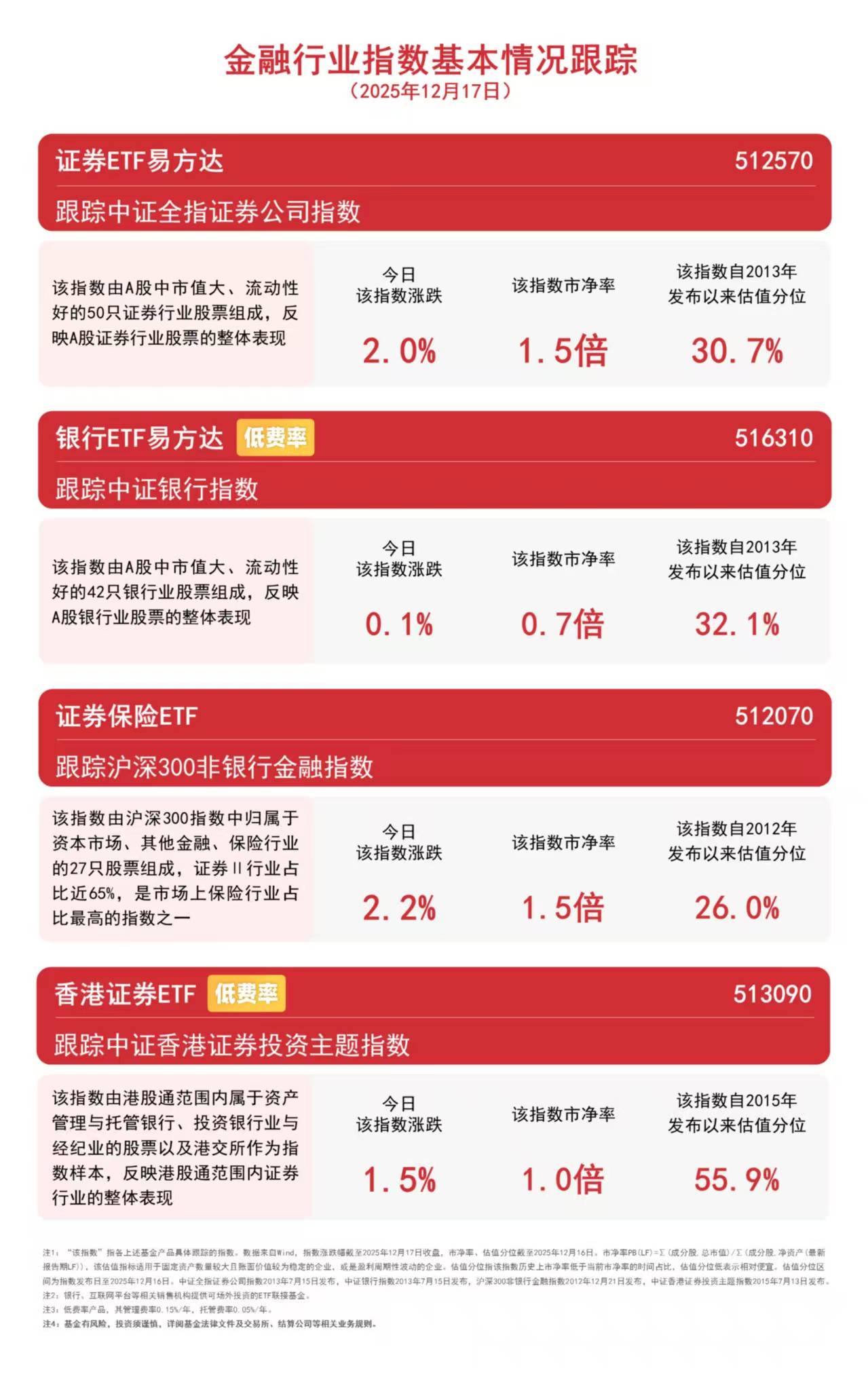
Group 1 - The core viewpoint of the article highlights a significant rally in the non-bank financial sector, particularly in securities and insurance, with the CSI 300 non-bank financial index rising by 2.2% and the CSI All Share Securities Companies Index increasing by 2.0% [1] - The recent policy adjustment by the National Financial Regulatory Administration, which lowers risk factors for long-term holdings in various indices, is expected to foster patient capital and support technological innovation [1] - The implementation of this policy is anticipated to continuously drive medium to long-term capital into the market, enhancing the equity allocation capacity of insurance funds [1] Group 2 - The securities insurance ETF (512070) has attracted over 500 million yuan in the past week, indicating strong investor interest [1] - The CSI 300 index reflects the overall performance of the top 50 securities industry stocks in A-shares, with a current price-to-book ratio of 1.5 times [3] - The CSI Bank Index, which represents the performance of the top 42 banking stocks in A-shares, has a price-to-book ratio of 0.7 times [4]
机构称三大核心利好有望带动板块,证券ETF龙头(159993)涨超2.2%
Xin Lang Cai Jing· 2025-12-17 06:49
Group 1 - The core viewpoint of the articles highlights a positive outlook for the securities industry, driven by policy support and market reforms aimed at enhancing capital market functions [1][2] - The National Securities Leading Index (399437) has shown a strong increase of 2.46%, with key stocks like Huatai Securities (601688) rising by 6.77% and GF Securities (000776) by 3.49%, indicating robust market performance [1] - The Central Economic Work Conference emphasized the need for continuous deepening of capital market reforms, positioning brokerages as essential service providers for direct financing and wealth management [1] Group 2 - According to CITIC Securities research, the securities sector is expected to enter a new growth cycle in 2025, with performance driven by favorable policies and market conditions [2] - The report identifies three core positive drivers: service to new productive forces, long-term capital inflow, and internationalization opportunities for brokerages, which are not yet fully priced into the market [2] - As of November 28, 2025, the top ten weighted stocks in the National Securities Leading Index account for 79.05% of the index, indicating a concentrated market structure [2]






资本市场这一年:向稳、向好、向新、向实
Shang Hai Zheng Quan Bao· 2025-12-16 18:42
Group 1 - The core viewpoint emphasizes the continuous strengthening of the momentum for long-term capital market investment, with significant policy support and record-high fund sizes in public and private sectors [1][2] - As of October 2023, the public fund size reached 36.96 trillion yuan, while private fund management size hit 22 trillion yuan, marking historical highs [1] - The A-share market has seen a substantial increase in trading activity, with an average daily trading volume of approximately 1.75 trillion yuan, significantly up from 1.08 trillion yuan in 2024 [1] Group 2 - The Central Economic Work Conference has outlined the need for comprehensive reforms in capital market investment and financing, aiming for a balanced development between investment and financing [2] - The "Two Innovation Boards" are highlighted as key reform areas, with new listing standards and the inclusion of unprofitable companies to support innovation [3] - A total of 103 companies completed IPOs in 2023, raising 116.3 billion yuan, with significant contributions from the semiconductor and biomedicine sectors [3] Group 3 - Mergers and acquisitions are identified as crucial, with a notable increase in asset restructuring cases, reflecting a 55% year-on-year growth in major asset restructurings [4] - The bond market is evolving with the issuance of technology innovation bonds exceeding 3 trillion yuan, promoting long-term investments in hard technology [4] - The capital market's inclusivity and adaptability are seen as essential for high-quality development, allowing for diverse participants and innovative financial tools [4] Group 4 - The capital market ecosystem is undergoing profound changes, with a focus on enhancing the quality and efficiency of listed companies and investment institutions [5][6] - Regulatory measures have been strengthened to ensure compliance and accountability among market participants, with a reported 40% increase in penalties for financial fraud [6] - The introduction of new guidelines for investment banks and funds aims to shift focus from scale to value creation, enhancing overall market efficiency [7] Group 5 - The opening up of the capital market to foreign investors is progressing, with reduced restrictions and improved transparency, making it an attractive destination for global capital [8] - The dual approach of aligning rules with international standards and enhancing market appeal is driving the success of China's capital market [8]
中信建投:2026年政策利好驱动业绩持续增长 证券板块有望重新定价
Xin Lang Cai Jing· 2025-12-15 23:56
Core Viewpoint - The report from CITIC Securities indicates that the securities sector is expected to experience sustained growth driven by favorable policies in 2026, leading to a potential revaluation of the sector [1] Group 1: Industry Growth Outlook - The securities industry is entering a new growth cycle in 2025, although brokerage stocks have underperformed due to a lack of independent catalysts and the continuation of pessimistic sentiment from previous years [1] - Three core favorable factors—service for new productive forces, long-term capital entering the market, and opportunities for brokerage internationalization—have not yet been fully priced in by the market [1] Group 2: Future Performance Drivers - The new drivers of investment banking, asset management, and international business are expected to gradually materialize in the industry fundamentals after 2026, providing solid support for medium to long-term performance resilience and elasticity [1] - There is no need to worry about a growth gap, as the aforementioned factors are anticipated to support the industry's performance [1]

五维度勾勒改革重点 资本市场蓄力高质量发展
Zheng Quan Ri Bao Wang· 2025-12-15 14:08
Core Viewpoint - The Central Economic Work Conference emphasizes the need to deepen comprehensive reforms in capital market investment and financing to support stable employment, enterprises, markets, and expectations, contributing to high-quality economic development and a good start to the 14th Five-Year Plan [1] Group 1: Market Stability and Company Governance - The meeting highlights the importance of enhancing the intrinsic stability of the market by improving the quality of listed companies, promoting long-term capital inflow, and establishing mechanisms for market stability and expectation guidance [2] - A new round of corporate governance initiatives will be launched to enhance risk prevention capabilities and promote high-quality development of listed companies [2][3] - The focus will be on transparency in shareholding structures, board independence, internal control systems, and the quality of information disclosure to strengthen corporate governance [3] Group 2: Long-term Capital Inflow - The meeting calls for the implementation of long-term assessment mechanisms for institutional investors, which is crucial for stabilizing capital inflow and supporting the transformation and innovation of the real economy [4][5] - The introduction of long-term assessment mechanisms is expected to guide funds towards long-term value and enhance market resilience [5] Group 3: "Double Innovation" Board Reforms - The meeting proposes to deepen reforms in the ChiNext board and accelerate the implementation of the "1+6" reform measures for the Sci-Tech Innovation Board to better serve technological self-reliance [8][9] - Reforms will focus on optimizing listing standards, enhancing financing flexibility, and improving corporate governance and investor returns [8][9] Group 4: Regulatory Enhancements - The meeting emphasizes the need for stricter regulatory measures and the introduction of a new regulatory framework for listed companies to improve quality and investor protection [10] - The proposed regulations aim to clarify responsibilities, enhance penalties for violations, and improve the operational and governance conditions of listed companies [10][11] Group 5: Strategic Planning for Capital Market Development - The meeting outlines the need for a scientific approach to the 14th Five-Year Plan for capital market development, focusing on creating a robust, open, innovative, and sustainable market ecosystem [11] - Key areas of focus include improving the institutional framework, optimizing capital supply structures, and enhancing legal regulations and investor protection [11]
每日市场观-20251211
Caida Securities· 2025-12-11 05:09
Market Overview - On December 10, the market showed a rebound after hitting a low, with the Shanghai Composite Index down 0.23%, the Shenzhen Component Index up 0.29%, and the ChiNext Index down 0.02%[3] - The total trading volume in the Shanghai and Shenzhen markets was less than 1.78 trillion yuan, showing a week-on-week decrease[1] Sector Performance - The leading sectors included precious metals, real estate services, education, commercial retail, real estate development, aviation, and automotive, while sectors like power equipment, banking, photovoltaic equipment, consumer electronics, and wind power equipment saw declines[1] - A total of 2,379 stocks rose, while 2,685 stocks fell, indicating a market with more decliners than gainers[1] Monetary Policy and Market Sentiment - Year-end capital competition is suppressing risk appetite, leading to tighter liquidity in both bond and stock markets[1] - Uncertainty in overseas monetary policy is causing market disturbances, with a cautious trading sentiment prevailing in the A-share market[1] Bond Market Insights - Positive signals emerged in the bond market starting Tuesday, with prices rebounding and yields slightly declining[1] - A potential interest rate cut by the Federal Reserve could boost the domestic bond market, positively impacting stock market liquidity[1] Fund Flows - On December 10, net inflows were recorded at 2.308 billion yuan for the Shanghai Stock Exchange and 4.226 billion yuan for the Shenzhen Stock Exchange[4] - The top three sectors for net inflows were communication equipment, real estate development, and automotive parts, while the top three sectors for outflows were components, photovoltaic equipment, and consumer electronics[4] Economic Indicators - In November, the Consumer Price Index (CPI) rose by 0.7% year-on-year but fell by 0.1% month-on-month, with food prices increasing by 0.2% and non-food prices rising by 0.8%[5] - The average CPI for January to November remained flat compared to the same period last year[5] Government Bond Issuance - The Ministry of Finance successfully issued 7 billion yuan of government bonds in Hong Kong on December 10, with a subscription rate of 5.22 times[6][7] - The issuance included 20 billion yuan for 2-year bonds at an interest rate of 1.43%, 30 billion yuan for 3-year bonds at 1.45%, and 20 billion yuan for 5-year bonds at 1.65%[7] Industry Developments - The China Securities Regulatory Commission proposed to appropriately relax capital space and leverage constraints for quality institutions, potentially reviving the brokerage sector[2] - The 6G network research is progressing, with active sectors including aerospace, communication equipment, and new materials, which investors should monitor[2] Long-term Investment Trends - There has been an acceleration of medium to long-term funds entering the A-share market, enhancing market resilience and promoting value investment transformation[13] - Foreign institutional interest in Chinese assets remains strong, with over 9,000 A-share company investigations conducted this year, leading to a cumulative increase of over 340 billion yuan in northbound capital holdings by the end of Q3[14]
期货市场赋能实体经济,助力打造“中国价格”新锚点
2 1 Shi Ji Jing Ji Bao Dao· 2025-12-11 03:13
Core Viewpoint - The Chinese futures market is leveraging product innovation and institutional improvements to enhance its role in supporting the real economy and increasing the international influence of "Chinese prices" while facilitating the revaluation of Chinese assets. Group 1: Market Development and Institutional Participation - The China Financial Futures Exchange (CFFEX) aims to promote long-term capital entry into the market, enhancing market capacity and institutional participation [1][2] - In the first three quarters of 2025, CFFEX reported an average daily trading volume of 1.24 million contracts and an average open interest of 2.08 million contracts, representing year-on-year increases of 30% and 13% respectively [3] - Institutional participation has increased significantly, with various institutions actively engaging in the market, leading to improved market quality [4] Group 2: Policy Support and Long-term Capital - A joint implementation plan by six departments was issued in January 2025 to promote long-term capital entry into the market, establishing a policy foundation for futures market services [2] - CFFEX has implemented the "Long Wind Plan" for three consecutive years, effectively guiding and mobilizing member institutions in risk management [2] - The introduction of simplified processes for account opening and hedging applications has increased the willingness of long-term capital to enter the market [2] Group 3: Green Development and Industry Support - The Guangzhou Futures Exchange (GFEX) is focusing on supporting the green low-carbon transition and high-quality development through innovative financial services [5] - GFEX has launched various futures and options products related to industrial silicon, lithium carbonate, and polysilicon, establishing a domestic futures market for new energy metals [5] - As of October 2025, over 90 listed companies have announced hedging strategies involving new energy metal futures, indicating a growing trend in risk management [6] Group 4: Enhancing "Chinese Price" Influence - The dual empowerment of the futures market and the real economy is enhancing the international discourse power of "Chinese prices" and facilitating the revaluation of Chinese assets [7] - GFEX has successfully established a transparent pricing mechanism for related futures products, with lithium carbonate futures becoming the most traded and liquid lithium salt product globally [7] - CFFEX is guiding long-term capital into the market, which has led to a significant increase in the scale of index funds and corresponding futures positions, reflecting the value of assets aligned with national strategies [8]