
人民币汇率升值

Search documents
人民币再创1年来新高,离岸人民币对美元升破7.06
Sou Hu Cai Jing· 2025-12-03 12:52
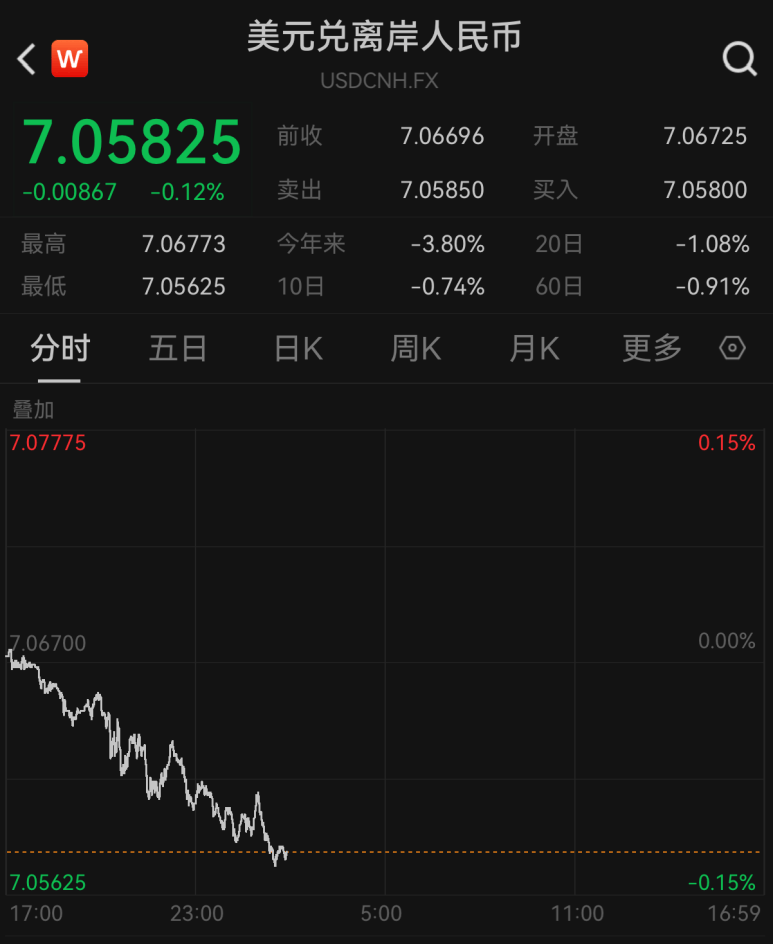
人民币对美元即期汇率最高达7.0620,刷新去年10月中旬以来新高,截至发稿,报7.0623。 12月3日,中国人民银行授权中国外汇交易中心公布,银行间外汇市场人民币汇率中间价为1美元对人民币7.0754 元,较上个交易日调高30个基点,创下2024年10月14日以来新高。 来源:江南都市报 人民币对美元汇率延续升值势头! 继升破7.07关口后,12月3日,离岸人民币对美元汇率盘中最高升至7.05625,创2024年10月9日以来新高。截至发 稿,报7.05825。 | < W | | | 美元兑离岸人民币 | | Q | | --- | --- | --- | --- | --- | --- | | USDCNH.FX | | | | | | | 7.05825 | | 前收 | 7.06696 | 开盘 | 7.06725 | | -0.00867 -0.12% | | 卖品 | 7.05850 | 买入 | 7.05800 | | 最高 | 7.06773 | 今年来 | -3.80% | 20日 | -1.08% | | 最低 | 7.05625 | 10日 | -0.74% | 60日 | -0.9 ...

强势升值!离岸人民币对美元升破7.07
Bei Jing Shang Bao· 2025-12-01 02:12
同日,在岸人民币、离岸人民币对美元汇率双双升值,双双创下2024年10月以来升值新高。截至当日9 时45分,在岸人民币对美元报7.0745,日内升值幅度为0.01%;离岸人民币对美元报7.0690,日内升值 幅度为0.03%。 北京商报讯(记者 廖蒙)12月1日,中国人民银行授权中国外汇交易中心公布,当日银行间外汇市场人 民币汇率中间价为1美元对人民币7.0759元,相较前一交易日中间价7.0789元,调升30基点,续创逾一年 以来升值高点。 ...
11月人民币对美元即期汇率升值近0.48%
Sou Hu Cai Jing· 2025-11-28 09:15
Core Viewpoint - The Chinese Yuan has strengthened against the US Dollar at the end of November, with significant appreciation observed throughout the month, driven by strong export performance and favorable market conditions [1][2]. Group 1: Exchange Rate Performance - On November 28, the onshore Yuan to US Dollar exchange rate closed at 7.0794, an increase of 12 basis points from the previous trading day [1] - In November, the onshore Yuan appreciated nearly 0.48% against the US Dollar, with a peak of 7.0738 on November 27, marking a new high since mid-October of the previous year [1] - The central parity rate on the last trading day of November was reported at 7.0789, with a cumulative appreciation of 0.128% for the month [1] - For the first eleven months of the year, the central parity rate appreciated by 1.52%, while the onshore rate appreciated by over 3% [1] Group 2: Factors Influencing the Yuan's Strength - According to China Merchants Securities, the recent strength of the Yuan is attributed to robust export performance, which has boosted market confidence, alongside a seasonal peak in foreign exchange settlements in the fourth quarter [1] - The continuous release of appreciation signals from the central parity rate has effectively guided market expectations [1] - The recent dovish stance from Federal Reserve officials has contributed to a marginal decline in the US Dollar index, further reinforcing the Yuan's appreciation trend [1] Group 3: Future Outlook - CITIC Securities notes that despite the recent resilience of the Yuan amid a rebound in the US Dollar index, changes in the Federal Reserve's interest rate expectations will remain a key short-term factor influencing the Dollar index [2] - It is anticipated that the export growth rate may decline in the fourth quarter, potentially weakening the current account support for the Yuan [2] - However, with ongoing policy support for investment and consumption, along with a balanced approach to exchange rate stabilization by the central bank, the Yuan is expected to gradually align with the central parity rate amidst fluctuations [2]
2026 港股行业比较投资策略:乘势外资东风,锚定核心资产
Shenwan Hongyuan Securities· 2025-11-28 05:20
Core Insights - The report emphasizes that the improvement in PPI (Producer Price Index) will drive corporate profit recovery, which is a key factor for foreign capital returning to Chinese assets. The market may perceive cyclical goods as superior to technology during the PPI recovery phase, but the report argues that foreign capital is fundamentally buying assets with improved fundamentals, focusing on ROE (Return on Equity) recovery [3][10][4] - Historical analysis shows a strong positive correlation between the RMB exchange rate and PPI growth, indicating that a recovering Chinese economy leads to foreign capital inflows. During previous appreciation phases, both A-shares and Hong Kong stocks saw price increases, suggesting that the RMB is likely to appreciate in 2026, prompting foreign capital to reassess Chinese assets [3][10][4] - The report forecasts that during past PPI recovery phases, both A-share and Hong Kong stock ROE have shown significant improvement, with a clear positive correlation between PPI growth and corporate profitability. It is expected that ROE for both markets will continue to improve in 2026 as PPI rises [4][10] - From the perspective of foreign capital's historical investment preferences, profitability is a crucial consideration. The report notes that changes in ROE are highly correlated with foreign ownership in various sectors, indicating that sectors with strong competitive advantages are likely to attract more foreign investment [10] - The report highlights that foreign capital has been reassessing Chinese assets in 2025, with a notable increase in foreign participation in Hong Kong IPOs. The A-H premium is expected to continue narrowing, reflecting heightened foreign interest in core assets listed in Hong Kong [10] - The report identifies several sectors in Hong Kong that are expected to see ROE improvements in 2026, including power equipment, internet (AI industry core assets), and cyclical sectors, which are anticipated to benefit from demand recovery and pricing power [10] - The report also notes that domestic capital has room to increase its holdings in Hong Kong stocks, with significant portions of public funds allocated to Hong Kong equities, indicating potential for further investment [10] Industry Analysis - The report discusses the knife industry, highlighting that rising costs and demand are driving price increases, with major manufacturers announcing price hikes due to surging tungsten prices. This trend is expected to lead to sustained performance improvements for knife companies [12][15][16] - The report indicates that the knife industry has experienced multiple rounds of price adjustments in response to raw material cost pressures, with the latest round occurring in November. The demand from the electric vehicle supply chain is providing strong support for the knife market [15][16] - The report notes that the profitability of knife manufacturers has improved significantly in Q3 2025, with companies reporting substantial year-on-year revenue and profit growth, driven by earlier price increases and low-cost inventory [15][16] - The report suggests that the current market dynamics may lead to a consolidation of the industry, as smaller manufacturers face challenges due to rising raw material costs, potentially benefiting larger firms with stronger financial positions [15][16]
中美刚通话,人民币升值创1年新高,特朗普敲打日本,重视对我们经济
Sou Hu Cai Jing· 2025-11-27 16:32
Group 1 - The emergency call between President Trump and Japanese Prime Minister Suga lasted about 25 minutes, occurring shortly after a call with Chinese leaders, indicating a strategic diplomatic maneuver [3][8] - The offshore RMB to USD exchange rate surged past 7.09, reaching a new high in over a year, reflecting market optimism regarding US-China relations [3][8] - The Chinese yuan's strong performance is attributed to better-than-expected export figures and a recovering domestic economy, contrasting with the pressures faced during previous trade tensions [8][16] Group 2 - Trump's communication with Suga included a summary of the US-China call, which is unusual in diplomatic practice, suggesting an effort to stabilize US-Japan relations [10][11] - The recent political dynamics in the US, including Trump's declining approval ratings and upcoming midterm elections, are influencing the administration's foreign policy towards seeking stability [16] - The interaction between the US, China, and Japan reflects not only political ties but also economic connections, as seen in the performance of Chinese companies like Alibaba and their investment strategies [17]
人民币汇率创阶段新高 或预示开启新一轮升值周期
Xin Hua Cai Jing· 2025-11-27 06:04
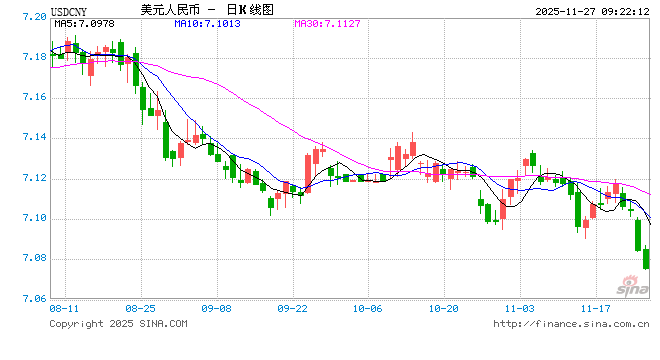
新华财经上海11月27日电(葛佳明)11月27日,人民币对美元中间价再度上调至7.0779,为2024年10月 14日以来新高,今年以来人民币对美元汇率中间价年内累计上调约1000个基点。在岸人民币、离岸人民 币对美元汇率均升至7.08附近。近一段时间以来,美元指数震荡上行至100关口上方,人民币汇率不降 反升,表现强劲,与美元指数走势呈现"双强"格局。 10月以来,伴随美联储降息预期回撤,资本流动方向逆转,非美货币均录得较大跌幅,其中欧元抹去半 年全部涨幅,以日元、韩元和印度卢比为代表的亚洲货币跌幅较大。而人民币受影响较小,走出了独立 的升值行情。 对于人民币强劲的表现,中信证券首席经济学家明明表示,近期中国人民银行稳汇率政策保持一定力 度,叠加年末、季末临近,结汇需求或阶段性释放,支撑人民币汇率走强。 中信期货表示,一方面中国人民银行通过中间价持续释放维稳信号。同时,我国三季度出口维持韧性, 权益市场表现良好,推动人民币升值。 "我们认为,2025年不仅是过去三年人民币走弱周期的结束,或预示人民币将开启新一轮升值周期。"东 吴证券首席经济学家芦哲表示,以2025年11月5日时点来计,人民币对美元终结了20 ...
人民币兑美元中间价报7.0779上调17点,升值至2024年10月14日来最高!美联储12月降息25个基点的概率维持在84.9%
Sou Hu Cai Jing· 2025-11-27 01:36
11月27日,人民币兑美元中间价报7.0779,上调17点,升值至2024年10月14日以来最高。 美联储12月降息25个基点的概率维持在84.9% 据CME"美联储观察":美联储12月降息25个基点的概率为84.9%,维持利率不变的概率为15.1%。美联 储到明年1月累计降息25个基点的概率为66.4%,维持利率不变的概率为11.1%,累计降息50个基点的概 率为22.6%。 中信明明:预计人民币汇率整体或呈现温和升值的态势 对于人民币对美元汇率的走升,首席经济学家明明表示,近期中国人民稳汇率政策保持一定力度,叠加 年末、季末临近,结汇需求或阶段性释放,支撑人民币汇率走强。展望人民币对美元汇率后期走势,明 明认为,短期来看,央行稳汇率政策有助于稳定人民币汇率预期。长期来看,2026年,美元指数或将延 续偏弱运行的趋势,人民币汇率面对的外部环境相对友好,叠加国内经济基本面的支撑、央行稳汇率张 弛有度,以及积压的客盘结汇需求,预计人民币汇率整体或呈现温和升值的态势。(证券日报) 来源:新浪网 【免责声明】本文仅代表作者本人观点,与和讯网无关。和讯网站对文中陈述、观点判断保持中立,不 对所包含内容的准确性、可靠性 ...
强势升值!人民币汇率创逾一年以来升值高点
Bei Jing Shang Bao· 2025-11-26 01:49
同日,在岸人民币、离岸人民币对美元汇率开盘走高,双双创下2024年10月以来升值新高。截至当日9 时35分,在岸人民币对美元报7.0841,日内升值幅度为0.01%;离岸人民币对美元报7.0820,日内升值 幅度为0.01%。 北京商报讯(记者 廖蒙)11月26日,中国人民银行授权中国外汇交易中心公布,当日银行间外汇市场 人民币汇率中间价为1美元对人民币7.0796元,相较前一交易日中间价7.0826元,调升30基点,再创逾一 年以来升值高点。 ...
2026年度展望:人民币汇率:人民币或进入中长期升值周期
Soochow Securities· 2025-11-07 04:09
Exchange Rate Outlook - The report predicts that the RMB may enter a medium to long-term appreciation cycle, with expectations for the USD/CNY exchange rate to break below 7.0 in 2026, potentially reaching 6.70-6.80 by the end of that year[1] - The RMB has ended a three-year depreciation cycle, with a significant appreciation expected to begin from April 2025, when the USD/CNY was at 7.42[6] Trade and Current Account - The current account surplus is expected to stabilize, driven by a recovery in merchandise trade, with a monthly surplus reaching $63.9 billion in September 2025, the highest since 2020[18] - The merchandise trade surplus has been expanding, with a single-month surplus of $72.4 billion recorded in September 2025[18] Investment Dynamics - Foreign investment in RMB-denominated assets is increasing, with a net inflow of $10.57 billion in securities investments by September 2025, reversing previous outflows[34] - Foreign investors have increased their holdings in A-shares by 622.9 billion CNY, indicating a strong interest in the Chinese equity market[42] Risk Factors - Potential risks include uncertainties in U.S. fiscal and tariff policies, unclear paths for Federal Reserve interest rate cuts, and political risks in non-U.S. regions that could lead to currency depreciation[1] - The report highlights the importance of monitoring the evolving dynamics of the U.S.-China interest rate differential, which significantly influences foreign investment behavior in Chinese bonds[51]