人民币对美元汇率

Search documents
交投活跃 人民币对美元汇率反弹走强
Jin Rong Shi Bao· 2026-01-28 00:51
Core Viewpoint - In 2025, the interbank foreign exchange market in China operated smoothly under comprehensive regulatory measures, with a steady increase in trading volume and active market participation, achieving a record high in transaction scale and daily average turnover [1][2]. Group 1: Foreign Exchange Market Performance - The cumulative transaction volume in the interbank foreign exchange market reached 48.52 trillion USD in 2025, with a daily average turnover of 199.66 billion USD, marking a year-on-year growth of 6.54% [1]. - The daily average transaction volume for the RMB foreign exchange market was 14.87 billion USD, with all varieties except for forwards showing an increase in daily average transaction volume [1]. - By the end of 2025, the RMB to USD exchange rate was reported at 6.9890, appreciating by 4.43% compared to the end of the previous year [2][3]. Group 2: RMB Exchange Rate Dynamics - Throughout 2025, the RMB to USD exchange rate experienced fluctuations, initially under pressure but later showing signs of strengthening and significant appreciation [2][3]. - The CFETS RMB exchange rate index ended the year at 97.99 points, reflecting a decline of 3.43% for the year [2]. - The annualized volatility of the exchange rate was recorded at 2.53%, a decrease of 0.51 percentage points from 2024 [2]. Group 3: Influencing Factors on RMB Exchange Rate - The RMB exchange rate faced pressure in April 2025 due to heightened trade tensions between China and the US, with the onshore RMB briefly falling below the 7.35 mark [3]. - Factors contributing to the RMB's subsequent rebound included easing trade tensions and a weakening US dollar due to concerns over the US economic outlook and fiscal issues [4]. - By the end of 2025, both onshore and offshore RMB broke through the significant psychological level of 7.0, driven by improved domestic economic fundamentals and stabilizing market expectations [4]. Group 4: Swap Market Trends - In 2025, the RMB swap curve shifted upward, reaching a three-year high, influenced by narrowing interest rate differentials between China and the US [5][6]. - The one-year RMB to USD swap points showed a significant upward trend, particularly in the second half of the year, with the spread against interest rate parity stabilizing in positive territory [6]. - The People's Bank of China issued a total of 300 billion RMB in offshore central bank bills throughout the year, maintaining tight liquidity in the offshore RMB market [6]. Group 5: Dollar Market Liquidity - The domestic dollar borrowing rates remained low throughout 2025, with the overnight borrowing rate fluctuating between 4.25% and 4.33% [7]. - The interest rate differential between domestic and foreign dollar markets widened in the second half of the year, reaching a three-year low of -40 basis points [7]. - By the end of 2025, domestic overnight rates and SOFR were recorded at 3.62% and 3.87%, respectively, both showing declines from the previous year [7].
人民币对美元汇率中间价升破“7” 汇率预计将继续双向浮动、保持弹性
Ren Min Ri Bao· 2026-01-23 22:27
Core Viewpoint - The People's Bank of China announced a strengthening of the Renminbi (RMB) exchange rate against the US dollar, reaching a new high since May 2023, reflecting a phase of appreciation influenced by various internal and external factors [1]. Group 1: Exchange Rate Changes - On January 23, the central parity rate of the RMB against the US dollar was set at 6.9929, an increase of 90 basis points from the previous day's rate of 7.0019 [1]. - Both offshore and onshore RMB appreciated against the US dollar on the same day, with projections indicating that by the end of 2025, both rates may break the "7" mark, currently remaining above it [1]. Group 2: Economic Factors - The appreciation of the RMB is attributed to a combination of market supply and demand, policy guidance, and external environmental factors, as stated by a researcher from Postal Savings Bank of China [1]. - The Deputy Governor of the People's Bank of China highlighted that China's large-scale market, complete industrial chain, and the integration of technological and industrial innovation support the long-term stability of the RMB exchange rate [1]. Group 3: Future Outlook - The external environment remains complex, with uncertainties regarding interest rate adjustments in major economies and potential geopolitical shocks that may affect exchange rate trends [1]. - The RMB is expected to continue to exhibit two-way fluctuations and maintain elasticity in its exchange rate [1].


2025年预测错了多少?2026年资本风口在哪里?
3 6 Ke· 2025-12-30 11:29
Core Insights - The year 2025 has been characterized by significant market volatility, with the US dollar depreciating and the euro strengthening, while gold prices surged over 70% to reach $4,500 per ounce, indicating a shift towards a more "financialized" order in the market [1][2][5] - Investors are advised to understand the transformation of fear into pricing, which will help them navigate the capital opportunities in 2026 [2][10] - The market has shown resilience despite numerous uncertainties, with a cautious optimism for 2026 as macro conditions align towards a "Goldilocks" scenario [2][10] Market Performance - As of December 28, 2025, silver led the market with a 173.13% increase, followed by gold at 73.91%, and other indices like the S&P 500 rising by 17.26% [3] - Conversely, light crude oil saw the largest decline at 19.63%, with other assets like Brent crude and Ethereum also experiencing significant drops [3] Predictive Discrepancies - The year 2025 exhibited a systematic misalignment between predictions and actual market performance, with many forecasts underestimating the resilience of risk assets [4][5] - Despite predictions of a recession, growth did not significantly falter, and the Federal Reserve adjusted interest rates downwards, contrary to earlier expectations [5][6] Key Variables Influencing the Market - Five main variables have driven market behavior in 2025: 1. Repricing of dollar credit and institutional risk premiums due to uncertainties in fiscal sustainability and central bank independence [7] 2. The rise of real assets, particularly gold, as a hedge against geopolitical and institutional uncertainties [7] 3. The interplay of demand and supply pricing in energy markets, reflecting concerns over inflation [7] 4. Global liquidity mechanisms affecting financing costs and volatility [8] 5. A concentrated narrative around AI, which has become a focal point for investment and valuation [8] 2026 Capital Outlook - The asset pricing logic for 2026 will shift from explaining the world to pricing discount rates, with a focus on maintaining financial conditions that support financing [10] - The emphasis will be on the infrastructure for AI, transitioning from merely acquiring GPUs to establishing sustainable computing factories [11] - Key factors influencing the success of this transition include financial conditions, visibility of returns, supply-side engineering, and regulatory certainty [12]
【首席观察】2025年预测错了多少?2026年资本风口在哪里?
经济观察报· 2025-12-30 09:55
Core Viewpoint - The market is not afraid but transforms fear into pricing, which is crucial for investors to grasp the "capital wind" of 2026 [2][3] Group 1: Market Performance in 2025 - The year 2025 exhibited a significant disconnect between predictions and reality, with silver leading gains at 173.13%, followed by gold at 73.91% and copper at 32.92% [5] - Major indices like the S&P 500 and the Hang Seng Index saw increases of 17.26% and 28.61% respectively, while light crude oil dropped by 19.63% [5][6] - The S&P 500 index, despite conservative forecasts, achieved a year-to-date increase of over 17%, nearing historical highs [6] Group 2: Key Variables Influencing the Market - Five key variables explain the market dynamics of 2025: 1. The repricing of dollar credit and institutional risk premiums due to uncertainties in fiscal sustainability and central bank independence [10] 2. The rise of real assets' "non-sovereign premium," with gold reaching $4500 per ounce as a response to geopolitical and fiscal uncertainties [10] 3. The collision of demand and supply pricing in energy markets, reflecting concerns over inflation expectations [11] 4. Global liquidity mechanisms affecting financing costs and volatility, leading to a dual structure in market transactions [11] 5. The concentration of growth narratives around AI, with capital increasingly focused on profitability and productivity verification [11][12] Group 3: Outlook for 2026 - The asset pricing logic for 2026 shifts from "explaining the world" to "pricing the discount rate," emphasizing the importance of financial conditions and narrative realization [15] - The focus will be on "infrastructure 2.0," where the emphasis is on building sustainable computing power rather than merely acquiring GPUs [15][16] - Key factors determining the transition from thematic trading to trend markets include financial conditions, visibility of returns, supply-side engineering, and regulatory certainty [16] Group 4: Investment Strategies and Risks - The potential for gold to reflect "institutional premiums" remains, but the impact of the dollar and real interest rates may lead to sharper corrections [17] - The outlook for oil prices suggests prolonged low levels with potential spikes, while the yield curve may split between short-term central bank paths and long-term fiscal pressures [17] - The volatility of assets will be influenced by the overall market structure rather than directional trading, as investors adapt to frequent but manageable events [17]


人民币对美元开盘微跌,报7.0085
Xin Lang Cai Jing· 2025-12-26 05:11
Group 1 - The onshore RMB against the USD opened slightly lower at 7.0085, compared to the previous closing of 7.0066 [1][4] - The offshore RMB against the USD was reported at 7.00370 as of 9:40 AM [1][4] - The RMB/USD central parity rate was set at 7.0358, an increase of 34 basis points from the previous day [2][4] Group 2 - The USD index fluctuated below the 98 mark, reported at 97.9243 as of 9:40 AM [3][5] - The Guolian Minsheng macro team believes the current fluctuations in the RMB exchange rate are reasonable, driven by three main factors: a weaker USD, a rebound due to changing expectations, and concerns over seasonal patterns of concentrated settlement at year-end and early next year [3][5]
经济向好筑底气 汇率走强显信心 外汇市场行稳致远
Yang Shi Wang· 2025-12-25 02:42
Core Viewpoint - The Chinese yuan has appreciated against the US dollar, reaching a 15-month high, driven by positive domestic economic conditions and external factors such as the US Federal Reserve's interest rate policies [1][3]. Group 1: Currency Exchange Rate Trends - The People's Bank of China raised the yuan's midpoint against the US dollar by 52 basis points to 7.0471, marking a significant increase [1]. - As of December 24, the onshore yuan broke the 7.02 mark, while the offshore yuan surpassed 7.01, with year-to-date increases of over 3.8% and 4.4% respectively [3]. Group 2: Economic Factors Supporting Yuan Strength - The overall stability and improvement in China's foreign trade, despite a complex international environment, provide solid support for the yuan's appreciation [5]. - The accumulation of pending foreign exchange settlements by enterprises, coupled with year-end behaviors, has contributed to the rapid appreciation of the yuan [5]. Group 3: Investor Confidence and Future Outlook - The recent strength of the yuan reflects growing confidence among domestic and foreign investors in the Chinese economy and market, particularly due to advancements in technology [7]. - Analysts suggest that the resilience of the Chinese economy, ongoing technological progress, and the US's continued interest rate cuts may allow for further appreciation of the yuan [7].
升破7.05元关口!人民币汇率盘中大涨
Sou Hu Cai Jing· 2025-12-15 09:01
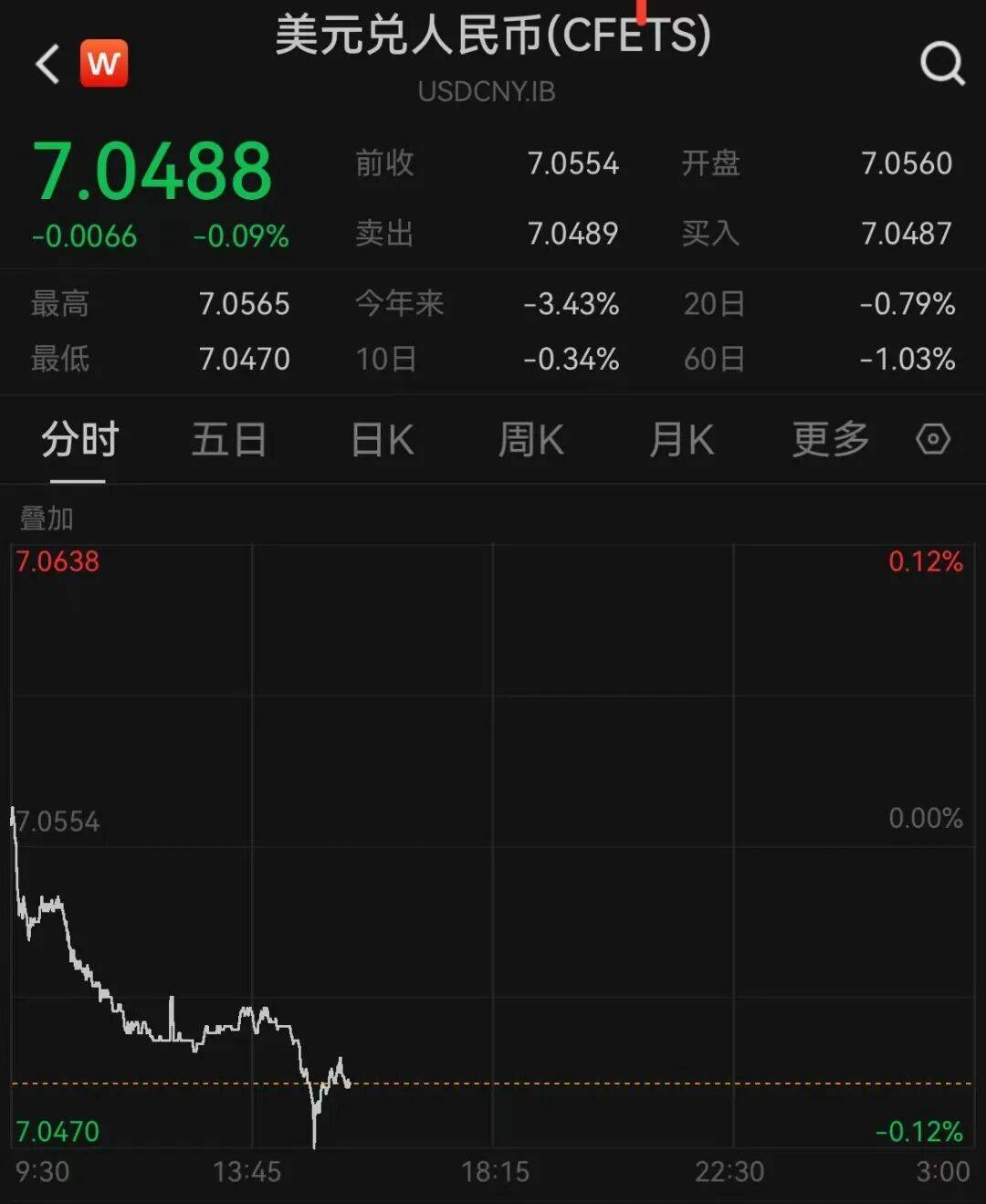
Core Viewpoint - The Chinese yuan has strengthened against the US dollar, breaking the 7.05 yuan mark for the first time in 14 months, driven by a weak dollar and stable year-end settlement demand [1][3][10]. Group 1: Onshore and Offshore Yuan Performance - As of December 15, the onshore yuan was reported at 7.0488 yuan per US dollar, an increase of 66 basis points from the previous close, with an intraday high of 7.0470 yuan [1]. - The offshore yuan also showed an upward trend, reaching 7.04725 yuan per US dollar, up 63 basis points from the previous close, with a peak of 7.04525 yuan [3]. - The yuan's performance throughout the year has been characterized by a steady increase, with onshore and offshore rates rising by 3.43% and 3.96% respectively [10]. Group 2: Central Bank and Market Dynamics - The People's Bank of China reported a slight decrease in the yuan's central parity rate against the dollar, set at 7.0656 yuan, down 18 basis points [5]. - The US dollar index experienced significant fluctuations, reporting a decline of 0.02% to 98.38 [8]. - Analysts suggest that the yuan's strength is supported by a weak dollar and stable settlement demand, indicating a potential for continued moderate appreciation under stable exchange rate policies [10].
11月人民币对美元即期汇率升值近0.48%
Sou Hu Cai Jing· 2025-11-28 09:15
Core Viewpoint - The Chinese Yuan has strengthened against the US Dollar at the end of November, with significant appreciation observed throughout the month, driven by strong export performance and favorable market conditions [1][2]. Group 1: Exchange Rate Performance - On November 28, the onshore Yuan to US Dollar exchange rate closed at 7.0794, an increase of 12 basis points from the previous trading day [1] - In November, the onshore Yuan appreciated nearly 0.48% against the US Dollar, with a peak of 7.0738 on November 27, marking a new high since mid-October of the previous year [1] - The central parity rate on the last trading day of November was reported at 7.0789, with a cumulative appreciation of 0.128% for the month [1] - For the first eleven months of the year, the central parity rate appreciated by 1.52%, while the onshore rate appreciated by over 3% [1] Group 2: Factors Influencing the Yuan's Strength - According to China Merchants Securities, the recent strength of the Yuan is attributed to robust export performance, which has boosted market confidence, alongside a seasonal peak in foreign exchange settlements in the fourth quarter [1] - The continuous release of appreciation signals from the central parity rate has effectively guided market expectations [1] - The recent dovish stance from Federal Reserve officials has contributed to a marginal decline in the US Dollar index, further reinforcing the Yuan's appreciation trend [1] Group 3: Future Outlook - CITIC Securities notes that despite the recent resilience of the Yuan amid a rebound in the US Dollar index, changes in the Federal Reserve's interest rate expectations will remain a key short-term factor influencing the Dollar index [2] - It is anticipated that the export growth rate may decline in the fourth quarter, potentially weakening the current account support for the Yuan [2] - However, with ongoing policy support for investment and consumption, along with a balanced approach to exchange rate stabilization by the central bank, the Yuan is expected to gradually align with the central parity rate amidst fluctuations [2]
在岸、离岸人民币对美元汇率盘中一度续创13个月新高
Sou Hu Cai Jing· 2025-11-27 07:44
Group 1 - The core viewpoint is that the Chinese yuan is strengthening against the US dollar, with the onshore exchange rate reaching a high of 7.0738, marking a new high since mid-October of the previous year [1] - The offshore yuan also strengthened, reaching a peak of 7.06527, indicating positive investor sentiment [1] - Short-term analysis suggests that if the yuan breaks through 7.10, the next key support level will be 7.05, with market dynamics influenced by stock market performance [1] Group 2 - The chief macro analyst from Dongfang Jincheng indicates that a strong yuan will boost confidence in the capital markets and attract more foreign investment [2] - It is expected that the yuan will remain strong in the short term, with key factors to monitor including the US dollar's performance and domestic growth policies [2] - The potential for further interest rate cuts by the Federal Reserve and the impact of US tariff policies are expected to limit the upward movement of the US dollar index [2]
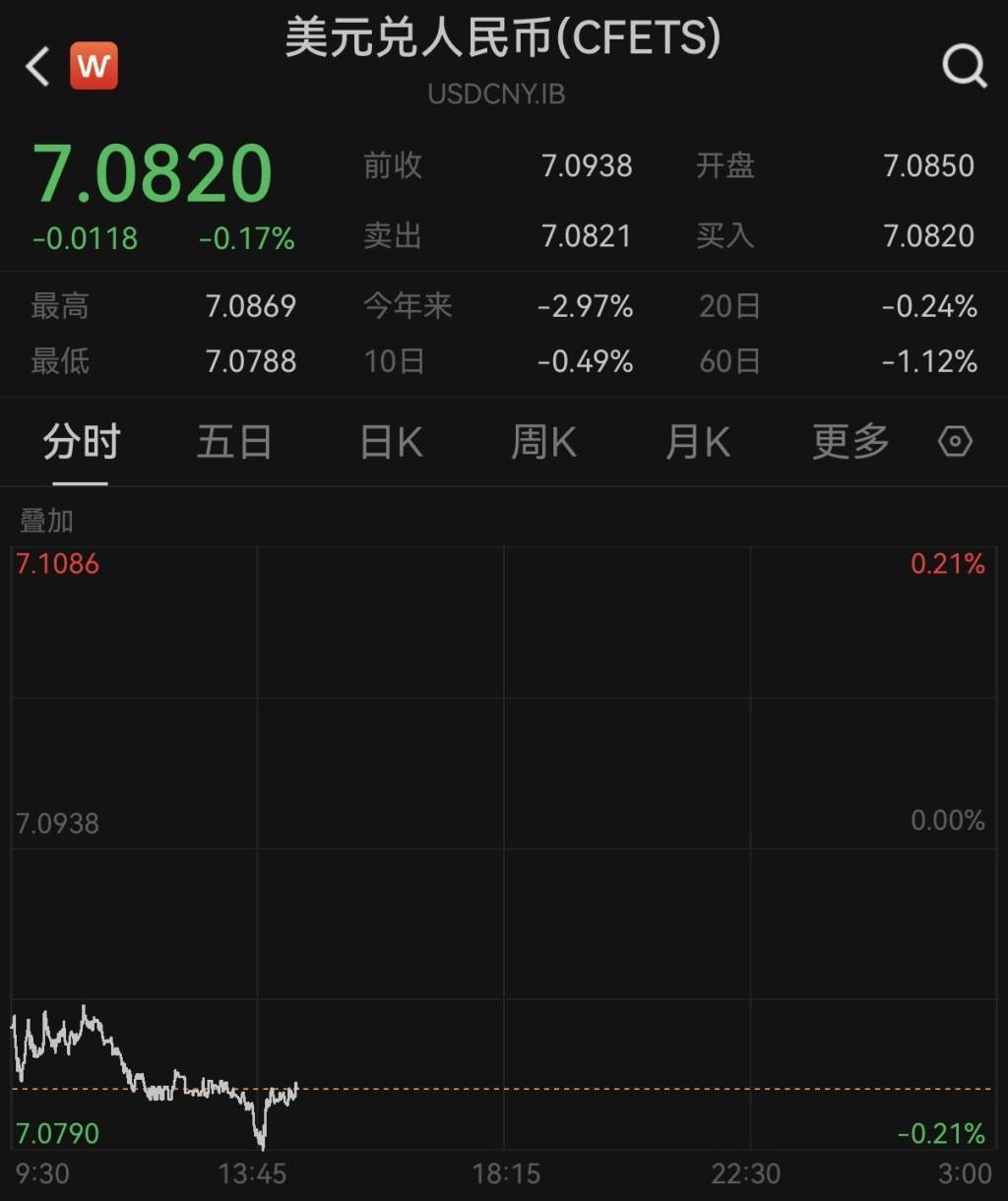
续创13个月新高,人民币对美元汇率盘中升破7.08
Sou Hu Cai Jing· 2025-11-26 06:56
Core Points - The Chinese Yuan (CNY) has strengthened against the US Dollar (USD) for two consecutive trading days, with the onshore exchange rate surpassing the 7.08 mark, reaching a high of 7.0788, the highest since mid-October 2024 [1] - The offshore Yuan also saw a peak of 7.07595 against the USD, marking a new high since mid-October 2024 [3] - The central parity rate of the Yuan against the USD was adjusted up by 30 basis points to 7.0796, the highest since October 14, 2024 [5] Summary by Category Exchange Rate Movements - On November 26, the onshore CNY/USD exchange rate opened at 7.0850 and reached a maximum of 7.0869, reflecting a year-to-date appreciation of nearly 3% [2] - The offshore CNY/USD exchange rate reached a new high of 7.07595, indicating strong investor sentiment [3] Economic Factors - The strengthening of the Yuan is attributed to two main factors: the continuous adjustment of the CNY/USD central parity towards a stronger direction and the robust performance of the domestic economy since the beginning of the year [5] - Increased export performance and a strong domestic capital market since July have led to higher demand for currency settlement, boosting market confidence in the Yuan [5]