热管理

Search documents
中鼎股份 | 2025Q2:业绩符合预期 进军机器人本体制造【民生汽车 崔琰团队】
汽车琰究· 2025-08-30 14:56
Core Viewpoint - The company reported steady revenue growth and improved profitability in the first half of 2025, with a focus on expanding its presence in the robotics sector and enhancing its product offerings in the automotive and new energy fields [2][3][4][5]. Financial Performance - In the first half of 2025, the company achieved revenue of 9.846 billion yuan, a year-on-year increase of 1.83%, and a net profit attributable to shareholders of 817 million yuan, up 14.11% year-on-year [2]. - For Q2 2025, revenue was 4.992 billion yuan, reflecting a year-on-year growth of 0.31% and a quarter-on-quarter increase of 2.84% [3]. - The gross profit margin for Q2 2025 was 23.83%, an increase of 1.78 percentage points year-on-year, attributed to changes in product structure [3]. Business Development - The company is actively expanding its business in the new energy vehicle sector, achieving revenue in various segments such as cooling systems (2.606 billion yuan), rubber business (2.043 billion yuan), and sealing systems (1.942 billion yuan) in the first half of 2025 [4]. - The company has launched a series of liquid cooling units for energy storage, leveraging technology from automotive thermal management [4]. Strategic Initiatives - The company has signed multiple strategic cooperation agreements to enter the humanoid robot manufacturing sector, collaborating with firms like Wuzhou Xinchun and Zhongqing Robotics [5]. - A joint venture is planned with Zhujie Power to deepen cooperation in robot manufacturing, and the company has been designated as a chain leader in the industry by the Hefei Baohe District government [5]. Future Projections - Revenue projections for 2025-2027 are estimated at 21.682 billion yuan, 24.392 billion yuan, and 27.685 billion yuan, respectively, with net profits expected to reach 1.696 billion yuan, 1.933 billion yuan, and 2.236 billion yuan [6][9]. - The company’s earnings per share (EPS) are projected to be 1.29 yuan, 1.47 yuan, and 1.70 yuan for the years 2025, 2026, and 2027, respectively [6][9].


三花智控(002050) - 2025年8月29日投资者关系活动记录表
2025-08-29 13:16
Group 1: Financial Performance - The company achieved a revenue of 16.263 billion yuan in the first half of 2025, representing an 18.91% year-on-year increase [6] - Net profit attributable to shareholders reached 2.11 billion yuan, up 39.31% year-on-year [7] - Gross profit margin was 28.12%, an increase of 0.65% compared to the previous year [7] - Net profit margin attributable to shareholders was 12.97%, reflecting a 1.90% year-on-year increase [7] Group 2: Business Segments Performance - Revenue from the refrigeration and air conditioning components business was 10.389 billion yuan, a 25.49% increase year-on-year [7] - Revenue from the automotive components business was 5.874 billion yuan, showing an 8.83% year-on-year growth [7] Group 3: Market Trends and Drivers - The growth in the refrigeration and air conditioning market is driven by increasing demand for temperature regulation due to climate variability [7] - The penetration rate of air conditioning in regions like Europe and Africa remains low, indicating significant market potential [7] - The expansion of heat pump technology into new applications such as data centers and energy storage is expected to exceed traditional household appliance markets [7] Group 4: Strategic Initiatives - The company is actively expanding its data center liquid cooling segment, leveraging over 40 years of experience in refrigeration technology [8] - A dedicated robotics division has been established to focus on electromechanical actuators and AI, facilitating product development and mass production [10] - The company has implemented targeted measures to enhance operational quality, contributing to the significant increase in net profit [10] Group 5: Globalization and Tariff Impact - The company has established overseas production bases in Poland, Mexico, Thailand, and Vietnam to ensure localized production [10] - Global production base layout and flexible capacity allocation have strengthened supply chain stability amid tariff policies [10] - The company has successfully negotiated favorable terms regarding tariff cost sharing with clients, ensuring long-term competitiveness [10]

风扇×微泵!华为、OPPO、一加手机厂商掀开主动散热新趋势
DT新材料· 2025-08-28 16:04
Core Viewpoint - Huawei is exploring a dual cooling solution for the Mate80 series, combining an active fan and micro-pump liquid cooling, which has garnered significant attention in the industry and among consumers [2][4][12] Group 1: Active Cooling Technologies - The introduction of active cooling technologies, such as micro fans and micro-pump liquid cooling, indicates that mainstream smartphone manufacturers are taking active cooling seriously, moving beyond niche applications [4][10] - OPPO has already integrated an active cooling fan in its mid-range K13 series, creating a "Storm Engine" system that mimics PC cooling solutions [8] - The OnePlus 11 concept phone was the first to feature Active CryoFlux micro-pump liquid cooling, showcasing the industry's shift from passive to active cooling solutions [10][12] Group 2: Importance of Thermal Management - As smartphones evolve into high-performance computing devices, the demand for effective thermal management has increased due to rising processor power consumption and heat output [13] - Early smartphones relied on passive cooling methods, but the introduction of materials like vapor chambers and graphene has significantly improved heat dissipation capabilities [13][14] - The transition from passive to active cooling is a collective response to the high power consumption era driven by AI functionalities and high-refresh-rate displays [14][21] Group 3: Comparison of Cooling Methods - Passive cooling relies on material properties for heat conduction and diffusion, while active cooling uses mechanical means to enhance heat exchange [14] - Active cooling methods, such as fans and micro-pumps, are more efficient and can sustain high power output, making them suitable for high-load scenarios [14][15] - The industry is witnessing a trend where active cooling technologies are moving towards mass production and market adoption [12][38] Group 4: Future Applications and Market Potential - The integration of micro-pump liquid cooling in smartphones could lead to new applications in AI glasses, AR devices, and humanoid robots, with market potential exceeding hundreds of billions [6][38] - The development of active cooling technologies is seen as a key driver for the next generation of high-performance smart devices, pushing the consumer electronics industry into a new era of high power and performance [38][39] Group 5: Supplier Recommendations - Several companies are emerging as key suppliers for micro-pump and fan technologies, including Chengdu Huitong Xidian Electronics, Resonance Precision, and Nanchip Technology, which are focusing on developing efficient and compact cooling solutions [22][24][26][30][34][36] - These suppliers are contributing to the advancement of thermal management technologies, which are crucial for the performance and longevity of modern electronic devices [30][36] Group 6: Upcoming Events - The 6th Thermal Management Industry Conference and Exposition will take place from December 3-5, 2025, in Shenzhen, focusing on advancements in thermal management technologies and featuring various suppliers and research teams [39][42][48]

美利信(301307):静待主业拐点,半导体、散热新业务多点开花
ZHONGTAI SECURITIES· 2025-08-28 11:44
Investment Rating - The report assigns a rating of "Accumulate" to the company, indicating an expected relative performance increase of 5% to 15% over the next 6 to 12 months [2]. Core Views - The company is facing profit pressure due to multiple factors, but it is expanding into the semiconductor and high-end precision industries, which are expected to drive future growth [2][5]. - The company reported a revenue of 1.86 billion yuan in the first half of 2025, a year-on-year increase of 12.4%, but continued to incur a net loss of 110 million yuan [3]. - The automotive parts segment showed strong performance with a revenue increase of 17.6%, while the communication segment remained stable [5]. Summary by Sections Financial Performance - The company’s revenue for 2023 is projected at 3.189 billion yuan, with a growth rate of 1% year-on-year. By 2025, revenue is expected to reach 4.431 billion yuan, reflecting a growth rate of 21% [2]. - The net profit for 2025 is adjusted to 33 million yuan, with projections of 148 million yuan and 207 million yuan for 2026 and 2027, respectively [5]. - The gross margin for the first half of 2025 was 7.46%, down 3.88 percentage points year-on-year, with the communication segment's gross margin at 4.43% [5]. Business Development - The company established a joint laboratory for thermal management and materials with top universities, aiming to provide comprehensive thermal management solutions across various sectors [4]. - The company is accelerating its globalization strategy through acquisitions, particularly in North America, to enhance its competitive edge [5]. Market Position - The semiconductor and thermal management sectors are identified as key growth areas, with the company leveraging its expertise in precision component manufacturing to meet client needs [5].
溯联股份2025年中报简析:增收不增利,应收账款上升
Zheng Quan Zhi Xing· 2025-08-27 23:31
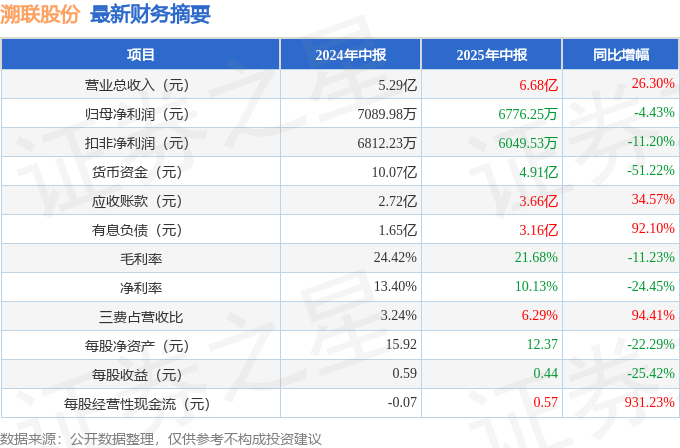
Core Viewpoint - The recent financial report of Su Lian Co., Ltd. (301397) indicates a mixed performance with a significant increase in revenue but a decline in net profit, highlighting challenges in profitability and cash flow management [1][3]. Financial Performance - The total revenue for the first half of 2025 reached 668 million yuan, a year-on-year increase of 26.3% [1]. - The net profit attributable to shareholders was 67.76 million yuan, a decrease of 4.43% compared to the previous year [1]. - The gross profit margin was 21.68%, down 11.23% year-on-year, while the net profit margin fell to 10.13%, a decline of 24.45% [1]. - The company's accounts receivable increased by 34.57%, indicating potential cash flow issues [1]. - Operating cash flow per share improved significantly to 0.57 yuan, a year-on-year increase of 931.23% [1]. Business Drivers - The revenue growth was primarily driven by increased sales in the new energy vehicle sector and advancements in customer vehicle technology, particularly in thermal management systems [4][5]. - Key growth areas included battery components and thermal management parts for electric vehicles, as well as a notable increase in fuel tank pipeline business [5]. Cost and Efficiency - Total sales, management, and financial expenses amounted to 42.04 million yuan, representing 6.29% of revenue, which is a significant increase of 94.41% year-on-year [1]. - The company is focusing on stabilizing gross margins through new product development, market expansion, and cost reduction initiatives [6]. Product Development and Market Expansion - The company is actively developing new products aligned with trends in new energy vehicles, including hydrogen fuel cell pipelines and high-pressure air suspension pipelines [8]. - A dedicated battery division has been established to enhance research and market development for battery-related products, which are expected to contribute significantly to future revenue [8]. Strategic Positioning - The company's main products and technologies are closely aligned with those of Su Lian Intelligent Control, indicating a high degree of complementarity and potential for collaborative development [9].
阿莱德:公司始终关注与热管理契合的行业动态与市场发展
Zheng Quan Ri Bao Zhi Sheng· 2025-08-27 11:41
Core Viewpoint - The company is actively monitoring industry dynamics and market developments related to thermal management, engaging in industry events, and collecting customer needs for collaboration and negotiation [1]. Group 1 - The company emphasizes the importance of aligning with industry trends in thermal management [1]. - The company participates in industry events to gather customer insights and foster communication [1]. - The approach of leveraging existing customer relationships is identified as an effective strategy [1].

美利信上半年营收稳健增长 研发协同赋能四大领域
Zheng Quan Shi Bao Wang· 2025-08-27 00:14
Group 1 - The company reported a revenue of approximately 1.859 billion yuan for the first half of 2025, representing a year-on-year growth of 12.41%. However, the net profit attributable to shareholders was -105 million yuan due to decreased gross margin and increased asset impairment [1] - The company is focusing on a strategy of "quality foundation, cost reduction and efficiency improvement, and solidifying overseas expansion" amidst the slowdown in the traditional fuel vehicle market and the rise of new energy vehicles. It aims to stabilize its traditional market share while accelerating R&D and production in thermal management, energy storage, and semiconductor technologies [1] - The company has established collaborations with several leading new energy vehicle manufacturers, including Rivian and various domestic new energy vehicle startups, as well as well-known tier-one suppliers like ZF, Eaton, Aisin, and Schaeffler [1] Group 2 - In the communication sector, the company has a long-standing partnership with Ericsson and other leading domestic communication equipment manufacturers, maintaining strong collaboration and entering Nokia's supply chain this year [2] - In the energy storage sector, the company has entered the supply chain of clients like Zhenghao, while in the semiconductor field, it has partnered with leading domestic clients in Shanghai and Shenzhen [2] - The company has established production bases in Chongqing, Xiangyang, Dongguan, and Ma'anshan, with a North American base already securing contracts with new energy vehicle and energy storage clients. The global layout of production bases allows the company to respond quickly to customer needs [2]
人形机器人热管理解决方案怎么选?
DT新材料· 2025-08-22 16:04
Core Viewpoint - The first humanoid robot sports event highlights the advancements in humanoid robotics, showcasing their capabilities in various competitive scenarios, while also emphasizing the critical importance of thermal management technology for their performance and safety [2][6][43]. Group 1: Humanoid Robot Sports Event - The inaugural humanoid robot sports event, featuring 280 teams from 16 countries, will include 487 competitions across 26 events, demonstrating cutting-edge achievements in intelligent decision-making and collaborative movement [2]. - Unlike traditional robot combat or laboratory demonstrations, this event allows humanoid robots to compete in running, weightlifting, and combat, showcasing their strength and speed [2]. - The event serves as a platform for testing thermal management technologies, which are essential for maintaining stable operation during high-intensity activities [6][19]. Group 2: Development and Key Technologies of Humanoid Robots - Humanoid robots, designed to mimic human shape and behavior, have evolved through various stages, from mechanical systems to advanced autonomous intelligent systems, driven by advancements in multiple disciplines [8][9]. - The last decade has seen humanoid robots enter commercialization, with products like Tesla's Optimus and Xiaomi's CyberOne marking a shift from laboratory to industry [12]. - Key technologies in humanoid robotics include mechanical design, sensing technology, control algorithms, and artificial intelligence, enabling complex perception, movement, and interaction capabilities [14]. Group 3: Thermal Management Challenges - Humanoid robots face significant thermal management challenges due to limited internal space, multiple heat sources, weight constraints, and complex environmental conditions [19][20]. - Common thermal management solutions include passive methods like structural optimization and high thermal conductivity materials, as well as active methods such as liquid cooling and bio-inspired cooling systems [20]. Group 4: Thermal Management Suppliers - Companies like Feirongda, Lingyi Zhizao, Sanhua, and Aled are actively involved in providing thermal management solutions for humanoid robots, focusing on materials and systems that enhance performance and safety [22][27][33][42]. - Feirongda has invested in Guoli Intelligent, aiming to advance the development of dexterous robotic hands, while Lingyi Zhizao has accumulated technology in industrial and special robots since 2009 [24][29]. - Sanhua is recognized for its innovative liquid cooling modules that significantly enhance the endurance of humanoid robots, while Aled specializes in thermal interface materials for critical components [33][42].

2025第六届热管理产业大会暨博览会丨12月3-5日 深圳
DT新材料· 2025-08-22 16:04
Core Viewpoint - The rapid advancement of electronic technology is driving the demand for efficient thermal management materials and innovative solutions across various sectors, including consumer electronics, 5G, AI, and energy storage, to ensure product efficiency, reliability, and safety [2]. Group 1: Conference Information - The 6th Thermal Management Industry Conference and Exposition (iTherM 2025) will be held from December 3-5, 2025, at the Shenzhen International Convention and Exhibition Center, focusing on the theme of "Fusion and Innovation" [3]. - The conference will feature over 350 exhibitors and a 20,000 m² exhibition area, aiming to provide a one-stop, high-efficiency value service platform for the thermal management industry [3][4]. - The event is expected to attract over 2,000 participants, including renowned scholars, technical experts, and executives from leading companies [3]. Group 2: Organizational Structure - The conference is organized by the China Productivity Promotion Center Association's New Materials Professional Committee and DT New Materials, with several prominent figures serving as advisors and executive chairs [5]. - Various activities will be conducted, including innovation showcases, closed-door seminars, expert consultations, and one-on-one exchanges to foster collaboration and innovation in the thermal management field [5]. Group 3: Conference Topics - The conference will address the current challenges and future opportunities in the thermal management industry, focusing on market dynamics, technological evolution, and high-quality industrial development [7]. - Key topics will include thermal science, functional materials, technical applications, and engineering solutions, with specialized sessions on areas such as liquid cooling technology, power device thermal management, and data center thermal management [7]. Group 4: Registration and Participation - Registration fees for participants are set at ¥2,200 for early birds (before October 31, 2025) and ¥3,000 for regular registration, with discounts available for students [8]. - Payment methods include bank transfer, Alipay, and WeChat Pay, with on-site payment options also available [8].

中石科技:公司主要产品包括高导热石墨产品、导热界面材料等
Zheng Quan Ri Bao Zhi Sheng· 2025-08-20 10:49
Core Viewpoint - The company focuses on research and development to address the reliability issues of electronic products, providing solutions in thermal management, electromagnetic shielding, bonding, and sealing [1] Product Offerings - The main products include high thermal conductivity graphite products, thermal interface materials, heat pipes, heat spreaders, thermal modules, EMI shielding materials, adhesive materials, and sealing materials [1] - These products are versatile and can be applied in the robotics sector [1]