生物制造

Search documents
中信证券港股市场2月投资策略:扰动已过,捕捉春季行情方向
Xin Lang Cai Jing· 2026-01-29 01:21
登录新浪财经APP 搜索【信披】查看更多考评等级 炒股就看金麒麟分析师研报,权威,专业,及时,全面,助您挖掘潜力主题机会! 港股市场|扰动已过,捕捉春季行情方向:2026年2月投资策略 来源:中信证券研究 文|徐广鸿 侯苏洋 陈采赋 2025年四季度导致港股下跌的业绩预期调整和资金面扰动已告一段落。而2015-2025年港股的春季躁动 行情中,恒指平均收益率为2.4%,期间平均周度胜率达70.8%,港股大盘股在春节前通常跑赢,而春节 后小盘股表现更为优异。随着地方两会的逐步召开,我们建议关注"十五五"规划建议和中央经济工作会 议的方向。展望2026年2月,港股业绩预期已有显著调整,叠加内外部资金面的扰动因素也已告一段 落,我们判断港股2025年12月下旬以来的春季行情或将延续,整体呈现春节前大盘股有相对收益,政策 方向支持的成长行业表现更优的态势。春季后需关注下一个解禁高峰期或对港股流动性预期的影响。短 期建议关注三大主线:1)"十五五"政策方向,包括生物制造、具身智能、6G等;2)政策推动基本预 期逆转的外卖平台和地产;3)受益于春季躁动的非银。 ▍基本面和资金面扰动因素已过。 基本面来看,2025年年底以 ...



探访全国首家人形机器人7S店(奋进“十五五”·一线见闻)
Ren Min Ri Bao· 2026-01-28 22:05
Group 1 - The article discusses the development and commercialization of humanoid robots in Wuhan, highlighting the establishment of the first humanoid robot 7S store in the country, which offers various humanoid robots priced between 7,999 yuan and 700,000 yuan for multiple applications [2][4] - The humanoid robot "Yuan You," developed in Wuhan, is designed for various services, including guidance and health care, and has been operational in a local hospital for nine months [2][3] - The production of humanoid robots in Wuhan is supported by a robust supply chain, with over 20 core suppliers and nearly 1,000 related enterprises, enabling efficient manufacturing and assembly of components [3] Group 2 - The Wuhan government has launched a three-year action plan and policy measures to promote the application of humanoid robots across various sectors, offering financial incentives for both application and product development [4] - The 7S store has generated over 600,000 yuan in revenue from experiences, sales, and rentals, indicating a growing market for humanoid robots in the region [4] - The establishment of the Humanoid Robot Innovation Center aims to enhance the training and data collection for humanoid robots, facilitating their evolution and integration into various industries [3][4]

10万亿元投资背后的国资央企产业跃迁
Xin Hua Wang· 2026-01-28 10:37
Group 1 - The core investment of over 10 trillion yuan by central enterprises since the "14th Five-Year Plan" reflects their commitment to transitioning the industrial system towards high value-added and high-tech sectors, with the proportion of strategic emerging industries in total investment rising from 22% to over 40% [1] - By 2025, central enterprises are expected to invest 2.5 trillion yuan in strategic emerging industries, accounting for 41.8% of total investment, with a revenue scale exceeding 12 trillion yuan, achieving a consistent annual growth of 1 trillion yuan [2] - The focus on developing emerging industries is seen as a key strategic initiative, with plans for a new work document to guide central enterprises in cultivating new pillar industries and optimizing the overall layout of state-owned economy [2] Group 2 - Central enterprises are leading the upgrade of traditional industries, with initiatives including the establishment of 70 excellent smart factories and the promotion of AI applications across key sectors such as energy and manufacturing [3] - Enhancing the resilience of industrial and supply chains is a primary focus, with actions taken to ensure the safety of critical industries related to national security and public welfare [4] - The State-owned Assets Supervision and Administration Commission (SASAC) aims to create competitive industrial clusters in emerging fields such as renewable energy, aerospace, and quantum technology, emphasizing a strategy of concentration in investment and structural optimization [6]
从吐丝到制药:一只蚕的工业化蝶变
3 6 Ke· 2026-01-28 09:06
数字背后,是传统提取模式日益逼仄的困境:国内血浆站监管趋严,导致资采浆成本飙升;而基于人源血浆的提取模式,理论上永远无法彻底规避未知病 毒跨物种传播的风险。 如今,传统意义上的地下血站基本根除,但非法的血液买卖链条并未消失,而是以一种更隐蔽、更具欺骗性的方式在运作。市场急需一种合规、安全、可 控、可大规模生产的替代来源。 这一次,破局的答案不再来自人,而是来自一只昆虫——蚕。 作为全球最大的人血白蛋白消费国,中国每年需消耗约1000吨,其中超60%长期依赖进口。 鉴于桑蚕丝腺是天然的高效"生物反应器",位于安吉的链码生物科技有限公司,通过构建标准化的工业方舱养殖体系与家蚕表达系统,实现了重组蛋白的 低成本、可规模化生产。 链码生物创始人吴宇青形容,他们正在"低头开辟新时代"。一场用工业确定性替代生物不确定性的革命,正在链码生物的方舱里发生。 曾被寄予厚望的转基因动物乳腺反应器,虽然单体产量潜力巨大,但牛羊漫长的繁育周期和严苛的动物福利监管,给产业化套上了沉重的时间枷锁,难以 实现快速响应的工业化交付。 植物表达如水稻,则困于不确定性。田间种植成本低廉,但这种开放式系统面临着极高的基因漂移风险,监管压力巨大;且 ...
国务院国资委:研究起草推动央企培育新兴支柱产业工作文件
Zhong Guo Xin Wen Wang· 2026-01-28 08:11
Core Insights - The State-owned Assets Supervision and Administration Commission (SASAC) is drafting a document to promote the cultivation of emerging pillar industries among central enterprises, aiming for leapfrog development in investment projects, leading enterprise cultivation, and optimization of the overall layout of state-owned economy [1][2] - By 2026, SASAC plans to accelerate the layout of emerging industries among central enterprises, emphasizing a new approach of "tiered cultivation and differentiated policies" for various types of industries [1] - The goal is to create a robust and resilient ecosystem for emerging industries through a mechanism that emphasizes "system empowerment and collaborative efforts," focusing on key areas such as industrial technological innovation and project implementation [1] Industry Development - By 2025, the revenue scale of strategic emerging industries among central enterprises is expected to exceed 12 trillion yuan, achieving an annual growth of 1 trillion yuan for three consecutive years [2] - Since the beginning of the 14th Five-Year Plan, central enterprises have invested over 10 trillion yuan in strategic emerging industries, with the investment proportion increasing from 22% to over 40% [2] - The total scale of central enterprise venture capital funds is nearly 100 billion yuan, with a special fund for the development of strategic emerging industries set to raise 51 billion yuan in its first phase, effectively leveraging social capital for long-term investments in hard technology [2] Future Focus Areas - SASAC aims to build a number of emerging pillar industries by creating market-oriented and specialized platforms for state capital operations, with a focus on sectors such as new energy, new energy vehicles, new materials, aerospace, and quantum technology [2] - The commission is also planning ahead for new tracks in areas like embodied intelligence, biomanufacturing, ocean energy, and green shipping, with the goal of establishing globally competitive industrial clusters [2]
美国单边退群冲击全球能化产业
Zhong Guo Hua Gong Bao· 2026-01-28 03:08
Core Viewpoint - The United States has officially initiated the process of withdrawing from key international agreements such as the United Nations Framework Convention on Climate Change, marking a significant policy shift that poses a serious threat to the multilateral global climate-energy governance system [1] Short-term Impact: Rising Compliance Costs and Fragmentation of Market Rules - The immediate effect of the U.S. withdrawal is a sharp increase in trade and compliance costs, as the decoupling of U.S. domestic emission policies from international standards will lead to substantial carbon tariff barriers for U.S. energy and chemical products exported to Europe [2] - U.S. chemical products, particularly those derived from oil and gas, will face significant challenges under the European Carbon Border Adjustment Mechanism (CBAM), which could erode their price competitiveness [2] - The weakening of the International Energy Forum (IEF) coordination mechanism will increase volatility risks in the global oil and gas market, impacting the profitability and predictability of production planning in the chemical industry [2] Long-term Changes: Shift in Technological Leadership and Supply Chain Resilience - The U.S. withdrawal is expected to result in a transfer of technological pathways and industry leadership, as it relinquishes its position in global clean energy technology rule-making [3] - This will lead to a reorganization of technological cooperation alliances, with countries like Europe, China, and Japan becoming central to the development of next-generation low-carbon chemical technologies [3] - The global green investment landscape, valued in trillions, will be reshaped, with capital flowing towards regions with stable policies and unified carbon market prospects, such as the EU and East Asia, potentially leading to a "bleeding" risk for U.S. chemical industries [3] Industry Response: From Passive Adaptation to Proactive Resilience Building - The global energy and chemical industry must strategically adjust to survive and compete in light of this historic change, with supply chains moving towards "nearshoring" and "friend-shoring" to mitigate carbon tariff risks [4] - Companies will accelerate the establishment of integrated, low-carbon production bases in major consumer markets, particularly in Europe and Asia, adopting a "regional production, regional sales" model [4] - There will be a shift away from U.S.-centric technological cooperation, with industry leaders seeking bilateral or regional alliances to ensure they remain aligned with global technological innovation [4] - Asset portfolios will increasingly tilt towards "climate resilience," with a notable increase in investments in circular economy, green hydrogen, and biomanufacturing, which are less affected by geopolitical and national policy changes [4] Role of Corporate Climate Diplomacy - In the absence of government leadership, large U.S. chemical companies may be compelled to adopt more proactive self-imposed emission reduction commitments and climate lobbying efforts, effectively engaging in "private sector climate diplomacy" to fill the leadership vacuum left by the government [5] - The U.S. unilateral withdrawal from international climate agreements signals a clear shift in the competitive paradigm of the global energy and chemical industry [5]
杭州生物制造大会“免费路演”!路演项目火热征集中!为你的项目寻找资金+合作伙伴!
synbio新材料· 2026-01-28 01:28
Conference Overview - The "5th China Synthetic Biology and Biomanufacturing Conference and Life China 3rd Functional Food and Nutrition Science Conference" will be held from March 31 to April 1, 2026, in Hangzhou [3][5]. - The conference aims to provide a platform for innovative synthetic biology projects with growth potential, facilitating face-to-face interactions among founders, industry experts, investors, and government representatives [3]. Event Details - The conference is organized by synbio Deep Wave and will accommodate approximately 1,000 participants [6]. - Various sessions will be held, including topics on biomanufacturing, functional foods, and applications of synthetic biology [7]. Roadshow Information - A special "Roadshow" segment is included to showcase promising synthetic biology projects, with a limited time of 8-10 minutes allocated for each presentation [8]. - Participants are required to submit a brief project introduction related to "synthetic biology" and "biomanufacturing" to secure a spot in the roadshow [8]. Previous Roadshow Projects - Notable past projects include efficient low-cost production of terpenoids, enzyme development, and applications of SYN milk exosomes in skincare [8]. - Other highlighted projects involve AI-driven health raw materials, industrial enzyme applications, and innovative biomanufacturing solutions [8][9].

免费注册参会!生物基化学品与材料专场,3月杭州,第五届中国合成生物学及生物制造大会
synbio新材料· 2026-01-28 01:28
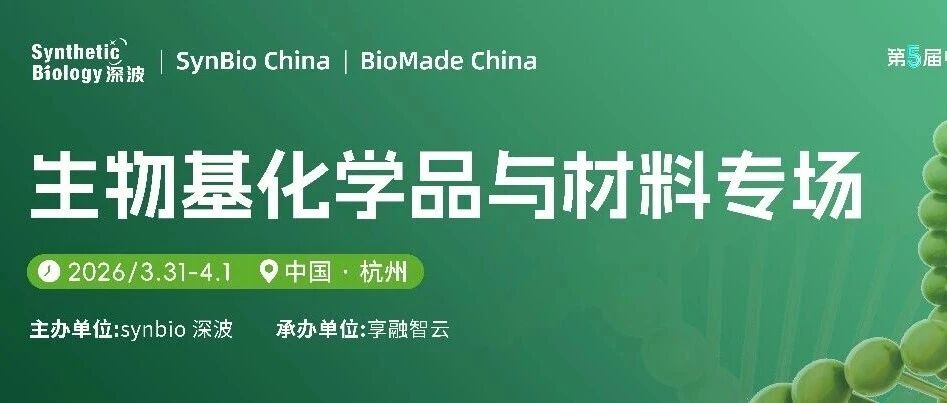
在全球推进绿色转型与"双碳"目标的战略背景下,生物基化学品与材料作为生物制造产业的核心支 柱,凭借原料可再生、全生命周期低碳环保等核心优势,正加速替代传统石油基产品,在包装、纺 织、汽车等领域展现出广阔应用前景,成为全球产业绿色转型的关键赛道。 我国高度重视该领域发展,将生物基新材料列为关键战略材料,多项产业扶持政策持续落地。然 而,产业仍面临包括综合成本竞争力、原料供应链稳定、产品性能优化及终端市场接受度等关键问 题。 基于此, 2026年3月31日-4月1日 ,"第五届中国合成生物学及生物制造大会"将在杭州举办,其中设 置 【 生物基化学品与材料专场】 ,旨在汇聚产学研用多方智慧,破解产业发展难题,助力生物基 化学品与材料产业高质量发展。 大会介绍 0 1 大会时间 | 2026年3月31日-4月1日 大会地点 | 杭州市 大会规模 | 1000人 主办单位 | synbio深波 承办单位 | 享融智云 媒体支持 | synbio新农食、synbio新美护、synbio新材料、生物制造圈、合成生物学俱乐部 扫码 免费 报名参会 论坛设置 0 2 | | 会场一 | 会场二 | 会场三 | | --- | ...
进军生物制造!中石油旗下公司「生物制造产业创新中心」成立揭牌!
synbio新材料· 2026-01-28 01:28
中国昆仑工程公司执行董事、党委书记李利军 表示,面向未来,昆仑工程将 以生物制造为重要发展方向 ,推进产业链、创新链、价值链深度融合,构 建"人才汇聚+技术攻关+成果转化"有效贯通的创新全链条,充分利用好既有科技力量、资源, 联合打造一流生物制造产业创新平台 ,助力蓝海新材料 向"炼化生精材"多产业链转型发展。 声明: 因水平有限,错误不可避免,或有些信息非最及时,欢迎留言指出。本文由仅作新材料相关领域介绍,本文不构成任何投资建议!转载请注明来源! 近日, 中石油蓝海新材料公司 与 中国昆仑工程公司 合作成立的 "生物制造产业创新中心" 在通州湾揭牌。 据悉,双方将 聚焦生物制造产业领域,加强合成生物学基础研究 ,加快攻克关键核心"卡脖子"技术,加快推进科技成果向现实生产力转化,实现战略科 技力量的同步升级。 蓝海新材料公司执行董事、党委书记李贵合 表示,当前,生物制造产业正迎来前所未有的发展机遇,是一片广阔的"蓝海"。蓝海新材料公司明确 将生物 制造与精细化工作为企业发展的第三曲线 ,未来将以生物制造产业创新中心为牵引,锚定生物制造领域的关键核心技术 ,聚力突破从实验室到工厂 的"最后一公里",形成一批可复 ...


聚焦五大核心战略方向 贡献成渝力量
Xin Lang Cai Jing· 2026-01-27 17:52
Core Strategy Directions - The focus is on five core strategic directions: innovation-driven development, industrial collaboration, open leadership, green development, and collaborative governance to establish a significant economic and technological innovation center in the region [2][3]. Innovation and Production Capacity - The strategy aims to address the issues of dispersed scientific innovation resources and inefficient results transformation by building a high-level innovation platform matrix and enhancing collaboration between Chongqing and Chengdu [2]. - Key areas of focus include artificial intelligence, low-altitude economy, and biomanufacturing, with plans to establish new research institutions and attract high-end talent [2]. Modern Industrial System - The goal is to construct a modern industrial system that emphasizes both quality and efficiency, transitioning from mere scale expansion to a balanced approach [3]. - Collaborative efforts will be made to build world-class industrial clusters in electronic information and advanced materials, with specific roles for Chengdu and Chongqing in research and high-end manufacturing [3]. Open Economy and Connectivity - The initiative aims to create a new inland open highland by enhancing the logistics network, including the Western Land-Sea New Corridor and the China-Europe Railway Express [3]. - There will be a focus on innovative institutional frameworks in cross-border service trade and digital trade, alongside efforts to attract multinational companies to establish regional headquarters [3]. Green Development - The strategy includes establishing a collaborative governance mechanism for environmental protection, focusing on pollution control in cross-border rivers and air quality [3]. - There will be an emphasis on energy-saving transformations in traditional industries and the cultivation of green industrial clusters [3]. Integrated Governance - The approach advocates for a unified strategy across the Sichuan-Chongqing region, promoting market-oriented reforms for resource allocation and enhancing public service integration [4]. - The aim is to create a one-hour commuting circle and establish a mechanism for integrated planning and project assessment to maximize collaborative development benefits [4].