
美国政府停摆

Search documents
宝城期货原油早报-20251110
Bao Cheng Qi Huo· 2025-11-10 02:06
Report Summary 1. Report Industry Investment Rating - Not provided in the given content 2. Report's Core View - The domestic crude oil futures 2512 contract is expected to show a weak - running trend. In the short - term, it is weak; in the medium - term, it is oscillating; and on the day, it is also weak. The market is dominated by weak supply - demand fundamentals [1][5] 3. Summary by Relevant Content Price and Trend - The domestic crude oil futures 2512 contract maintained an oscillating and stable trend in the night session last Friday, with the futures price slightly rising 0.59% to 459.6 yuan/barrel. It is expected to maintain a weak trend on Monday [5] Driving Logic - Some Fed officials have made hawkish remarks. The ongoing US government shutdown may delay the release of October CPI data and impact the US economic resilience. They suggest no interest - rate cuts before Powell's term ends in May 2026. As geopolitical sentiment fades, the domestic and foreign crude oil futures markets are back to the supply - demand fundamental - driven market [5]
宝城期货甲醇早报-20251110
Bao Cheng Qi Huo· 2025-11-10 02:02
1. Report Industry Investment Rating - Not provided in the given content 2. Core Viewpoints of the Report - The methanol 2601 contract is expected to be weak in the short - term and fluctuate in the medium - term, with an overall view of weak operation. The weak supply - demand situation dominates, causing methanol to fluctuate weakly. The contract may maintain a weak trend on Monday [1][5]. 3. Summary by Related Catalogs 3.1 Time - Cycle Viewpoints - Short - term (within a week): The methanol 2601 contract is expected to be weak [1]. - Medium - term (two weeks to one month): The methanol 2601 contract is expected to be in a state of fluctuation [1]. - Intraday: The methanol 2601 contract is expected to be weak [1][5]. 3.2 Driving Logic - Some Fed officials have made hawkish remarks. The ongoing government shutdown in the US may delay the release of October CPI data, and it has also impacted the US economic resilience. They suggest no interest rate cuts before Powell's term ends in May 2026 [5]. - The domestic methanol operating rate and weekly output remain at relatively high levels, and the external import pressure continues to increase. The methanol inventories at ports in East and South China are persistently high [5]. - On the night session of last Friday, the domestic methanol futures 2601 contract fluctuated weakly, with the futures price slightly down 0.76% to 2,103 yuan/ton [5].
美多座机场因人员短缺出现长时间延误
Yang Shi Xin Wen· 2025-11-09 05:46
Core Points - The recent record-breaking "shutdown" of the U.S. government has had a catastrophic impact on the U.S. aviation industry [1] - Air traffic controller shortages have led to significant flight delays and cancellations since the shutdown began [1] - On November 8, the Federal Aviation Administration reported that multiple airports in the U.S. experienced long delays due to personnel shortages [1]
【UNforex财经事件】中美关系改善与降息预期交织 黄金延续高位震荡
Sou Hu Cai Jing· 2025-11-07 10:41
Group 1 - Recent positive signals in US-China relations, including the suspension of sanctions on China's shipbuilding industry and public consultations on delaying tariffs, have boosted investor risk appetite [1] - The Dow Jones futures rose approximately 0.20%, while S&P 500 and Nasdaq 100 futures increased by 0.25% and 0.33% respectively, indicating a recovery in market sentiment [1] - October's employment data showed a significant increase in layoffs, with over 153,000 job cuts reported, marking the largest monthly increase in over 20 years, which has strengthened expectations for a Federal Reserve rate cut in December [1] Group 2 - The CME FedWatch tool indicates a 67% probability of a Federal Reserve rate cut in December, up from 60% a week prior, supporting stock market risk appetite and maintaining high gold prices [1] - Despite the recovery in market sentiment, safe-haven funds remain resilient due to ongoing government shutdown risks, with independent estimates suggesting a potential 1% to 2% reduction in Q4 GDP if the shutdown continues [1] - The US Supreme Court's hearings on presidential tariff powers have added policy uncertainty, sustaining market demand for safe-haven assets like gold [1] Group 3 - Gold prices have returned above $4,000 but remain below overnight highs, with short-term volatility driven by dollar buying and interest rate cut expectations [2] - Technical analysis suggests that if gold prices break through the $4,020–$4,030 resistance range, they may further test $4,045–$4,050 and potentially $4,100; conversely, a drop below $3,975–$3,965 could see prices retreat to around $3,929 [2] - The market is characterized by a coexistence of policy expectations and safe-haven demand, with gold stability above $4,000 dependent on upcoming data confirming rate cut prospects and dollar performance [2]
贵金属策略报告-20251107
Shan Jin Qi Huo· 2025-11-07 10:27
Group 1: Report Investment Ratings - Not provided in the content Group 2: Core Views - The report expects precious metals to be volatile and strong in the short - term, oscillate at high levels in the medium - term, and rise in a stepped manner in the long - term. Gold price trends are the anchor for silver prices. In terms of silver, there are small increases in CFTC silver net - long positions and iShare silver ETF, and a slight decrease in recent visible silver inventories [1][6] Group 3: Summary by Directory Gold - **Core Logic**: In the short - term for hedging, the negative impact of the China - US talks has materialized, while risks such as a US government shutdown and geopolitical changes still exist. The US employment is weakening and inflation is moderate, so the expectation of the Fed's interest rate cut remains. In terms of the hedging attribute, the results and consensus of the China - US economic and trade consultations in Kuala Lumpur were announced, the US government shutdown reached 35 days, tying the longest record in history, and the US Supreme Court questioned the legitimacy of Trump's tariffs. Regarding the monetary attribute, private reports show a decrease in US employment positions in October and a surge in layoffs to a 22 - year high for the same period. The overall labor demand is still slowing down, and salary growth remains stagnant. The Fed's interest rate cut path has changed, and internal differences are intensifying. The market expects a 70% probability of a 25 - basis - point interest rate cut by the Fed in December. The US dollar index and US Treasury yields are under pressure and falling. For the commodity attribute, the CRB commodity index is oscillating weakly, and the appreciation of the RMB is negative for domestic prices [1] - **Data**: Comex gold主力合约收盘价 is $3984.80 per ounce, down $5.60 (-0.14%) from the previous day and down $53.50 (-1.32%) from the previous week. London gold is $3986.50 per ounce, up $18.30 (0.46%) from the previous day and down $7.65 (-0.19%) from the previous week. The closing price of SHFE gold主力 is 921.26 yuan per gram, up 3.46 yuan (0.38%) from the previous day and down 0.66 yuan (-0.07%) from the previous week. The closing price of gold T + D is 917.64 yuan per gram, up 0.13 yuan (0.01%) from the previous day and down 3.38 yuan (-0.37%) from the previous week. There are also data on positions, inventories, etc. [2] - **Strategy**: Conservative investors should wait and see, while aggressive investors can buy low and sell high. It is recommended to manage positions well and set strict stop - loss and take - profit levels [3] Silver - **Core Logic**: Gold price trends are the anchor for silver prices. There are small increases in CFTC silver net - long positions and iShare silver ETF, and a slight decrease in recent visible silver inventories [6] - **Data**: Comex silver主力合约收盘价 is $47.85 per ounce, down $0.02 (-0.03%) from the previous day and down $0.88 (-1.82%) from the previous week. London silver is $48.69 per ounce, up $1.08 (2.26%) from the previous day and up $0.51 (1.05%) from the previous week. The closing price of SHFE silver主力 is 11484 yuan per kilogram, up 57 yuan (0.50%) from the previous day and up 43 yuan (0.38%) from the previous week. The closing price of silver T + D is 11480 yuan per kilogram, up 59 yuan (0.52%) from the previous day and up 70 yuan (0.61%) from the previous week. There are also data on positions, inventories, etc. [7] - **Strategy**: Conservative investors should wait and see, while aggressive investors can buy low and sell high. It is recommended to manage positions well and set strict stop - loss and take - profit levels [7] Fundamental Key Data - **Fed - related**: The upper limit of the federal funds target rate is 4%, the discount rate is 4%, the reserve balance interest rate (IORB) is 3.9%, and the Fed's total assets are $66236.43 billion, down $167.70 billion (-0.00%) from the previous period. M2 year - on - year growth is 4.49%, up 0.01 percentage points from the previous period [9] - **Other Key Indicators**: The 10 - year US Treasury real yield is 2.39, up 0.02 (0.84%) from the previous day and up 0.04 (1.70%) from the previous week. The US dollar index is 99.71, down 0.45 (-0.45%) from the previous day and up 0.19 (0.19%) from the previous week. There are also data on US Treasury spreads, inflation, economic growth, labor market, real estate market, consumption, industry, trade, economic surveys, central bank gold reserves, and IMF foreign exchange reserve ratios [9][11][13]
【UNFX财经事件】中美缓和推动情绪修复 黄金维持强势整理格局
Sou Hu Cai Jing· 2025-11-07 10:19
Group 1 - Recent positive signals in US-China relations, including the US pausing sanctions on China's shipbuilding industry and initiating a public consultation process to suspend tariff increases for one year, are seen as significant progress in bilateral relations, boosting market confidence [1] - The Dow Jones futures rose approximately 0.20%, while S&P 500 and Nasdaq 100 futures increased by 0.25% and 0.33% respectively, following a period of market pressure due to corrections in the technology and AI sectors [1] - The latest employment data indicates signs of economic cooling, with October layoffs exceeding 153,000, marking the highest level in over 20 years, reinforcing expectations for a Federal Reserve rate cut in December [1] Group 2 - The CME FedWatch tool indicates a 67% probability of a Federal Reserve rate cut in December, up from 60% the previous week, which has contributed to a positive sentiment in the stock market and provided solid support for gold [1] - Despite an increase in risk appetite, safe-haven sentiment has not completely dissipated due to concerns over the ongoing US government shutdown, which has lasted over five weeks, potentially impacting the economy [1] - The US Supreme Court's hearings on the legality of presidential tariff powers have heightened policy uncertainty, leading to a resurgence of safe-haven sentiment that supports gold prices [1] Group 3 - Gold (XAU/USD) stabilized above $4,000 but failed to break the overnight high, with market volatility increasing due to the divergence between the dollar's rebound and rate cut expectations [2] - Technically, if gold prices break through the resistance zone of $4,020–$4,030, they may further test the $4,045–$4,050 range and approach the $4,100 mark; conversely, a drop below the support zone of $3,975–$3,965 could see prices retreat to around $3,929 [2] - The market remains in a pattern of intertwining policy expectations and safe-haven sentiment, with gold supported by both rate cut expectations and safe-haven demand, maintaining its position above $4,000 [2]
如何解读美国回购市场流动性收紧︱重阳问答
重阳投资· 2025-11-07 07:32
Core Viewpoint - The article discusses the tightening liquidity in the US repurchase market, highlighting the significant widening of the spread between the Secured Overnight Financing Rate (SOFR) and the Overnight Reverse Repurchase Rate (ONRRP) to 47 basis points, the highest since the pandemic began in 2020, and the surge in the usage of the Standing Repo Facility (SRF) to $50 billion, marking a new high since its establishment in 2021 [2][3]. Group 1: Causes of Liquidity Tightening - The liquidity tightening is attributed to a combination of the US government shutdown and month-end factors, with the usage of overnight reverse repos declining sharply after the Federal Reserve halted interest rate hikes and accelerated balance sheet reduction [3]. - The Treasury General Account (TGA) balance has risen to $1 trillion, significantly above the acceptable level of $850 billion, further draining liquidity from the repo market [3]. - The combination of reduced liquidity in the repo market and banks being more cautious in external financing due to regulatory requirements at month-end has led to the rapid widening of the SOFR and ONRRP spread [3]. Group 2: Current Market Impact - Despite the tightening liquidity in the repo market, there has not been a substantial impact on other financial markets, as the daily limit for the SRF is $500 billion, and the Federal Reserve can quickly respond to liquidity needs [4]. - Recent data shows that the SOFR and ONRRP spread has narrowed to 25 basis points, indicating a decrease in the usage of the SRF [4]. - The performance of risk assets has been more reflective of their inherent vulnerabilities, with notable declines in global risk asset prices, but short-term fluctuations in the money market are not expected to have a direct and lasting impact on stock prices [4].


美国:破纪录的日子 不光彩的一天
Xin Hua She· 2025-11-06 09:08
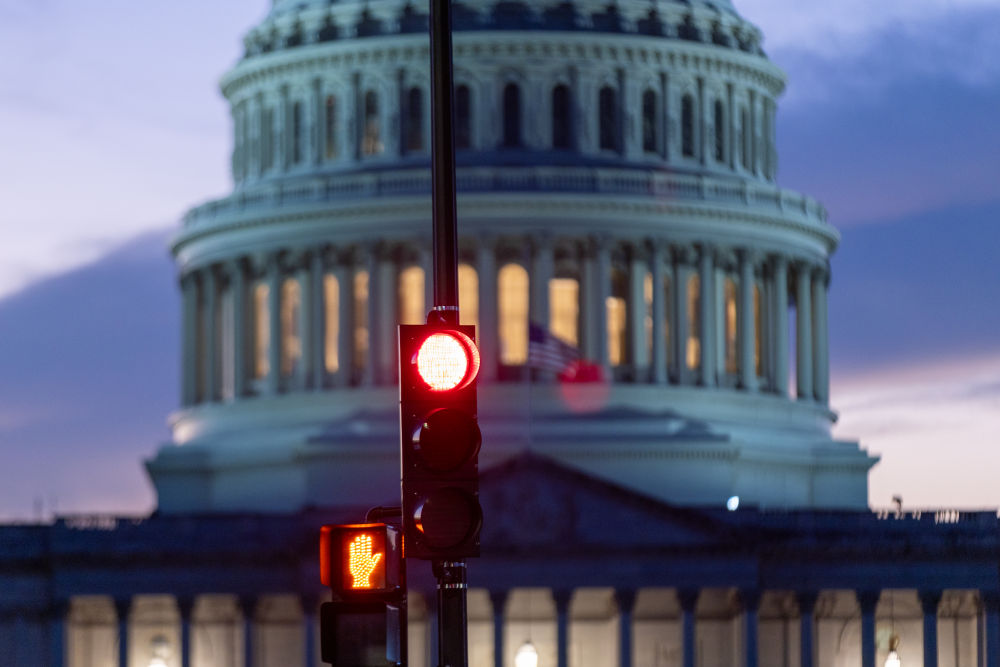
11月5日,美国联邦政府"停摆"进入第36天,打破2018年底至2019年初"停摆"35天的纪录,成为美国历史上持续时间最长的政府"停摆"。 11月5日,美国首都华盛顿的国会大厦前亮起红色的交通信号灯。 新华社记者 胡友松 摄 11月5日,在美国首都华盛顿拍摄的国会大厦倒影。 新华社记者 胡友松 摄 美国国会预算办公室日前表示,根据联邦政府"停摆"持续时间的长短,预计今年四季度美国实际国内生产总值(GDP)的年增长率将下降一至 两个百分点。英国广播公司估计,"停摆"每持续一周将给美国GDP造成约150亿美元的损失。 为"停摆"买单的人是美国民众。"停摆"对食品救济、医保福利、民航交通等多个民生领域造成巨大冲击。参议院民主党领袖查克·舒默说,在 这场"停摆"之争中,"孩子、老人、残疾人、工薪阶层的父母都被用作政治棋子","饥饿被用作威胁手段"。 11月5日,在美国首都华盛顿,联邦雇员排队领取免费食品。 新华社记者 胡友松 摄 11月5日清晨,在美国波特兰的深秋寒意中,无家可归者蜷缩在街边角落里。 新华社记者 吴晓凌 摄 11月5日清晨,在美国波特兰的深秋寒意中,无家可归者排队等待领取救助物品。 新华社记者 吴晓 ...
特朗普关税政策岌岌可危?美国高院多数大法官齐声质疑
Sou Hu Cai Jing· 2025-11-06 07:21
Core Points - The fate of Trump's tariff policy is uncertain as the U.S. Supreme Court hears a case that could overturn it, potentially leading to over $100 billion in tariff refunds [2][4] - The atmosphere in the Supreme Court was tense, with several justices expressing doubts about the legality of Trump's tariffs, questioning whether such powers should rest with Congress [4][5] - The probability of the Supreme Court supporting Trump's tariffs has significantly decreased, dropping from 40% to around 20% [4] Tariff Policy - The Supreme Court's decision will determine the future of Trump's tariffs, which he has claimed are essential for national security [5] - The Senate previously voted to terminate Trump's comprehensive tariff policy, indicating a shift in legislative support [4] Government Shutdown - The U.S. government has been in a shutdown for 37 days, marking the longest in history, which has exacerbated economic uncertainties [6][8] - The shutdown has led to significant disruptions in transportation, affecting thousands of flights and millions of travelers [6][7] - Essential programs like the Supplemental Nutrition Assistance Program have halted, impacting 42 million Americans [7] Economic Impact - The prolonged government shutdown is causing employers to delay investments and hiring, with potential large-scale layoffs [8][9] - The Congressional Budget Office estimates that if the shutdown lasts six weeks, economic losses could reach $11 billion, with GDP growth potentially declining by 1 to 2 percentage points in Q4 [9]
政策仍存托底作用 天然橡胶期货盘中高位震荡运行
Jin Tou Wang· 2025-11-06 07:05
Group 1 - Natural rubber futures experienced high volatility, with the main contract reported at 15,080.00 yuan/ton, a slight increase of 1.75% [1] - In Thailand, the natural rubber raw material market showed stability with slight declines; sheet rubber remained at 60.00 THB/kg, while cup rubber decreased by 0.30 THB/kg to 54.35 THB/kg [2] - As of early November, the total inventory of natural rubber in Qingdao reached 447,700 tons, an increase of 15,400 tons or 3.57% from the previous period, with general trade inventory rising by 4.36% [2] Group 2 - According to Guodu Futures, the global supply of rubber remains ample due to high production levels, with China's supply increasing by 4.4% year-on-year from January to August [3] - Domestic tire manufacturers maintain high operating rates, but their inventory levels are substantial, limiting their replenishment enthusiasm [3] - The ANRPC report indicates that global natural rubber production is expected to increase moderately by 1.3% in 2025 compared to 2024, amid improved production and subdued demand [2] Group 3 - According to Ruida Futures, the rubber supply situation in Yunnan has eased, while Hainan faces supply tightness due to severe weather, impacting normal harvesting operations [4] - Qingdao's total inventory is showing a significant accumulation trend, with general trade warehouses experiencing substantial increases, while tire manufacturers remain cautious in their purchasing [4] - The capacity utilization rate of domestic tire enterprises has slightly decreased, with some companies facing production halts, but overall production levels are expected to remain stable [4]