耐心资本

Search documents
2024—2025年度政府投资基金竞争力评价研究报告发布
2 1 Shi Ji Jing Ji Bao Dao· 2026-01-09 23:08
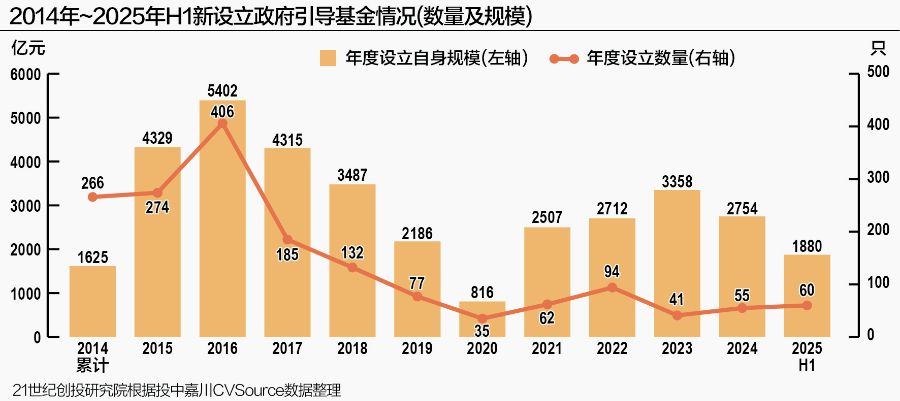
Core Viewpoint - Government investment funds have become a major source of capital in China's private equity investment industry, with increasing policy support and a focus on high-quality development in 2025 [1][9][23]. Group 1: Government Investment Fund Development - The State Council issued the "Guiding Opinions on Promoting the High-Quality Development of Government Investment Funds," outlining 25 measures across seven areas to enhance the fund's operational efficiency and effectiveness [1][9]. - In 2025, the establishment of new government investment funds showed a significant decline, with only 60 new funds set up in the first half of the year, compared to 55 in the entire previous year [4][19]. - The total scale of newly established government investment funds in the first half of 2025 reached 188 billion yuan, indicating a continued but slowing growth trend [4][19]. Group 2: Regional Disparities - The willingness to establish new government investment funds has significantly decreased in the central and western regions due to policy constraints and fiscal capacity, while regions like the Yangtze River Delta and the Guangdong-Hong Kong-Macao Greater Bay Area continue to show strong momentum [2][6][22]. - Local governments are increasingly focusing on optimizing existing funds rather than merely increasing the number of new funds, adopting a "fund cluster" model for more targeted investments [1][21]. Group 3: Investment Focus and Strategies - Government investment funds are primarily targeting strategic emerging industries such as new-generation information technology, biotechnology, and new energy vehicles, which are crucial for developing new productive forces [6][10]. - The investment strategy has shifted towards "early and small" investments, with a growing consensus on supporting early-stage projects while also considering investments in mature companies [6][10]. Group 4: Management and Operational Efficiency - The management model of government investment funds is evolving towards market-oriented and professional approaches, with a diverse range of fund managers being selected [25][27]. - Many local governments are offering more attractive conditions to fund managers, including lowering return ratios and extending fund durations to enhance operational efficiency [2][25]. Group 5: Exit Strategies and Market Conditions - The recovery of the A-share and Hong Kong IPO markets in 2025 has provided a favorable environment for government investment funds to realize exits, with many funds benefiting from the active M&A market [34][35]. - The introduction of S funds and the increasing flexibility in exit mechanisms are creating diverse exit pathways for government investment funds [34][39].

“耐心资本”助力科创企业加速跑
Bei Jing Ri Bao Ke Hu Duan· 2026-01-09 22:17
Group 1 - The core viewpoint of the articles highlights the significant role of patient capital from financial institutions in supporting the growth of technology-driven enterprises in Beijing, with a focus on long-term partnerships and tailored financial solutions [1][2][3] - Beijing Bank has achieved a technology finance loan balance exceeding 440 billion yuan, serving over 30,000 specialized and innovative enterprises, indicating a strong commitment to supporting the local economy [1] - The Chinese government's emphasis on developing technology finance, green finance, inclusive finance, pension finance, and digital finance is reflected in the strategic initiatives of Beijing Bank, which aims to empower the industrial ecosystem [1] Group 2 - The successful IPO of Moer Technology, a domestic GPU manufacturer, was supported by Beijing Bank through initial loans and flexible financing solutions, showcasing the importance of sustained financial backing for long-cycle, capital-intensive enterprises [2] - Beijing Bank has developed a "Science and Technology Radar" evaluation system to identify promising startups and offers a variety of financial products tailored to different stages of enterprise development, including loans for research and development and equity financing [3] - The bank has provided credit funding exceeding 1.45 trillion yuan to nearly 60,000 technology-oriented small and medium-sized enterprises, with a significant percentage of listed companies on various stock exchanges having received financial support from Beijing Bank [3]


“微”观行业之变|从一只AIC探索设立的70亿元母基金看耐心资本如何浇灌硬科技
Xin Hua Cai Jing· 2026-01-09 04:41
Core Viewpoint - The Shenzhen Jianyuan Zhengxing Fund, a 7 billion yuan mother fund, is accelerating its operations and aims to leverage its structure to enhance investment in key industries, particularly in hard technology sectors [1][2]. Group 1: Fund Structure and Strategy - The Jianyuan Zhengxing Fund is initiated by several entities including Jianxin Financial Asset Investment Company and aims to expand its scale to over 20 billion yuan through the establishment of sub-funds [2]. - The mother fund structure allows for diversified investments across various sectors, addressing the limitations of direct investment funds in covering the broad "20+8" industrial cluster in Shenzhen [2][3]. - The fund's strategy includes collaborating with specialized investment institutions to enhance industry insights and project identification, thereby improving investment outcomes [3]. Group 2: Evolution of AIC's Role - The evolution of AIC from primarily engaging in debt-to-equity swaps to becoming a "patient capital" provider reflects a significant shift in its operational focus [4][6]. - AIC's recent policy changes have expanded its investment capabilities, allowing for direct equity investments and enhancing its role in supporting long-term financing for technology enterprises [5][6]. - The transition from a risk management tool to an active participant in the growth cycle of enterprises positions AIC as a crucial link between financial capital and technological innovation [6][7]. Group 3: Challenges and Future Outlook - AIC faces challenges such as misalignment in incentive mechanisms, short assessment cycles, and insufficient risk tolerance in equity investments [7][8]. - Recommendations for AIC's future include enhancing long-term performance evaluation systems and fostering deeper collaboration with local governments and industry funds to create a sustainable technology finance ecosystem [8].
又一家AI独角兽上市!这一波,上海为什么赢?
Xin Lang Cai Jing· 2026-01-08 22:15
Core Viewpoint - Shanghai's AI unicorn MiniMax is set to go public on the Hong Kong stock exchange, marking a significant moment for the city's hard technology sector, particularly in AI and large models, with five local AI companies having listed in less than a month [3] Group 1: Investment Landscape - The funding requirements for hard technology are substantial, and there is a persistent contradiction between high financing needs of companies and investors' risk preferences [4] - The call for "patient capital" has been recognized socially, with the central government emphasizing the cultivation of such capital, particularly through state-owned funds in Shanghai [5] - Shanghai aims to establish a 100 billion yuan industry investment mother fund targeting integrated circuits, biomedicine, and artificial intelligence, with a focus on critical areas like computing chips [5] Group 2: Investment Mechanisms - The mother fund model allows for most funds to be invested in other funds, which then invest in specific projects, creating a leverage effect [6] - Unlike traditional financial investments, Shanghai's state-owned capital is deeply involved in technological breakthroughs and ecosystem building, supporting companies like Biran Technology in developing high-performance GPGPU chips [6] Group 3: Ecosystem Development - A strong innovation ecosystem, characterized by a dense concentration of industry elements, can significantly lower innovation costs and enhance company survival and growth rates [9] - The "Mosu Space" serves as a professional incubator for large models, fostering a complete ecosystem that integrates various aspects from foundational chips to core algorithms and applications [9][10] Group 4: Market Dynamics - The competitive landscape in artificial intelligence is dominated by the US and China, with China focusing on both technological breakthroughs and application expansion [8] - The successful scaling of AI applications across various sectors, such as manufacturing and finance, relies on providing innovative companies with real-world scenarios for development and experimentation [11] Group 5: Continuous Improvement - The cultivation of hard technology requires a positive feedback loop involving more nurturing and openness, necessitating reforms beyond mere investment [12][13]

发展科技金融激发创新活力
Jing Ji Ri Bao· 2026-01-08 21:43
Core Viewpoint - The development of technology finance is crucial for promoting the mutual enhancement of technology and finance, as emphasized in China's economic planning and regulatory frameworks [1][3]. Group 1: Importance of Technology Finance - Technology finance is positioned as a key support for achieving high-level technological self-reliance and building a strong technological nation, being recognized as the foremost area in financial development [2]. - The evolution of technology finance in China dates back to 1985, with a focus on integrating financial services with technological innovation through diverse financial tools and systems [2]. - The current phase of the "14th Five-Year Plan" is critical for advancing technology finance, which aids in overcoming key technological challenges and supports the transformation of traditional industries [3]. Group 2: Policy and Structural Developments - Significant policy initiatives have been introduced to enhance financial support for technology innovation, including the establishment of a comprehensive technology finance system that aligns with national technological goals [4]. - By the end of Q3 2025, loans to high-tech enterprises reached 18.84 trillion yuan, with a loan growth rate surpassing the average for all loans, indicating a robust expansion of technology finance [4]. - The establishment of multiple technology finance reform pilot zones aims to reduce financing costs for technology enterprises and optimize the allocation of financial resources [12][13]. Group 3: Role of Patient Capital - Patient capital, characterized by a long-term investment outlook and a higher risk tolerance, is essential for supporting technology innovation, particularly in high-risk, long-cycle projects [7][8]. - The government encourages the development of patient capital through various investment vehicles, which can provide stable funding for technology projects and help bridge the gap between short-term financial returns and long-term innovation goals [9][10]. - The growth of patient capital is seen as a vital driver for directing resources towards new quality productivity and addressing the challenges faced by technology enterprises in securing financing [10]. Group 4: Challenges and Future Directions - Despite the potential of patient capital, challenges such as an imbalanced supply structure and inadequate market ecology hinder its effectiveness in supporting technology innovation [10]. - Future efforts should focus on broadening the sources of patient capital, enhancing market mechanisms, and improving incentive structures to encourage investment in technology innovation [11][16]. - The establishment of a robust policy framework and the integration of market-driven approaches are necessary to enhance the sustainability and coverage of financial support for technology innovation [16].
祝贺智谱(2513.HK)、天数(9903.HK)联袂上市 开局坤元资产FOF生态迎双喜临门
Cai Fu Zai Xian· 2026-01-08 09:27
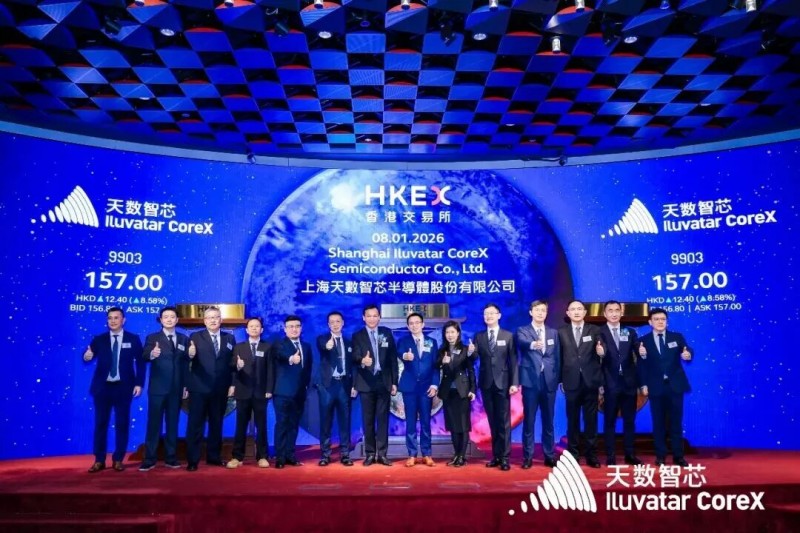
Group 1: Market Performance - TianShuZhiXin (9903.HK) opened with a 31.54% increase, reaching HKD 190.20 per share, with a market capitalization of HKD 48.371 billion [1] - ZhiPuHuaZhang (2513.HK) opened with over a 3% increase, priced at HKD 120 per share, and a market capitalization exceeding HKD 52.8 billion [1] - Both companies experienced significant price increases and increased trading volumes, indicating strong demand for Chinese hard technology assets in the international capital market [1] Group 2: Industry Context - The global AI computing power demand is experiencing exponential growth, while the need for domestically controlled high-performance computing is becoming increasingly urgent [3] - The domestic GPU industry is transitioning from "usable" to "usable and effective," driven by three core factors: risks of technology supply disruptions, diversification of market demand, and a revaluation in the capital market [3] - The successful listing of TianShuZhiXin highlights its strategic positioning as the first domestic company to achieve full-stack application and large-scale production of general-purpose GPUs [3] Group 3: Investment Strategy - KunYuan Asset's FOF ecosystem has strategically positioned itself in the GPU sector, providing not only financial support but also facilitating connections between enterprises and industry resources [5] - The investment philosophy of "patient capital" emphasizes long-term support for innovative companies, aligning with national strategies to foster technological innovation and industrial transformation [12] - The recent IPOs of multiple leading companies in the computing power sector within a short timeframe reflect a tactical positioning and strategic ecosystem success by KunYuan Asset [5] Group 4: Technological Advancements - ZhiPuHuaZhang is recognized as a leading player in the large model sector, marking a shift from the exploration phase to deep industry engagement [6] - The company achieved a remarkable 1159.46 times oversubscription during its public offering, indicating strong market recognition of its capabilities as a leader in the AI 2.0 era [7] - ZhiPuHuaZhang's revenue is projected to grow from CNY 57.409 million in 2022 to CNY 190 million by mid-2025, showcasing its strong commercialization potential [7] Group 5: Future Outlook - The year 2026 is anticipated to be a significant year for technology innovation IPOs, with TianShuZhiXin and ZhiPuHuaZhang's listings being just the beginning of a broader trend in China's tech innovation wave [11] - The Chinese government is expected to continue leading global R&D investments in foundational sciences and strategic emerging industries, particularly in the context of intensified US-China tech competition [11] - The ongoing development of hard technology companies within KunYuan Asset's ecosystem is expected to yield significant advancements in various sectors, including semiconductors and AI [12]

创投圈强势回暖,硬科技成“耐心资本”宠儿
Huan Qiu Wang· 2026-01-08 09:06
政策层面的发力为"耐心资本"提供了强大后盾。近期,国家创业投资引导基金正式宣布,使用超长期特 别国债资金出资1000亿元,并同步在京津冀、长三角、粤港澳大湾区设立区域引导基金。这一举措是推 动政府引导基金从传统的"招商工具"向市场化资本转型,引导社会资本共同服务于国家科技创新战略。 受此影响,资金流向高度集中于硬核技术领域。数据显示,人工智能(1539起)、医疗健康(1455 起)、集成电路(1032起)位居2025年热门投融资行业前三,新材料、机器人、新能源及空天经济等赛 道也备受青睐。 行业迎来黄金期 【环球网财经综合报道】国内创投行业在2025年迎来强势复苏。Wind最新数据显示,截至2025年12月 底,国内一级市场全年共发生投融资事件9004起(不含并购、上市及上市后融资),投融资金额合计 8044.17亿元。在整体向好的趋势下,人工智能、医疗健康、集成电路等"硬科技"赛道成为资金涌入的 绝对高地,国资背景的"耐心资本"正逐步确立市场主导地位。 投融资触底反弹,头部机构加速 " 扫货 " 回溯过去五年的市场数据,2025年无疑是一个重要的转折点。自2021年投融资规模达到历史峰值后,一 级市场在20 ...
一级市场投融资超9000起 “耐心资本”涌向“硬科技”
Xin Lang Cai Jing· 2026-01-07 21:21
(来源:经济参考报) 对于今年的创投市场走势,多位业内人士在近期公开表示"看好"。"如果说2025年是'好'的开端,我们期 待2026年能实现'更好'的突破。"同创伟业创始合伙人、董事长郑伟鹤明确表示,2026年到2028年,对 创投行业来说将会是非常好的年份,可能会开启黄金三年。 在经历了两年的市场调整后,国内创投圈在刚刚翻篇的2025年迎来了"回暖潮"。记者梳理IT桔子数据发 现,截至2015年12月底,国内一级市场全年发生9004起投融资事件(不含并购、上市及上市后融资), 投融资金额合计8044.17亿元(未披露融资额不纳入统计),创投资金加速流向人工智能、医疗健康、 集成电路等"硬科技"赛道。 头部机构出手频率加快 "在2025年的11个月里,我们整体投资节奏明显在加快,新投与追加的项目近50个。从金额角度来看, 整体投资规模预计将达到2024年的两倍多。"纪源资本管理合伙人符绩勋在上个月举办的第二十五届中 国股权投资年度大会上给出了创投"业绩"预告,算是2025年创投行业"回暖潮"的一个缩影。 回溯近五年数据,2021年一级市场投融资事件为9054起,投融资金额合计14958.63亿元,融资规模达 ...
③精进管理:管理人类型多元化,耐心资本与大胆资本共舞
2 1 Shi Ji Jing Ji Bao Dao· 2026-01-07 14:19
Core Insights - The development of government investment funds is transitioning towards market-oriented and professional management models, with a diversification in the types of fund managers favored by local governments [1][4][10] Group 1: Fund Management Trends - In 2024, brokerage private equity subsidiaries have become increasingly popular among local governments, with firms like CICC Capital and Haitong Kaiyuan actively engaging in regional mother fund businesses [1] - By 2025, bank-affiliated financial asset investment companies (AICs) are expected to accelerate their entry into the equity investment market, becoming regular partners with government investment funds and local state-owned assets [1][6] - The management fee standards for government investment funds are becoming more refined and standardized, with a trend towards market-oriented cost control [2] Group 2: Market Dynamics and Collaborations - The entry of AICs into the equity investment market is closely linked to policy support, with pilot programs expanding to multiple cities [4][6] - Corporate venture capital (CVC) teams are emerging as significant partners for local governments, driven by market demands and the need for business development [7][8] - CVCs have advantages in fundraising, investment strategies, and post-investment management, leading to an increase in collaborations between government investment funds and CVCs [8] Group 3: Investment Strategies and Risk Management - Government investment funds are increasingly adopting a "patient capital" approach, with measures such as lowering return investment ratios and extending fund durations [1][11] - The average return investment multiple requirement for government-guided funds has decreased from 2.6 times in 2017 to 1.31 times in 2024, with some regions allowing ratios below 1 [10] - Policies are being implemented to enhance the due diligence exemption mechanisms, allowing for a higher tolerance for investment losses, with some areas permitting up to 100% loss on individual projects [11][12]
①数据探秘:年度政府投资基金竞争力评价研究核心发现
2 1 Shi Ji Jing Ji Bao Dao· 2026-01-07 12:05
Core Insights - Government investment funds have become a major source of capital in China's private equity investment industry, playing a crucial role in promoting healthy industry development and optimizing traditional industries [1][3] Group 1: Policy and Regulatory Framework - The Chinese government has increased its focus on venture capital and private equity, with the release of the "Guiding Opinions on Promoting the High-Quality Development of Government Investment Funds" on January 7, 2025, which includes 25 measures covering the entire process of fundraising, investment, management, and exit [1][3] - The implementation of the "1号文" has guided local governments in developing investment funds, leading to the establishment of a "1+N" system across various regions [1][3] Group 2: Regional Trends - There is a noticeable decline in the willingness to establish new government investment funds in the central and western regions due to policy constraints and fiscal capacity, while economically active regions like the Yangtze River Delta and the Guangdong-Hong Kong-Macao Greater Bay Area continue to show strong momentum in fund establishment [2][6] Group 3: Fund Management and Investment Strategies - The management model of government investment funds is evolving towards market-oriented and professional approaches, with local governments increasingly seeking suitable general partners (GPs) for long-term cooperation rather than merely increasing the number of partnerships [2][6] - Many regions are lowering the reinvestment ratios and adopting more flexible recognition methods for reinvestment, while also extending fund durations to address the challenges of exit strategies [2][6] Group 4: Fund Performance and Growth - In the first half of 2025, 60 new government investment funds were established, surpassing the total of 55 for the entire year of 2024, with a total scale of 188 billion yuan, indicating a robust growth trend [4][6] - From 2014 to 2024, the number of government-guided funds increased by 1,361, with a compound annual growth rate (CAGR) of 19.85%, and the total scale increased by 31,866 billion yuan, with a CAGR of 35.33% [4][6] Group 5: Investment Focus and Trends - Government investment funds are increasingly focusing on strategic emerging industries such as new-generation information technology, biotechnology, new energy vehicles, and high-end equipment, which are crucial for accelerating the development of new productive forces [6][7] - There is a consensus in the industry to invest early and in smaller amounts, with both national and local government funds providing more guidance and support for early-stage projects [6][7] Group 6: Management Efficiency and Policy Impact - Most government investment funds have established sound systems and operational processes, with effective risk control mechanisms and information technology supporting fund selection and post-investment services [7][8] - Many funds are willing to disclose annual investment numbers and project scales, although they are cautious about revealing actual exit amounts and returns [8]