AI硬件

Search documents
【兴证策略张启尧团队】后续还有哪些催化值得期待?
Xin Lang Cai Jing· 2026-01-25 09:01
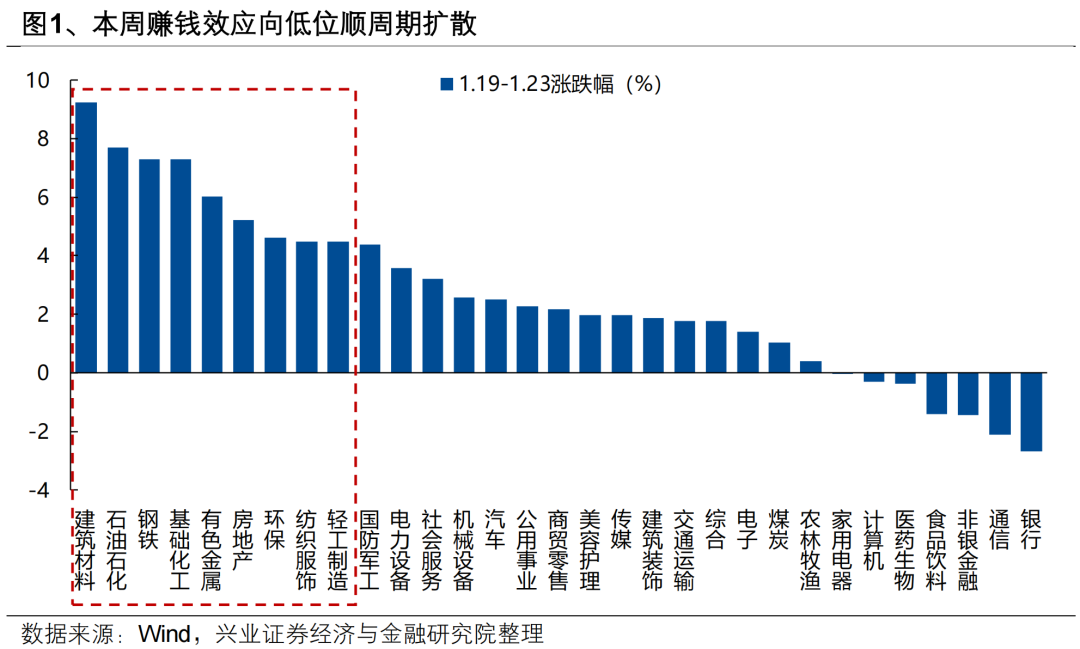
Group 1 - The core argument emphasizes that the current spring market rally is supported by a liquidity-rich environment, with expectations for further catalysts to drive growth [1][4] - The influx of new insurance premiums, driven by strong performance in the insurance sector, is a significant source of market liquidity, with major companies reporting individual insurance premium growth rates exceeding 30% [4][5] - The upcoming peak of residents' fixed deposit maturities in the first half of the year is expected to lead to increased allocation of equity assets, further supporting market liquidity [4][5] Group 2 - The continuous appreciation of the RMB is attracting foreign capital back into the market, contributing to the liquidity that supports the current spring rally, with a record high of $99.9 billion in bank foreign exchange settlement surplus reported in December 2025 [5][9] - Positive macroeconomic data and coordinated policy efforts in real estate, consumption, and monetary policy are providing a supportive environment for market risk appetite, which is expected to enhance the profitability effect across various sectors [9][21] - The upcoming earnings announcements from North American tech giants are anticipated to influence domestic market trends, particularly in AI and computing sectors, which are expected to see significant investment and growth [9][11] Group 3 - The earnings forecast disclosure period is entering a peak, with a projected disclosure rate of around 55% by the end of January, which is expected to significantly impact market structure [11][14] - Companies in sectors such as computing, chemicals, new energy, and pharmaceuticals are showing high growth potential, with 304 companies forecasting net profit growth exceeding 50% [14][17] - The focus on sectors with upward revisions in earnings forecasts since November indicates potential for strong performance in technology, advanced manufacturing, and cyclical industries [21][24] Group 4 - February is expected to be a critical period for market activity, characterized by a liquidity-rich environment and a focus on high-growth sectors, particularly in AI applications and other emerging themes [27][30] - Historical trends suggest that February is one of the months with the highest success rates for major indices, with small-cap and growth sectors likely to outperform [27][30] - The market is anticipated to respond positively to upcoming catalysts, particularly in AI applications and narratives surrounding energy shortages, which could reignite interest in previously cooled themes [30][42]

从70元到585元暴涨7倍!中际旭创超越宁德时代,改写公募重仓格局
Hua Xia Shi Bao· 2026-01-24 06:57
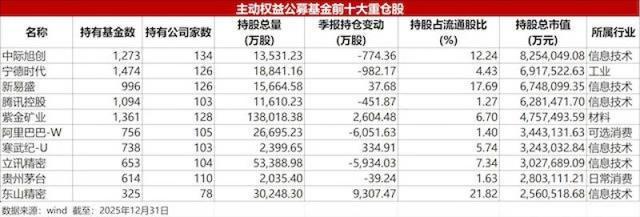
Core Insights - The active equity public funds have seen a significant shift in their top holdings, with Zhongji Xuchuang surpassing Ningde Times to become the largest holding, indicating a transition in investment focus from new energy to AI hardware [2][3][10] Group 1: Company Performance - Zhongji Xuchuang's market capitalization reached 825.40 billion yuan, while Ningde Times held a market cap of 818.28 billion yuan, indicating a close competition for the top position [2] - Zhongji Xuchuang's stock price surged from 70 yuan to 585 yuan within nine months, reflecting a sevenfold increase and a total market value nearing 650 billion yuan [7][9] - The company reported a revenue of 14.79 billion yuan in the first half of 2025, a year-on-year increase of 36.95%, and a net profit of 3.995 billion yuan, up 69.40% [9] Group 2: Market Trends - The shift in top holdings reflects a broader trend where institutional funds are reallocating from traditional sectors like new energy to emerging sectors such as AI hardware [10] - The global market for Ethernet optical modules is projected to grow significantly, with a forecasted increase of 35% to 18.9 billion USD in 2026, driven by the demand for data center infrastructure [9] Group 3: Fund Holdings - As of the end of Q4 2025, the top ten holdings of active equity funds included Zhongji Xuchuang, Ningde Times, and Xinyi Technology, highlighting the dominance of AI-related stocks [4] - Zhongji Xuchuang was held by 1,273 active equity funds, with a total holding of 135.31 million shares, representing 12.24% of its circulating shares [3][4]

国泰海通晨报-20260123
GUOTAI HAITONG SECURITIES· 2026-01-23 05:55
Group 1: Aviation Industry - The core viewpoint of the aviation industry report indicates that the demand for air travel in China remains strong, particularly during the Spring Festival travel season, with pre-sales already initiated for 2026 [3][5] - It is estimated that the passenger flow in China's civil aviation will grow by 5-6% year-on-year in 2025, with a cumulative increase of 17% compared to 2019 [3] - The report highlights that the airline industry is entering a low growth era, with structural changes in demand being a key issue, as the proportion of business travel remains below 2019 levels [3][4] Group 2: Netflix (NFLX.O) - The report on Netflix projects that the company's revenue for FY26-28 will be $51.1 billion, $57.6 billion, and $64.6 billion respectively, reflecting year-on-year growth of 13.2%, 12.7%, and 12.0% [7] - Netflix's content amortization cost guidance for 2026 indicates a 10% increase year-on-year, with a focus on enhancing advertising revenue and content quality [9] - The company is expected to maintain a net profit margin of 20.1% in Q4 2025, with a significant increase in advertising revenue projected for 2026 [8][9] Group 3: BAIC Blue Valley (北汽蓝谷) - The report provides a first coverage of BAIC Blue Valley, giving it an "Accumulate" rating with a target price of 11.49 yuan, driven by dual-brand synergy and a diversified product matrix [11][26] - The company is expected to achieve revenues of 29 billion, 58.2 billion, and 88.9 billion yuan for 2025, 2026, and 2027 respectively, with a projected net profit turning positive by 2027 [11][26] - BAIC Blue Valley's dual-brand strategy, focusing on the premium and luxury segments, is anticipated to drive revenue growth, with significant sales increases expected for its models [12][27]
新面孔突围!中际旭创超越宁德时代,登顶主动权益基金去年末第一重仓股
Sou Hu Cai Jing· 2026-01-23 05:21
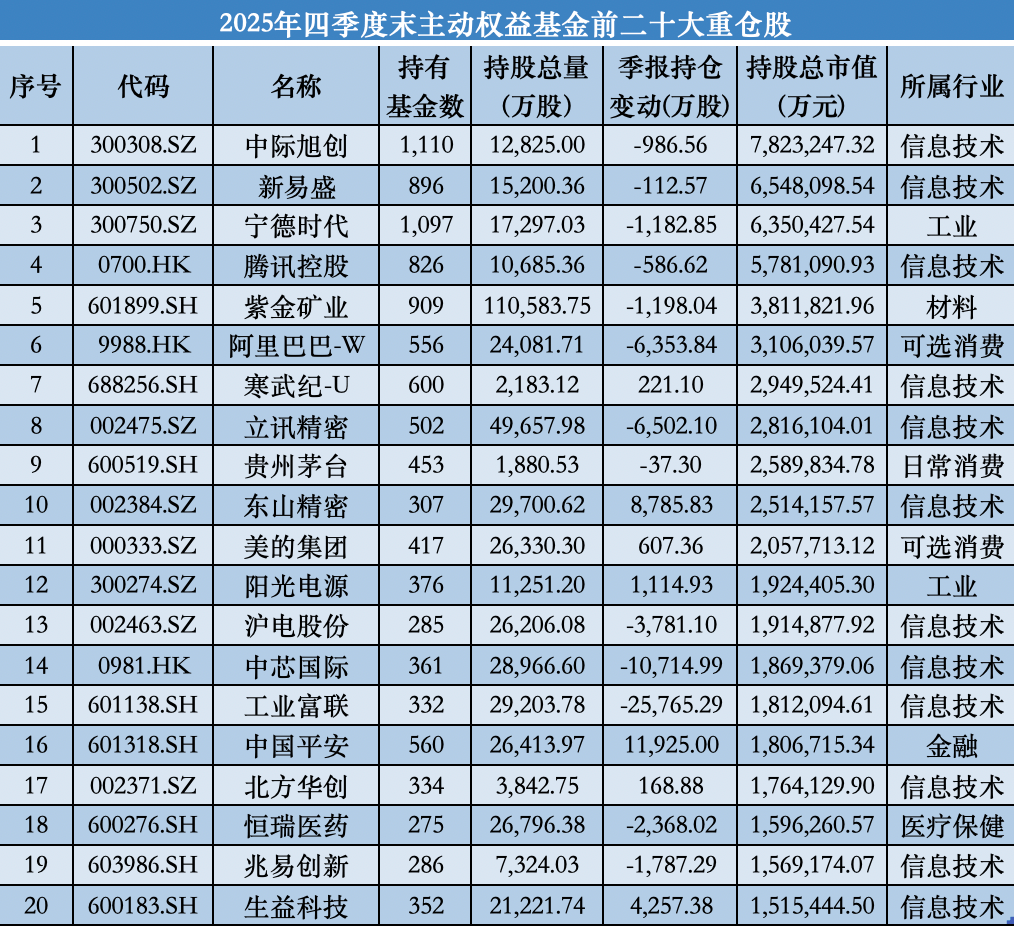
Core Insights - The top holdings of active equity funds have shifted, with Zhongji Xuchuang and Xinyi Sheng surpassing CATL and Tencent as the top two positions [1][2] Group 1: Fund Holdings Changes - As of the end of Q4 2025, Zhongji Xuchuang (300308.SZ) and Xinyi Sheng (300502.SZ) have become the top two holdings in active equity funds, overtaking CATL (300750.SZ) and Tencent (00700.HK) [1] - Significant increases in holdings were noted, with the Invesco Great Wall Fund increasing its stake in Zhongji Xuchuang by 1.747 million shares, making it the fund's largest holding [1] - The GF Technology Pioneer Fund also increased its position in Zhongji Xuchuang by 1.076 million shares, marking its first investment in the stock [1] Group 2: Other Notable Changes - In Q4 2025, major reductions were observed in holdings of traditional leaders like CATL and Tencent, which fell to third and fourth positions respectively [2] - East Mountain Precision (002384.SZ) saw a substantial increase of 8.785 million shares, entering the top ten holdings of active equity funds [2] - The overall trend indicates a shift from traditional consumer internet stocks to AI hardware and semiconductor sectors, reflecting a structural rebalancing by institutions [3]



独家丨原科沃斯大中华区业务总裁刘文宁创业,布局可穿戴设备赛道
雷峰网· 2026-01-23 00:28
Group 1 - Liu Wenning, former President of Greater China Business at Ecovacs, has transitioned to entrepreneurship focusing on the wearable device sector [2][4] - Liu Wenning joined ByteDance in the first half of 2025 as the market head of the Ocean team but left after less than a year to start his own venture [2][4] - The wearable device market is gaining traction, with various types such as rings, necklaces, headphones, glasses, and watches being utilized for health monitoring, recording, entertainment, and office applications [5] Group 2 - The AI hardware sector has become a hot investment area, with wearable devices particularly attracting capital market interest [5] - Many entrepreneurs from the ByteDance ecosystem are entering the AI application field, showing a level of enthusiasm comparable to that of DJI-related entrepreneurs [5]


字节、OpenAI、Meta都在赌一件事
3 6 Ke· 2026-01-22 23:34
Core Insights - Major tech companies are entering the AI hardware market, with OpenAI planning to launch its first AI hardware device in the second half of 2026, indicating a significant shift in strategy from software to hardware [1] - This trend is seen across various companies including ByteDance, Alibaba, and Meta, which are all investing heavily in AI hardware despite past failures in the hardware sector [1][2][4] Group 1: Reasons for Past Failures - Historically, major tech companies have struggled with hardware due to a lack of understanding of the complexities involved, often leading to failed products and financial losses [2][3][5] - The inherent arrogance of internet companies, which thrive on rapid iteration and low marginal costs, has hindered their ability to manage the high stakes and complexities of hardware production [6][7][8] Group 2: Changes in the Market - The emergence of AI models has changed the dynamics of hardware development, allowing for simpler interaction methods that reduce the need for complex designs [9][10] - AI hardware is now viewed as a sensor for AI, enabling companies to gather real-world data that can enhance their models, thus making hardware development more appealing [11][22][23] Group 3: Strategic Shifts - Companies like ByteDance, Meta, and OpenAI are now focusing on creating their own hardware to maintain control over user interactions and data, as the risk of losing direct access to users increases [15][17] - The collaboration between software and hardware companies is becoming more common, allowing for reduced development times and shared risks, making hardware ventures less daunting [25][26] Group 4: Future Implications - The AI hardware trend reflects a broader fear among software companies of being sidelined in the evolving tech landscape, as they seek to embed themselves into users' daily lives [27][28] - The proliferation of AI devices raises questions about the necessity and impact of such technology on human life, suggesting a deeper integration of AI into everyday activities [27][29]

苹果入局AI Pin,或对标OpenAI,能否打破「电子垃圾」魔咒?
机器之心· 2026-01-22 11:00
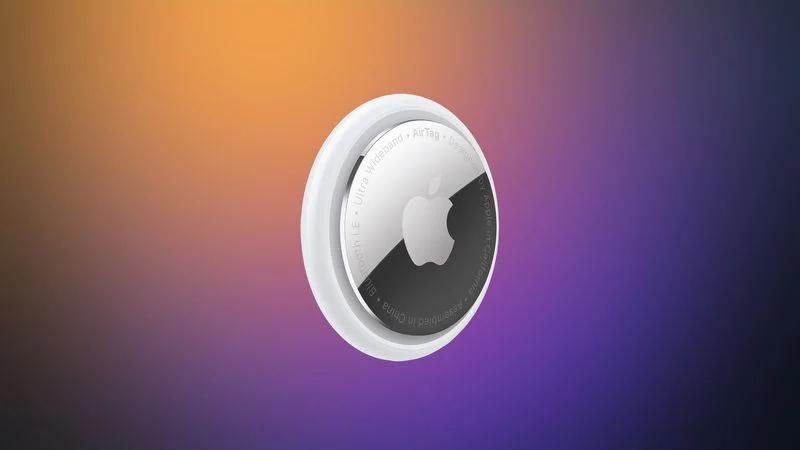
Core Viewpoint - Apple is reportedly developing an AI-driven wearable "Pin" device, which is still in the early stages of development and may not be released until 2027 [1]. Group 1: Product Specifications - The device is expected to be similar in size to the AirTag, featuring a "thin, flat circular" design made of aluminum and glass. It will include a standard lens and a wide-angle lens for environmental sensing, three microphones, a speaker, a physical button on the side, and support for wireless charging, potentially using a magnetic induction charging interface similar to the Apple Watch [3]. Group 2: Market Context and Competition - The entry of Apple into the hardware AI Pin market could revitalize interest, especially given the previous challenges faced by companies like Humane, which aimed to create a smartphone replacement but faced significant product failures and ultimately was acquired by HP for $116 million [5][10]. - Humane's AI Pin, launched in November 2023 at a price of $699 with a monthly subscription fee of $24, saw disappointing sales of only 10,000 units by summer 2024, far below its target of 100,000 units [7][8]. - The failure of Humane's product was attributed to multiple factors, including immature technology, high development costs, and an exorbitant price point [10]. Group 3: Future Prospects - The AI hardware market is seen as poised for growth, with various AI wearable devices like AI glasses and AI headphones being developed as potential next-generation interaction points [10]. - Apple is reportedly accelerating the development of its AI Pin to compete with OpenAI's upcoming wearable device, which is expected to be launched in the second half of 2026 [10][11]. - OpenAI has hinted at a new hardware device that promises simplicity and ease of use, although specific details remain undisclosed [11].


苹果拟入局AI Pin
3 6 Ke· 2026-01-22 07:30
Group 1 - Apple is developing an AI wearable device called Pin, which resembles a badge or brooch and is expected to be released as early as 2027 [1] - The AI Pin will feature multiple cameras, a speaker, three microphones, a side physical button, and support for magnetic wireless charging, potentially serving as a new AI wearable interface [3] - The pricing of the AI Pin is anticipated to be lower than the Apple Watch, which starts at $249, and it may be bundled with the latest Apple Watch or iPhone [3] Group 2 - The AI hardware market is becoming a competitive space for technology companies, with Apple planning various AI hardware products, including camera-equipped AirPods and AI glasses without display capabilities [7] - Apple's AI initiatives have faced challenges, including delays in Siri upgrades due to quality issues and a recent collaboration with Google to enhance Siri's capabilities [7] - The failure of Humane's AI Pin, which was priced at $699 and required a monthly fee, highlights the difficulties in the AI wearable market, as it ceased operations in February 2025 [4][6]
“鬼压床” | 谈股论金
水皮More· 2026-01-21 10:11
Market Overview - A-shares major indices collectively rose today, with the Shanghai Composite Index up 0.08% closing at 4116.94 points, Shenzhen Component Index up 0.70% at 14255.13 points, ChiNext Index up 0.54% at 3295.52 points, and the STAR 50 Index up 3.53% at 1535.39 points [2] - The trading volume in the Shanghai and Shenzhen markets was 26,240 billion, a decrease of 1,804 billion compared to the previous day [2] ETF Market Dynamics - The broad-based ETFs continue to exert downward pressure, particularly the SSE 50 ETF (510050), which saw a record trading volume of 16.9 billion and negative premium, indicating strong regulatory control [5] - The CSI 1000 ETF (512100) also reached a historical trading volume of 18.2 billion, showing the ongoing regulatory pressure from state-backed funds [5] - Despite the negative premium in SSE 50 ETF, the CSI 300 ETF showed no premium, while the CSI 500 ETF had a positive premium rate of 0.21 and the CSI 1000 ETF had a positive premium rate of 0.15, indicating a tug-of-war between bulls and bears in the market [5] Sector Performance - The AI hardware sector showed significant rebounds, with stocks like Haiguang Information rising nearly 18%, driving up shares of companies like Cambrian, Industrial Fulian, and SMIC [6] - Precious metals performed strongly, with international gold prices surpassing 4,700 USD per ounce, while energy and non-ferrous metals also saw gains [7] - The coal sector, however, lagged behind, contrasting with the performance of the non-ferrous sector, indicating a divergence in sector performance [7] Capital Flow Insights - Main capital flows showed a net inflow of 6.3 billion in the Shanghai market, which is relatively rare, while the Shenzhen market experienced a net outflow of 670 million, possibly indicating a shift in main capital allocation [8]

深圳AI硬件创业火了,投资人争抢大疆系
第一财经· 2026-01-21 09:51
Core Viewpoint - The article discusses the increasing competition among tech giants and startups in the AI hardware sector, highlighting the emergence of various AI-enabled devices and the investment trends surrounding them [3][5]. Group 1: AI Hardware Development - OpenAI plans to launch a series of small devices in the second half of 2026, indicating a shift towards AI hardware [3][5]. - Major companies like Apple and ByteDance are also entering the AI hardware space, with plans for new devices such as desktop robots and AI recording devices [3][5]. - The variety of AI hardware forms is expanding beyond traditional devices, with potential innovations including robots, toys, and cameras [5][6]. Group 2: Investment Trends - There is a notable shift in investment focus from software to hardware, with many investors now targeting AI hardware projects [14][15]. - Investment in AI hardware projects has surged, with some early-stage projects achieving valuations exceeding $100 million [12][14]. - The competition for funding in the AI hardware sector is intense, with many investors eager to secure stakes in promising startups [11][12]. Group 3: Entrepreneurial Landscape - Founders with backgrounds in established hardware companies like DJI are highly sought after by investors, as they bring valuable industry experience [8][9]. - The emergence of "robot valley" in Shenzhen has attracted significant attention from investors, with many robotics companies located in this area [7][8]. - The trend of talent leaving major hardware firms to start their own companies is contributing to a vibrant entrepreneurial ecosystem in Shenzhen [9][10]. Group 4: Market Dynamics - The market for AI toys and companion devices is growing rapidly, with several startups in the Greater Bay Area developing innovative products [17][19]. - Companies are increasingly integrating AI capabilities into traditional hardware, enhancing user interaction and experience [22][24]. - The concept of AI is being applied broadly, but some investors caution against overusing the term without substantial value [25][26].