AI泡沫

Search documents
五万亿市值的英伟达,托起了谁的脊梁?
Hu Xiu· 2025-10-29 15:43
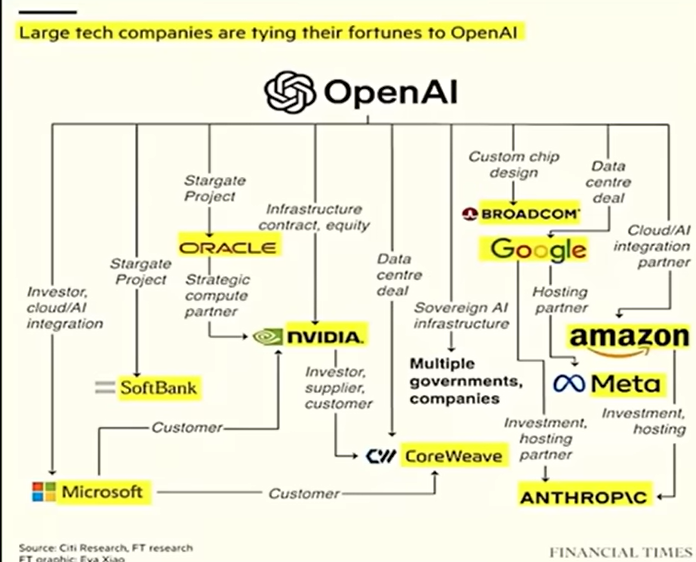
Core Viewpoint - Nvidia has become the first company in history to surpass a market capitalization of $5 trillion, driven by strong demand for AI technology and significant investments in AI infrastructure [1][2]. Group 1: Nvidia's Market Position and AI Demand - Nvidia's CEO Jensen Huang highlighted that the Blackwell and Rubin architecture chips could generate over $500 billion in revenue from 20 million GPUs by 2026, which is five times the revenue expected from the Hopper architecture chips between 2023 and 2025 [2]. - Huang also dismissed concerns regarding an AI bubble, despite rising skepticism in the market as Nvidia's valuation soared [3][4]. Group 2: Capital Circulation and Investment Dynamics - Nvidia's $100 billion investment in OpenAI has raised concerns about an AI bubble, as OpenAI committed to a $10 billion GPU order in return, creating a circular flow of capital between Nvidia and OpenAI [5][7]. - This capital cycle involves Nvidia investing in OpenAI, which in turn purchases cloud services from Oracle worth $300 billion, leading to further chip orders from Nvidia [7][8]. Group 3: Financial Health of Major Tech Companies - The free cash flow of the "Big Seven" tech companies has decreased by 62.45% from the end of 2024 to mid-2025, indicating a shift towards leveraging external financing for AI investments [12][14]. - Companies like Meta are increasingly resorting to debt financing, with Meta raising $27 billion through private debt issuance to build data centers, reflecting a trend of high-risk financing strategies [14]. Group 4: AI's Role in U.S. Economic Strategy - The U.S. government views AI as a core component of national strategic competition, leading to increased investments and policies aimed at maintaining dominance in AI technology [15][37]. - The "Stargate Project" aims to establish a global AI data center network with a $500 billion investment, indicating the scale of financial commitment required to support AI initiatives [40][42]. Group 5: Market Dynamics and Valuation Concerns - The S&P 500 has risen by 17.16% this year, driven by optimism around corporate earnings and AI investments, but this growth is largely attributed to valuation increases rather than fundamental earnings growth [22][31]. - The concentration of market capitalization among the top 10 stocks in the S&P 500, which are heavily AI-related, has reached 41.43%, raising concerns about potential overvaluation similar to the dot-com bubble [28][30].


英伟达成史上首家市值破5万亿美元的公司
Xin Lang Cai Jing· 2025-10-29 14:57
Core Viewpoint - Nvidia has become the first company in history to surpass a market capitalization of $5 trillion, reaching $5.13 trillion amid the ongoing global AI wave, although there are debates about a potential bubble in AI stocks [1][1][1] Group 1: Company Performance - Nvidia's stock price increased by over 5% on October 29, contributing to its historic market valuation [1][1] - The surge in market capitalization is attributed to the continuous drive of the global artificial intelligence trend [1][1] Group 2: Market Sentiment - Ark Invest CEO Cathie Wood believes that AI is not in a bubble and that the valuations of large tech companies are reasonable in the long term [1][1] - Bridgewater Associates founder Ray Dalio warns that large U.S. tech stocks may be forming a bubble, noting that 80% of the market's gains are concentrated in these stocks, while the overall market performance remains relatively poor [1][1][1]
史上首家!英伟达市值破5万亿美元
第一财经· 2025-10-29 13:49
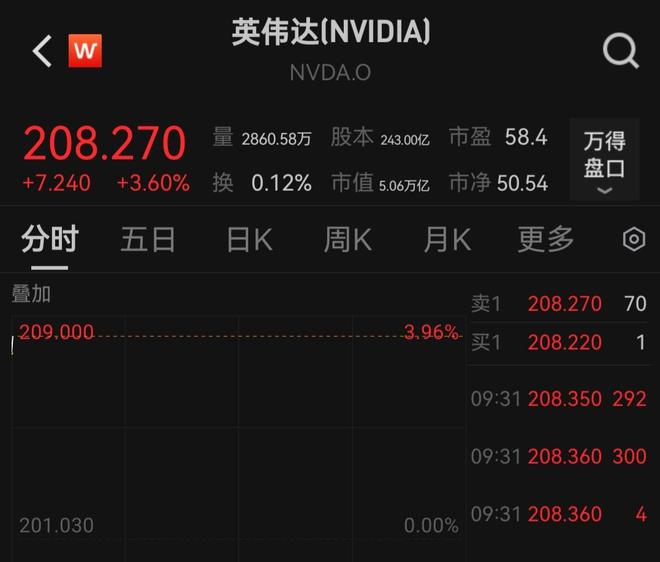
Core Viewpoint - NVIDIA's stock price surged over 5%, reaching a market capitalization of $5.13 trillion, making it the first company to surpass the $5 trillion mark [3] Group 1: Financial Performance - For the second quarter of fiscal year 2026, NVIDIA reported revenue of $46.743 billion, a year-on-year increase of 56%, slightly exceeding market expectations [7] - The net profit (GAAP) for the same quarter was $26.422 billion, reflecting a year-on-year growth of 59% [7] - Data center revenue was $41.1 billion, also up 56% year-on-year, but slightly below market expectations [7] Group 2: Product Developments - CEO Jensen Huang indicated strong AI demand, projecting that revenue from Blackwell and Rubin architecture chips could exceed $500 billion from 20 million GPUs by 2026, five times the revenue from Hopper architecture chips between 2023 and 2025 [4] - The Rubin chip, which boasts a computing power of 100 PFlops, is set to enter production by next year [5] - NVIDIA announced a $1 billion investment in Nokia to accelerate AI-RAN innovation, facilitating the transition from 5G to 6G [5] - The company introduced the NVIDIA BlueField-4 data processor, which will support AI factory operating systems and is part of the Rubin architecture products scheduled for release in 2026 [6] Group 3: Market Context - The surge in stock prices for NVIDIA, Microsoft, and Apple reflects the ongoing global AI wave, with Apple reaching a market cap of $4 trillion and Microsoft at $4.04 trillion [7] - There is ongoing debate in the market regarding the potential bubble in AI stocks, with differing opinions from investment leaders [7]

史上首家!英伟达市值破5万亿美元
Di Yi Cai Jing Zi Xun· 2025-10-29 13:44
Core Viewpoint - NVIDIA's stock price surged over 5% on October 29, 2023, reaching a market capitalization of $5.13 trillion, making it the first company in history to surpass a $5 trillion market cap [1] Company Developments - NVIDIA's CEO Jensen Huang indicated strong demand for AI, projecting that revenue from the Blackwell and Rubin architecture chips could exceed $500 billion from 20 million GPUs by 2026, which is five times the revenue expected from the Hopper architecture chips between 2023 and 2025 [2] - Huang showcased the next-generation Rubin superchip, which boasts a computing power of 100 PFlops, 100 times that of NVIDIA's first AI-specific computer, DGX-1, with production expected to begin by next year [3] - NVIDIA announced a $1 billion investment in Nokia to accelerate AI-RAN innovation, facilitating the transition from 5G to 6G, and introduced the Arc Aerial RAN Computer to support next-generation AI-native mobile networks [3] - In quantum computing, NVIDIA launched NVQLink, enabling hybrid simulation between QPUs and GPU supercomputers, with support from 17 different quantum computing companies [3] - NVIDIA introduced the NVIDIA BlueField-4 data processor, which will support AI factory operating systems and is part of the Rubin architecture products set to launch in 2026 [4] Financial Performance - For the second quarter of fiscal year 2026 ending July 27, 2025, NVIDIA reported revenue of $46.743 billion, a 56% year-over-year increase, slightly exceeding market expectations, with a net profit of $26.422 billion, up 59% year-over-year [5] - NVIDIA's data center revenue reached $41.1 billion, also a 56% year-over-year increase, but slightly below market expectations [5] Market Context - On October 28, 2023, NVIDIA, Microsoft, and Apple briefly entered the "4 trillion club," with Apple's market cap at $3.99 trillion and Microsoft's at $4.03 trillion, while on October 29, Apple's market cap rose to $4 trillion and Microsoft's to $4.04 trillion [5] - The surge in market capitalization among tech giants is driven by the ongoing global AI wave, although there are ongoing discussions about the potential for an AI bubble [5]
STARTRADER:美联储议息会议能否成为市场的转折点?
Sou Hu Cai Jing· 2025-10-29 09:58
Group 1 - The Federal Open Market Committee (FOMC) is expected to lower interest rates by 25 basis points, with market focus on Chairman Powell's forward guidance [2] - In Norway, private consumption has significantly increased this year, supported by high real wage growth, low unemployment, and declining mortgage rates, although a slight month-on-month decrease of about 0.3% in September is noted [2] - In Sweden, GDP indicators for September and Q3 are cautiously interpreted, with expectations of a 0.7% quarter-on-quarter growth and 1.6% year-on-year growth, indicating a potential recovery after a prolonged stagnation [2] Group 2 - In the Eurozone, the European Central Bank's (ECB) bank lending survey indicates a slight tightening of corporate loan standards in Q3, driven by increased risk perception, while household loan demand remains strong [5] - In the US, consumer confidence improved slightly in October, with the index rising to 94.6, although overall confidence continues to decline amid ongoing uncertainty [5] - China's detailed outline for the 2026-2030 Five-Year Plan emphasizes the critical role of consumption in driving economic growth, contrasting with the previously milder language of the initial draft [5] Group 3 - The Swedish central bank's business survey results were weaker than expected, indicating a deterioration in the current economic situation and outlook, with significant declines in corporate pricing plans [6] - The overall stock market showed a slight increase, primarily driven by the "Magnificent Seven" tech stocks, which rose by approximately 1.3%, while the broader market sentiment remains weak [7] - The euro/dollar exchange rate continues to fluctuate between 1.16 and 1.17, with a slight increase to 1.1630, as the market awaits the FOMC meeting [8]
微软冲上4万亿,苹果还差一步
第一财经· 2025-10-29 09:22
Core Viewpoint - The article discusses the significant market capitalization milestones achieved by major tech companies like Microsoft, Nvidia, and Apple, driven by the ongoing AI revolution, while also raising concerns about the sustainability of their growth momentum and the potential for an AI bubble [3][4][16]. Group 1: Market Capitalization Milestones - On October 28, 2023, Nvidia reached a market capitalization of $4.89 trillion, Microsoft surpassed $4 trillion, and Apple was close to $4 trillion, highlighting the impact of AI on their valuations [3][4]. - Nvidia's rapid rise in market value from $4 trillion to nearly $5 trillion in just three months is attributed to its advancements in chip architecture and strategic investments in companies like OpenAI and Intel [4][5]. Group 2: AI Investment and Growth Potential - The article emphasizes the critical role of AI in reshaping the tech industry, with Nvidia leading in upstream computing power, Microsoft in midstream ecosystem support, and Apple in downstream consumer products [4]. - Microsoft announced a new agreement with OpenAI, extending its investment in the company to approximately $135 billion, which is expected to enhance its Azure cloud services [6][7]. Group 3: Sales Performance and Consumer Demand - Apple's strong sales performance for the iPhone 17 series, which saw a 14% increase in sales compared to the iPhone 16 series, is a key driver of its market valuation [10][11]. - The demand for the iPhone 17 Pro Max in the U.S. has been particularly strong, indicating a positive consumer response to the new product line [10]. Group 4: Challenges and Competitive Landscape - Nvidia faces challenges in the Chinese market, where its market share has dropped significantly, and it must navigate increasing competition from companies like AMD and Google, which are also investing heavily in AI technologies [12][14]. - Microsoft is dealing with operational challenges, including layoffs and adjustments in its Azure cloud business, which have affected its growth expectations [13][14]. Group 5: AI Bubble Debate - The article highlights the ongoing debate about the existence of an AI bubble, with some investors expressing concerns about the sustainability of high valuations in the tech sector, while others argue that the current investments in AI infrastructure are justified [16][18]. - Prominent figures in finance, such as Larry Fink and Cathie Wood, suggest that the current AI spending is not indicative of a bubble, but rather a necessary investment for future growth [17][19].



微软冲上4万亿,苹果还差一步,AI 狂欢下的泡沫隐忧
Di Yi Cai Jing· 2025-10-29 09:03
Core Insights - The market capitalization of major tech companies like Microsoft, Nvidia, and Apple has surged, with Nvidia leading at $4.89 trillion, followed by Microsoft at $4.03 trillion and Apple at $3.99 trillion, driven by the ongoing AI wave [1][2] - Concerns remain about whether these tech giants can sustain their growth momentum and meet market expectations after a rapid increase in valuations [1][2] - Upcoming earnings reports from major tech firms will address critical questions regarding AI investment returns, cloud business growth, and the commercialization of AI products [1][2] Group 1: Nvidia's Growth and Strategy - Nvidia's market value has rapidly increased from $4 trillion to nearly $5 trillion in about three months, supported by chip architecture iterations and significant investments in companies like OpenAI and Intel [2][3] - The GTC conference highlighted Nvidia's potential revenue of over $500 billion from new chip architectures by 2026, driven by the sale of 20 million GPUs [2][3] - Nvidia's investments in Intel and Nokia aim to enhance its AI ecosystem and expand into telecommunications, showcasing its ambition beyond being a GPU supplier [3] Group 2: Microsoft's Position and Challenges - Microsoft's market capitalization has reached $4 trillion, bolstered by its strategic partnership with OpenAI and growth in Azure and AI-related businesses [4][8] - Microsoft has invested approximately $135 billion in OpenAI, securing rights to use its models until 2032, and has signed a $250 billion Azure service agreement with OpenAI [4][8] - Despite strong AI business growth, Microsoft faces challenges such as cost management, market regulation, and a need for organizational restructuring [7][8] Group 3: Apple's Performance and Market Dynamics - Apple's stock performance is driven by strong sales of the iPhone 17 series, which has seen a 14% increase in sales compared to the iPhone 16 series in the first ten days [5][9] - The iPhone 17's acceptance in China is notably high, with sales nearly double that of the iPhone 16, indicating a strong market response [5][9] - However, Apple's AI initiatives lag behind competitors, and its new products have not yet generated significant consumer interest, posing risks to its market position [9][10] Group 4: Market Sentiment and AI Bubble Debate - The rapid increase in valuations of tech giants has sparked debates about a potential AI bubble, with significant capital expenditures in AI infrastructure raising questions about future revenue generation [11][12] - Some investors argue that the current AI landscape is not a bubble, citing the necessity for large companies to adapt and the potential for long-term returns [12][13] - Concerns persist regarding the concentration of market gains among large tech stocks, with warnings about the sustainability of this trend [12][13]
“木头姐”加入AI泡沫争论:泡沫尚不存在 但AI股票估值或迎“现实检验”
Zhi Tong Cai Jing· 2025-10-29 06:31
不过,凯茜·伍德旗下的Ark Invest仍在持续进行一系列聚焦创新与科技股的重大投资操作。其中值得注 意的买入包括Robinhood (HOOD.US)、奈飞(NFLX.US)以及百度(BIDU.US)等股票。同时,该基金也进 行了部分减持操作,如Shopify(SHOP.US)与AMD(AMD.US)的股票。此外,该基金在10月出售了4,064股 Palantir Technologies(PLTR.US)的股票。 值得注意的是,近段时间以来,随着AI相关公司估值飙升、大规模的AI投资以及AI生态系统的日益闭 环,有关AI泡沫的担忧再度浮现。华尔街对此观点不一。 例如,美国银行在10月进行的一项基金经理调查显示,随着今年以来AI概念股经历了一轮强劲上涨, 认为该板块已陷入泡沫的全球基金经理比例创下历史新高。在这项调查中,约54%的受访者表示科技股 当前估值过高。 (原标题:"木头姐"加入AI泡沫争论:泡沫尚不存在 但AI股票估值或迎"现实检验") 智通财经APP获悉,Ark首席执行官凯茜·伍德周二表示,她并不认为当前的人工智能(AI)市场存在泡 沫,但警告称,AI相关股票的估值可能很快会面临一次"现实检验 ...
OpenAI的弑神赌局,看懂的人还不多
3 6 Ke· 2025-10-29 00:20
然而,实现梦想的代价,已然飙升了百倍不止。对于这一点,山姆·奥特曼及其团队并无意隐瞒。在他们面向公众的融资计划书中,便已直言不讳: "我们渴望在履行使命的同时,增强融资能力。但我们所知的任何现有法律架构,都无法平衡这对矛盾。我们的解决方案,是创造了OpenAI LP,将 其塑造为一个营利与非营利的混合体——我们称之为'利润上限'公司。" 2019年11月,在举世惊呼的"大模型元年"2023年尚未来临的四年前,在OpenAI LP——这家机构用以探索商业可能性的营利性子公司的官网上,静默 地悬挂着一幅画作。它给人的观感是"温暖、宁静、朦胧,却又在底色中涌动着无穷生机": 这幅在当时未激起太多涟漪的图画,数年之后被回溯者解读为一种深意:它象征着这家当时仍显神秘与边缘的人工智能初创公司,对其终极目标 ——通用人工智能(AGI)——所做出的、"充满柔性却坚定不移"的视觉诠释。 在同一页面之上,比图像更为凝练的,是一段定义其灵魂的文字: "Our mission is to ensure that artificial general intelligence (AGI) benefits all of humanit ...

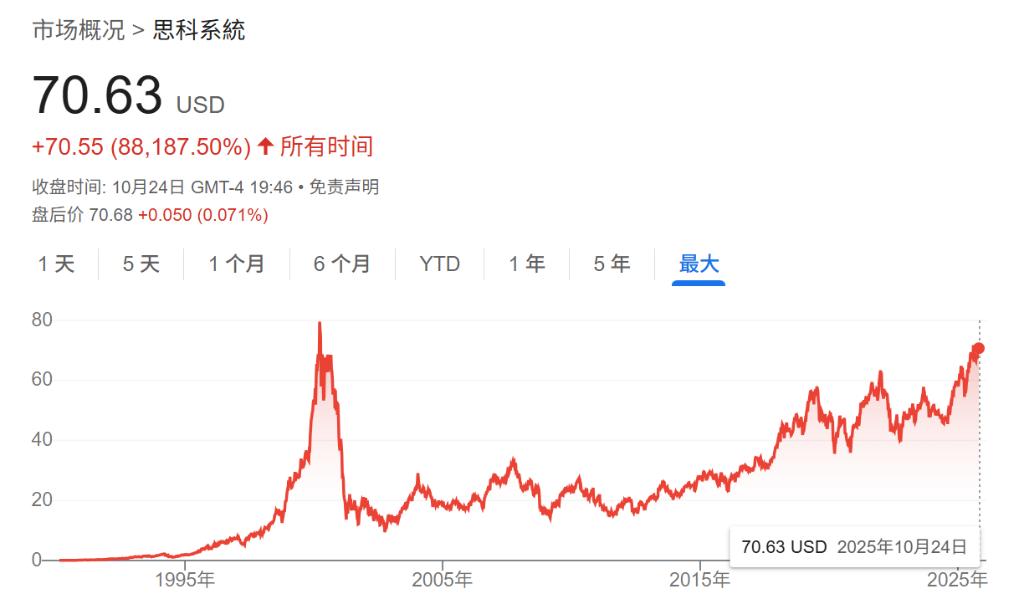
给出100美元目标价,英伟达“唯一的空头”:这不是我第一次看到泡沫
3 6 Ke· 2025-10-27 00:47
Core Viewpoint - Seaport Global Securities analyst Jay Goldberg is the only one among 80 analysts covering Nvidia to issue a "sell" rating, setting a target price of $100, expressing skepticism about the AI hype and comparing the current situation to the dot-com bubble [1][2][7] Group 1: Historical Comparison - Goldberg believes Nvidia's growth is heavily reliant on massive capital expenditures from a few tech giants, including Microsoft, Alphabet, Amazon, Meta, Oracle, and OpenAI, which have created a market cap of $4.5 trillion for Nvidia [2] - The projected capital expenditures for these companies are expected to approach $400 billion by 2025, with OpenAI committing over $1 trillion [2] - Goldberg warns that the actual returns from these massive investments have been limited, drawing parallels to the telecom infrastructure boom during the dot-com bubble, where companies like Cisco saw stock prices soar based on unrealized internet traffic expectations [2][5] Group 2: Market Dynamics and Concerns - Goldberg questions the sources of incremental power for new data centers, suggesting that the current market sentiment assumes Nvidia's AI chips are sold out, leaving little room for further price increases [6] - He highlights the accumulating leverage around data center development, indicating that the failure of a seemingly insignificant company could trigger a chain reaction throughout the supply chain [6] - Despite his "sell" rating, Goldberg admires Nvidia and its CEO Jensen Huang, clarifying that his rating reflects an expectation that Nvidia will underperform compared to peers like Broadcom, Qualcomm, and AMD [6] Group 3: Wall Street Sentiment - While Goldberg is the only analyst with a "sell" rating, concerns about an AI bubble are echoed by others on Wall Street, including Goldman Sachs CEO David Solomon, who has compared the current AI craze to the dot-com bubble [7] - A recent Bank of America survey indicated a record high percentage of respondents believe AI stocks are in a bubble, with even OpenAI's CEO Sam Altman acknowledging the possibility of an AI bubble [7] - Despite these concerns, the majority of analysts remain bullish on Nvidia, with 73 out of 80 analysts rating it as a "buy," and some, like HSBC's Frank Lee, setting target prices as high as $320 based on anticipated demand for AI accelerators [8]