
脑机接口

Search documents
光伏出口退税将取消,谷歌为苹果AI提供支持 | 财经日日评
吴晓波频道· 2026-01-14 00:29
Group 1: Photovoltaic Industry - The export tax rebate for photovoltaic products will be fully canceled starting April 1, 2026, increasing export costs for companies [2] - The export tax rebate for photovoltaic silicon wafers, batteries, and modules was previously reduced from 13% to 9% in December 2024, indicating a trend of declining export tax rates [2] - The Chinese photovoltaic industry has seen a decrease in export prices since 2024, leading to a "volume increase, price decrease" situation, with some companies passing on rebate amounts to foreign buyers, resulting in profit loss [2][3] - The cancellation of export tax rebates aims to promote rational competition in the photovoltaic industry and curb excessive price declines [3] Group 2: Elderly Care Robotics - Eight departments, including the Ministry of Civil Affairs, have issued measures to encourage the development of the elderly care robotics industry, promoting technological integration across various sectors [4] - The initiative aims to provide comprehensive intelligent support for the elderly, leveraging technologies such as embodied intelligence and new materials [4][5] - The market for elderly care technology products and services is expected to expand rapidly, although current technology maturity remains insufficient [5] Group 3: Real Estate Market in Tianjin - Tianjin will tighten control over new housing prices, limiting price changes to within 10% of the registered price for new sales permits [6] - The city has previously implemented price control measures to stabilize housing prices, with over 20 cities having introduced similar "price drop limits" [6][7] - The new management approach aims to control both price increases and decreases, although enforcing price decreases may face challenges [6] Group 4: AI and Technology Collaborations - Google and Apple have entered a strategic partnership, with Google's Gemini model being used to support Apple's AI developments, including Siri [8] - Apple is expected to pay approximately $1 billion annually to Google for technology licensing, indicating a significant investment in AI capabilities [8] - Nvidia and Eli Lilly have announced a $1 billion collaboration to establish a research lab focused on AI applications in the pharmaceutical industry, highlighting the growing intersection of AI and healthcare [10][11] Group 5: ByteDance's Stock Options - ByteDance's stock option price has increased from $44 in 2019 to $226.07 in January 2024, representing a rise of over 4 times [14] - The company is reportedly raising its valuation to between $350 billion and $370 billion as it continues to enhance employee compensation and stock option incentives [14][15] - ByteDance's strong financial performance and aggressive AI application strategy position it as a leading player in the tech industry, despite facing increasing policy risks in overseas markets [15]





上市公司竞相“抢风口” 谁能驶入银发经济蓝海
Shang Hai Zheng Quan Bao· 2026-01-14 00:12
Group 1 - The government is promoting the integration of technology in elderly care services, emphasizing the use of big data, cloud computing, artificial intelligence, and other advanced technologies for health monitoring and personalized services [1] - There is a strong growth in the silver economy, particularly in industries catering to both disabled and semi-disabled individuals, as well as active elderly consumers, driven by advancements in AI, robotics, and IoT [2] - Companies are focusing on rehabilitation and elderly care services, with significant investments planned in smart elderly care projects to capitalize on the silver economy [3] Group 2 - The development of smart and digital products for the elderly is a primary focus, with companies creating multi-layered, scenario-based smart elderly care products and services [4] - Companies are launching various rehabilitation robots and smart solutions for elderly care, with ongoing pilot tests in real-life scenarios [5] - Cross-industry collaborations are emerging, with companies in education and real estate exploring opportunities in the silver economy to enhance their service offerings [6]

八部门发文促银发经济发展 14项举措培育养老服务经营主体
Shang Hai Zheng Quan Bao· 2026-01-13 23:34
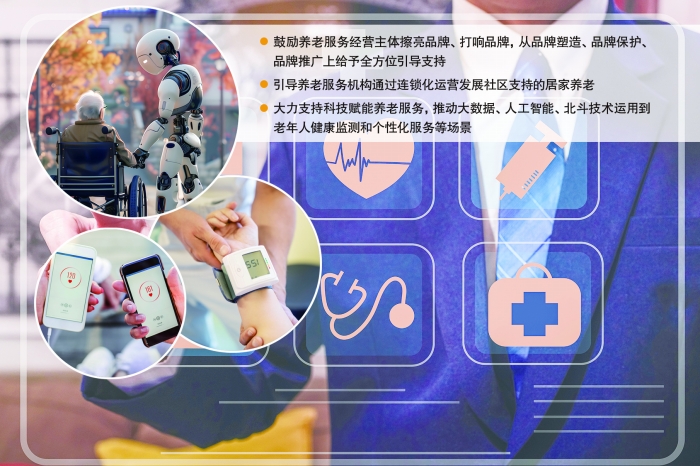
Core Viewpoint - The Ministry of Civil Affairs and seven other departments have jointly issued measures to cultivate the elderly care service sector and promote the silver economy, focusing on brand development and technological empowerment [1][2]. Group 1: Policy Measures - The measures include 14 specific initiatives aimed at optimizing the development environment for elderly care services and stimulating operational vitality [1]. - There is a strong emphasis on brand building, with support for brand creation, protection, and promotion to foster well-known brands in the elderly care sector [1]. - The measures aim to enhance market supply and demand matching by optimizing the supply of elderly care services and age-friendly products, encouraging community-supported home care through chain operations [1]. Group 2: Technological Empowerment - The measures advocate for the integration of big data, artificial intelligence, and Beidou technology in health monitoring and personalized services for the elderly [2]. - There is encouragement for the development of elderly care robots and smart devices, with a focus on improving the service experience for older adults [2]. - The initiative aims to transition the elderly care service system from traditional care to a more intelligent and quality-enhanced model, addressing labor shortages and improving service efficiency [2][3]. Group 3: Industry Development Focus - The Ministry of Industry and Information Technology plans to focus on key areas such as elderly care robots, smart footwear, and easy-to-swallow foods, enhancing product development [3]. - There will be a collaborative effort between production and application enterprises to advance core technology and product development in elderly care [3]. - The Ministry of Commerce will work on five key areas, including the development of home care services for the elderly and creating platforms for supply and demand matching in elderly care [3].
260亿龙头,拿下1200亿大单!上交所问询
Zhong Guo Zheng Quan Bao - Zhong Zheng Wang· 2026-01-13 23:30
Group 1: Company News - Rongbai Technology signed a procurement cooperation agreement with CATL for lithium iron phosphate cathode materials, with a total sales amount exceeding 120 billion yuan, supplying 3.05 million tons from Q1 2026 to 2031 [10][11] - Baiwei Storage expects a net profit attributable to shareholders of 850 million to 1 billion yuan in 2025, representing a year-on-year increase of 427.19% to 520.22% [5] - Dazhu CNC anticipates a net profit attributable to shareholders of 785 million to 885 million yuan in 2025, reflecting a year-on-year growth of 160.64% to 193.84% [6] - TCL Technology forecasts a net profit attributable to shareholders of 4.21 billion to 4.55 billion yuan in 2025, indicating a year-on-year increase of 169% to 191% [6] - Hengdi Pharmaceutical expects a net profit attributable to shareholders of 31 million to 39 million yuan in 2025, showing a decline of 57.40% to 66.14% [9] - *ST Wanfang anticipates a revenue below 300 million yuan in 2025, with net profit expected to be negative, leading to potential delisting [10] Group 2: Industry Developments - The State Grid reported that inter-provincial electricity trading volume reached 1.67 trillion kWh in 2025, a 10% year-on-year increase, with renewable energy trading volume up 41% to 317.7 billion kWh [2] - The Ministry of Industry and Information Technology released an action plan for the high-quality development of industrial internet platforms from 2026 to 2028, aiming for over 450 influential platforms and a core industry scale exceeding 1.6 trillion yuan by 2025 [3] - The sixth batch of high-value medical consumables procurement has concluded, with results to be announced today [1]
六大经济部委释放2026关键信号 两大市场要稳,这些产业要飞
2 1 Shi Ji Jing Ji Bao Dao· 2026-01-13 23:16
Group 1: Economic Policy Signals - The Chinese government is focusing on four key policy signals for 2026: stabilizing growth, expanding domestic demand, supporting technological innovation, and stabilizing the real estate and stock markets [1][2] - Various ministries are actively promoting early policy implementation to ensure a smooth start to 2026, including the early issuance of project lists and investment plans [1][2] Group 2: Fiscal and Monetary Policy - The 2026 fiscal policy will continue to be proactive, with an expanded fiscal spending plan and optimized government bond tools to enhance effectiveness [2][3] - The People's Bank of China will maintain a moderately loose monetary policy, with expectations of a 25-50 basis point reduction in the reserve requirement ratio and a 10-20 basis point decrease in the 7-day reverse repo rate [3][4] Group 3: Consumption and Investment - Measures to boost consumption include optimizing the trade-in policy for consumer goods and expanding service consumption, while investment will be supported through various government funding initiatives [5][6] - The government plans to implement a consumption upgrade policy, providing subsidies for trade-ins of automobiles, home appliances, and digital products [6] Group 4: Real Estate Market Stability - The 2026 strategy includes stabilizing the real estate market through targeted policies, such as controlling new supply and utilizing existing housing stock for affordable housing [11][12] - Major cities are expected to further relax housing purchase restrictions and lower mortgage costs to stimulate housing demand [12] Group 5: Emerging Industries Development - The government aims to enhance technological innovation capabilities and support the growth of emerging industries such as integrated circuits, new materials, and biomedicine [8][9] - A new venture capital fund has been established to attract investment in high-tech sectors, with an expected total investment scale exceeding one trillion yuan [9] Group 6: Innovation-Driven Growth - The focus for 2026 will be on building an innovation-driven growth model, emphasizing the integration of short-term policies with long-term structural reforms [10]
六大经济部委释放2026关键信号
2 1 Shi Ji Jing Ji Bao Dao· 2026-01-13 23:16
Core Viewpoint - The Chinese government is focusing on stabilizing economic growth, expanding domestic demand, supporting technological innovation, and stabilizing the real estate and stock markets as it prepares for the economic goals of 2026, the first year of the 14th Five-Year Plan [1][2]. Economic Policy Initiatives - Various ministries are implementing proactive macroeconomic policies, including enhancing economic monitoring, improving policy tools, and ensuring effective fiscal and monetary policy coordination [2]. - The fiscal policy for 2026 will be more active, with an expanded fiscal spending plan and optimized government bond tools to enhance local financial capabilities [2][3]. - The People's Bank of China will maintain a moderately loose monetary policy, focusing on high-quality economic development and reasonable price recovery, with expectations of a 25-50 basis point reduction in the reserve requirement ratio [2][3]. GDP and Fiscal Projections - The GDP growth target for 2026 is expected to remain around 5%, with a fiscal deficit rate holding steady at 4% and an increase in special bonds to 4.8 trillion yuan [3][4]. - The broad deficit scale is projected to rise from 11.86 trillion yuan in 2025 to approximately 12.45 trillion yuan in 2026, corresponding to a broad deficit rate increase from 8.4% to 8.5% [3]. Consumer and Investment Stimulus - The government aims to boost consumption through practical measures, including optimizing the trade-in policy for consumer goods and expanding service consumption [5][6]. - Investment will be supported through various government funding initiatives, including the issuance of special bonds and increased central budget investments [5][6]. Real Estate and Stock Market Stability - Policies will focus on stabilizing the real estate market through targeted measures, including optimizing housing purchase policies and promoting the use of existing housing for social needs [12]. - The central bank will work on mitigating financial risks in key areas and enhancing market confidence through specific monetary policy tools [13]. Emerging Industry Development - There is a strong emphasis on fostering new and emerging industries, including integrated circuits, new materials, and artificial intelligence, with significant investments planned in these sectors [8][9]. - The establishment of the National Venture Capital Guiding Fund aims to attract substantial investment in high-tech fields, with an expected total investment scale exceeding one trillion yuan [9]. Innovation-Driven Growth - The focus for 2026 will be on building an innovation-driven growth model, enhancing the modern industrial system, and promoting technological self-reliance [10].
融资狂揽20亿元后 强脑科技冲击港股IPO
Mei Ri Shang Bao· 2026-01-13 22:20
Group 1 - Zhejiang Qiangnao Technology Co., Ltd. has secretly submitted an IPO application in Hong Kong, aiming to raise several hundred million dollars [1][2] - The company recently completed a financing round of approximately 2 billion RMB, making it the second-largest single financing in the global brain-computer interface sector, following Neuralink [1][2] - The financing attracted participation from notable investors including IDG, Huaden International, and leading manufacturing companies, indicating strong market expectations for the commercialization of non-invasive brain-computer interfaces [1][2] Group 2 - Qiangnao Technology aims to help 1 million physically disabled individuals regain daily life through neural-controlled prosthetics within the next five to ten years [2] - The company plans to use the funds raised from the IPO to accelerate core technology research and development, engineering breakthroughs, and product scaling [1][2] - The involvement of major manufacturing and technology firms in the financing round suggests a collaborative effort to enhance hardware production capabilities and core component synergies [2][3] Group 3 - The brain-computer interface sector is experiencing significant growth, with a projected global market size of $12.4 billion by 2034 and a Chinese market size of 6.14 billion RMB by 2028 [6] - Recent positive developments in the sector, including the establishment of industry standards and participation in major medical investment conferences, have energized the market [4] - Brain-computer interface concept stocks have shown strong performance, with several companies experiencing significant stock price increases [4][5]
八部门出台14项举措促进银发经济发展
Zhong Guo Zheng Quan Bao· 2026-01-13 20:46
Core Insights - The Ministry of Civil Affairs reported that by the end of 2025, there will be 41,700 elderly care institutions in China, employing 722,000 people, with private and public-private institutions making up 71.9% of the total [1] Group 1: Policy Measures - The Ministry of Civil Affairs and eight other departments have issued measures to support the development of the elderly care service industry and the silver economy, focusing on technology empowerment, brand building, supply-demand matching, environmental optimization, and support for resources [1][2] - Specific initiatives include encouraging technological innovation in elderly care services, such as the use of big data, cloud computing, artificial intelligence, and robotics to enhance service efficiency and quality [2][3] Group 2: Financial Support and Market Development - The Ministry of Civil Affairs plans to develop specialized financial support policies to encourage social capital participation and provide diverse financing options tailored to the elderly care industry [1][4] - The Ministry aims to create competitive elderly care service brands and leading enterprises, enhancing accessibility, convenience, and intelligence in elderly care services to meet diverse needs [4] Group 3: Integration and Collaboration - The Ministry of Commerce will focus on integrating elderly care services with home care and domestic services, promoting high-quality development in the home service industry [3] - Efforts will be made to establish a platform for matching supply and demand in elderly care services, creating new consumption scenarios and fostering an open cooperative environment [3]
八部门发文促银发经济发展 14项举措培育养老服务经营主体 鼓励养老服务机器人产业发展
Shang Hai Zheng Quan Bao· 2026-01-13 18:34
Core Insights - The Ministry of Civil Affairs and seven other departments have jointly issued measures to cultivate the elderly care service sector and promote the silver economy, focusing on brand development and technological innovation [2][3][4] Group 1: Policy Measures - The measures include 14 specific initiatives aimed at enhancing the operational vitality of elderly care service providers and promoting structural reforms in supply [2] - Emphasis is placed on brand building, with support for brand creation, protection, and promotion to foster well-known brands in the elderly care sector [2] Group 2: Market Optimization - The measures aim to optimize the supply of elderly care services and age-friendly products, encouraging community-based home care through chain operations [3] - Support is provided for e-commerce platforms and large supermarkets to enhance the connection between supply and demand in elderly care services [3] Group 3: Technological Empowerment - The initiative promotes the integration of big data, artificial intelligence, and other technologies into elderly health monitoring and personalized services [3][4] - Development of elderly care robots and smart devices is encouraged, with a focus on improving the service experience for the elderly [3][4] Group 4: Industry Development - The Ministry of Industry and Information Technology will focus on the deep integration of new information technologies with elderly care services, addressing the pain points of elderly living [4] - Key areas for development include elderly care robots, age-friendly clothing, and easy-to-swallow food products [4] Group 5: Business Development - The Ministry of Commerce will focus on five areas, including the development of home care services for the elderly and creating platforms for supply-demand matching in elderly care [5] - Efforts will be made to create new consumption scenarios for elderly care and foster an open cooperative environment [5]

股市必读:创新医疗(002173)1月13日收盘跌5.08%,主力净流出8.44亿元
Sou Hu Cai Jing· 2026-01-13 16:48
Trading Information Summary - On January 13, 2026, Innovation Medical (002173) closed at 35.11 yuan, down 5.08%, with a trading volume of 1.54 billion yuan [1][3] - Over the past 10 trading days, the main funds have seen a cumulative net outflow of 1.93 billion yuan, while the stock price has increased by 62.62% during the same period [1][3] Fund Flow Analysis - On January 13, 2026, the main funds experienced a net outflow of 1.26 billion yuan, while retail investors saw a net inflow of 1.85 billion yuan [1][3] Company Announcement Summary - Innovation Medical issued an announcement regarding abnormal trading fluctuations due to a cumulative price deviation exceeding 20% over three consecutive trading days [1][3] - The company confirmed that there were no undisclosed significant matters and that its production and operational conditions remain stable [1] - The subsidiary, Bole Brain Machine, has launched brain-machine interface products, but it is currently facing operational losses [1][3]
