
代币化

Search documents
华尔街大行首度为以太坊建模:预测年底价格4300美元
Hua Er Jie Jian Wen· 2025-09-16 03:40
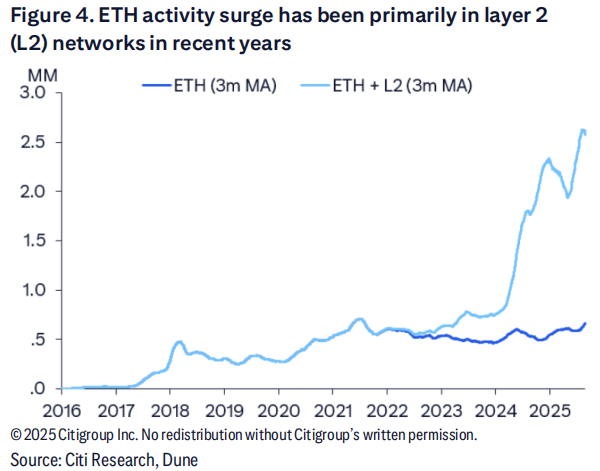
Core Viewpoint - Citigroup predicts Ethereum's year-end target price at $4,300, which is lower than the current spot price, based on a model considering fundamental value, capital inflow potential, and macroeconomic environment [1][15]. Group 1: Value Capture and L2 Challenges - The report highlights that Ethereum's value is closely tied to its network activity as a smart contract platform, unlike Bitcoin's "digital gold" positioning [1]. - Recent growth in Ethereum's ecosystem activity is primarily occurring on Layer 2 (L2) networks, raising concerns about how much value L2 can translate back to the Ethereum mainnet [3]. - Citigroup assumes a 30% value transmission rate from L2 activities to the Ethereum mainnet, indicating that even with this assumption, Ethereum's current price exceeds the valuation derived from combined Layer 1 (L1) and L2 activities [3]. Group 2: Fundamental Value and Price Risks - Citigroup's model suggests that Ethereum's current price is above what its network activity can support, likely driven by recent ETF inflows and market excitement over tokenization use cases, indicating a risk of overvaluation in the short term [4]. - The report notes that while the inflow of funds into Ethereum ETFs can significantly impact prices (with every $1 billion inflow potentially raising prices by 6%), the overall inflow is expected to be much lower than that of Bitcoin [4][10]. Group 3: Macroeconomic Environment - The macroeconomic environment has a limited impact on Ethereum's price in the base case scenario, although it could become a key driver in a recession, particularly if the stock market declines [11][14]. - Citigroup's baseline scenario predicts a year-end price of $4,300, assuming moderate capital inflows and sustained market excitement about Ethereum's network use cases [15]. Group 4: Price Scenarios - In a bullish scenario, the price could reach $6,400, driven by significant increases in network activity and sustained demand from ETFs and treasury companies [15]. - Conversely, in a bearish scenario, the price could drop to $2,200, primarily influenced by macroeconomic factors such as a recession and stock market downturns [15]. Group 5: Overall Analysis Framework - The report provides a clear analytical framework for investors, affirming Ethereum's value as an application platform while pointing out its core shortcoming in capturing value from the L2 ecosystem [18].

中国新城市与EX.IO合作推出商业地产RWA项目
Zhi Tong Cai Jing· 2025-09-15 15:03
Core Viewpoint - China New City (300778) has entered into a service agreement with EXIO Group Limited to provide tokenization services, indicating a strategic move towards digital asset integration and value enhancement [1] Group 1: Agreement Details - The agreement with EXIO includes services such as legal document coordination, smart contract development, smart contract auditing, wallet solutions, token access on the EXIO platform, and coordination of investor KYC processes [1] - EXIO is a licensed virtual asset trading platform in Hong Kong, backed by Sina's Huasheng Group, and received its operating license from the Hong Kong Securities and Futures Commission in December 2024 [1] Group 2: Strategic Intent - The company aims to leverage Hong Kong's status as an international financial center to deepen collaboration with leaders in the digital asset industry [1] - The strategic research and layout in digital assets are intended to promote the re-release of existing asset values [1]

星展香港完成“数码港元”先导计划第二阶段测试 提升数码代用券应用
智通财经网· 2025-09-15 07:25
Core Insights - DBS Hong Kong has completed the second phase of the Hong Kong Monetary Authority's "Digital Hong Kong Dollar" pilot program, focusing on how tokenization and programmability can enhance the application of digital vouchers [1][2] - The pilot project integrates tokenization and smart contract technology with DBS's banking services, utilizing Purpose-Bound Money (PBM) to test specific consumption conditions on digital currencies like the digital Hong Kong dollar [1] Group 1 - The collaboration with Kua Ltd. on the ESG rewards platform "ZERO2" allows participants who complete environmental tasks to receive PBM-based digital vouchers, which can only be used at designated merchants [1] - Once the vouchers are verified, merchants can receive simulated digital Hong Kong dollar payments in real-time at the point of sale, simplifying the settlement and reconciliation process through the Faster Payment System (FPS) [1] - DBS Hong Kong sees potential for tokenized currency applications to extend to other reward programs, financial management, supply chain payments, and improving payment process management [1] Group 2 - The bank's commitment to shaping the future of payments is reflected in its participation in the HKMA's pilot program and expertise in the field of tokenization [2] - Leveraging its leading position in programmable currency and conditional payments, DBS is deploying its token services to help Hong Kong corporate clients enhance efficiency and redefine payment models [2]
Stablecoins vs. Tokenized Securities: The Risks and Benefits for Investors
Yahoo Finance· 2025-09-13 12:32
Core Insights - Stablecoins and tokenized securities are blockchain-based technologies that aim to revolutionize global finance by providing faster settlement times, increasing investor access, and enhancing liquidity [1][8] Group 1: Technology and Standards - Both stablecoins and tokenized securities utilize general-purpose, fungible token standards like Ethereum's ERC-20, allowing issuers to define parameters such as total token supply and decimal subdivisions [3] - Tether's USDT, launched in 2015, gained traction after migrating to Ethereum in 2017, leading to lower transaction costs and increased adoption of stablecoins [4] Group 2: Market Dynamics - While stablecoins have seen significant growth, early security tokens faced challenges due to regulatory hurdles, limiting their adoption [6] - Various financial assets, including shares and real estate funds, have been tokenized, but the permissionless nature of blockchain often conflicts with securities laws [7] Group 3: Risk and Benefits - Stablecoins and tokenized securities present distinct risks and benefits for investors, with current products offering varying levels of protection [8] - The use of special purpose vehicles (SPVs) to manage financial risks is seen as a transitional step towards fully on-chain securities, which would eliminate the need for intermediaries [9]
全天候交易时代来临?贝莱德探索将ETF“代币化”
Hua Er Jie Jian Wen· 2025-09-12 03:21
Core Insights - BlackRock is exploring the possibility of tokenizing exchange-traded funds (ETFs), which could fundamentally change the operation of one of Wall Street's most important investment products [1] - The company has previously seen success in the digital asset space, with its tokenized money market fund BUIDL growing to over $2 billion [1][2] - The tokenization of ETFs may lead to extended trading hours, easier access for overseas investors, and new uses as collateral in crypto networks [1][2] Group 1: Tokenization Technology - Tokenization creates digital versions of traditional assets, allowing them to flow on blockchain systems, potentially enabling 24-hour trading [2] - This technology could facilitate easier access to U.S. financial products for overseas investors and create new collateral uses in crypto networks [2] - BlackRock has been a proactive advocate for digital assets, testing tokenized fund share trading on JPMorgan's Onyx infrastructure [2] Group 2: Industry Trends - Interest in tokenization is rising within the industry, with companies like Franklin Templeton and BlackRock paving the way for this transition [2] - Analysts note that while the market for tokenized assets is still small, BlackRock's exploration indicates mainstream finance is beginning to test blockchain for reconstructing market infrastructure [5] Group 3: Challenges and Regulatory Environment - The transition to tokenized ETFs faces significant obstacles, including the need to coordinate existing clearing systems with blockchain's instantaneous trading capabilities [4] - The regulatory environment is becoming more accommodating, with policymakers showing openness to testing blockchain-based market projects in controlled settings [4] - Nasdaq has requested regulatory approval to allow investors to trade tokenized versions of stocks, marking a significant potential test of blockchain technology in the U.S. stock market [4]

新型加密资产用例+1?传贝莱德(BLK.US)探索将ETF代币化
Zhi Tong Cai Jing· 2025-09-12 00:44
Group 1 - BlackRock is exploring the digitization of its investment products, specifically focusing on tokenizing exchange-traded funds (ETFs) for blockchain trading [1] - The company launched a tokenized money market fund named BUIDL in 2024, which has surpassed $2 billion in size and gained popularity on cryptocurrency platforms [1] - Tokenization allows for trading outside of traditional Wall Street hours, making U.S. products more accessible internationally and creating new collateral uses for crypto networks [1][2] Group 2 - BlackRock is actively supporting digital assets and has tested tokenized fund shares on JPMorgan's Onyx infrastructure, positioning itself as an early adopter of digital settlement models [2] - The transition to tokenized assets faces challenges, including the need for regulatory clarity and integration with existing clearing systems [2] - The current market size for tokenized assets is approximately $28 billion, while the U.S. ETF industry is valued in the trillions, indicating significant potential for growth in this area [3]
王晋斌:逆全球化叠加金融全球化,加速资产收益率下行
Jing Ji Guan Cha Bao· 2025-09-05 09:56
Core Viewpoint - The combination of trade de-globalization and financial globalization is expected to exert downward pressure on global asset returns [1] Group 1: Trade De-globalization - Trade de-globalization is narrowing global market demand, which in turn reduces the returns of the real economy [1][6] - The U.S. has seen a continuous trade deficit exceeding $1 trillion from 2021 to 2024, leading to a significant outflow of dollars [3] - Tariff policies in the U.S. artificially raise import prices, aiming to protect domestic industries but ultimately increasing global commodity prices and reducing overall demand [4] Group 2: Financial Globalization - The introduction of the "Genius Act" regarding stablecoins represents a significant step in financial globalization, potentially increasing competition among financial assets [5] - The market capitalization of stablecoins has surpassed $280 billion, serving as a crucial link between traditional finance and digital assets [6] - The tokenization of assets is seen as the ultimate form of financial product innovation, allowing for the fractionalization of high-value assets to meet the needs of smaller investors [6] Group 3: Economic Implications - The stagnation of labor productivity in U.S. manufacturing has led to rising product prices, diminishing the global competitiveness of U.S. goods [2] - The combination of trade de-globalization and financial globalization is likely to lead to a long-term decline in asset returns due to increased competition and supply of financial assets [6]
3D打印与区块链的结合:制造业未来的代币化
Sou Hu Cai Jing· 2025-09-05 00:34
Industry Overview - 3D printing has evolved from a niche hobby to a global industry with significant potential across various sectors including healthcare, aerospace, defense, construction, consumer goods, and food [1][3] - The 3D printing market is projected to reach a value of $22 billion to $25 billion by 2025, with expectations to exceed $100 billion by 2032, driven by industrial applications, cheaper hardware, and a wider range of materials [3] Market Dynamics - The evolution of hardware includes a wide range of printers, from desktop resin printers under $500 to industrial metal printers worth millions, with major players like Stratasys, 3D Systems, HP, Formlabs, and EOS leading the market [3] - There is a surge in material availability, including metals, ceramics, biopolymers, composites, and even living cells, which could open new opportunities in various industries [3] - The integration of software and artificial intelligence with CAD tools allows engineers to optimize parts for strength, weight, and cost [3] Sector-Specific Insights - In healthcare, the market for 3D printing could reach $15 billion by 2030, focusing on custom prosthetics, orthodontics, surgical implants, and experimental bioprinted organs [3] - The aerospace and defense sectors are investing heavily in lightweight, complex metal parts to reduce fuel consumption and speed up prototyping [3] - In construction, entire homes and office buildings can now be printed on-site using large robotic printers, potentially redefining affordable housing and disaster relief efforts [3] - Consumer goods brands are exploring customization and on-demand manufacturing, with companies like Adidas and Nike leading the way [3] - Food printing is still experimental but is gaining attention with developments in 3D-printed meat alternatives, chocolates, and pizzas [3] Challenges Facing the Industry - Cost reduction remains a critical issue, as industrial metal printing is still expensive despite the decrease in printer prices over the past decade [4] - Regulatory and standardization challenges are significant, especially in healthcare and aerospace, where certification is crucial [5] - The transformation of supply chains towards decentralized production is a key consideration, as 3D printing could shift manufacturing closer to consumers [5] - Sustainability concerns arise, as 3D printing reduces waste compared to traditional manufacturing but has high energy consumption, particularly in metal printing [5] Future Outlook - 3D printing will not completely replace traditional manufacturing but will complement it, particularly for customized, complex, or low-volume parts [6] - The industry is at the intersection of technology, medicine, sustainability, and supply chain resilience, with its influence expected to grow as technology matures [6] - By 2025, 3D printing will be a tangible reality, and the winners will be those who understand its advantages and limitations while keeping pace with the fastest-growing applications [6] Integration with Blockchain - The combination of 3D printing and blockchain technology is poised to revolutionize the manufacturing landscape by introducing trust, ownership, and traceability to the digital manufacturing process [7] - Blockchain can prevent unauthorized modifications of CAD files, ensuring the integrity of digital designs [8] - Designers can tokenize their CAD files as NFTs, allowing them to earn royalties each time their designs are printed, thus protecting intellectual property [9] - The partial ownership of expensive industrial printers can be tokenized, enabling global investors to hold shares and earn revenue from their usage [10] - Supply chain verification can be enhanced through blockchain, ensuring the authenticity and compliance of 3D printed parts in critical industries [11] - A community-driven ecosystem can be established through a 3D printing token, allowing manufacturers and customers to earn rewards and discounts [12] - Smart contracts based on blockchain can automate production orders at certified 3D printing centers, reducing costs and carbon footprints [13] Vision for the Future - The integration of 3D printing and blockchain could lead to a decentralized manufacturing economy, democratizing production similar to how the internet democratized information [17] - The industry must address challenges such as regulatory issues, scalability, and security to fully realize the potential of this integration [16]

银价高位回落日内关注下方40.20-39.56一带支撑预期
Sou Hu Cai Jing· 2025-09-04 09:30
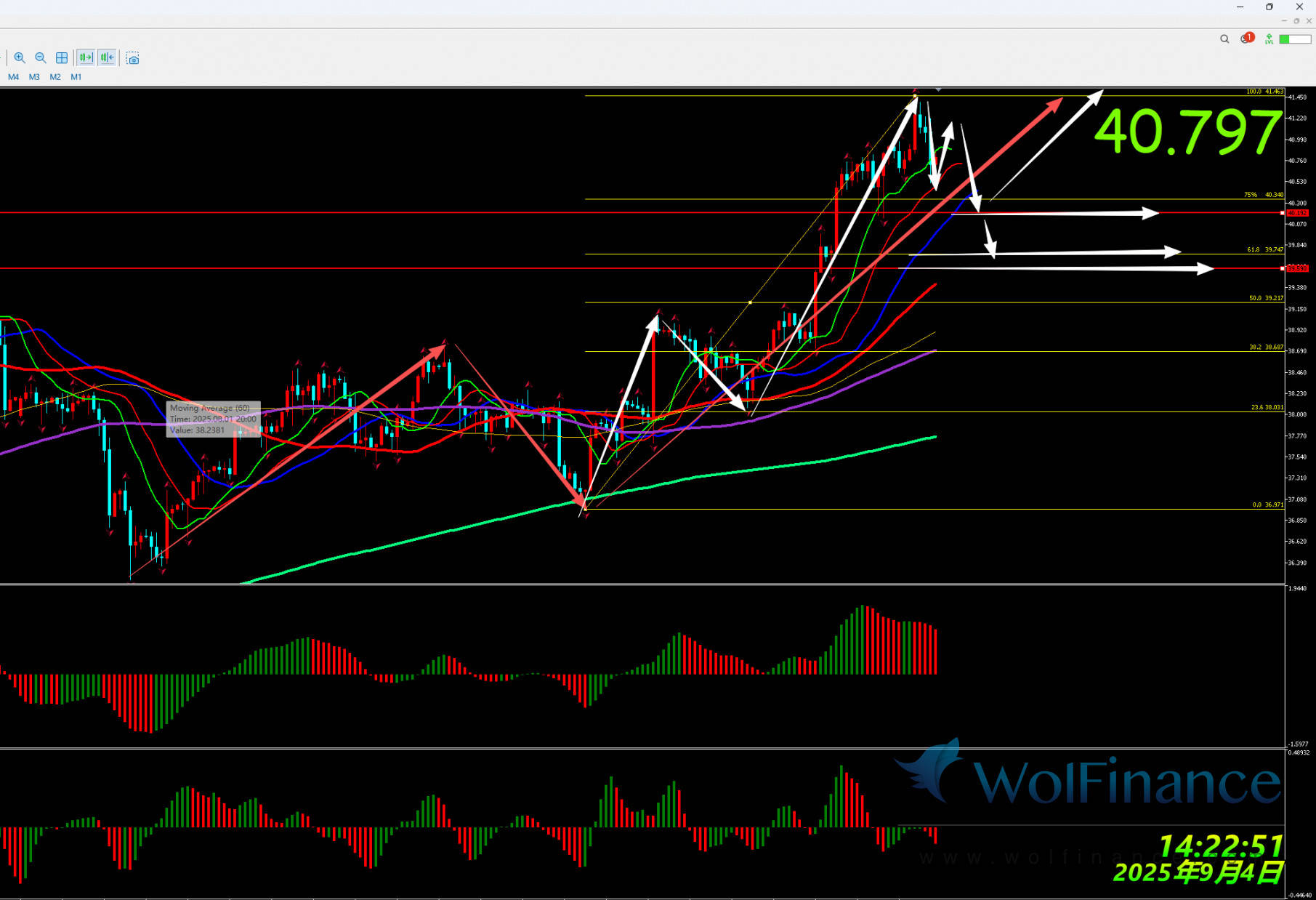
Market Overview - Silver opened at $40.843 on September 3, reached a high of $41.461, a low of $40.622, and closed at $41.1260. On September 4, silver opened at $41.270, peaked at $41.382, dipped to $40.957, and closed at $41.010 [1]. Key Economic Data - U.S. July JOLTs job openings were reported at 718.1 thousand, lower than the expected 737.8 thousand and previous 743.7 thousand [2]. - U.S. July factory orders decreased by 1.3%, slightly better than the expected decline of 1.4% and a previous drop of 4.8% [2]. - U.S. August ISM Manufacturing PMI was 48.7, below the expected 49 and previous 48 [2]. - U.S. August Consumer Confidence Index was reported at 97.4, exceeding the expected 96.2 and revised previous value of 98.7 [2]. - U.S. July Core PCE Price Index year-on-year was 2.9%, matching expectations and slightly above the previous 2.8% [2]. Federal Reserve Policies and Events - Federal Reserve officials expressed differing views on interest rate cuts, with some suggesting potential cuts depending on economic data [2]. - The Federal Reserve will hold a payment innovation meeting on October 21 to discuss stablecoins, AI, and tokenization [2]. Precious Metals Market Dynamics - The largest gold ETF, SPDR Gold Trust, saw a decrease in holdings by 6.3 tons, bringing the total to 984.26 tons [2]. - The largest silver ETF, iShares Silver Trust, reported a reduction of 85.08 tons in holdings, now totaling 15,281.4 tons [2]. Technical Analysis - The silver price is currently in an upward trend, with potential targets set at $41.03, $42.00, and $43.56 based on recent price movements [5]. - The analysis indicates that as long as silver does not fall below the 60-minute moving average, there is an expectation for continued upward movement [5]. Trading Strategies - Aggressive traders are advised to short between $40.90 and $41.30, while conservative traders may consider shorting between $42.80 and $43.16, with a stop loss of $0.35 [6]. - For long positions, aggressive traders may enter between $40.15 and $39.70, with strict stop losses, while conservative traders may look to enter between $39.70 and $39.50 [7].
财联社9月4日早间新闻精选
Xin Lang Cai Jing· 2025-09-04 00:20
Group 1 - The Ministry of Commerce has decided to apply the current anti-dumping tax rates on imports of non-dispersion single-mode optical fibers from the U.S. to related cutoff wavelength single-mode optical fibers starting September 4, 2025. The anti-dumping tax rates are as follows: Corning Inc. at 37.9%, OFS-Fitel LLC at 33.3%, and Draka Communications USA at 78.2%, with other U.S. companies also at 78.2% [1] - The Ministry of Finance and the People's Bank of China held a meeting to emphasize the collaboration between fiscal and monetary policies, aiming to ensure the smooth development of the bond market and the effective implementation of these policies [2] - FTSE Russell announced changes to the FTSE China 50 Index, effective after the market close on September 19, which includes the addition of companies such as BeiGene, Neway, WuXi AppTec, and Zhongji Xuchuang, while removing China National Nuclear Power, China Unicom, Guodian NARI, and Wanhua Chemical [3] Group 2 - Several paper manufacturers, including Nine Dragons Paper, Shanying International, Lee & Man Paper, and Wuzhou Special Paper, have implemented a dual strategy of price increases and production halts as the traditional peak season approaches [4] - Wenzhou has officially established an artificial intelligence bureau, marking the first such bureau in Zhejiang Province [5] - Zhongcheng Co. plans to issue shares to acquire 100% of Jiangsu Qingneng and raise matching funds, while Botek announced a contract for approximately €9.465 million for fully automated silicon photonic packaging equipment [6] Group 3 - Tianpu Co. has been suspended for review due to multiple instances of unusual stock trading since August 22, while Yuanjie Technology warned that its sales revenue in the data center market may be significantly impacted if market development does not meet expectations [7] - Dongxin Co. reported that Lishuan Technology has begun sample deliveries to some clients and is continuously optimizing its products [8] - A subsidiary of Aishida, Qianjiang Robotics, has secured an order for 1,888 intelligent welding robots from Honglu Steel Structure [9] Group 4 - U.S. stock indices closed mixed, with the Dow Jones down 0.05%, the S&P 500 up 0.51%, and the Nasdaq Composite up 1.02%. The Nasdaq Golden Dragon China Index fell 0.19% [10] - The Federal Reserve will hold a "Payment Innovation" conference on October 21 to discuss stablecoins, artificial intelligence, and tokenization [11] - A Goldman Sachs executive noted that investor sentiment has significantly improved, indicating further upside potential for the Chinese stock market [12] Group 5 - Apple is reportedly set to launch an AI search feature in Siri next year to compete with OpenAI, and has reached an agreement with Google to evaluate the GEMINI model for the new version of Siri [13] - OpenAI is said to have increased the scale of its second stock sale to $10.3 billion, raising over $4 billion, with a valuation reaching $500 billion [14] Group 6 - Reports indicate that OPEC+ is considering a new round of production increases, leading to a decline in international oil prices, with WTI crude oil futures for October closing at $63.97 per barrel, down 2.47%, and Brent crude for November at $67.60 per barrel, down 2.23% [15] - International gold prices continue to reach historical highs, with spot gold fluctuating around $3,560 per ounce [16]