
加息

Search documents
美联储下周或将“按兵不动”,经济学家预计:降息需等待鲍威尔“谢幕”
Hua Er Jie Jian Wen· 2026-01-21 13:35
强劲的经济增长动力与依然顽固的通胀数据,正在重塑市场对美联储货币政策路径的预期。根据最新调 查显示,美联储在下周的议息会议上或将维持利率不变,且本季度降息的可能性大幅降低,货币宽松窗 口或将推迟至美联储主席鲍威尔今年5月任期结束之后。 据路透1月16日至21日对100位经济学家进行的调查,所有受访者均预计美联储将在1月27日至28日的会 议上将基准利率维持在3.50%-3.75%的区间。更为关键的是,58%的受访经济学家目前预测整个第一季 度利率都将保持不变,这一预期较上月发生了显著转变,当时多数人曾预计3月至少会有一次降息。 虽然大多数经济学家仍预计今年晚些时候至少会有两次降息,但在短期路径上,强劲的经济基本面并不 支持立即宽松。调查显示,在第一季度之后的前景虽无绝对共识,但微弱多数(100人中的55人)受访 者预计,降息周期最快也要等到鲍威尔5月卸任美联储主席后才会重启。 降息窗口或随领导层更迭开启 鉴于当前的经济数据,部分分析师认为美联储甚至有理由考虑加息,但基准预测仍指向"维持现状"。 LSEG StarMine计算显示,野村证券的高级美国经济学家Jeremy Schwartz是去年预测最准确的分析师 ...
今日1月20日:金价冲到4600美元,2026年或重演15年规律,该买还是等?
Sou Hu Cai Jing· 2026-01-21 11:36
Core Viewpoint - The current surge in gold prices, reaching $4600 per ounce, is driven by central banks accumulating gold at an unprecedented rate, contrasting with the speculative behavior of retail investors seen in the past [1][3][5]. Group 1: Historical Context - In 2011, gold prices peaked at $1920 per ounce due to quantitative easing and economic uncertainty, leading to a rapid rise followed by a significant decline as the Federal Reserve raised interest rates [3][5]. - The current gold price increase is influenced by similar factors such as anticipated interest rate cuts and geopolitical tensions, but the driving force is now central banks rather than retail investors [5][6]. Group 2: Central Bank Activity - Central banks, including the People's Bank of China, have been consistently increasing their gold reserves, with China adding approximately 38 tons in December 2025, marking 14 consecutive months of accumulation [5][6]. - In the third quarter of 2025, global central banks purchased over 370 tons of gold, the highest recorded for that period, indicating a strategic long-term trend rather than a short-term reaction [5][6]. Group 3: Market Dynamics - The current market dynamics show a strong, sustained demand for gold driven by central banks, providing a "safety net" for gold prices, unlike the previous speculative-driven market [8]. - The relationship between gold prices and U.S. interest rates remains significant, with expectations of further rate cuts in 2026 potentially enhancing gold's attractiveness as a low-cost asset [8][9]. Group 4: Geopolitical and Economic Factors - Ongoing geopolitical conflicts, particularly in the Middle East, contribute to a persistent demand for gold as a safe-haven asset, appealing to both institutional and individual investors [9][11]. - Concerns about inflation and the volatility of commodity prices further solidify gold's position as a hedge against economic uncertainty [11]. Group 5: Investment Strategies - For individual investors, purchasing gold jewelry may not be the best investment strategy due to high premiums; instead, gold ETFs are recommended for their liquidity and lower costs [11][12]. - Investment in physical gold bars should focus on minimizing additional costs, avoiding high-priced collectible items, and ensuring proximity to market prices [12][13]. - Caution is advised against high-leverage gold futures and dubious online investment schemes, which pose significant risks [13][15]. Group 6: Long-term Perspective - Historical patterns indicate that many investors have lost money in gold due to poor timing and emotional trading; a more strategic, planned approach is essential for successful investment [16]. - Gold should be viewed as a stabilizing asset within a diversified portfolio, rather than a primary wealth-building tool, with recommended allocations not exceeding 30% of total assets [15][16].


汇丰:澳大利亚央行2月份加息将是痛苦的
Jin Rong Jie· 2026-01-20 23:59
汇丰首席经济学家Paul Bloxham表示,如果澳大利亚央行被迫在2月份上调隔夜拆款利率,那么这次加 息将是痛苦的。他表示,2月份加息不会是因为经济增长处于强劲上升期,而是因为在生产率低下和公 共支出强劲的情况下,该国经济正过早地遭遇其供给能力限制。缺乏供给侧改革意味着生产率增长已停 滞。他补充说,汇丰的基本预测是,澳大利亚央行在第三季度前不会加息。 ...
日元面临巨震?“高市交易”裹挟日本央行,周五或重现2022年“口头维稳后闪电干预”
Zhi Tong Cai Jing· 2026-01-20 07:48
Group 1 - The Bank of Japan is expected to maintain its policy rate at 0.75% during the upcoming meeting, which may not provide direct support for the yen [1] - The yen has depreciated approximately 7% against the dollar since early October, marking the largest decline among major currencies [2] - The market anticipates a 58% probability of the Bank of Japan raising interest rates in April, up from 38% in December [2] Group 2 - The upcoming press conference by Bank of Japan Governor Ueda will be closely monitored for any hawkish signals regarding the yen's weakness [3] - Economic indicators suggest that consumer inflation in Japan has exceeded the Bank of Japan's 2% target for four consecutive years, indicating rising inflationary pressures [4] - Prime Minister Kishi's fiscal measures may be too expansionary for an economy already struggling with inflation, potentially increasing living costs through currency fluctuations [5]
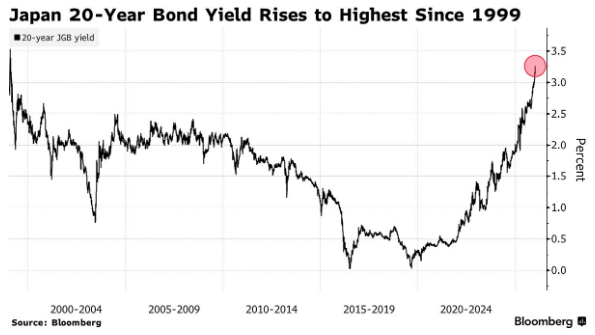
日本20年期国债收益率创1999年新高 今日拍卖面临财政忧虑大考
Zhi Tong Cai Jing· 2026-01-20 00:57
Group 1 - The Japanese government plans to introduce a temporary food sales tax reduction, which has caused market volatility and investor anxiety ahead of the upcoming 20-year government bond auction [1] - Bond prices fell sharply on Monday, leading to a significant rise in the yields of 20-year and longer-term bonds to multi-year highs [1] - Barclays Securities strategists highlighted the risk of expansionary fiscal policies appearing in party platforms ahead of the House of Councillors election, which could negatively impact bond values [1] Group 2 - Recent polls indicate Prime Minister Suga's approval rating remains high at 67%, with 52% of respondents believing the ruling coalition should win a majority [2] - The establishment of the "Center Reform Alliance" increases the risk of election dynamics, despite high approval ratings suggesting an easy victory for the Prime Minister [2] - On Monday, the yield on 20-year government bonds reached 3.265%, the highest level since 1999, with 30-year and 40-year bond yields also hitting record highs [2]
调查:澳大利亚消费者信心降至18个月低点
Xin Lang Cai Jing· 2026-01-20 00:24
Core Viewpoint - Australian consumer confidence has significantly declined, reaching its lowest level in 18 months, as consumers weigh the possibility of an interest rate hike next month [1] Group 1: Consumer Confidence - Australian consumer confidence dropped by 5.2 points to 79.3, marking the lowest level in 18 months [1] - The decline in consumer confidence is attributed to concerns over potential interest rate increases by the Reserve Bank of Australia [1] Group 2: Interest Rate Outlook - The probability of an interest rate hike by the Reserve Bank of Australia next month is currently at 30% [1] - If the upcoming fourth-quarter inflation data indicates a worsening inflation outlook, the likelihood of a rate hike may increase [1] - The Reserve Bank of Australia has signaled that it will not further lower interest rates and has noted that recent inflation rates have deviated from the target level of 2.5% and are on an upward trend [1] Group 3: Economic Forecast - ANZ Bank economist Sophia Angala stated that while the expectation is for the Reserve Bank of Australia to maintain interest rates unchanged until 2026, the risk of a rate hike in the first half of this year has increased [1]
分析:澳大利亚央行加息可能性或大于预期
Xin Lang Cai Jing· 2026-01-16 11:58
Core Viewpoint - The Reserve Bank of Australia (RBA) is facing pressure to potentially raise interest rates amid strong economic indicators, contrasting with the Federal Reserve's inclination to lower rates, which could impact global forex and fixed income markets [1][4]. Group 1: Economic Indicators - The RBA's upcoming meeting in February is set against a backdrop of concerning indicators for investors accustomed to loose monetary policy, including persistent price pressures, strong private sector demand, and a booming real estate market [1][5]. - Upcoming inflation data for the three months ending in December is crucial; if it shows trimmed mean inflation above the RBA's 2%-3% target, the RBA may have no choice but to act [1][5]. - Current household spending is robust, economic growth is steady, core and overall inflation are above targets, and unit labor costs have risen, although productivity growth remains weak [1][5]. Group 2: Interest Rate Predictions - RBA Governor Michele Bullock's recommendations may focus on actions to mitigate inflation risks, with expectations that the RBA will raise rates in February and again in May, reflecting a historical pattern of consecutive rate changes [2][6]. - Some economists predict that if CPI momentum slows, the RBA may pause after a February hike but could raise rates again later in the year [2][6]. - There is a consensus that Australia is not on the verge of an aggressive tightening cycle, as the RBA has been cautious in its rate adjustments compared to other central banks [2][6]. Group 3: Currency and Market Reactions - The potential for the RBA to maintain or raise rates while the Federal Reserve lowers them could widen the interest rate differential favoring Australia, potentially leading to an appreciation of the Australian dollar [3][7]. - The Australian dollar is nearing its highest level since October 2024, trading at 0.6705 USD [3][7].
日元干预可能不会在日本央行会议前进行
Sou Hu Cai Jing· 2026-01-16 10:12
Core Viewpoint - The report by Derek Halpenny from MUFG indicates that prior to the Bank of Japan's policy decision on January 23, Japanese authorities may be hesitant to follow through on their threats to intervene in the yen's depreciation [1] Group 1: Bank of Japan's Stance - The Bank of Japan's Governor, Kazuo Ueda, is likely to maintain a cautious stance regarding further interest rate hikes [1] - This cautious approach could be a factor that leads to the potential failure of intervention measures aimed at supporting the yen [1] Group 2: External Influences - Other influencing factors include Prime Minister Fumio Kishida's plans for an early election and indications from Federal Reserve officials suggesting a pause in interest rate cuts [1] - A more explicit opposition to yen depreciation from the Bank of Japan, along with hints of earlier interest rate hikes, could enhance the success of intervention measures [1] Group 3: Market Reaction - The dollar fell by 0.3% to 158.10 yen [1]
高市交易发酵日元日债同步承压
Jin Tou Wang· 2026-01-16 02:46
Group 1 - The Japanese yen has been depreciating significantly since the beginning of 2026, with the USD/JPY exchange rate reaching 159.45, the lowest in 18 months, due to political uncertainty and policy contradictions [1] - Prime Minister Fumio Kishida's announcement of a snap election on January 23 has raised concerns about continued aggressive fiscal expansion, contributing to market fears and speculation that the yen could fall to 165 [1][2] - The Bank of Japan's recent interest rate hike to 0.75% has failed to stabilize the yen, as the interest rate differential with the US remains over 2.75%, leading to increased pressure on the yen [2] Group 2 - The depreciation of the yen has led to rising import costs for energy and food, exacerbating inflation and putting pressure on small and medium-sized enterprises [2] - The upcoming election results are expected to influence the yen's future trajectory, with predictions that a victory for the ruling party could further weaken the yen, while a loss might trigger a safe-haven appreciation [3] - Official interventions in the currency market have only had short-term effects, highlighting the challenge for Japanese authorities to balance exchange rates, inflation, and fiscal sustainability [3]
澳元走势深 澳洲联储政等待方向催化
Jin Tou Wang· 2026-01-15 13:18
Core Viewpoint - The Australian dollar (AUD) is currently in a phase of oscillation against major currencies, influenced by commodity prices, the Reserve Bank of Australia's (RBA) policy direction, and expectations of Chinese demand [1] Group 1: Economic Factors - The Australian economy is experiencing a moderate recovery with stable private demand and a robust labor market, but growth is slowing, the housing market is cooling, and inflation remains above target despite a decline [1] - As a resource-exporting country, the AUD's commodity currency nature ties it closely to core commodity prices, with Chinese demand expectations and global commodity fluctuations directly impacting exports [1] Group 2: Monetary Policy and Market Sentiment - The core driver for the AUD is the divergence in RBA policy, with the governor signaling a potential resumption of interest rate hikes due to concerns over uncontrolled inflation after several rounds of rate cuts [1] - Market speculation regarding the RBA's policy direction in the first half of the year is intense, with uncertainty being a key variable affecting the AUD [1] Group 3: Technical Analysis - The AUD is currently in a balanced oscillation range, with technical signals being ambiguous; strong support is formed by moving averages and previous lower bounds, while resistance is created by prior highs and psychological levels [2] - Indicators show a neutral position with no overbought or oversold conditions, and the overall trend is still developing, with potential for upward movement if resistance is broken [2] Group 4: Future Outlook - Institutions predict that the AUD will primarily oscillate in 2026, closely tied to RBA policy, commodity trends, and Chinese demand [2] - Key upcoming data to watch includes U.S. data affecting the dollar and Australian quarterly inflation data, which will directly influence policy expectations and provide direction for the AUD [2]