
汽车出口

Search documents
自主三强年末冲刺:比亚迪继续领跑、吉利增速最快、奇瑞出口最多
Guan Cha Zhe Wang· 2025-12-03 02:38
Core Insights - BYD remains the absolute leader in China's automotive sales, but its growth rate has slowed compared to previous years [1][3] - Geely has achieved a new high in growth driven by new energy vehicles [1][3] - Chery maintains its position as the domestic passenger car brand with the highest overseas exports [1][3] Sales Performance - In November, BYD sold 480,200 vehicles, a year-on-year decrease of 5.25%; Geely sold 310,400 vehicles, a year-on-year increase of 24%; Chery sold 255,800 vehicles, a year-on-year decrease of 2% [1][3] - For the first 11 months, BYD's cumulative sales reached 4.182 million vehicles, a year-on-year increase of 11.3%; Geely's cumulative sales were 2.7878 million vehicles, a year-on-year increase of 42%; Chery's cumulative sales reached 2.3991 million vehicles, a year-on-year increase of 11% [1][3] Year-End Sales Targets - BYD's initial sales target for the year was 5.5 million vehicles, later adjusted to 4.6 million; it needs to sell 400,000 vehicles in December to meet this target [3] - Geely's initial target was 2.71 million vehicles, raised to 3 million; it only needs to maintain November's sales level to exceed this target [3] - Chery's target was to achieve a growth rate exceeding the industry average of 10-20%, with a projected sales target of 3.18 million to 3.45 million vehicles; achieving this seems unlikely based on current performance [3] New Energy Vehicle Sales - BYD continues to lead globally in new energy vehicle sales, with all its vehicles being new energy types; Geely's November new energy vehicle sales reached 187,800, a year-on-year increase of 53.36%; Chery's new energy vehicle sales were 110,000, a year-on-year increase of 50% [5] - For the first 11 months, Geely's cumulative new energy vehicle sales were 1.5335 million, a year-on-year increase of 97.35%; Chery's cumulative new energy vehicle sales were 814,700, a year-on-year increase of 69.4% [5] Export Performance - In November, BYD exported 131,930 vehicles, with a cumulative export of 917,000 vehicles for the first 11 months, doubling from the previous year; Chery exported 131,850 vehicles in November, with a cumulative export of 1.1996 million vehicles, a year-on-year increase of 14.7%; Geely exported 42,100 vehicles, with a cumulative export of 379,800 vehicles [5][7] - BYD's export volume accounted for approximately 22% of its total sales; Chery's export volume exceeded 50% of its total sales; Geely's export volume accounted for less than 15% [7] Strategic Insights - BYD's complete transition to new energy vehicles gives it a significant market advantage, although its growth has slowed due to high previous year bases; Geely and Chery are accelerating their new product launches and catching up in sales, particularly in new energy vehicles [7] - Chery leads in both total export volume and export percentage, while BYD is expanding its overseas market significantly faster than its domestic market, indicating a shift in its global strategy; Geely is consolidating its brand and has not significantly expanded its overseas business [7]




前11个月中国品牌电动汽车销量领跑以色列市场
Xin Hua Cai Jing· 2025-12-03 00:54
同期,包括电动汽车和燃油车在内的中国汽车在以色列的总销量为96208辆,继续位居所有出口国之 首,韩国汽车和日本汽车分列第二和第三位。 近年来,随着中国车企不断提升在智能化、续航能力和性价比等方面的竞争力,中国品牌汽车在以色列 市场的份额持续扩大。 新华财经耶路撒冷12月2日电(记者路一凡 王卓伦)以色列汽车进口商协会2日发布的数据显示,今年 前11个月,中国品牌电动汽车销量领跑以色列市场,中国依然是以色列最大汽车供应国。 数据显示,今年1月至11月,中国汽车品牌在以色列共售出44752辆电动汽车。比亚迪、奇瑞和小鹏等品 牌位居电动汽车销量榜前列。 数据显示,今年1月至11月,中国汽车品牌在以色列共售出44752辆电动汽车,中国品牌电动汽车销量领 跑以色列市场。 ...

销量、营收、核心市场份额占比不断提升 海外市场成新增长极
Huan Qiu Wang· 2025-12-02 07:04
Core Insights - The Chinese automotive industry is experiencing a significant shift towards overseas markets, with exports growing faster than domestic sales, indicating a transition from incremental competition to stock competition [1][4][12] - By 2030, it is projected that Chinese automotive brands will achieve nearly 10 million units in overseas sales, highlighting the increasing importance of international markets for growth [1][13] Export Growth - In October, China exported 666,000 vehicles, a month-on-month increase of 2.1% and a year-on-year increase of 22.9%. From January to October, total exports reached 5.616 million units, up 15.7% year-on-year [1] - Chery's overseas sales reached 1.06 million units from January to October, accounting for 46% of its total sales, maintaining a steady growth trend [1] - BYD's exports for the same period were 780,000 units, a significant increase of 130%, with overseas sales making up 21% of total sales [2] - Geely's overseas sales approached 300,000 units, with a remarkable 214% increase in exports of new energy vehicles [3] Financial Performance - Chery's revenue for the first three quarters of 2025 was 214.83 billion yuan, a 17.9% increase year-on-year, with overseas sales contributing significantly to this growth [6] - BYD's overseas revenue share rose from 28% in 2024 to 36.5% in the third quarter of 2025, with a net profit margin of 4.2% surpassing domestic margins [7] - Great Wall Motors reported overseas revenue of 80.3 billion yuan in 2024, accounting for 39.69% of total revenue, indicating the growing importance of international markets [8] Market Share and Competitive Position - By 2025, China's automotive global market share is expected to exceed 38%, with significant growth in Europe, where Chinese brands achieved a record 7.4% market share in September 2025 [10] - In Southeast Asia, particularly Thailand, Chinese brands captured 34.3% of the market share in the first three quarters of 2025, leading the segment [11] - Chinese brands are also making significant inroads in Brazil, with market share increasing from 6.8% in 2024 to 9.1% in 2025, particularly in the new energy vehicle segment [11] Strategic Initiatives - Chinese automotive companies are increasingly establishing local production facilities overseas, allowing them to better meet local market demands and navigate trade barriers [5][9] - The shift from product export to a comprehensive ecosystem approach is evident, with companies focusing on local production, service, and supply chain integration [9][14] - The emphasis on localization and understanding local consumer preferences is crucial for success in international markets, as highlighted by the need for tailored products and services [12][15]


2030年将大变天!“全球十大车企,中国占半壁江山”
Guan Cha Zhe Wang· 2025-11-28 02:55
Core Viewpoint - Chinese automakers are expected to rise in the global automotive rankings over the next five years, potentially placing five companies among the top ten by 2030, driven by advancements in electric vehicle (EV) technology and production capacity [1][4]. Group 1: Market Position and Predictions - By 2030, significant changes in the automotive industry are anticipated, with indications of a major transformation already underway [1]. - BYD and Geely are currently ranked fifth and tenth globally in terms of vehicle deliveries, with BYD delivering 4.27 million vehicles and Geely 3.34 million in the previous year [3]. - Emerging EV manufacturers like Xiaomi, Xpeng, and Leap Motor have seen substantial sales growth, attracting consumers away from traditional brands like Tesla [1][4]. Group 2: Production and Export Trends - China's automotive production accounts for over 30% of the global total, with three out of every five electric vehicles sold globally purchased by Chinese consumers [4]. - Over 70% of the batteries used in global electric vehicles are produced by Chinese companies, with CATL and BYD leading in production capacity [4]. - In the first ten months of 2025, China's automotive exports reached 5.62 million units, marking a year-on-year increase of 15.7% [4]. Group 3: Future Growth and Challenges - Analysts suggest that while the growth rate of Chinese automotive exports may slow in the coming years, an overall increase is still expected [4]. - The profitability of Chinese EV manufacturers in overseas markets can be significantly higher, with profit margins reaching 20,000 RMB per vehicle, four times that of the domestic market [5]. - The automotive industry is projected to achieve an annual sales volume of 40 million vehicles during the "14th Five-Year Plan" period, with substantial growth potential [5].
乘联分会:11月1-23日全国乘用车市场零售138.4万辆 同比下降11%
Zhi Tong Cai Jing· 2025-11-26 10:13
Group 1: Retail Sales Performance - From November 1 to 23, the national retail sales of passenger cars reached 1.384 million units, a year-on-year decrease of 11% compared to the same period last year, and a 2% decline compared to the previous month. Cumulatively, retail sales for the year reached 20.64 million units, a year-on-year increase of 6% [1][4] - The average daily retail sales for the first week of November were 46,000 units, down 19% year-on-year and down 4% from the previous month [2] - The average daily retail sales for the second week of November were 67,000 units, down 9% year-on-year and down 7% from the previous month [3] Group 2: Wholesale Sales Performance - From November 1 to 23, the wholesale volume of passenger cars reached 1.69 million units, a year-on-year decrease of 8%, but an 8% increase compared to the previous month. Cumulatively, wholesale sales for the year reached 25.464 million units, a year-on-year increase of 11% [1][7] - The average daily wholesale volume for the first week of November was 52,000 units, down 22% year-on-year but up 48% from the previous month [5] - The average daily wholesale volume for the second week of November was 79,000 units, down 5% year-on-year and down 4% from the previous month [6] Group 3: New Energy Vehicle Market - From November 1 to 23, the retail sales of new energy vehicles reached 849,000 units, a year-on-year increase of 3% and an 8% increase compared to the previous month. Cumulatively, retail sales for the year reached 10.998 million units, a year-on-year increase of 20% [1] - The wholesale volume of new energy vehicles reached 995,000 units, a year-on-year increase of 4% and a 13% increase compared to the previous month. Cumulatively, wholesale sales for the year reached 13.051 million units, a year-on-year increase of 27% [1] Group 4: Inventory and Market Outlook - As of the end of October 2025, the inventory of passenger cars in the industry was 3.41 million units, an increase of 130,000 units from the previous month and an increase of 440,000 units from October 2024 [8] - The current inventory level supports an estimated sales period of 44 days, which is relatively moderate compared to previous years [8] - The market outlook for November shows a 64% optimism level among manufacturers, indicating a cautious but positive sentiment towards future sales [8] Group 5: Battery Market Analysis - In October, the total production of power and other batteries reached 171 GWh, a year-on-year increase of 49%. Cumulatively, the production from January to October was 1,293 GWh, a year-on-year increase of 45% [9] - The market for lithium batteries is characterized by strong competition, with CATL and BYD being the dominant players. The market share of lithium iron phosphate batteries has seen significant growth [11] Group 6: International Market Dynamics - In October 2025, the Russian automotive market saw sales of 183,000 units, a year-on-year decrease of 8% but a month-on-month increase of 35%. Cumulatively, sales from January to October reached 1.19 million units, a year-on-year decrease of 23% [12] - Chinese brands have significantly increased their market share in Russia, with local sales surpassing export volumes, indicating a successful strategy in navigating complex international relations [12]


【周度分析】车市扫描(2025年11月17日-11月23日)
乘联分会· 2025-11-26 08:39
Group 1: Market Overview - From November 1 to 23, the national retail sales of passenger cars reached 1.384 million units, a year-on-year decrease of 11% compared to the same period last year, and a 2% decrease compared to the previous month. Cumulatively, retail sales for the year reached 20.64 million units, a year-on-year increase of 6% [2][6] - During the same period, wholesale sales of passenger cars by manufacturers totaled 1.69 million units, a year-on-year decrease of 8% but an 8% increase compared to the previous month. Year-to-date wholesale sales reached 25.464 million units, a year-on-year increase of 11% [2][10] Group 2: New Energy Vehicles - Retail sales of new energy vehicles from November 1 to 23 reached 849,000 units, a year-on-year increase of 3% and an 8% increase compared to the previous month. Year-to-date retail sales reached 10.998 million units, a year-on-year increase of 20% [2][6] - Wholesale sales of new energy vehicles during the same period totaled 995,000 units, a year-on-year increase of 4% and a 13% increase compared to the previous month. Year-to-date wholesale sales reached 13.051 million units, a year-on-year increase of 27% [2][10] Group 3: Market Trends and Consumer Behavior - The retail performance in early November was weak due to last year's strong market performance, leading to lower growth rates this year. However, compared to the same period in 2023, there was still a 14% increase in sales [6][7] - Consumer sentiment remains relatively stable, but the tightening of trade-in and scrapping subsidy policies has led to a cautious market outlook, with many consumers adopting a wait-and-see attitude [6][7] Group 4: Inventory and Production Analysis - As of the end of October 2025, the inventory of passenger cars in the industry was 3.41 million units, an increase of 130,000 units from the previous month and 440,000 units from October 2024. This indicates a seasonal inventory buildup [11] - The production of new energy vehicles saw fluctuations, with inventory levels rising from 620,000 units in September to 730,000 units in October, although this is still below peak levels [11][12] Group 5: Battery Market Insights - In October, the production of power and other batteries reached 171 GWh, a year-on-year increase of 49%. Cumulatively, from January to October, the production reached 1,293 GWh, a year-on-year increase of 45% [12] - The market for lithium batteries is characterized by strong competition, with CATL and BYD holding significant market shares. The share of lithium iron phosphate batteries has surpassed that of BYD since 2024 [13]

崔东树:10月俄罗斯汽车销量达到18.3万辆 中国自主车企份额回升至60%
智通财经网· 2025-11-25 08:59
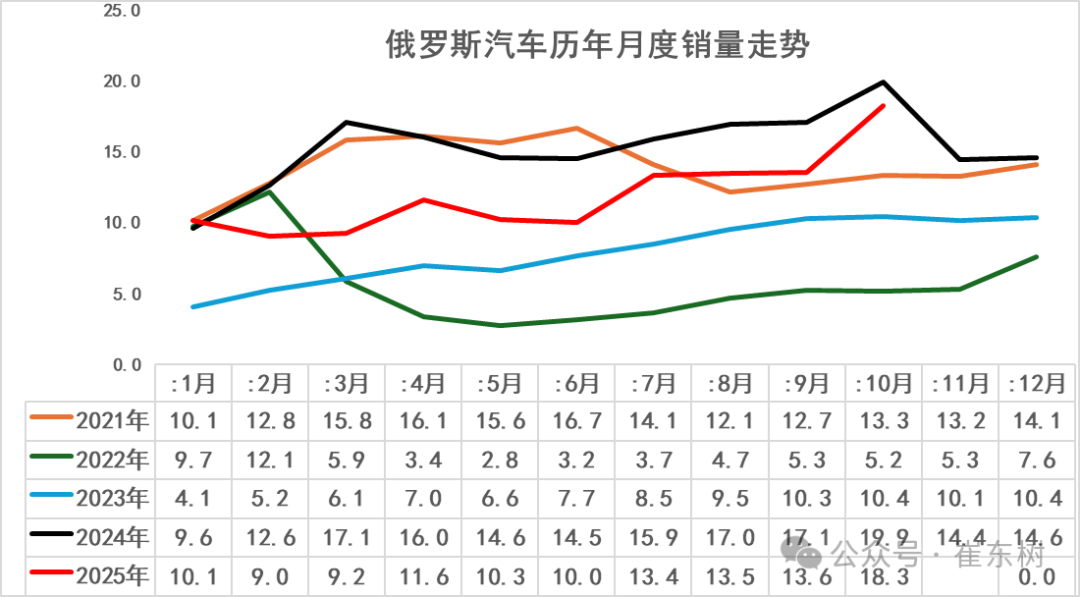
智通财经APP获悉,乘联会秘书长崔东树发文称,2025年10月俄罗斯汽车销量达到18.3万辆的水平,同比下降8%,环比9月增35%。1-10月俄罗斯车市的 累计销量119万辆,同比下降23%。2023年中国出口俄罗斯100万辆车,自主的俄罗斯市场销量48万辆,销量是中国自主出口量的48%。2024年中国出口俄 罗斯128万辆车,自主的俄罗斯市场销量107万辆,自主的俄罗斯市场销量是中国自主出口量的84%。2025年1-10月中国出口俄罗斯45万辆车,自主品牌俄 罗斯销量68.5万辆,当地销量是中国出口的152%,终于实现了大幅去库存的走势。 面对俄罗斯的复杂环境,自主品牌多生孩子好打架的战略意义重大。自主品牌的整车官方车口,平行出口、绕道出口、本地化建厂、合资组装等各种模式 齐上阵,大量的品牌群狼作战,实现了很好的效果。规范出口对俄罗斯是不适合的,尤其我们面对是俄罗斯的针对性干扰措施,一定要在复杂的国际关系 下发挥群众优势,实现创新式发展。 中国车企在在俄罗斯加速本土化生产与供应链重构,多项举措改善状态。首先是针对俄罗斯进口关税阶梯式上调深化KD组装模式,建立区域生产基地。 通过本地化生产规避关税并缩短交付周 ...

今年中国汽车出口量创下历年新高,有望再度超过日本
Di Yi Cai Jing· 2025-11-18 11:41
Group 1 - China's automobile exports reached 5.616 million units in the first ten months of this year, a year-on-year increase of 15.7%, with export value at 798.39 billion yuan, up 14.3% [2] - New energy vehicles (NEVs) have significantly contributed to this growth, with over 2 million units exported, marking a 90.4% increase year-on-year [2] - In the first nine months, China's automobile exports surpassed Japan's by 1.6 times, with 4.95 million units compared to Japan's 3.06 million units [2] Group 2 - China has become the world's largest automobile exporter, surpassing Japan for two consecutive years, with expectations to maintain this lead through 2025 [3] - In Southeast Asia, Chinese NEVs are gaining market share, with significant sales growth in countries like Thailand, where NEV sales reached 9,107 units in September, a 99% increase [3] - In Europe, Chinese automobile registrations exceeded 430,000 units in the first eight months, a 74% increase, with brands like BYD and Chery gaining traction [4] Group 3 - Chinese brands captured 65% of the retail market share in the domestic market in the first ten months, a 5.5 percentage point increase year-on-year [4] - Japanese automakers are facing challenges due to a 25% tariff on imported vehicles imposed by the U.S. government, leading to significant profit declines among major Japanese car manufacturers [5] - Nissan reported the highest net loss of 221.9 billion yen (approximately 10.17 billion yuan) in the first half of the 2025 fiscal year [5]
今年中国汽车出口量创下历年新高,有望再度超过日本
第一财经· 2025-11-18 11:35
Core Viewpoint - China's automobile exports have reached a new peak, with significant growth driven by the export of new energy vehicles (NEVs) [3][4]. Group 1: Export Performance - In the first ten months of 2025, China exported 5.616 million vehicles, a year-on-year increase of 15.7%, with export value reaching 798.39 billion yuan, up 14.3% [3]. - NEVs have shown remarkable performance, with cumulative exports exceeding 2 million units, marking a 90.4% year-on-year increase [3]. - China's automobile export volume has consistently surpassed Japan's, with a current export volume 1.6 times that of Japan [3][4]. Group 2: Market Dynamics - In Southeast Asia, Chinese NEVs are gaining market share, with companies like BYD and GAC establishing factories in key markets such as Thailand and Indonesia [4]. - In September, the sales of pure electric vehicles (BEVs) in Thailand reached 9,107 units, a 99% increase year-on-year, surpassing the sales of fuel vehicles for the first time [4]. - In Europe, the registration of Chinese vehicles has exceeded 430,000 units in the first eight months, a 74% increase year-on-year, with BYD surpassing Suzuki in sales [5]. Group 3: Competitive Landscape - Chinese brands have captured 65% of the retail market share in the domestic market, an increase of 5.5 percentage points year-on-year [5]. - Japanese automakers are facing challenges due to a 25% tariff on imported vehicles imposed by the U.S. government, leading to a significant decline in profits across major Japanese car manufacturers [6].

中国汽车出口量为日本1.6倍 大幅甩开昔日霸主
Di Yi Cai Jing· 2025-11-18 10:39
Group 1 - China's automobile exports reached 5.616 million units in the first ten months of this year, a year-on-year increase of 15.7%, with export value at 798.39 billion yuan, up 14.3% [1] - New energy vehicles (NEVs) have significantly contributed to this growth, with over 2 million units exported, marking a 90.4% increase year-on-year [1] - In the first nine months, China's automobile exports were 4.95 million units, surpassing Japan's 3.06 million units, making China's exports 1.6 times that of Japan [1] Group 2 - China has become the world's largest automobile exporter, surpassing Japan for two consecutive years, with expectations to maintain this lead through 2025 [2] - In Southeast Asia, Chinese NEVs are gaining market share, with significant sales growth in countries like Thailand, where NEV sales reached 9,107 units in September, a 99% increase year-on-year [2] - In Europe, Chinese automobile registrations exceeded 430,000 units in the first eight months, a 74% increase, with companies like BYD and Chery establishing local factories [3] Group 3 - Chinese brands captured a retail market share of 65% in the domestic market in the first ten months, an increase of 5.5 percentage points year-on-year [3] - Japanese automakers are facing challenges due to a 25% tariff on imported cars imposed by the U.S. government, leading to significant profit declines across major Japanese car manufacturers [4] - Nissan reported the highest net loss of 221.9 billion yen (approximately 10.17 billion yuan) in the first half of the 2025 fiscal year [4]