
科创板

Search documents
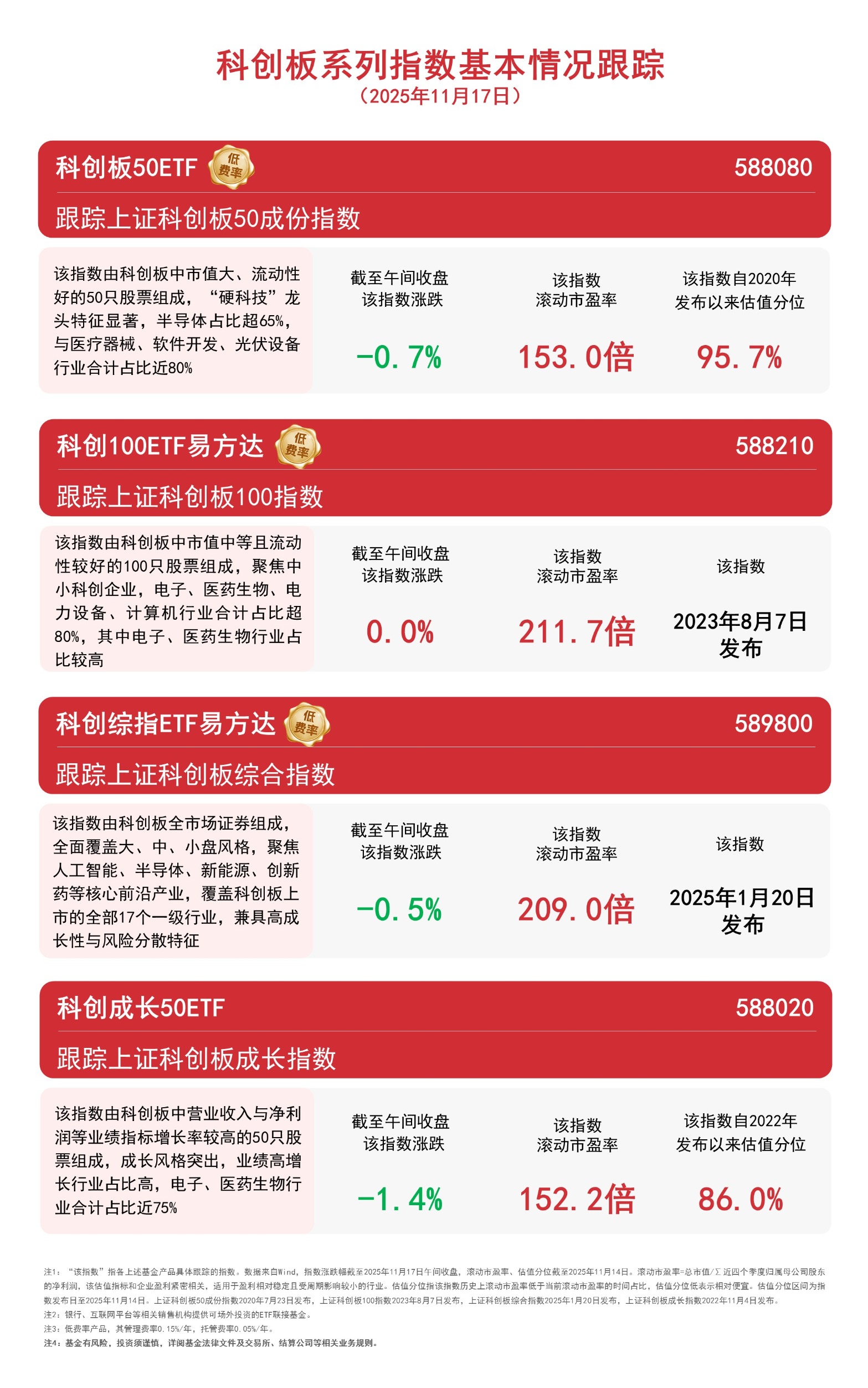
科创板系列指数早盘震荡,关注科创板50ETF (588080)、科创综指ETF易方达(589800)等产品布局机会
Mei Ri Jing Ji Xin Wen· 2025-11-17 05:26
Group 1 - The Sci-Tech Innovation Board (STAR Market) features several ETFs that track different indices, focusing on companies with significant market capitalization and liquidity in the technology sector [2][3][4] - The STAR 50 ETF tracks the STAR 50 Index, which consists of 50 stocks characterized by strong "hard technology" leadership, with over 65% of its composition in the semiconductor sector, and nearly 80% combined with medical devices, software development, and photovoltaic equipment [2] - The STAR 100 ETF follows the STAR 100 Index, which includes 100 stocks with medium market capitalization and good liquidity, focusing on small and medium-sized innovative enterprises, with over 80% of its composition in electronics, biomedicine, power equipment, and computer industries [3] Group 2 - The STAR Comprehensive Index ETF tracks the overall STAR Market, encompassing all securities in the market, reflecting a broad spectrum of small and medium-sized companies [4]

培育一批世界级“明星”科技企业 科创板重任在肩未来可期
证券时报· 2025-11-14 00:19
Group 1: Core Views - The Shanghai Stock Exchange (SSE) aims to deepen capital market reforms to foster a more inclusive and innovative environment for technology companies, particularly in the STAR Market [2][4] - The STAR Market has allowed unprofitable and special equity structure companies to list, creating a dedicated financing channel for tech enterprises since its establishment in 2019 [2][4] - The SSE has implemented various policies to enhance the STAR Market, including the "1+6" policy combination and the expansion of listing standards to cover cutting-edge fields like artificial intelligence and commercial aerospace [2][4] Group 2: Industry Insights - The Chinese biopharmaceutical sector has seen significant growth, with 115 biopharmaceutical companies listed on the STAR Market, making it the third-largest biopharmaceutical listing venue globally [2][4] - Industry leaders believe that for Chinese innovative drug companies to reach a world-class level, they need to achieve sales of $1-2 billion in overseas markets [3][4] - Mergers and acquisitions (M&A) are viewed as essential for Chinese companies to internationalize, with a focus on developing core competencies and competitive advantages [3][4] Group 3: Internationalization and Market Dynamics - The Business Development (BD) activities in China's biopharmaceutical industry have rapidly increased, accounting for 38% of global BD transactions this year [4] - Companies are encouraged to license out their products to maximize the value of innovative drugs, with a strong emphasis on international market presence [4][5] - The SSE is committed to providing a clearer and more stable investment environment for international investors, facilitating smoother capital allocation for tech enterprises [4][5]

科创板前三季度592家公司营收合计破1.1万亿、研发投入达1197亿,科创50继续发挥压舱石作用,全面领跑A股
Xin Lang Zheng Quan· 2025-11-13 12:09
Core Insights - The overall performance of the Sci-Tech Innovation Board shows a strong recovery, with a significant year-on-year net profit growth of 75% in Q3 2025, indicating a positive trend for the sector [1] Financial Performance - In the first three quarters, companies on the Sci-Tech Innovation Board achieved total operating revenue of 1,105.01 billion yuan, representing a year-on-year growth of 7.9% [1] - The net profit for the same period reached 49.27 billion yuan, with a year-on-year increase of 8.9% [1] - After excluding four leading photovoltaic companies, the revenue and net profit growth rates further expanded to 14.6% and 30.6%, respectively [1] Growth Dynamics - Over 70% of the companies reported revenue growth, and nearly 60% experienced net profit growth [1] - A total of 158 companies saw net profit increases exceeding 50%, while 46 companies successfully turned losses into profits [1] - The Sci-Tech 50 Index component companies continued to play a stabilizing role, accounting for 46% of revenue and 50% of net profit [1] - The Sci-Tech 100 Index component companies reported revenue and net profit growth of 12% and 134%, respectively, showcasing high elasticity [1] R&D Investment - The total R&D investment for the first three quarters reached 119.75 billion yuan, which is 2.4 times the net profit [1] - The median R&D intensity stood at 12.4%, maintaining a leading position in the A-share market [1]
科创板活跃股榜单:68股换手率超5%
Zheng Quan Shi Bao Wang· 2025-11-13 09:24
Core Points - The Sci-Tech Innovation Board (STAR Market) index rose by 1.44%, closing at 1399.29 points, with a total trading volume of 4.357 billion shares and a turnover of 189.525 billion yuan [1] - Among the tradable stocks on the STAR Market, 419 stocks closed higher, with 11 stocks experiencing a rise of over 10%, including Kangpeng Technology, Haibo Sichuang, and Huasheng Lithium, which hit the daily limit [1] - The turnover rate for STAR Market stocks showed that 3 stocks had a turnover rate exceeding 20%, while 21 stocks had a turnover rate between 10% and 20% [1] Trading Performance - The highest turnover rate was recorded by Haibo Sichuang at 22.07%, with a closing price increase of 20.00% and a trading volume of 2.869 billion yuan [1][3] - Other notable stocks with high turnover rates included Saifen Technology (21.43% turnover rate, 10.92% increase) and Kangpeng Technology (20.48% turnover rate, 20.02% increase) [3][4] - The stocks with the largest net inflow of funds included Haibo Sichuang (281.31 million yuan), Changguang Huaxin (166.1 million yuan), and Huasheng Lithium (88.835 million yuan) [2] Sector Analysis - In terms of industry distribution, the electronics sector had the most stocks with a turnover rate exceeding 5%, totaling 20 stocks, followed by power equipment and pharmaceutical biotechnology with 18 and 9 stocks, respectively [2] - The stocks with significant net outflows included Artis (454 million yuan), Yuanjie Technology (185 million yuan), and Baiwei Storage (168 million yuan) [2] Recent Trends - As of November 12, the stocks with the largest increase in financing balance over the past five days included Purun Co. (271 million yuan), Yuanjie Technology (252 million yuan), and Shenkong Co. (223 million yuan) [2] - Conversely, the stocks with the largest decrease in financing balance included Foxit Software (192 million yuan), New Xiangwei (184 million yuan), and Jucheng Co. (117 million yuan) [2]

一财主播说 | 上交所:科创板有望涌现一批世界级明星科技企业
Xin Lang Cai Jing· 2025-11-13 06:50
Core Viewpoint - The Shanghai Stock Exchange (SSE) aims to cultivate a batch of world-class technology companies through the STAR Market, which serves as a testing ground for capital market innovations [1] Group 1: STAR Market Developments - The STAR Market has already seen notable companies such as Semiconductor Manufacturing International Corporation (SMIC), BeiGene, and Cambricon Technologies, indicating its potential to attract leading tech firms [1] - The STAR Market allows unprofitable companies, red-chip enterprises, and those with special equity structures to list, creating a dedicated financing channel for innovative tech companies [1] Group 2: Policy Innovations - The SSE has continuously improved its institutional offerings, introducing the "1+6" policy combination for issuance and expanding the fifth set of listing standards to include cutting-edge fields like artificial intelligence and commercial aerospace [1] - Regulatory reforms, known as the "Eight Articles of Science," have been implemented to optimize the merger and acquisition mechanisms within the STAR Market [1]
上交所副总经理傅浩:未来科创板有望涌现一批世界级的“明星”科技企业
Zheng Quan Ri Bao Wang· 2025-11-13 04:12
监管端,实施"科八条"改革,优化并购重组机制,2024年9月份以来,科创板新增重大资产重组交易145 单,创新性、代表性案例接连涌现;同时,科创板率先推出第二类限制性股票制度,累计800余单股权 激励计划覆盖24万研发人员。 傅浩表示,上交所坚信在持续创新、公开透明的生态环境引导下,未来科创板有望涌现一批世界级 的"明星"科技企业,正如科创板的英文名STAR=Market所寄予的美好愿景一样,拥有更多的rising star companies。 本报讯(记者毛艺融)11月13日,上海证券交易所副总经理傅浩在上海证券交易所国际投资者大会上表 示,近两年来,上交所不断完善制度供给。 发行端,推出科创板"1+6"政策组合,并将第五套上市标准进一步扩围至人工智能、商业航天等前沿领 域,GPU龙头摩尔线程从受理到过会仅用88天,彰显制度适配性。 ...
上海证券交易所副总经理傅浩:热忱欢迎更多外资机构和长期资本投资科创板
Zheng Quan Ri Bao Wang· 2025-11-13 03:09
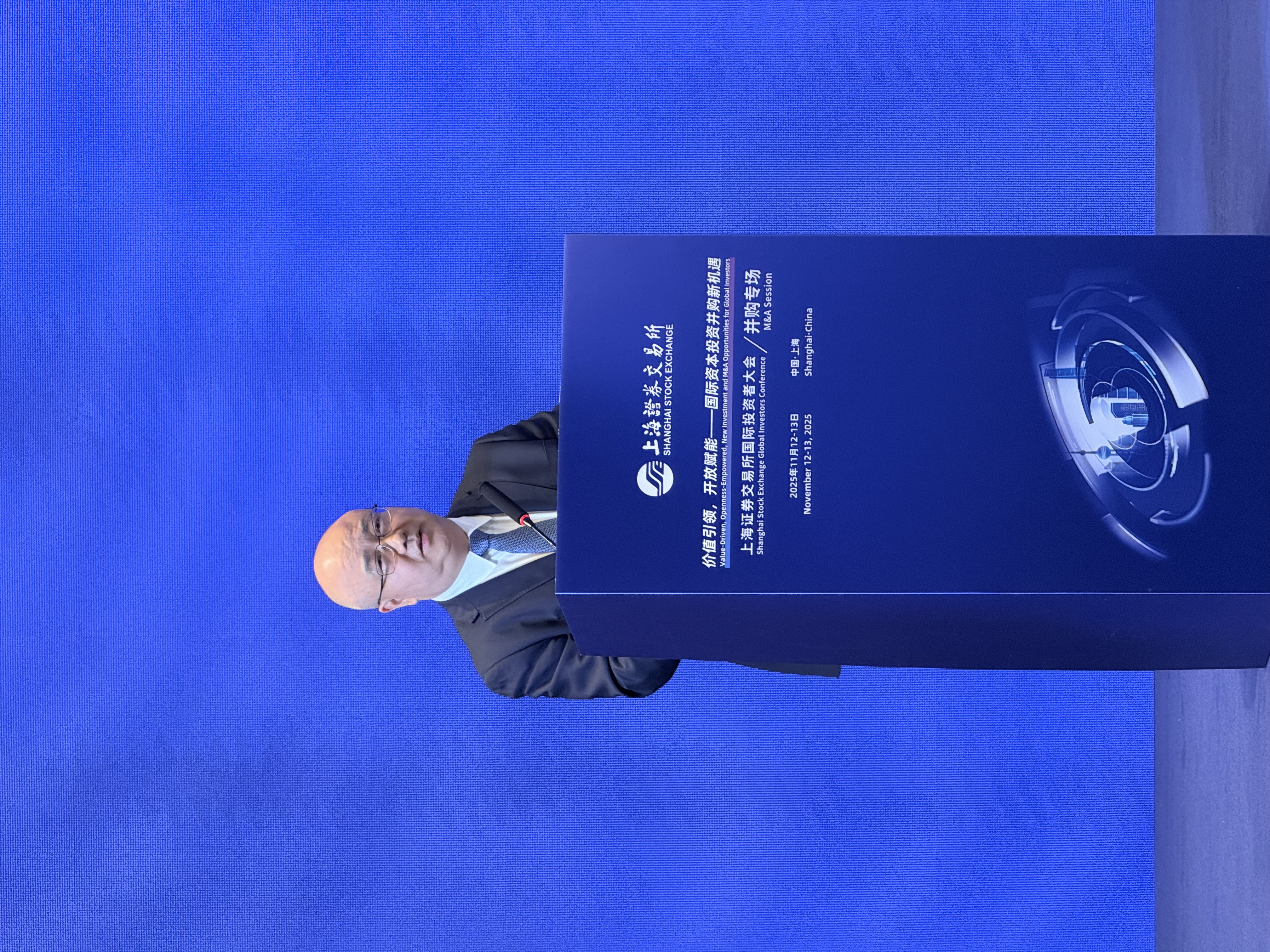
第三,科创板有着很强的国际基因,有着对国际投资者友好的投资生态,正发展成为一个国际化的市场。 傅浩表示,当前,全球科技创新进入密集活跃期,中国资本市场的开放步伐也在持续加快。上交所将继续立足上海"五个 中心"建设大局,进一步深化资本市场改革:以更完善的制度让国际投资者"看得清、投得稳",以更通畅的合作机制让科创企 业"走得远、发展好",以更高效的服务生态让资本配置"更顺畅、更高效"。 (编辑 才山丹) 本报记者 毛艺融 11月13日,上海证券交易所副总经理傅浩在上海证券交易所国际投资者大会上表示:"科创板将以更加成熟的市场生态赋 能科技进步,以金融高质量发展服务中国式现代化。上交所热忱欢迎更多外资机构和长期资本投资科创板,布局中国科技产 业,共享中国新质生产力发展红利,共促全球科创资本深度融合的新格局!" 傅浩表示,从国际投资者视角看科创板,第一,科创板汇聚了一大批优秀的中国科技创新企业,是境内外投资者分享中国 科技创新产业发展成果最重要的市场。 第二,科创板以制度创新持续发挥资本市场"试验田"功能,必将吸引和培育更多优秀的世界级科技企业,未来会涌现出更 多科技创新的企业明星。 上海证券交易所副总经理傅浩发表 ...
上交所副总经理傅浩:科创板已形成33条覆盖“宽基+主题+策略”的科创板指数
Zheng Quan Ri Bao Wang· 2025-11-13 03:08
Core Viewpoint - International investors have significantly engaged with the STAR Market through various channels, indicating a growing interest in innovative companies and related financial products [1] Group 1: Investment Channels - International investors are utilizing QFII, RQFII, and Stock Connect to invest in STAR Market companies and related indices and ETFs [1] - The STAR Market has established 33 indices that cover a range of strategies, including broad-based and thematic approaches [1] Group 2: Market Size and Performance - The total scale of tracking products for the STAR Market exceeds 300 billion yuan [1] - The STAR Chip ETF and STAR 50 ETF rank as the 3rd and 4th most held A-share ETFs by foreign investors in terms of market value [1]
“科创板外资参与度越来越高”
Di Yi Cai Jing Zi Xun· 2025-11-13 01:57
Core Insights - The participation of international investors in the STAR Market is increasing significantly [1] - Various channels such as QFII, RQFII, and Stock Connect have enabled widespread investment in STAR Market companies and related indices and ETFs [1] - The STAR Market has established 33 indices covering "broad-based + thematic + strategic" categories, with a total tracking product scale exceeding 300 billion yuan [1] - The STAR Chip ETF and STAR 50 ETF rank as the 3rd and 4th most held A-share ETFs by foreign investors in terms of market value [1]
AH股小幅低开,创业板跌0.09%,锂电电解液强势上涨,恒指跌0.52%,两市贵金属走强
Hua Er Jie Jian Wen· 2025-11-13 01:56
Market Overview - A-shares opened lower with the Shanghai Composite Index down 0.09% and the ChiNext Index also down 0.09% [1] - The Hong Kong market opened lower, with the Hang Seng Index down 0.52% and the Hang Seng Tech Index down 0.82% [4][5] - The bond market opened lower across the board, with the 30-year main contract down 0.03% [2][3] Sector Performance - The photovoltaic glass, duty-free shops, and Hainan Free Trade Zone concepts saw significant declines, while lithium battery electrolyte stocks surged, with Furi Shares achieving six consecutive trading limits and Lianhong Xinke hitting the daily limit [1] - Precious metals saw a strong performance with international gold prices rising significantly, while the oil and gas sector experienced a pullback [1] - In the commodity market, precious metals were among the top gainers, while energy products faced declines [1][6] Policy and Institutional Insights - At the Shanghai Stock Exchange International Investors Conference on November 13, the Deputy General Manager Fu Hao emphasized that the Sci-Tech Innovation Board continues to serve as a "testing ground" for capital market innovations, which will attract and nurture more world-class technology companies [1] - The Sci-Tech Innovation Board allows unprofitable companies, red-chip companies, and those with special equity structures to list, creating a dedicated financing channel for innovative enterprises [1]

