高质量充分就业

Search documents
促进高质量充分就业(学习贯彻党的二十届四中全会精神)
Ren Min Ri Bao· 2025-12-14 22:30
二、准确把握促进高质量充分就业的重点任务 以习近平同志为核心的党中央,坚持把就业作为民生之本,坚持依靠发展促进就业,在《建议》中明确 了促进高质量充分就业的主要目标,提出了一系列重点任务。我们要以推动高质量发展为基础,以实施 就业优先战略为引领,以强化就业优先政策为抓手,以破解结构性就业矛盾为着力点,以深化就业体制 党的二十届四中全会通过的《中共中央关于制定国民经济和社会发展第十五个五年规划的建议》(以下 简称《建议》),把促进高质量充分就业作为保障和改善民生的重要内容,提出新要求、作出新部署。 这是以习近平同志为核心的党中央坚持以人民为中心的发展思想,从战略和全局高度作出的重大部署。 我们要深入学习领会,坚决抓好贯彻落实。 一、深刻认识促进高质量充分就业的重要意义 就业是最基本的民生。2024年5月27日,习近平总书记主持二十届中央政治局第十四次集体学习并发表 重要讲话,深刻指出"促进高质量充分就业,是新时代新征程就业工作的新定位、新使命",科学回答了 促进高质量充分就业的一系列重大理论和实践问题,标志着就业工作目标向更加注重提升就业质量转 变,标志着就业主要任务向更加注重破解结构性矛盾转变,标志着就业主题 ...
新思想引领新征程丨站在人民立场考虑问题,坚持在发展中保障和改善民生
Yang Guang Wang· 2025-12-11 05:36
Core Viewpoint - The Chinese government emphasizes the importance of improving people's livelihoods as part of its modernization efforts, focusing on equitable development and common prosperity [1]. Group 1: Urban Renewal and Community Development - The government is actively implementing urban renewal actions during the 14th Five-Year Plan, particularly focusing on the renovation of old residential communities to enhance living standards [4]. - In Shenyang, the renovation of the Chang'an community has significantly improved residents' quality of life, with upgrades to heating and other utilities [1][4]. - The Ministry of Housing and Urban-Rural Development is prioritizing projects that directly impact citizens' interests, aiming to eliminate safety hazards and improve living environments [4]. Group 2: Elderly Care and Social Services - Hebei's Shijiazhuang has developed a comprehensive home-based elderly care service network, creating a 15-minute service radius for senior citizens [4]. - The city has established standardized community elderly service centers to provide various support services, including meal delivery and health guidance [4]. - The government is reforming elderly care services to ensure that the elderly are well cared for and can contribute to society [5]. Group 3: Employment and Economic Stability - The government has introduced policies to promote high-quality employment, aiming for an annual urban job creation target of over 12 million, with 10.57 million jobs created in the first three quarters of this year [5]. - The Ministry of Human Resources and Social Security is focusing on income distribution to ensure that hard work and skills are rewarded, particularly in high-demand sectors [6]. Group 4: Family Support and Childcare - The government has launched various policies, including childcare subsidies and free preschool education, to reduce the financial burden on families [5]. - These initiatives are part of a broader strategy to support families and ensure that children receive proper care and education [5]. Group 5: People's Well-being and Governance - The government is committed to placing people's needs at the forefront of its policies, ensuring that quality of life continues to improve as a primary goal of economic and social development [7]. - President Xi Jinping has reiterated the importance of addressing the public's basic needs, such as education, elderly care, and job opportunities, as essential to achieving a happy life for all [7].
孔乙己脱掉“长衫”就能行吗?
虎嗅APP· 2025-12-07 23:55
Core Viewpoint - The article discusses the structural challenges faced by the younger generation in the labor market, drawing parallels between contemporary issues and the classic film "Bicycle Thieves," emphasizing that hard work and moral choices often do not guarantee dignity or survival in a system that fails to provide basic support and upward mobility [4][5]. Group 1: Hidden Costs of Physical Labor - The narrative around "pragmatic employment" often overlooks the harsh realities of labor intensity, job security, and career prospects in so-called "practical jobs" [7]. - According to the National Bureau of Statistics, there are nearly 300 million migrant workers in China, with significant portions employed in manufacturing (18.3%), construction (14.6%), and retail (13.1%), facing long hours and inadequate social security [7]. - In the express delivery sector, data shows that frontline couriers work over 10 hours daily, with 58.7% lacking work injury insurance and 72.1% without housing fund contributions, while the average monthly income is around 4,800 yuan [7][8]. Group 2: Downward Pressure and Involution - The employment crisis for youth cannot be solely attributed to "attitudinal issues," as structural mismatches in the job market are a core problem, with traditional sectors like internet and real estate contracting [11][12]. - Emerging industries such as high-end manufacturing and AI require high skills but offer limited positions, while low-value service jobs lack stability and formal contracts, leading to increased competition among lower-tier workers [12][13]. - The influx of highly educated individuals into low-end labor markets does not enhance job quality but instead depresses wages and exacerbates social competition [13][14]. Group 3: Stigma of Lower Status Jobs - Despite individuals' willingness to abandon their educational status, societal biases against physical labor remain entrenched, leading to feelings of shame and self-denial among those in lower-status jobs [15][16]. - A survey indicates that only 23.1% of respondents believe that manual laborers receive equal social respect compared to white-collar workers, with this perception declining significantly among older demographics [16]. - The long-standing association of education with social status creates a challenging environment for those transitioning to lower-status jobs, as they face both economic and emotional burdens [17][18]. Group 4: Need for Systemic Change - The article argues that the tragedy of individuals like "Kong Yiji" is not isolated; it reflects a broader societal issue where individual struggles are often overlooked [21]. - Recent government initiatives aim to create high-quality jobs and improve labor rights, indicating a recognition of the need for systemic support rather than moral exhortations [22]. - The call for a society that allows individuals to maintain dignity regardless of their job status emphasizes the importance of creating pathways for all workers, ensuring that choices do not come at the cost of self-respect [22].


实现更充分更高质量的就业
Sou Hu Cai Jing· 2025-12-07 21:43
Core Insights - The "14th Five-Year Plan" period should focus on enhancing economic development momentum and resilience as a fundamental support, solidifying China's economic foundation which is stable, advantageous, resilient, and has great potential for long-term positive development [1] Employment Market Matching Mechanism - Strengthening the coordination mechanism between industry and employment is essential, requiring the establishment of a comprehensive signal transmission mechanism that connects "industrial transformation - demand generation - supply response" [2] - A classification-based employment support mechanism should be developed to cater to different age groups, providing inclusive basic courses and specialized training to bridge traditional skills with digital technologies [2] Stabilizing Employment Functions of Enterprises - Financial subsidies and tax incentives should be provided to enterprises for internal training and absorbing transformed labor, while a responsibility assessment mechanism for employment targets should be established to balance technological replacement and employment security [3] Intergenerational Employment System - A support system for older labor forces should be developed, focusing on community services and experience-oriented public welfare positions, while ensuring their basic rights and protections [4] - Gradual reforms in the retirement system should be deepened, establishing a matching assessment system for qualifications, abilities, and positions to facilitate intergenerational job rotation [4] Upgrading Human Capital - Reforms in higher education supply and demand adaptation are necessary to address structural mismatches, emphasizing the need for a dynamic adjustment mechanism for professional training [5] - A lifelong learning system should be established, offering targeted training for different age groups and creating a credit bank system to facilitate recognition of learning outcomes [6] Balanced Employment Landscape - Reforms in the household registration system and equalization of public services should be advanced to remove barriers to population mobility and ensure equal access to resources for migrant labor [7] - Urban-rural integration and two-way labor mobility should be promoted, establishing cross-regional employment service alliances for better resource sharing [7] "Industry-Employment" Spatial Coordination Mechanism - In regions with net labor outflow, platforms for characteristic industries should be developed to create local job opportunities, while high-end industrial clusters should be nurtured in core areas to extend production and service links to surrounding counties [8]
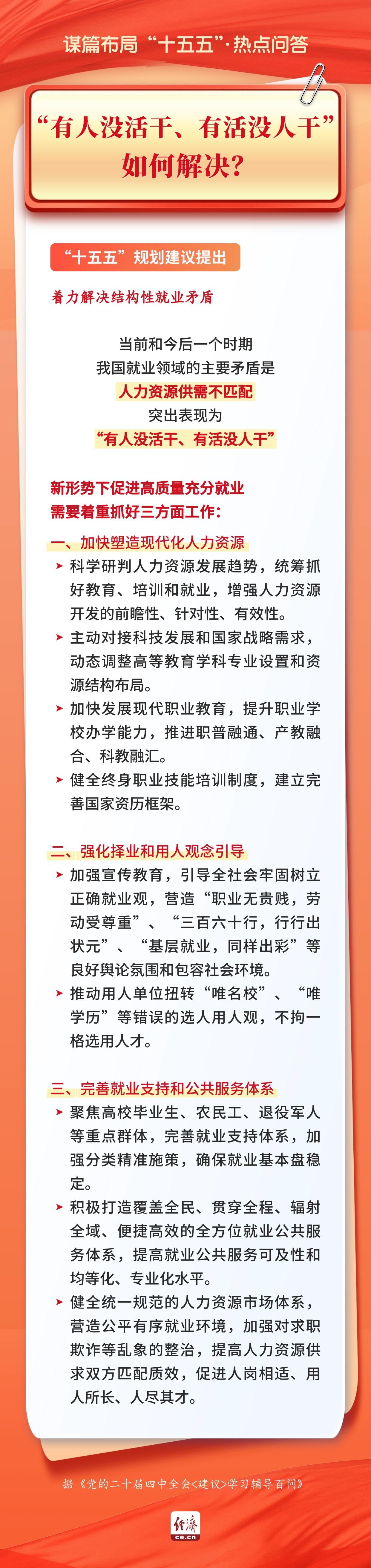
谋篇布局“十五五”·热点问答|如何解决“有人没活干、有活没人干”?
Zhong Guo Jing Ji Wang· 2025-12-04 06:54
Core Viewpoint - The "14th Five-Year Plan" emphasizes addressing structural employment contradictions, particularly the mismatch between labor supply and demand, characterized by the phenomenon of "some people have no work, while some jobs have no applicants" [2][4]. Group 1: Employment Structure and Challenges - The main contradiction in the employment sector is the mismatch of human resources supply and demand, which is a pressing issue in the current and future periods [2]. - The need for a modernized human resource framework is highlighted, focusing on enhancing employment and recruitment concepts through public education and awareness campaigns [3][4]. Group 2: Education and Training - There is a call for proactive alignment of educational programs with technological advancements and national strategic needs, including dynamic adjustments to higher education disciplines and resource allocation [4]. - The development of modern vocational education is crucial, with an emphasis on improving vocational school capabilities and integrating vocational and academic education [4]. Group 3: Employment Support and Public Services - The plan aims to enhance employment support systems, particularly for key groups such as college graduates, migrant workers, and veterans, ensuring stability in the employment landscape [6]. - A comprehensive employment public service system is to be established, focusing on accessibility, equality, and professionalism in employment services [6]. - The establishment of a unified and standardized human resources market system is essential to create a fair and orderly employment environment, addressing issues like job fraud and improving the matching quality between job seekers and employers [6].
夯实共富之基 织密民生之网——江苏人社交出“十四五”高质量发展优异答卷
Xin Hua Ri Bao· 2025-12-02 23:44
Core Viewpoint - Jiangsu's human resources and social security system is focused on promoting high-quality employment and social security to contribute to common prosperity, aligning with the province's modernization goals. Employment and Economic Development - Employment is prioritized as a key political task, with an average of over 1.35 million new urban jobs created annually during the 14th Five-Year Plan, ranking second nationally [2] - The urban survey unemployment rate has been maintained below 5%, with a cumulative total of 6.714 million new urban jobs created by the end of October this year [2] - A combination of policies, including wage subsidies and special loans, has effectively stabilized employment for over 20.5 million workers [2] - Training programs have been conducted for 9.7 million individuals, with a job placement rate of 37% and a training retention rate of 94% [2] Human Resources Service Industry - By the end of 2024, Jiangsu will have 6,752 human resources service agencies, employing 67,000 people and generating an annual revenue of 221.5 billion [3] - The "Just in Jiangsu" smart employment service platform has facilitated numerous recruitment events, collecting nearly 27 million job postings [3] - Innovative employment services, such as live-streaming job fairs, have provided over 5.5 million job opportunities [3] Social Security System - Jiangsu is enhancing its social security system to ensure comprehensive coverage and equitable benefits for all residents [5] - As of October, the number of basic pension insurance participants reached 61.573 million, an increase of 1.92 million since the end of 2021 [6] - The minimum pension for urban residents has been increased annually by at least 8%, benefiting 12 million residents [6] Support for Key Groups - Targeted support for college graduates has resulted in a placement rate exceeding 92% for recent graduates [4] - Unemployment insurance totaling 11.97 billion has been distributed, assisting 655,000 unemployed individuals [4] - Continuous employment services for migrant workers have stabilized their employment at over 24 million [4] Talent Development and Innovation - Jiangsu has implemented a talent strategy to attract and retain skilled individuals, with 16,736 doctoral candidates introduced during the 14th Five-Year Plan [8] - The province has established a unique talent evaluation system and enhanced support for high-skilled workers [9] - Entrepreneurship support has led to 1.483 million individuals starting their own businesses since the beginning of the 14th Five-Year Plan [10] Labor Relations and Wage Protection - Jiangsu is committed to building harmonious labor relations and has implemented measures to address wage arrears effectively [11] - The province has established a digital monitoring system for wage payments, ensuring timely intervention in cases of wage disputes [12] - A comprehensive approach to wage protection has resulted in a 100% case closure rate for wage-related complaints [13]
今元集团携旗下金柚GEO亮相第三届服发会,「国内+海外」双轨服务赋能全球高质量增长
Sou Hu Cai Jing· 2025-12-02 07:42
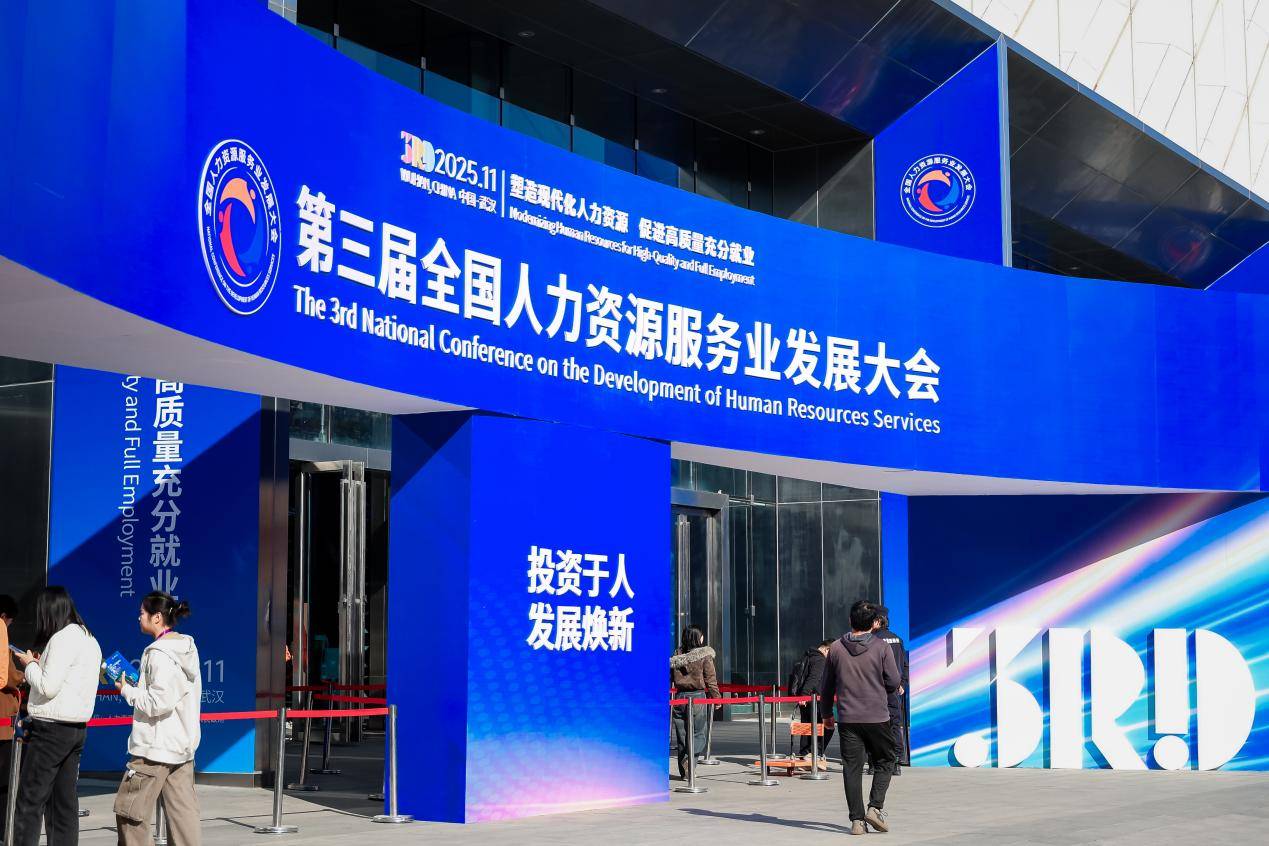
Core Insights - The third National Human Resources Service Development Conference emphasizes the theme of "shaping modern human resources and promoting high-quality full employment" [1] - The conference serves as a platform for efficient connections between human resource agencies, employers, and various talents through four main segments: research, conferences, talent, and recruitment [1] Group 1: Industry Development - The "14th Five-Year Plan" aims to promote high-quality full employment and strengthen the employment promotion mechanism [3] - The human resources service industry directly serves millions of workers and employers, playing a crucial role in enhancing human resource development and building a modern industrial system [3] - The company, founded in 2014, has established a comprehensive digital product and service system for human resources, serving both domestic and global markets [3] Group 2: Service Offerings - The company has developed a full-service matrix addressing challenges in recruitment, management, and social security, utilizing a self-developed "Generative AI + HR SaaS" product line [4] - The intelligent recruitment system enhances efficiency by 43.6% while significantly reducing recruitment costs for enterprises [4] - The company has provided professional services to over 85,000 enterprises across various sectors, including intelligent manufacturing and logistics [4] Group 3: Global Expansion - The establishment of Jin You GEO in Wuhan aims to provide comprehensive global human resource services for companies venturing abroad [10] - Jin You GEO has rapidly expanded its operations to over 150 countries and regions, serving more than 500 leading enterprises [10][11] - The company integrates global resources to facilitate cross-border talent mobility, addressing challenges in cultural integration and compliance management [14] Group 4: Digital Transformation - The launch of the "Jin You GEO AI + Global Talent Management Platform" at the conference represents a significant advancement in cross-border human resource management [12] - This platform enhances service response speed and efficiency by integrating AI solutions for compliance risk management [12] - The company’s dual-track service model combines domestic capabilities with global expansion, promoting high-quality employment and modernizing human resource services [15][19]
发展向前 民生向暖|你我的生活将会这样改变
Zhong Guo Jing Ji Wang· 2025-12-01 07:14
Group 1: Employment and Economic Development - The "14th Five-Year Plan" emphasizes the importance of promoting high-quality and full employment as a foundation for improving people's livelihoods and economic development [2][3] - The plan outlines strategies such as implementing an employment-first strategy, enhancing employment promotion mechanisms, and fostering new job opportunities in emerging industries [2][3] - The development of new industries, such as the drone sector, is expected to create significant employment opportunities, with registered drone users and drones doubling compared to the previous year [3] Group 2: Income Distribution and Middle-Income Expansion - The "15th Five-Year Plan" aims to improve the income distribution system, increasing the proportion of residents' income in national income distribution and enhancing labor remuneration in primary distribution [4][5] - The plan targets the expansion of the middle-income group, with projections indicating that the middle-income population could exceed 800 million in the next decade [6] - The focus is on optimizing the income distribution system to balance fairness and efficiency, ensuring that economic growth benefits all segments of society [6] Group 3: Education and Talent Development - The "15th Five-Year Plan" highlights the importance of providing quality education, with initiatives aimed at improving educational resources and aligning them with population changes [8][9] - The plan includes measures to expand free education and explore extending compulsory education, ensuring equitable access to quality education [9][10] - The goal is to cultivate innovative and versatile talents to support national development and enhance the country's competitiveness [9][10] Group 4: Social Security System - The "15th Five-Year Plan" emphasizes the need to strengthen the social security system as a safety net for people's livelihoods and a stabilizer for social order [10][11] - Recent developments include nationwide coverage of basic pension insurance and the establishment of a personal pension system, enhancing the comprehensiveness of social security [11][12] - The plan aims to balance social security expenditures while ensuring continuous investment in people's welfare [12] Group 5: Housing and Real Estate Development - The "15th Five-Year Plan" positions the promotion of high-quality real estate development as a key aspect of improving people's livelihoods and achieving common prosperity [13][14] - The plan addresses the need for a shift in real estate policy from quantity shortages to meeting diverse housing needs, with significant housing projects already completed [14][15] - Emphasis is placed on optimizing housing supply and improving housing quality to ensure that all citizens have access to decent living conditions [15][16] Group 6: Health and Well-being - The "15th Five-Year Plan" includes a commitment to building a healthy China, with a focus on preventive health measures and comprehensive health services [17][18] - The plan aims to improve health indicators, with projections indicating an increase in life expectancy to 80 years by 2024 [17][18] - Strategies include enhancing public health services and promoting healthy lifestyles to reduce disease prevalence and improve overall health outcomes [18][19] Group 7: Public Services and Accessibility - The "15th Five-Year Plan" outlines the goal of advancing the equalization of basic public services, ensuring that all citizens have access to essential services [22][23] - The plan emphasizes the need for improved efficiency in public service resource allocation and addressing disparities in service levels across regions [23][24] - Digital tools and infrastructure development are highlighted as means to enhance service delivery and accessibility, particularly in rural and underserved areas [24][25]
“两个聚焦、三个服务”北京国际人力构建就业服务新生态
Xin Hua Wang· 2025-11-30 01:42
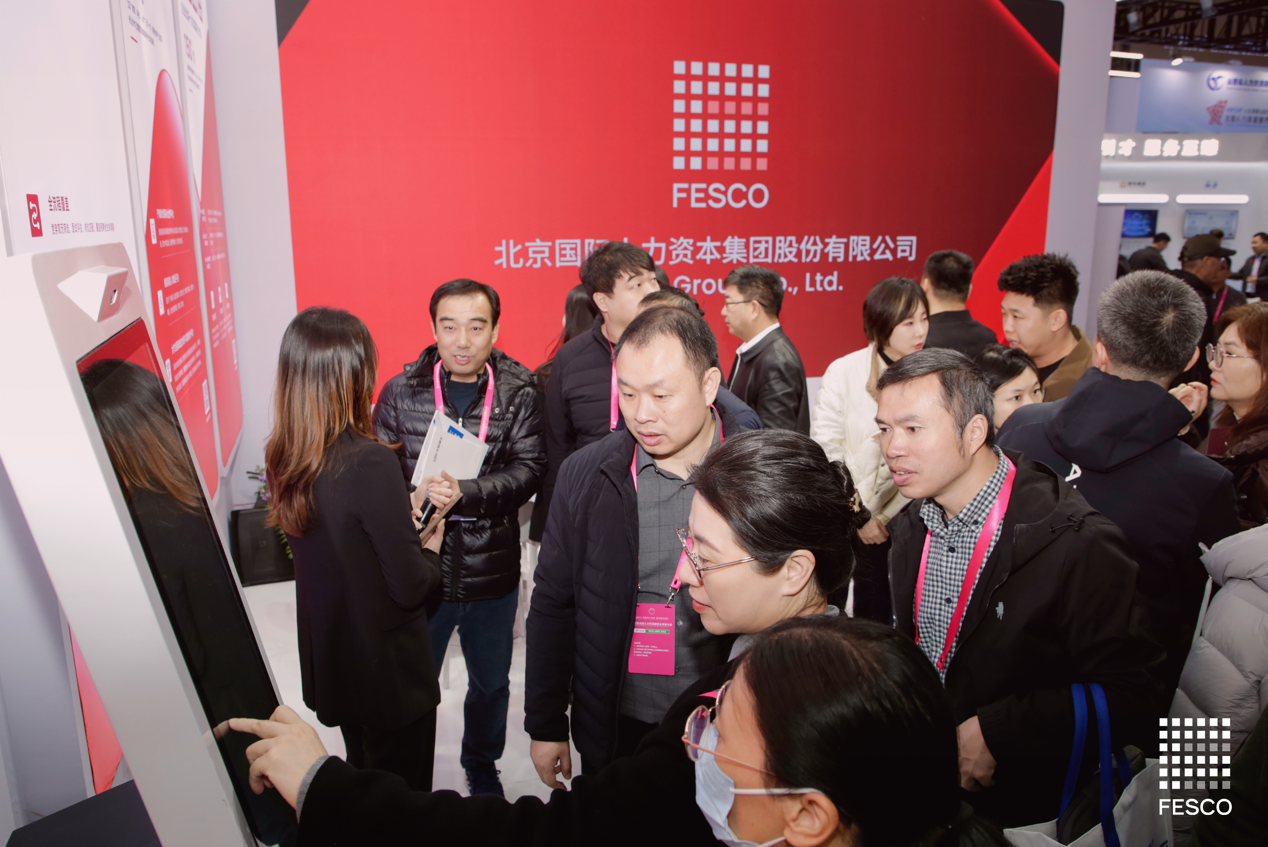
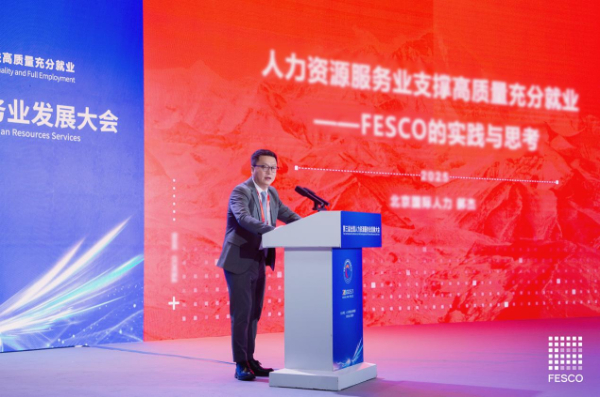
Core Viewpoint - The conference emphasizes the importance of human resources services in supporting high-quality and full employment, highlighting the need for collaboration among government, enterprises, educational institutions, and research organizations to enhance employment quality and effectiveness [1][2]. Group 1: Forum Insights - The forum featured a presentation by the General Manager of Beijing International Human Capital Group, focusing on the company's practices in promoting high-quality employment through innovative employment scenarios and industry-education integration [2]. - High-quality full employment is defined not only by high employment rates but also by fair compensation, stable labor relations, comprehensive social security, and good personal development prospects [2]. - The forum facilitated consensus on key issues and provided valuable insights for the industry to support national strategies and enhance high-quality employment [2]. Group 2: Company Initiatives - Beijing International Human Capital showcased several innovative achievements, including the "Digital Partner Alliance" and collaborative platforms among government, enterprises, and educational institutions [3]. - The company is upgrading its recruitment services from "information services" to "scenario services," creating immersive job-seeking experiences through live broadcasts and AI recruitment machines [3]. - The company is addressing structural talent supply and demand issues by establishing customized talent training systems in collaboration with local educational institutions, particularly in industries like optoelectronics and biomedicine [3][5]. Group 3: Regional and International Services - The company is leveraging its extensive service network across over 400 cities to meet the labor demands of key regional industrial clusters, focusing on sectors such as information technology and healthcare in the Beijing-Tianjin-Hebei region [3][5]. - In response to the "Belt and Road" initiative, the company offers comprehensive solutions for overseas enterprises, including global personnel management and cross-border training [5]. - The company is actively participating in building a global innovation service network, linking international resources in cutting-edge fields like artificial intelligence and renewable energy to foster high-quality employment [5]. Group 4: Future Directions - Moving forward, the company aims to deepen its strategic renewal driven by technological innovation, maintaining an open approach and professional services to contribute to high-quality employment and the implementation of talent strategies [7].
搭建共商平台 北京国际人力引领行业构建高质量充分就业新生态
Yang Guang Wang· 2025-11-29 10:02
Core Viewpoint - The third National Human Resources Service Industry Development Conference emphasizes the theme of "shaping modern human resources and promoting high-quality full employment," showcasing cutting-edge technology applications and industry achievements in the human resources service sector [1]. Group 1: Conference Overview - The conference is the largest and highest-level national event in the human resources service field in China, held in Wuhan [1]. - The event focuses on the application of innovative technologies and the results achieved in the human resources service industry [1]. Group 2: Company Participation - Beijing International Human Capital Group Co., Ltd. (FESCO) showcased innovations in three dimensions: "experience, efficiency, and employment" at the conference [4]. - The General Manager of Beijing International Human Capital, Hao Jie, participated in a forum discussing the role of the human resources service industry in supporting high-quality full employment [4][5]. Group 3: Innovations and Technologies - The conference highlighted intelligent employment service devices, such as the "AI job recruitment integrated machine," which optimizes resumes, simulates interviews, and matches job positions accurately [5]. - The company presented various innovative solutions, including the "Digital Partner Alliance" and a collaborative platform among government, enterprises, and educational institutions [10]. Group 4: Employment Quality and Strategies - The forum aimed to gather insights from various sectors to explore systematic paths for improving employment quality and efficiency [6][8]. - The focus is on ensuring that high-quality full employment not only maintains a high employment rate but also guarantees fair compensation, stable labor relations, and good personal development prospects [7]. Group 5: Future Directions - Beijing International Human Capital aims to leverage its 46 years of expertise and technological innovation to deepen its strategic renewal and contribute to the national talent strategy and high-quality full employment [14]. - The company plans to adopt a more open approach, utilize smarter technologies, and provide more professional services to build a modern human resources service system [14].