
ETF投资

Search documents
ETF掘金图鉴系列报告之二:信用债ETF运作机制拆解
Changjiang Securities· 2025-10-31 02:21
1. Report Industry Investment Rating No relevant content provided. 2. Core Viewpoints of the Report - The report focuses on the product design, operation mechanism, and investment logic of credit bond ETFs. Credit bond ETFs achieve tracking through sampling replication of indexes, with diversified annualized returns and durations, catering to various investment needs. The PCF list, market - maker system, and repurchase system enhance the transparency and tradability of the products. Credit bond ETFs have advantages in risk diversification and liquidity, and offer arbitrage opportunities through price differences between the primary and secondary markets, but costs need careful evaluation [4]. - Credit bond ETFs are becoming increasingly important in asset allocation and liquidity management, with their institutional design and trading mechanisms continuously improving, gradually evolving from emerging products to widely - recognized investment tools [17]. 3. Summary by Related Catalogs 3.1 Credit Bond ETF Product Design and Index Tracking - Credit bond ETFs are passive index funds that mainly track credit bond series indexes compiled by China Securities Index and China National Securities Index. They generally use sampling replication instead of full replication due to the large number of individual bonds and significant liquidity differences in the credit bond market. Sampling replication can control tracking errors, reduce transaction costs, and potentially achieve excess returns through active management [19]. - Different indexes have different selection criteria for component bonds, covering aspects such as issuance scale, credit rating, and remaining maturity. The annualized returns of the indexes tracked by credit bond ETFs have been positive in the past three years, showing a trend of decline, rise, and then decline since 2022. There are significant differences in duration characteristics among indexes, with some suitable for long - term and others for short - term investment [25][29]. 3.2 Transparency and Efficiency: PCF List and Market - Making Mechanism - The PCF list is the core tool in the subscription and redemption process, providing information on a basket of bonds and cash substitution arrangements. It includes information from T - 1 days (minimum subscription/redemption unit net value, cash difference, and fund share net value) and T days (estimated cash part, cash substitution ratio limit, etc.), helping investors understand the value and capital requirements of ETFs [36][37]. - The market - maker system consists of primary market - makers and general market - makers (or primary liquidity providers and general liquidity providers in the Shenzhen Stock Exchange). Market - makers have obligations to quote prices, and exchanges evaluate and incentivize them based on service quality. This system enhances the liquidity of credit bond ETFs in the secondary market [69]. - Credit bond ETFs are gradually included in the general collateralized repurchase system, which improves the efficiency of capital use. There are three types of repurchase methods in the bond market, each with different characteristics in terms of standardization, flexibility, and risk [73]. 3.3 Investment Logic: Allocation Value and Arbitrage Space - As a bottom - position allocation tool, credit bond ETFs are characterized by stability and efficiency. They can diversify credit risks, provide stable coupon income, and have strong liquidity, suitable for long - term holding. They can also be used for leverage financing to increase returns, and are an important part of diversified asset allocation [81][82]. - Credit bond ETFs can achieve arbitrage through primary and secondary market trading, including premium arbitrage and discount arbitrage. However, due to the lack of IOPV disclosure in credit bond ETFs, alternative methods are needed for estimation. Additionally, the uncertainty of coupon - replacement costs and the liquidity of component bonds need to be considered during the arbitrage process [91][94].
中央汇金,继续坚定持有
Zhong Guo Zheng Quan Bao· 2025-10-30 12:35
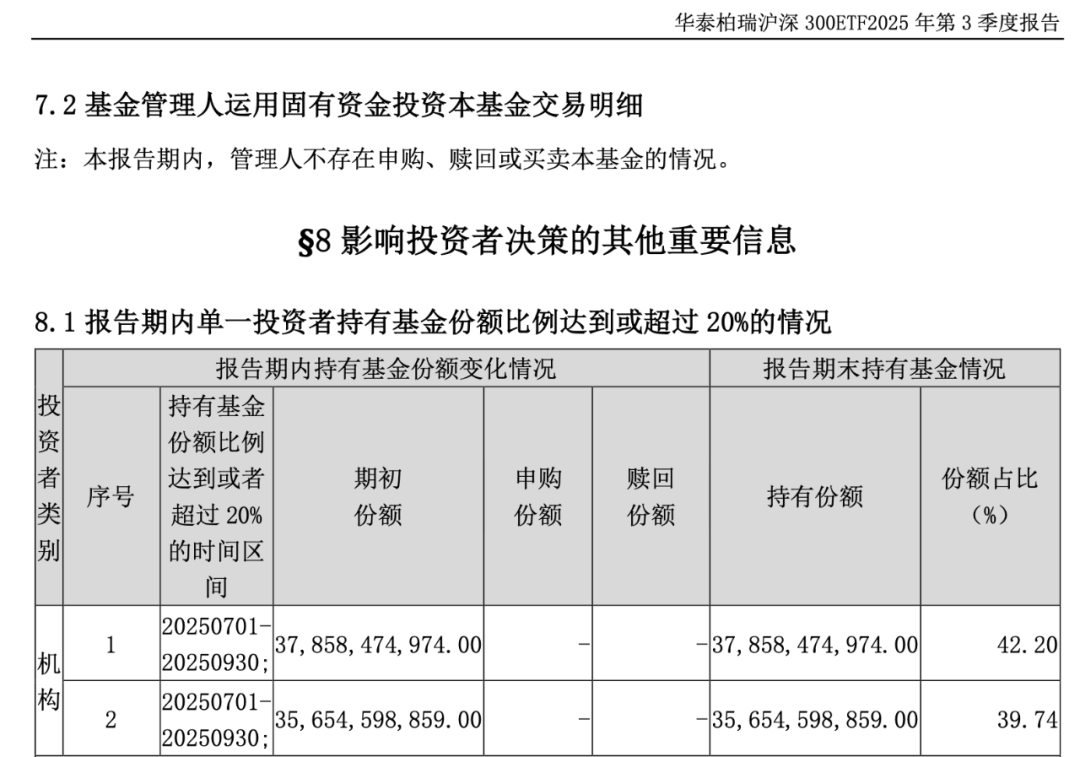
Core Insights - Central Huijin Asset Management and Central Huijin Investment maintained their holdings in several leading broad-based ETFs during Q3, indicating a strong commitment to these investments [1][2][6] - Notable adjustments were observed among some institutional investors, with Huaxia Fund's proprietary account completely liquidating its position in the Huaxia Hang Seng China Enterprises High Dividend ETF [7][8] - China Life Insurance reduced its holdings in multiple STAR Market ETFs, reflecting a strategic shift in its investment approach [11] Central Huijin's ETF Holdings - Central Huijin Asset Management held 37.86 billion shares of the Huatai-PineBridge CSI 300 ETF, while Central Huijin Investment held 35.65 billion shares, with both figures remaining unchanged from the previous quarter [2][5] - The total holdings in various ETFs, including the E Fund CSI 300 ETF and Huaxia CSI 500 ETF, also remained stable during Q3, suggesting a consistent investment strategy [6] Institutional Adjustments - Huaxia Fund's proprietary account, previously the largest holder of the Huaxia Hang Seng China Enterprises High Dividend ETF with 8.06 million shares (19.35% of total), completely exited this position in Q3 [8][10] - China Life Insurance's significant reductions in holdings of STAR Market ETFs included a drop from 753 million shares to 480 million shares in the Huaxia STAR Market 100 ETF, and from 1.23 billion shares to 679 million shares in the Bosera STAR Market 100 ETF [11]

【周周牛事】告别选股难题,ETF也能跟上风口热点!
新财富· 2025-10-28 10:55
Core Viewpoint - The article emphasizes the importance of using the "ETF Hot Themes" feature on the Go-Goal financial terminal to identify and invest in trending ETFs that align with current market hotspots [2][3]. Group 1: ETF Hot Themes - The "ETF Hot Themes" function on Go-Goal selects 10 of the hottest themes daily and matches them with the most relevant ETFs, helping investors quickly identify investment opportunities [2][3]. - The correlation between the market theme and the ETF is indicated by the percentage of market capitalization held in related concept stocks, with higher percentages signifying stronger relevance [6]. Group 2: Steps to Utilize ETF Hot Themes - Step 1: Browse the top ten hot themes of the day [12]. - Step 2: Check the concept stock holding percentage of related ETFs [12]. - Step 3: Consider additional factors such as ETF size, tracking error, and trading volume [12]. Group 3: Accessing the Feature - The "ETF Hot Themes" feature can be found on the Go-Goal PC financial terminal under the ETF comprehensive screen [11][10].
关键时刻,投资不迷茫!投资ETF必备实战策略 | 投教训练营25期
Zhong Guo Ji Jin Bao· 2025-10-28 00:31
Core Insights - The current market situation has left many investors feeling confused, with the Shanghai Composite Index continuously reaching new highs, leading to concerns about chasing prices and missing opportunities [1] Group 1: Market Conditions - Frequent shifts in market hotspots make it difficult for investors to keep pace, resulting in traditional investment yields declining and prompting the need for new investment avenues [2] - As the difficulty of investing in individual stocks increases, many investors are turning to ETFs to better capture market trends [2] Group 2: ETF Investment Strategies - The upcoming "ETF Practical Strategy Training Camp" aims to address how to select ETFs, investment strategies for ETFs, and how to build an investment portfolio using ETFs [2][4] - The training camp will feature expert insights from a renowned lecturer, providing practical knowledge in an accessible format [3] Group 3: Target Audience and Engagement - The training camp is designed for investors who have previously bought stocks or funds but have experienced unstable returns, as well as those lacking foundational knowledge and practical experience in ETF investments [4] - Participants will have the opportunity to join a dedicated community for networking and support, enhancing their investment journey [3]
天府证券ETF日报-20251027
天府证券· 2025-10-27 11:16
Report Overview - Report date: October 27, 2025 [5] - Analyst: Ma Yaoshi [5] - Qualification certificate: S1330524050001 [5] - Contact email: mayst@hxzb.cn [5] - Contact phone: 15201282186 [5] Market Overview - A-share market: The Shanghai Composite Index rose 0.71% to 3,950.31 points, the Shenzhen Component Index rose 2.02% to 13,289.18 points, and the ChiNext Index rose 3.57% to 3,171.57 points. The total trading volume of A-shares in the two markets was 1.9918 trillion yuan [2][6] - Leading gainers: Communications (4.73%), electronics (4.72%), and national defense and military industry (2.34%) [2][6] - Leading losers: Petroleum and petrochemicals (-1.36%), coal (-1.29%), and food and beverages (-1.18%) [2][6] Stock ETF - Top trading volume: The top three were the Harvest Shanghai - Science and Technology Innovation Board Chip ETF (up 5.40% with a discount rate of 5.47%), the ChinaAMC Shanghai - Science and Technology Innovation Board 50 ETF (up 4.21% with a discount rate of 4.31%), and the ChinaAMC CSI A500 ETF (up 1.38% with a discount rate of 1.49%) [3][7] Bond ETF - Top trading volume: The top three were the Haitong Fortune CSI Short - Term Financing Bond ETF (up 0.01% with a discount rate of 0.01%), the Bosera CSI Convertible and Exchangeable Bond ETF (up 0.43% with a discount rate of 0.54%), and the ChinaAMC Shanghai Benchmark Market - Making Treasury Bond ETF (down 0.02% with a discount rate of - 0.02%) [4][9] Gold ETF - Gold prices: AU9999 fell 0.60%, and Shanghai Gold fell 0.49% [12] - Top trading volume: The top three were the Huaan Gold ETF (down 0.49% with a discount rate of - 0.60%), the E Fund Gold ETF (down 0.50% with a discount rate of - 0.58%), and the Bosera Gold ETF (down 0.51% with a discount rate of - 0.63%) [12][13] Commodity Futures ETF - Performance: The Dacheng Non - Ferrous Metals Futures ETF rose 1.22% with a discount rate of 1.67%, the CCB Yisheng Zhengzhou Commodity Exchange Energy and Chemical Futures ETF fell 0.40% with a discount rate of - 0.03%, and the ChinaAMC Feed Soybean Meal Futures ETF fell 0.26% with a discount rate of 4.36% [13][14] Cross - Border ETF - Overseas indices: The Dow Jones Industrial Average rose 0.31%, the Nasdaq Composite rose 0.89%, the S&P 500 rose 0.58%, and the German DAX rose 0.23% the previous day. The Hang Seng Index rose 0.74%, and the Hang Seng China Enterprises Index rose 0.68% today [15] - Top trading volume: The top three were the E Fund CSI Hong Kong Securities Investment Theme ETF (up 1.28% with a discount rate of 1.65%), the Huatai - Peregrine CSI Korea Exchange Sino - Korean Semiconductor ETF (up 4.36% with a discount rate of 4.36%), and the Huatai - Peregrine Hang Seng Technology ETF (up 1.01% with a discount rate of 2.05%) [15][16] Money ETF - Top trading volume: The top three were the Yin Hua Day - to - Day Profit ETF, the Hua Bao Add - Benefit ETF, and the CCB Add - Benefit Money ETF [17][19]
5G通信ETF领涨,资金逆势加仓黄金ETF丨ETF晚报
2 1 Shi Ji Jing Ji Bao Dao· 2025-10-27 10:39
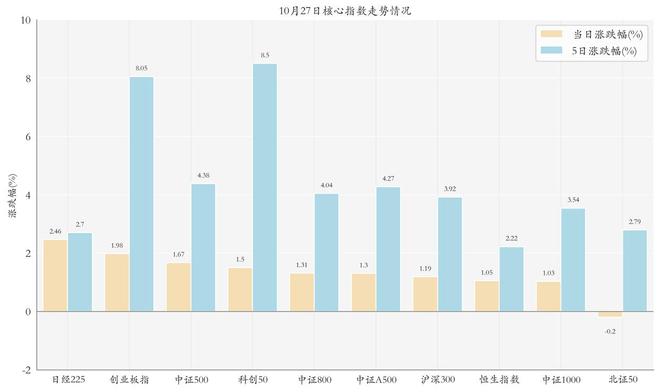
Market Overview - The three major indices in the A-share market rose collectively, with the Shanghai Composite Index increasing by 1.18%, the Shenzhen Component Index by 1.51%, and the ChiNext Index by 1.98% [1][4] - The Nikkei 225 and ChiNext Index showed strong performance, with daily increases of 2.46% and 1.98% respectively [4] ETF Performance - The 5G Communication ETFs led the market with significant gains, including a 5.07% increase for the 5G Communication ETF (515050.SH) and a 5.01% increase for the 5GETF (159994.SZ) [1][12] - The overall ETF market saw a net inflow exceeding 130 billion yuan, with defensive ETFs, particularly gold ETFs, attracting substantial investments despite a general decline of over 6% in their value [3] Sector Performance - The communication and electronics sectors performed well, with daily increases of 3.22% and 2.96% respectively, while the food and beverage sector lagged behind with a decline of 0.35% [7] - Over the past five trading days, the communication sector has risen by 11.55%, and the electronics sector by 10.18% [7] New ETF Listings - The total scale of the Sci-Tech Innovation Board ETFs reached 300 billion yuan, with 105 ETFs listed, including 21 new ETFs in the past four months [2] Trading Volume - The top three ETFs by trading volume included the Sci-Tech 50 ETF (588000.SH) with a trading volume of 6.351 billion yuan, the Sci-Tech Chip ETF (588200.SH) at 5.218 billion yuan, and the A500 ETF at 5.054 billion yuan [14]
Netflix Lags Q3 Earnings Yet Ups Free Cash Flow View: ETFs in Spotlight
ZACKS· 2025-10-23 14:21
Core Insights - Netflix reported disappointing third-quarter 2025 results, missing earnings and revenue expectations, leading to a more than 10% drop in share prices [1][4] - Despite the quarterly miss, Netflix experienced year-over-year growth in revenue across all regions, driven by successful content releases [5][6] Q3 Performance Analysis - Earnings missed the Zacks Consensus Estimate by 14.8%, while revenues lagged slightly by 0.1% [4] - A one-time expense of $619 million related to a dispute with Brazilian tax authorities was the primary reason for the earnings miss [4] - Year-over-year, Netflix's Q3 results showed improvement in both earnings and revenues [4] Regional Revenue Growth - Netflix achieved double-digit revenue growth year-over-year in all regions: UCAN, EMEA, Latin America, and Asia-Pacific [5] - The animated film "KPop Demon Hunters" became Netflix's most popular film with over 325 million views [5] - Other successful content included the British political thriller "Hostage" and the South Korean drama "Bon Appétit, Your Majesty" [6] Future Outlook - Netflix is optimistic about Q4 2025, with a strong lineup of content including the final season of "Stranger Things" and new series [7] - The company expects Q4 revenues of $11.96 billion, reflecting a 16.7% year-over-year growth [8] Full-Year Guidance - For full-year 2025, Netflix anticipates revenues of $45.1 billion, slightly above previous guidance [9] - The free cash flow forecast for 2025 is approximately $9 billion, an increase from prior estimates [9] ETF Investment Opportunities - Several ETFs provide exposure to Netflix, including: - First Trust Dow Jones Internet Index Fund (FDN) with $7.68 billion in assets and a 9.84% share of Netflix [12] - FT Vest Dow Jones Internet & Target Income ETF (FDND) with $9.4 million in assets, also holding 9.84% of Netflix [13] - MicroSectors FANG+ ETN (FNGS) with $531 million in assets, holding 10.1% of Netflix [14] - Communication Services Select Sector SPDR Fund (XLC) with $26.68 billion in assets, holding 7.14% of Netflix [15] - Invesco Next Gen Media and Gaming ETF (GGME) with $63.98 million in assets, holding 8.05% of Netflix [16]


ETF投资高手实战大赛丨10月23日“实战牛人”买入十大ETF出炉:通信ETF霸榜(明细)
Xin Lang Zheng Quan· 2025-10-23 08:48
Group 1 - The "Second Golden Unicorn Best Investment Advisor Selection" event is currently ongoing, with over 3,000 professional investment advisors participating in simulated trading competitions [1] - The event aims to provide a platform for investment advisors to showcase their capabilities, expand their services, and enhance their skills, thereby promoting healthy development in China's wealth management industry [1] Group 2 - The top ten ETFs by buy frequency on October 23 include Communication ETF, Bank ETF, and Securities ETF, indicating strong interest in these sectors [2] - The top ten ETFs by buy amount on the same date also feature Communication ETF and Bank ETF, highlighting significant investment flows into these products [3] Group 3 - The data for the top buy stocks/ETFs is based on the frequency of purchases by all participating advisors, while the buy amount data reflects the total investment amounts in the top ten stocks/ETFs [4] - The competition includes a performance evaluation segment divided into three categories: stock simulation group, on-site ETF simulation group, and public fund simulation configuration group, with specific trading rules in place [4]
油气板块ETF上涨;全球黄金ETF总规模再创新高丨ETF晚报
2 1 Shi Ji Jing Ji Bao Dao· 2025-10-22 10:13
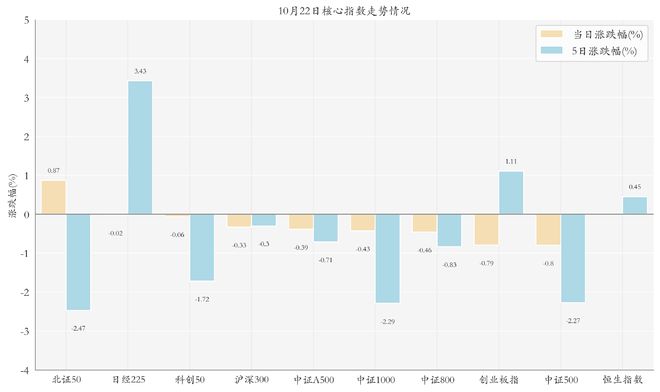
ETF Industry News - The three major indices experienced fluctuations and declines, with the Shanghai Composite Index down by 0.07%, the Shenzhen Component down by 0.62%, and the ChiNext Index down by 0.79. However, several oil and gas sector ETFs rose, including the Oil and Gas Resources ETF (563150.SH) which increased by 1.27% [1][3] - The World Gold Council reported that in September 2025, global physical gold ETFs recorded the largest single-month inflow in history, contributing to a record total inflow of $26 billion for the third quarter. By the end of the third quarter, the total assets under management (AUM) of global gold ETFs reached $472 billion, marking a new historical high [2] Market Overview - On October 22, 2025, the A-share market and major overseas indices collectively declined, with the Shanghai Composite Index closing at 3913.76 points, the Shenzhen Component at 12996.61 points, and the ChiNext Index at 3059.32 points. The highest intraday points were 3918.59, 13078.64, and 3089.76 respectively [3] - In terms of sector performance, the oil and petrochemical, banking, and home appliance sectors ranked highest with daily increases of 1.58%, 0.97%, and 0.82% respectively. Conversely, the non-ferrous metals, electric equipment, and agriculture sectors saw declines of -1.36%, -1.29%, and -1.19% respectively [5] ETF Market Performance - An overview of ETF performance categorized by investment type showed that strategy index ETFs performed the best with an average increase of 0.13%, while commodity ETFs had the worst performance with an average decline of -3.34% [7] - The top-performing ETFs included the Communication ETF (159507.SZ) with a daily increase of 4.77%, followed by the Oil and Gas Resources ETF (563150.SH) at 1.27%, and the Banking ETF (515020.SH) at 1.21% [10][11] Trading Volume of Different ETF Categories - The trading volume of ETFs indicated that the top three stock ETFs by trading volume were the A500 ETF (512050.SH) with 4.551 billion yuan, the Sci-Tech 50 ETF (588000.SH) with 4.383 billion yuan, and the CSI A500 ETF (159338.SZ) with 4.167 billion yuan [13][14]
ETF投资高手实战大赛丨10月22日“实战牛人”抄底芯片ETF?十大买入ETF出炉(明细)
Xin Lang Zheng Quan· 2025-10-22 08:58
Group 1 - The "Second Golden Unicorn Best Investment Advisor Selection" event is currently ongoing, with over 3,000 professional investment advisors participating in simulated portfolio competitions [1] - The event aims to provide a platform for investment advisors to showcase their capabilities, expand services, and enhance skills, while also facilitating communication between outstanding advisors and the public [1] Group 2 - The top ten ETFs by buy frequency as of October 22 include the Sci-Tech Chip ETF, Real Estate ETF, and Communication ETF, indicating strong interest in technology and real estate sectors [2] - The top ten ETFs by buy amount include the Communication ETF and Gold ETF, suggesting significant capital flow into these areas [3] - The data for the top buy frequency and buy amount ETFs is based on the aggregated buying activity of all participants in the competition [4]