
无人驾驶

Search documents
我们对无人驾驶的想法,竟然狭隘了?
3 6 Ke· 2025-06-16 01:43
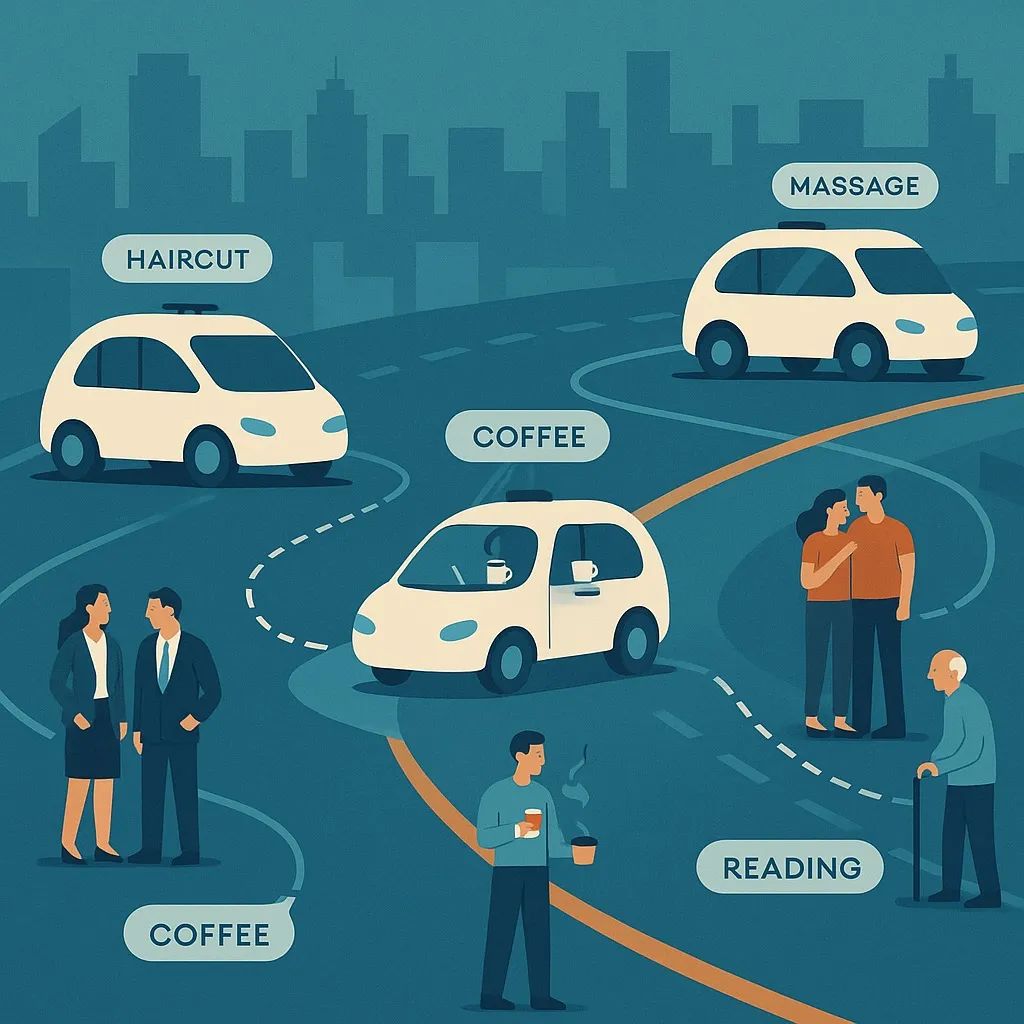
Core Insights - The integration of autonomous driving technology with new business models is creating a new, fluid industry landscape [1][35] - Autonomous vehicles have the potential to transform into mobile third spaces, redefining urban commercial structures and consumer experiences [4][22] Group 1: Autonomous Driving and Consumer Experience - The visit of European Central Bank President Christine Lagarde to Baidu's Apollo park highlighted the potential of autonomous vehicles beyond traditional transportation, suggesting they could serve as mobile service spaces [2][30] - The concept of a "third space," as proposed by sociologist Ray Oldenburg, emphasizes the need for environments where individuals can socialize outside of home and work, which autonomous vehicles could fulfill [5][14] - Consumers are already utilizing autonomous vehicles like "萝卜快跑" for purposes beyond transportation, such as mobile study rooms or quiet spaces for relaxation [27][29] Group 2: New Business Models - Traditional fixed-location businesses face challenges due to high costs and inflexibility, while mobile third spaces can adapt to real-time consumer demands [31][36] - The shift from fixed storefronts to mobile service providers allows businesses to reduce overhead costs and dynamically connect with consumers based on demand [32][36] - The emergence of a "fluid ecology" in urban spaces enables businesses to operate without being tied to a specific location, fostering a decentralized approach to consumer engagement [36][38] Group 3: Future Urban Planning - As autonomous driving technology matures, it will fundamentally alter perceptions of urban space, transportation, and commercial interactions [38][40] - The future of urban infrastructure may evolve to support intelligent networks that link services and consumers dynamically, rather than relying solely on traditional fixed locations [38][40] - The concept of a "mobile oasis" offers a new vision for urban living, where individuals can find personalized spaces for work, relaxation, or socialization on the go [40]

广汽接受预订、长安年底试飞,飞行汽车反超无人驾驶?
Zhong Guo Qi Che Bao Wang· 2025-06-16 01:16
Core Insights - The emergence of flying cars is becoming a reality, with major automotive companies announcing production timelines and technological advancements [2][3][5][7][11] Group 1: Company Developments - GAC Group has successfully transitioned its flying car, GOVY AirCab, from concept to mass production, with a planned price of no more than 1.68 million RMB and deliveries expected by the end of 2026 [2][3] - Deep Blue Automotive announced that it will conduct test flights of its flying car by the end of 2025, which features a unique design with 8 arms and 16 rotors, achieving a maximum range of 30 km and a top speed of 130 km/h [5] - XPeng Motors plans to mass-produce its flying car by the third quarter of 2026, with approximately 5,000 orders already received for its split flying car design [5] Group 2: Technological Advancements - GAC's flying car utilizes a dual technology approach of "short-distance multi-rotor + cross-city composite wing," with a self-developed electric drive system that boasts a torque density 200% higher than traditional electric vehicles [3] - The GOVY AirJet, another model from GAC, supports a range of 200 km and a fast charge time of 30 minutes, with future plans to incorporate solid-state batteries for an expected range of 400 km [3] Group 3: Policy and Market Environment - The flying car industry is benefiting from supportive policies in related fields, such as general aviation and low-altitude economy, which provide a foundation for infrastructure development and operational support [8][9] - The Chinese government has recognized low-altitude economy as a strategic emerging industry, promoting the development of flying cars through various policy initiatives [8] Group 4: Competitive Landscape - The race to mass-produce flying cars is intensifying among automotive companies, with GAC's leadership suggesting that flying cars may achieve commercial viability faster than autonomous ground vehicles due to simpler operational environments [11] - The commercial cycle for flying cars is projected to evolve from a nascent stage (2020-2023) to a growth phase (2028-2030), with expectations of explosive growth post-2030 [11]




隆利科技(300752) - 投资者关系活动记录表(2025年6月11日-2025年6月13日)
2025-06-13 10:34
Group 1: Industry Trends - The automotive display market is expected to see a growth in the number of screens and an upgrade in screen specifications, particularly in the rapidly growing domestic new energy market [2] - The penetration rate of smart cockpits is continuously increasing, leading to a trend towards personalization, convenience, and multimodal development in human-machine interaction [2] - The mainstream size of single screens is upgrading from 8-10 inches to 15-16 inches, indicating an expanding market space for automotive displays [2] Group 2: Company Positioning - The company is a leading player in Mini-LED automotive backlight display technology, possessing significant advantages in technology reserves, patent rights, and mass production capabilities [2] - The company aims to leverage its Mini-LED technology advantages and overall solution capabilities for smart cockpit displays to accelerate business development [3] Group 3: Technology Adoption - The LIPO ultra-narrow bezel technology, adopted by Apple in its latest 2024 smartphone, is setting a market trend and driving consumer demand, which is expected to propel the rapid development of LIPO technology [3] - The company is accelerating the verification and transformation of LIPO process innovation technology, with LIPO technology gradually entering mass production, positively impacting company performance [3] Group 4: Future Profitability - The company is committed to a high-quality long-term development strategy based on profitability, actively expanding its diversified business layout [3] - The core business segments include consumer electronics (mobile phones, tablets, notebooks), rapidly growing automotive display business, and LIPO business entering mass production in 2025, forming a "1+2+N" diversified layout [3]

股市特别报道·财经聚焦丨北交所将于月底开启“双指数”时代, 业内称北证市场的影响力将提升
Shen Zhen Shang Bao· 2025-06-12 13:33
Core Viewpoint - The launch of the Beijing Stock Exchange (BSE) Specialized and Innovative Index on June 30 marks the beginning of a "dual index" era for the BSE, enhancing its market influence and providing new investment opportunities for investors [1][2]. Group 1: Index Launch and Market Impact - The BSE's total market capitalization has exceeded 800 billion yuan, with specialized and innovative "little giant" enterprises accounting for over half of this value [1][2]. - The new index will include 50 securities selected based on market capitalization and liquidity from the "little giant" enterprises, aiming to objectively reflect their operational status [1][2]. - The introduction of the index is expected to facilitate the development of index ETFs and other investment products, allowing investors to participate more actively in the BSE market [1][2][3]. Group 2: Company Representation and Investment Opportunities - The inclusion of companies in the new index signifies their high market capitalization and representativeness among specialized and innovative enterprises, enhancing their market visibility and brand image [2][3]. - The index is anticipated to guide social resources towards key sectors and strategic emerging industries, promoting innovation and development within these fields [2][3]. - Investors are encouraged to diversify their portfolios based on their risk preferences and investment goals, with the potential for public funds to be developed based on the new index [2][3]. Group 3: Future Outlook and Sector Focus - The BSE's Specialized and Innovative Index reflects its commitment to serving innovative small and medium-sized enterprises, with plans for more industry-specific indices in the future [3]. - Analysts suggest focusing on sectors such as robotics, semiconductor testing, and consumer goods, highlighting specific companies like Suzhou Axle, Audiwei, and Hualing [4].
股市特别报道·财经聚焦丨两只北交所主题基金今年以来净值涨逾70% ,业内称北交所板块仍具备中长期投资价值
Shen Zhen Shang Bao· 2025-06-12 11:59
Core Viewpoint - The Beijing Stock Exchange (BSE) has shown strong performance this year, with related thematic funds experiencing significant net value increases, suggesting medium to long-term investment value in the BSE sector [1][2][3] Group 1: Market Performance - The BSE 50 Index has risen by 37.25% year-to-date, outperforming major indices such as the Shanghai Composite Index and Shenzhen Component Index [1] - Nearly 40 BSE-themed funds have seen an average net value increase of approximately 33.53% this year, with some funds like CITIC Securities BSE Selected Mixed Fund A and Huaxia BSE Innovative SMEs Selected Fund A achieving net value increases of over 70% [1][2] - 24 BSE funds have recorded net value increases exceeding 30% this year, indicating a broad-based positive performance across various funds [2] Group 2: Investment Opportunities - Analysts suggest focusing on companies with growth potential and strong R&D investments, particularly those in hot sectors and those benefiting from capacity expansion [3] - There is an emphasis on companies that are diversifying and expanding their industrial chains, as well as state-owned enterprises with stable operations and strong growth capabilities [3] - Investment strategies include targeting long-cycle performance stability and unique production capabilities, high dividend and steady growth domestic demand stocks, and thematic sectors such as AI and low-altitude economy [3]
《中国企业家》采访文远知行创始人兼CEO韩旭:更聚焦企业长期价值
Zhong Guo Chan Ye Jing Ji Xin Xi Wang· 2025-06-12 11:26
Core Insights - Company has achieved significant breakthroughs in globalization and is gaining widespread attention in the autonomous driving sector [1] - The CEO emphasizes the importance of safety and long-term planning in the company's development strategy [1][2] Group 1: Safety and Technology - Company’s autonomous vehicles have operated for over 2000 days without a single safety incident attributed to them [1] - The safety measures include a multi-modal sensor fusion technology that combines millimeter-wave radar, ultrasonic radar, cameras, and LiDAR for 360° perception [1] - The L2 level driver assistance solution utilizes the QNX operating system, known for its reliability and safety, enabling defensive driving capabilities and obstacle avoidance [1] Group 2: Strategic Partnerships - The partnership with Uber has provided a shortcut for the company to expand into overseas markets, enhancing service recommendations to users [1] - Following the strategic cooperation established in September 2024, the company launched the largest commercial Robotaxi fleet in the Middle East in Abu Dhabi [1] - The collaboration has expanded to Dubai and plans to deploy Robotaxi services in 15 additional international cities over the next five years, with Uber committing an additional $100 million investment [1] Group 3: Market Perspective - The CEO focuses on long-term value rather than market capitalization, emphasizing the importance of unique technology that benefits humanity [2] - The company aims to advance towards the autonomous driving era with a commitment to innovation and technology, contributing to the global development of the industry [2]


道交法修订列入议程,自动驾驶如何驶入法律轨道?
Huan Qiu Wang Zi Xun· 2025-06-12 08:48
Group 1 - The core viewpoint is that the legislative process for autonomous driving in China is advancing, with the revision of the Road Traffic Safety Law being a critical step towards addressing legal regulations for "driverless" scenarios [2][3] - Multiple cities, including Beijing, Shanghai, Guangzhou, and Shenzhen, have initiated various pilot programs for autonomous vehicles, including logistics and public transport applications [2] - Scholars emphasize the need for legal frameworks to address issues related to road testing, traffic violations, and the responsibilities of autonomous vehicles [2][3] Group 2 - The current Road Traffic Safety Law is based on human drivers, and the transition to "driverless" technology necessitates a fundamental re-evaluation of legal responsibilities and definitions [3][6] - The proposed legislative changes may involve adding a new chapter to the existing law or creating new guidelines specifically for autonomous vehicles, which requires thorough discussion and consensus [4] - The integration of the revised Road Traffic Safety Law with other planned laws, such as the Transportation Law, is essential for a cohesive legal framework [5] Group 3 - In the event of an accident involving an autonomous vehicle, determining liability will depend on whether the vehicle was in fully autonomous mode or under human supervision, with different accountability standards for each scenario [6][7] - The responsibility for accidents may be categorized into external and internal liabilities, with external liabilities handled under traditional rules and internal liabilities requiring a clear division of responsibility between drivers and manufacturers [10] - The establishment of a three-tier governance mechanism is suggested to ensure safety standards, verify operational qualifications, and implement a unified regulatory platform for autonomous vehicles [9] Group 4 - The legal challenges posed by autonomous driving extend beyond traffic laws, impacting administrative, civil, and criminal laws, necessitating a comprehensive approach to legal reform [11][12] - The revision of the Road Traffic Safety Law should focus on vehicle management, traffic rules, and accident liability, while avoiding excessive detail on criminal and civil responsibilities [12] - A phased approach to accident resolution is recommended, allowing for quick determination of liability on-site, followed by detailed investigations into insurance and product liability [12]
同力股份分析师会议-20250612
Dong Jian Yan Bao· 2025-06-12 01:17
1. Report Industry Investment Rating - No relevant information provided 2. Core Views of the Report - The company will focus on the R & D of automated line - controlled vehicles as its line - controlled vehicles have a competitive edge in the industry, and it will not engage in the intelligent driving system for now [25] - The market for autonomous mining trucks is driven by market forces, with the cost - effectiveness of electric vehicles becoming more prominent. The market demand and product iteration are mutually reinforcing [25][26] - The cost difference between autonomous and manned vehicles is mainly due to new energy and fuel vehicles, and the price - performance ratio of products will increase as costs decline [27] - The pure - electric solution will be more advantageous in the future, and the application of pure - electric products will accelerate with the improvement of charging and power - swapping facilities [27] - The company will vigorously expand overseas markets, with good opportunities in regions such as Mongolia, Central Asia, Southeast Asia, and South America [28] 3. Summary According to the Table of Contents 3.1 Research Basic Situation - The research object is Tongli Co., Ltd., belonging to the construction machinery industry. The reception time was June 9, 2025. The company's reception personnel were Chief Engineer Wang Yong and Board Secretary Yang Peng [16] 3.2 Detailed Research Institutions - The participating institutions include asset management companies such as Shanghai Huijin and Fusheng Asset, securities companies such as China Galaxy Securities and Orient Securities, insurance asset management companies such as China Life Asset, and other types of institutions [17][18][19] 3.3 Research Institution Proportion - Securities companies account for 37%, asset management companies 17%, fund management companies 24%, insurance asset management companies 7%, and other types and investment companies each account for 7% [21] 3.4 Main Content Information - **Regarding the intelligent driving system**: The intelligent driving system for mine unmanned vehicles is difficult to standardize, and the company will not engage in it for now, focusing on automated line - controlled vehicles [25] - **Market outlook for autonomous mining trucks**: Market - driven development, with rapid investment in charging and power - swapping facilities, and an increasing market demand for autonomous vehicles [25][26] - **Price difference between autonomous and manned wide - body vehicles**: The cost difference is mainly due to new energy and fuel vehicles, and the price - performance ratio will increase with cost reduction [27] - **Potential of pure - electric solutions**: With the improvement of charging and power - swapping facilities, pure - electric solutions will be more advantageous than range - extended solutions in the future [27] - **Overseas market**: The company will expand overseas markets, with slow progress in high - end markets such as Australia and North America, and good opportunities in other regions [28]
老博会一线观察:打破边界 多元需求激发银发经济新活力
Shang Hai Zheng Quan Bao· 2025-06-11 18:45
Core Viewpoint - The silver economy is rapidly expanding in China, driven by the increasing population of elderly individuals and the diversification of products and services tailored to their needs [2][4]. Group 1: Market Trends - By the end of 2024, the population aged 60 and above in China is expected to reach 310 million, accounting for 22% of the total population, leading to significant growth in the silver market [2]. - The total number of age-friendly products reached 216,000 by April 2025, involving nearly 10,000 companies, with a year-on-year increase of 255.2% in new products from January to April [2]. - The silver economy is transitioning from a broad supply model to a refined consumption ecosystem, with innovative products like smart ECG clothing and air quality improvement systems gaining attention at the expo [2]. Group 2: Technological Innovations - Advanced technologies such as artificial intelligence, autonomous driving, and flexible robotics are breaking traditional boundaries in elderly care products, exemplified by the smart autonomous wheelchair showcased at the expo [2]. - The emergence of "black technology" in elderly care indicates a shift from merely providing for the elderly to enhancing their quality of life through intelligent solutions [2]. Group 3: Cross-Industry Collaboration - Major brands like Huawei, Haier, and Skyworth are entering the silver economy with smart home solutions, while travel agencies are offering tailored travel packages for seniors [3]. - Financial institutions are diversifying their offerings with various retirement financial products, indicating a growing interest in the silver economy from multiple sectors [3]. Group 4: Policy Support and Industry Growth - The Chinese government is actively promoting the development of the silver economy through policies aimed at enhancing elderly care services and products [4][5]. - There are over 367,000 existing companies related to the silver economy, with more than 22,000 new registrations this year, reflecting a steady growth trend in the sector [4]. - Companies like New Mile Health Technology and Sichuan Portong Medical Equipment are focusing on developing products and services specifically for elderly care, indicating a strategic shift towards this market [4]. Group 5: Local Initiatives - Shanghai is taking proactive steps to develop its silver economy, including the establishment of a dedicated elderly care technology industrial park that aims to integrate research, development, and production [6]. - The park has attracted over 40 elderly care technology innovation companies and aims to achieve a production value of 20 billion yuan within seven years [6].
同力股份(834599) - 投资者关系活动记录表
2025-06-11 13:05
Group 1: Investor Relations Activities - The company conducted an online communication event on June 9, 2025, with various investment firms participating [3][4]. Group 2: Autonomous Driving Technology - The company focuses on self-developed autonomous driving models with a line control chassis, emphasizing that the technology will be tailored to specific mining needs rather than standardized products [5]. - The market for autonomous mining trucks is expected to grow significantly as charging and battery swap facilities are rapidly established, transitioning from policy-driven to market-driven demand [5]. Group 3: Cost and Pricing Dynamics - The cost difference between autonomous and conventional mining trucks is minimal, primarily influenced by the disparity between electric and fuel vehicle costs, with electric products priced approximately twice that of fuel vehicles [6]. - The deployment of range-extended vehicles is currently more prevalent, but the potential for pure electric solutions is expected to increase as charging infrastructure improves [7]. Group 4: International Market Outlook - The global market for autonomous mining trucks is primarily concentrated in Australia, with China surpassing Australia in ownership last year; however, market expansion is slow due to regulatory requirements and specific client needs [7]. - The company aims to expand its presence in overseas markets, including Mongolia, Central Asia, Southeast Asia, and South America, where significant opportunities exist [7].
