半导体

Search documents
帮主郑重:美联储再降息,中长线布局正当时
Sou Hu Cai Jing· 2025-10-29 23:22
Core Viewpoint - The Federal Reserve's recent decision to cut interest rates by 25 basis points, with two dissenting votes, indicates internal divisions and a cautious approach to monetary policy amidst economic uncertainties [1][3]. Group 1: Federal Reserve Actions - The Federal Reserve has announced a 25 basis point interest rate cut and plans to halt balance sheet reduction in December, which has led to significant market reactions, including a surge in U.S. stock prices and a rise in the dollar [1][3]. - The dissenting votes within the Federal Reserve highlight differing opinions on the appropriateness and extent of the rate cut, suggesting a careful and uncertain approach to future monetary policy [3]. Group 2: Economic Implications - The Federal Reserve has pointed out that government shutdowns are negatively impacting the economy, indicating that internal U.S. issues are contributing to economic pressures [3]. - Despite global economic challenges, the Fed's willingness to lower rates suggests a level of confidence in a potential medium to long-term recovery [3]. Group 3: Investment Strategy - For long-term investors, the focus should remain on sectors like technology, particularly AI and semiconductors, which are less affected by interest rate policies, viewing any market pullbacks as buying opportunities [3]. - Attention should be given to resource assets, particularly oil, as expectations for global economic recovery persist, with Brent crude oil prices expected to rise beyond $65 [3]. - Maintaining liquidity is advised, as the Fed's signals of pausing for assessment may lead to increased market volatility, allowing investors to navigate uncertainties more effectively [3].


日本新政府经济“闯关”挑战重重
Jing Ji Ri Bao· 2025-10-29 22:04
Economic Challenges - The newly elected Prime Minister of Japan, Sanae Takaichi, faces a complex economic situation with rising prices and pressure on citizens' living standards [1][5] - The core Consumer Price Index (CPI) in Japan has risen for 48 consecutive months, with a growth rate above 3% for seven months from January to July this year [2] Policy Measures - Takaichi's government plans to address rising prices by canceling temporary gasoline taxes, providing subsidies for electricity and gas during winter, and raising the income tax threshold [2] - Critics argue that these measures may contradict the goal of controlling inflation, as the main drivers of price increases are high food prices [2] Economic Strategy - The new government intends to establish a "Japan Growth Strategy Council" to implement active fiscal policies aimed at increasing national income and improving consumer confidence [3] - Takaichi advocates for significant investments in strategic sectors like AI and semiconductors, but concerns arise regarding the sustainability of such fiscal expansion [3] Defense Spending and International Relations - Takaichi's administration is under pressure to increase defense spending, potentially raising the GDP ratio from 2% to 3.5%, which could add significant financial strain [4] - The government plans to showcase cooperation with the U.S. through purchases of agricultural products and LNG, but unresolved investment commitments could further challenge Japan's fiscal situation [4] Currency and Inflation Outlook - There are concerns that the combination of yen depreciation and rising prices may become a norm, impacting economic stability [5] - The government's approach to monetary policy may influence the Bank of Japan's decisions, with potential implications for inflation and market stability [5]
紧盯公司业绩!机构密集调研这些方向
Zhong Guo Zheng Quan Bao - Zhong Zheng Wang· 2025-10-29 17:04
Core Insights - The A-share listed companies are entering a concentrated disclosure period for Q3 reports, with institutional research focusing on companies with profit growth [1] - Nearly 260 companies have been investigated by institutions, particularly in the electronics, machinery, power equipment, and pharmaceutical sectors [1] - The technology sector and "anti-involution" policies are highlighted as key investment themes for the future [1] Group 1: Company Performance - New Q3 profit data shows that New Qianglian achieved a net profit of 664 million yuan, recovering from a loss of over 36 million yuan in the same period last year [2] - Over 189 institutions have conducted research on New Qianglian, making it the third most visited company during this period [2] - Multi-Fluorine reported a net profit of 78.05 million yuan for Q3, with a year-on-year increase of 407.74%, and its stock price reached a two-year high [2] Group 2: Market Trends - The demand for lithium hexafluorophosphate is expected to remain strong, with an overall upward price trend anticipated next year [3] - The lithium battery segment of Multi-Fluorine is projected to achieve a capacity of 22 GWh by the end of 2025, with profitability expected to increase as production capacity is released [3] Group 3: Industry Focus - The electronics industry has the highest number of companies receiving institutional research, followed by machinery and power equipment sectors [4] - The technology growth sectors and industries benefiting from "anti-involution" policies are identified as key areas of interest, with significant performance noted in electronics and media [4] - Investment recommendations for November include focusing on high-growth sectors such as information technology, mid-to-high-end manufacturing, and resource recovery industries [5]

沪指站上4000点!五组数据 看这次有啥不一样
Zhong Guo Zheng Quan Bao· 2025-10-29 15:24
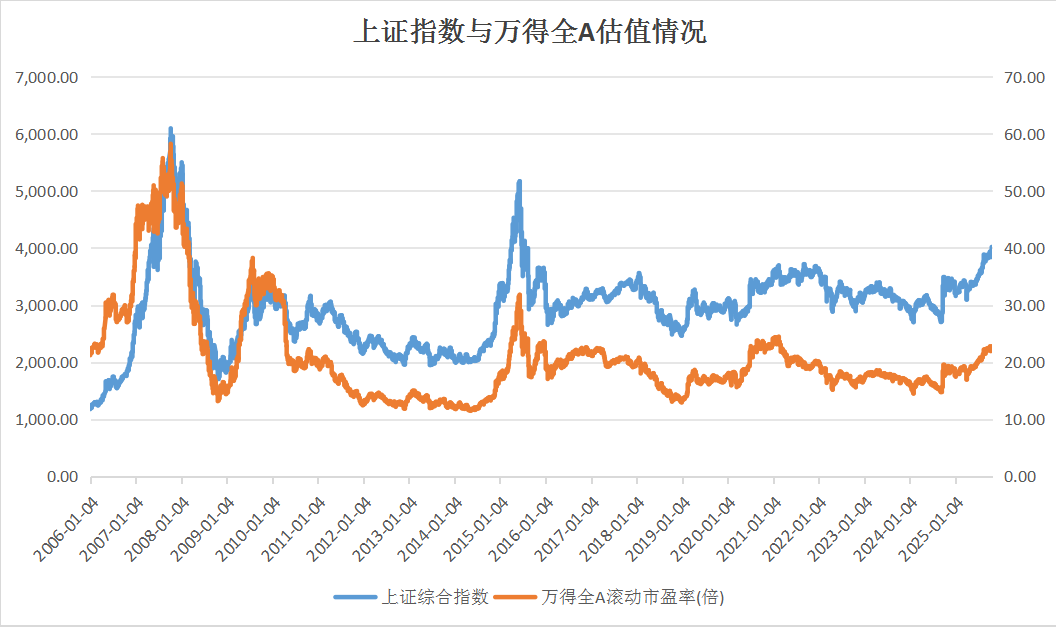
Core Viewpoint - The A-share market has reached a significant milestone, with the Shanghai Composite Index closing at 4016.33 points, marking the third time it has surpassed the 4000-point threshold in a decade, indicating a robust annual market trend [1][7]. Market Overview - As of October 29, the A-share market comprises 5444 listed companies with a total market capitalization of 119.20 trillion yuan, a substantial increase from 2449 companies and 52.98 trillion yuan in 2015, and 1283 companies and 17.38 trillion yuan in 2007 [1]. - The rolling price-to-earnings (P/E) ratio for the entire A-share market is 22.66 times, and the price-to-book (P/B) ratio is 1.87 times, showing a decrease in valuation compared to previous peaks in 2015 and 2007 [1]. Valuation Metrics - Current A-share valuations are considered reasonable, with the financing balance reaching a historical high of 24,769.91 billion yuan, but the financing balance as a percentage of the circulating market value is only 2.53%, lower than in 2015 [3][7]. Sector Performance - The leading sectors in the current market rally from September 1, 2024, to October 29, 2025, include telecommunications (up 135.48%), electronics (up 112.62%), and the comprehensive sector (up 107.21%), with several other sectors also showing strong performance [5][6]. - In contrast, the previous major rallies saw non-bank financials, computers, and construction sectors leading the gains, indicating a shift towards technology-driven growth in the current cycle [5][6]. Market Dynamics - The current market structure has fundamentally changed compared to 2015, with a shift from a capital-driven market to one focused on real economic transformation and industrial structure optimization, reflecting a more rational valuation level [7]. - There is a notable increase in foreign capital allocation to Chinese assets, alongside a trend of domestic asset reallocation, contributing to enhanced market liquidity [7].
沪指站上4000点!五组数据,看这次有啥不一样
Zhong Guo Zheng Quan Bao· 2025-10-29 14:11
Core Viewpoint - The A-share market has reached a significant milestone, with the Shanghai Composite Index closing above 4000 points for the third time in its history, indicating a robust annual market trend and a shift in market dynamics compared to previous peaks [1][10]. Market Overview - As of October 29, the A-share market comprises 5444 listed companies with a total market capitalization of 119.20 trillion yuan, a substantial increase from 2449 companies and 52.98 trillion yuan in April 2015, and 1283 companies and 17.38 trillion yuan in May 2007 [1]. - The rolling price-to-earnings (P/E) ratio for the entire A-share market is 22.66 times, and the price-to-book (P/B) ratio is 1.87 times, showing a decrease in valuation compared to 23.63 times and 2.81 times in April 2015, and 47.32 times and 4.95 times in May 2007 [1]. Fund Flow Analysis - The financing balance in the A-share market reached a historical high of 24,769.91 billion yuan as of October 28, 2025, with a financing balance to circulating market value ratio of 2.53%, lower than the 3.87% ratio in April 2015 [3]. - The financing buy-in amount accounted for 11.93% of the A-share transaction volume, indicating a more cautious approach to financing compared to 15.12% in 2015 [3]. Sector Performance - The leading sectors in the current market rally from September 1, 2024, to October 29, 2025, include telecommunications (up 135.48%), electronics (up 112.62%), and the comprehensive sector (up 107.21%), with several other sectors also showing significant gains [5][8]. - In contrast, the previous market rallies saw non-bank financials, computers, and construction decoration sectors leading with gains of 190.77%, 174.36%, and 172.71% respectively from May 1, 2014, to April 10, 2015 [5][8]. Structural Changes - The current market structure has shifted from being driven by capital to focusing on the transformation and upgrading of the real economy and optimization of industrial structure, which is seen as a foundation for healthy market operation [9]. - The technology sector has gained a larger market capitalization share, with AI, semiconductors, and advanced manufacturing becoming the core themes, replacing traditional industries [10].

国泰海通|海外策略:加仓零售半导体,减仓硬件新消费——25Q3基金港股持仓点评
国泰海通证券研究· 2025-10-29 13:20
Core Insights - The issuance of investable Hong Kong stock funds has significantly rebounded in Q3 2025, reaching the highest level since Q1 2021 [2] - The active public fund's allocation to Hong Kong stocks has slightly decreased, with the market value proportion of Hong Kong stocks in active equity funds dropping from 20.0% in Q2 2025 to 19.2% in Q3 2025 [2] Fund Issuance - In Q3 2025, the issuance of public funds that can invest in Hong Kong stocks through the Stock Connect has increased on a month-on-month basis, marking a new high since Q1 2021 [2] Fund Positioning - The active public funds have slightly reduced their positions in Hong Kong stocks, with the market value proportion of Hong Kong stocks in their portfolios decreasing from 20.0% in Q2 2025 to 19.2% in Q3 2025 [2] - The allocation to Hong Kong small-cap stocks and technology stocks has increased, with the market value proportion rising by 1.1 and 3.0 percentage points respectively [2] Sector Analysis - In Q3 2025, public funds primarily increased their holdings in the retail, pharmaceutical, and non-ferrous metal sectors, focusing on concepts such as internet retail, semiconductors, and innovative pharmaceuticals [2] - Conversely, there was a reduction in holdings in the communication, computer, social services, light industry, and automotive sectors, which include concepts like communication equipment, new consumption, and new energy vehicles [2]

成立仅3个月,斥资10亿元收购上市川企,这家公司是什么来头?
Sou Hu Cai Jing· 2025-10-29 12:51
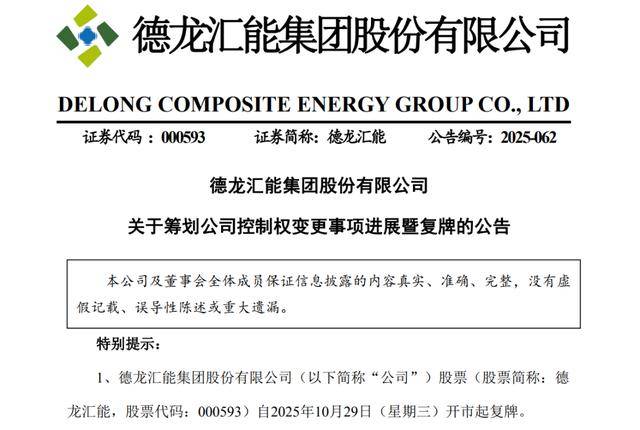
Core Viewpoint - Delong Huineng (000593) resumed trading today with a limit-up at 9.58 CNY per share, resulting in a total market capitalization of 3.436 billion CNY. The company announced a share transfer agreement where its controlling shareholder, Beijing Dingxin Ruitong Technology Development Co., Ltd., will transfer 106 million shares (29.64% of total shares) to Dongyang Noxin Chip Material Enterprise Management Partnership (Limited Partnership) for a total price of 1 billion CNY at 9.41 CNY per share [1][3]. Group 1: Share Transfer Details - The share transfer will change the controlling shareholder from Dingxin Ruitong to Noxin Chip Material, with the actual controller changing from Ding Liguan to Sun Weijia [3]. - Noxin Chip Material was established only three months ago and has not yet commenced business operations. Its limited partner, Dongyang Caizhi Industrial Development Co., Ltd., has a state-owned background and holds a 49% partnership share in Noxin Chip Material [3]. Group 2: Company Background and Financials - Delong Huineng, founded in 1993 and listed in 1996, primarily engages in urban pipeline gas supply, LNG/CNG production, and distributed energy investment and operation [6]. - In the first half of this year, Delong Huineng reported revenue of 889.6 million CNY, a year-on-year increase of 4.49%, while net profit attributable to shareholders decreased by 20.25% to 24.71 million CNY [7].

先锋精科2025年前三季度营收同比增长11.47%,持续加码研发投入巩固技术优势
Zheng Quan Shi Bao Wang· 2025-10-29 11:58
Core Viewpoint - Jiangsu Pioneer Precision Technology Co., Ltd. (stock code: 688605.SH) reported a steady performance in its Q3 2025 financial results, with total revenue of 969 million yuan, an increase of 11.47% year-on-year, and a net profit attributable to shareholders of 162 million yuan, indicating robust operational stability [1] Group 1: Financial Performance - The company achieved total revenue of 969 million yuan in the first three quarters of 2025, reflecting an 11.47% increase compared to the same period last year [1] - The net profit attributable to shareholders reached 162 million yuan, showcasing a solid operational performance [1] Group 2: Market and Industry Context - The performance of Pioneer Precision is closely tied to the semiconductor industry, which has seen a continuous demand release in 2025, particularly driven by AI and advanced process capacity expansion [1] - The domestic semiconductor equipment market is experiencing stable growth, with expectations for steady performance in the second half of the year as new production capacity is gradually released [3] Group 3: Research and Development - The company has increased its R&D investment, with R&D expenses reaching 53.617 million yuan in the first three quarters of 2025, a year-on-year increase of 14.32%, representing 5.54% of total revenue [1] - In Q3 2025 alone, R&D investment was 19.1299 million yuan, showing a significant year-on-year growth of 29.64% [1] Group 4: Capacity Expansion and New Business Development - Key projects for capacity expansion are underway, including the stable operation of new production lines and the completion of a new 30,000 square meter factory [2] - The company is diversifying its business by entering new fields such as aerospace surface treatment and medical device precision components, aiming to build a multi-business layout of "semiconductors + medical + aerospace" [2]
每日报告精选-20251029
GUOTAI HAITONG SECURITIES· 2025-10-29 11:56
Group 1: Market Trends - In Q3 2025, the issuance of public funds for Hong Kong stocks saw a significant recovery, reaching the highest level since Q1 2021[4] - The stock position of actively managed public funds slightly decreased to 85.6%, with Hong Kong stock holdings at 18.7%[6] - Public funds mainly increased their positions in retail, pharmaceuticals, and non-ferrous sectors, while reducing exposure to communications, computing, and new energy vehicles[4] Group 2: Real Estate Insights - Only 19% of cities showed signs of bottoming out in the real estate market, with second-hand housing outperforming new housing in transaction volume[14] - New housing prices continued to decline, with a significant drop in transaction volumes in second-tier cities, reflecting ongoing inventory pressure[16] - The inventory clearance cycle for first-tier cities increased to 19.9-21.1 months, while second-tier cities reached a new high of 24.8 months[16] Group 3: Steel Industry Overview - Steel prices showed mixed trends, with rebar prices decreasing by 20 CNY/ton to 3190 CNY/ton, while hot-rolled coil prices increased by 20 CNY/ton to 3300 CNY/ton[18] - The operating rate of blast furnaces in 247 steel mills rose to 84.71%, indicating a slight increase in production activity[19] - The average gross profit for rebar production increased to 126.1 CNY/ton, while hot-rolled coil profits decreased to 16.1 CNY/ton[20] Group 4: Logistics and E-commerce Performance - In September 2025, the national express delivery volume increased by 12.7% year-on-year, with SF Express leading the growth at 31.8%[29] - The express delivery industry saw a revenue increase of 7.2% in September, despite a decline in single-ticket revenue by 4.9%[31] - The industry concentration continued to rise, with the CR8 market share increasing to 86.9%[30]
暂停新客申购!私募巨头,最新宣布
券商中国· 2025-10-29 11:29
Core Viewpoint - Ningquan Asset announced the suspension of new investor subscriptions for all its funds starting from October 30, 2025, while existing investors can still make additional subscriptions. This move signals a cautious approach amidst market fluctuations [1][3]. Group 1: Company Background - Ningquan Asset was founded by Yang Dong in January 2018, with a registered capital of 20 million yuan. Yang has held significant positions in the financial sector, including General Manager of Xingye Securities and Xingquan Fund Management [3]. - The company has grown to be among the top tier of domestic stock private equity firms, with a management scale exceeding 40 billion yuan [3]. Group 2: Market Context - The Shanghai Composite Index recently surpassed 4,000 points, coinciding with Ningquan's decision to "seal" its funds, which may indicate a cautious stance in the current market environment [3]. - In its September report, Ningquan noted that the market was experiencing a structural rise, with significant gains in sectors like AI-related semiconductors and optical modules, while traditional industries lagged behind [4]. - The company expressed concerns about the rapid pace of market heating and the visible bubbles in popular sectors, although it acknowledged that there are still valuable investment opportunities available [4]. Group 3: Regulatory and Operational Notes - Ningquan Asset's "Ningquan Zhiyuan No. 55 Private Securities Investment Fund" faced a six-month restriction from participating in offline new share offerings, effective from June 20, 2025, to December 19, 2025 [4].