
短剧

Search documents
永不停歇的情绪工厂:字节造红果,平台驯化影视业
晚点LatePost· 2026-03-30 17:08
Core Viewpoint - The article discusses the rapid evolution and dominance of short dramas in the Chinese entertainment industry, highlighting the shift from traditional long-form content to short, efficient productions driven by platforms like Hongguo, which leverage free viewing models and data-driven content creation to attract massive audiences [3][20][22]. Group 1: Industry Dynamics - The short drama market is projected to surpass the Chinese film box office by 2024, indicating a significant shift in viewer preferences and industry focus [7]. - Hongguo, a platform developed by ByteDance, has disrupted traditional video platforms by offering free access and achieving over 100 million monthly active users within two years [3][20]. - The production cost for a short drama ranges from 300,000 to 800,000 yuan, significantly lower than that of long dramas, allowing for a higher volume of content creation [10][11]. Group 2: Production Efficiency - Short dramas are produced at an unprecedented pace, with some companies able to release over 1,000 new episodes monthly, which is four times the annual output of long dramas [9][10]. - The production process is highly streamlined, often taking only a week from script approval to filming completion, emphasizing efficiency and cost-effectiveness [8][12]. - The industry has adopted a "no idle personnel" approach, where every crew member is essential to maintaining production speed and reducing costs [8][10]. Group 3: Audience Engagement - The content of short dramas is designed to be immediately engaging, often featuring dramatic plot twists and high-stakes scenarios to capture viewer attention quickly [9][17]. - Audience preferences are continuously monitored through data analytics, allowing platforms to adapt content in real-time to meet viewer demands [18][28]. - The emotional resonance of short dramas reflects current societal sentiments, with themes evolving from revenge to familial warmth as societal conditions change [18][19]. Group 4: Market Competition - The competitive landscape has shifted, with smaller production companies now able to thrive due to lower barriers to entry and the ability to produce content quickly and cheaply [11][12]. - The traditional hierarchy in the film industry is being dismantled, allowing for more collaborative input from all crew members, which enhances creativity and efficiency [12][29]. - The rise of AI-driven content creation tools is beginning to impact the industry, potentially lowering production costs even further and changing the competitive dynamics [32][33].


大厂入局引爆AI漫剧,第一批跳槽的人工资涨10倍?
创业邦· 2026-03-06 03:29
Core Insights - The article discusses the rapid growth of AI-generated animated dramas (漫剧), highlighting their potential to replicate the success of short dramas in the entertainment industry [5][10][22]. - The market for animated dramas is projected to reach 240 billion yuan by 2026, reflecting a 45% increase from 2025 [8]. - The production costs for animated dramas have significantly decreased, allowing for faster production cycles and increased output [19][30]. Group 1: Market Dynamics - The animated drama market is experiencing explosive growth, with the number of productions increasing from dozens to 200 within a few months [5][10]. - Major players like ByteDance and Baidu are entering the market, leveraging existing IPs to quickly scale their offerings [11][18]. - The competition for talent has intensified, with companies offering salaries up to ten times higher to attract skilled workers in AI and content creation [13]. Group 2: Audience and Content Trends - The primary audience for animated dramas is younger males, with over 80% of popular titles targeting male viewers [17][18]. - The themes of animated dramas often include fantasy and adventure, resonating with the emotional needs of young male audiences [17][18]. - There is a notable gap in female-targeted content, which is seen as a potential growth area for the industry [18]. Group 3: Production Efficiency - The cost of producing a 100-episode animated drama can be kept under 150,000 yuan, significantly lower than traditional live-action dramas [19]. - AI technology has reduced production time from 90 days to approximately 10-13 days, enhancing the industry's capacity to meet demand [19][30]. - The integration of AI across various production stages is transforming the creative process, allowing for more efficient content generation [30][32]. Group 4: Monetization Strategies - Animated dramas are adopting similar monetization strategies as short dramas, including advertising, in-app purchases, and platform revenue sharing [22][30]. - The return on investment (ROI) for animated dramas is reportedly higher than that of short dramas, indicating strong financial potential [22]. - The industry consensus is leaning towards free content models, as users have become accustomed to consuming entertainment without direct payment [22]. Group 5: Future Outlook - The article suggests that the animated drama sector may experience a second wave of growth, driven by technological advancements and evolving audience preferences [21][33]. - There is potential for animated dramas to develop into interactive experiences, similar to video games, enhancing user engagement [33]. - The ongoing competition among major players indicates a dynamic and rapidly evolving landscape, with significant opportunities for innovation and market capture [11][33].

字节“弃子”,标价480亿
投中网· 2026-03-05 06:49
Core Viewpoint - The article discusses ByteDance's strategic decision to sell its gaming division, Mu Tong Technology, to Savvy Games Group for an estimated $6 billion to $7 billion, marking a significant shift in its business focus towards AI and other core areas [5][20]. Group 1: Transaction Details - ByteDance has reached a preliminary agreement with Savvy Games Group to sell its gaming division, Mu Tong Technology, with the deal expected to close in the first quarter of 2026 [5]. - The transaction is valued between $6 billion and $7 billion and includes several popular games, such as "Decision Peak" and others developed by Mu Tong [5][6]. - This sale is seen as a strategic asset restructuring rather than a simple divestment, as Mu Tong has been a significant player in the gaming market with a strong user base and revenue generation [6][7]. Group 2: Performance and Market Position - "Decision Peak" has achieved over 1.5 billion downloads globally and maintains a monthly active user count of over 110 million, indicating its strong market presence [6]. - The game has generated nearly $2.4 billion in revenue as of January 2024, contributing approximately $200 million in profit to ByteDance in 2024 [6][13]. - Despite its success, Mu Tong's reliance on "Decision Peak" for 86% of its revenue has raised concerns about its long-term sustainability and growth potential [13]. Group 3: Strategic Shift - ByteDance's decision to sell Mu Tong is part of a broader strategy to pivot away from the gaming sector, which has proven to be uncertain and resource-intensive [7][20]. - The company is focusing on AI and short video content, which are seen as more aligned with its core competencies and growth potential [20][29]. - Savvy Games Group's acquisition of Mu Tong aligns with Saudi Arabia's Vision 2030, which emphasizes the importance of gaming and esports in diversifying the economy [7][20]. Group 4: Historical Context - Mu Tong was founded by former Tencent employees and gained prominence by targeting overseas markets during a time when the domestic gaming market was booming [9][10]. - ByteDance acquired Mu Tong for approximately $4 billion five years ago, and the upcoming sale represents a significant profit margin for the company [6][11]. - The gaming division's performance has been inconsistent, with new titles failing to replicate the success of "Decision Peak," leading to strategic reassessments within ByteDance [13][27].

横店影视(603103):2025年业绩点评:大力发展短剧等创新业务,向以IP为核心的全链路运营模式转型
Guohai Securities· 2026-03-02 14:33
Investment Rating - The report maintains a "Buy" rating for the company [1][14] Core Insights - The company is transitioning to an "IP-centric full-link operation model" while significantly developing innovative businesses such as short dramas [2][12] - In 2025, the company reported revenue of 2.298 billion yuan, a year-over-year increase of 16.55%, and a net profit of 159 million yuan, compared to a loss of 96 million yuan in 2024 [5][6] Financial Performance - The company's revenue growth is driven by the overall growth of the film market, with the Chinese film market's box office reaching 51.831 billion yuan, a year-over-year increase of 21.95% [6][11] - The gross profit margin for 2025 was 14.84%, an increase of 11.63 percentage points year-over-year, while the expense ratio decreased to 7.40% [6][11] Business Segments - The box office revenue from the company's cinema operations was 2.14 billion yuan, a year-over-year increase of 24.8%, with a gross margin of 14.3% [9][10] - The company is focusing on enhancing non-ticket revenue streams, including food sales and IP derivative products, and is developing immersive XR cinema experiences [9][10] Future Projections - Revenue forecasts for 2026 to 2028 are 2.530 billion yuan, 2.697 billion yuan, and 2.859 billion yuan, respectively, with net profits projected at 249 million yuan, 319 million yuan, and 371 million yuan [11][13] - The company aims to leverage AI technology for IP development and content creation, enhancing its competitive edge in the market [10][12]

A股马年开门红:三大股指集体收涨,油气、化工爆发
Xin Lang Cai Jing· 2026-02-24 08:00
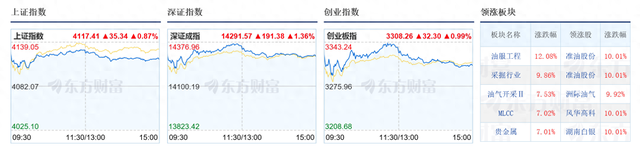
Market Performance - The A-share market experienced a collective rise on the first trading day of the Year of the Horse, with the Shanghai Composite Index closing at 4117.41 points, up 0.87% [1] - The Shenzhen Component Index closed at 14291.57 points, up 1.36%, and the ChiNext Index closed at 3308.26 points, up 0.99% [1] Trading Volume - The total trading volume in the Shanghai and Shenzhen markets was approximately 22020.62 billion yuan, an increase of about 2193.82 billion yuan compared to the previous trading day [2] - A total of 4006 stocks rose, while 1392 stocks fell, with 109 stocks hitting the daily limit up and 21 stocks hitting the daily limit down [2] Sector Performance - Industries such as MLCC, fiberglass, cultivated diamonds, precious metals, petroleum and petrochemicals, and coal mining saw significant gains [2] - Conversely, sectors like short dramas, intellectual property, film and television, film theaters, cultural media, and computers experienced notable declines [2] Individual Stock Highlights - The precious metals and petroleum sectors saw substantial increases, with Tongyuan Petroleum hitting the daily limit up, along with several other stocks such as Hunan Silver, China Oil Engineering, and Zhongman Petroleum [2] - The chemical sector also performed well, with Meibang Co. achieving a four-day limit up streak, and stocks like Hongbaoli, Hongqiang Co., Chengxing Co., and Jinpu Titanium hitting the daily limit up [2] - In contrast, film and theater concept stocks collectively fell, with companies like Light Media and China Film hitting the daily limit down [2]
孩子王(301078.SZ):目前暂无短剧相关业务布局
Ge Long Hui· 2026-02-12 16:05
Core Viewpoint - The company, Kidswant (301078.SZ), currently has no business layout related to short dramas, and its AI products are still in the early development stage, contributing a small proportion to the company's overall performance, thus not significantly impacting its financial results [1] Group 1 - The company has stated that it does not have any short drama-related business initiatives at this time [1] - The AI products of the company are in the initial development phase and represent a minor share of the overall business [1] - The current status of AI products does not have a major impact on the company's financial performance [1]
读客文化:公司持续关注行业发展动态
Zheng Quan Ri Bao Wang· 2026-02-12 11:39
Group 1 - The company is continuously monitoring industry trends, such as the popular short drama sector [1] - The company plans to align its strategies with its business development while making investments in relevant areas [1] - Currently, the company has a partnership with ByteDance's Tomato Novel platform for e-book licensing [1]
读客文化(301025.SZ):与字节跳动运营的番茄小说平台存在电子书授权业务合作
Ge Long Hui· 2026-02-12 07:06
Core Viewpoint - The company is actively monitoring industry trends, particularly in popular areas such as short dramas, and plans to align its business strategies accordingly [1] Group 1 - The company is focusing on the development dynamics of the industry [1] - The company is considering strategic layouts that align with its business and development status [1] - The company has an ongoing e-book licensing collaboration with the Tomato Novel platform operated by ByteDance [1]
华谊兄弟股价持续下跌,多重因素影响公司基本面
Jing Ji Guan Cha Wang· 2026-02-12 04:38
Core Viewpoint - Huayi Brothers' stock price continues to decline due to deteriorating fundamentals, increasing debt risks, and insufficient market confidence [1] Financial Performance - Huayi Brothers has reported losses for seven consecutive years since 2018, with a cumulative net loss exceeding 8.2 billion yuan [2] - Revenue for the first three quarters of 2025 was only 215 million yuan, a year-on-year decrease of 46%, with a net loss of 114 million yuan [2] - The core business of film and entertainment saw revenue drop to 443 million yuan in 2024, only 13% of the peak value of 3.374 billion yuan in 2017 [2] - In the first half of 2025, film and entertainment revenue fell by 50.37%, and the gross margin turned negative at -30.54% [2] Financial Condition - As of December 10, 2025, overdue debts reached 52.5 million yuan, exceeding 10% of the net assets for 2024 [3] - Some bank accounts have been frozen, with only 645,000 yuan available for daily operations, severely threatening operational viability [3] - The debt-to-asset ratio has been rising, reaching 87.69% by the end of the third quarter of 2025, with cash reserves around 50 million yuan and short-term loans nearing 200 million yuan, indicating significant repayment pressure [3] Executive Shareholding - The shares held by controlling shareholders Wang Zhongjun and Wang Zhonglei are all pledged or frozen, accounting for 13.81% of the total share capital [4] - In December 2025, Wang Zhongjun's 154 million shares (5.55% of total shares) were subject to judicial auction [4] - The second-largest shareholder, Alibaba Investment, reduced its stake by 1.06% in December 2025, bringing its holding below 5%, further undermining market confidence [4] Project Development - Assets acquired at high premiums in earlier years, such as real-life entertainment (e.g., Suzhou Movie World) and gaming (e.g., Hero Mutual Entertainment), have been continuously losing money and are now being sold at low prices [5] - In 2024, the company recognized asset impairment losses of 155 million yuan, which accounted for 33.2% of its revenue [5] - Revenue from diversified businesses (brand licensing, internet entertainment) is less than 1%, with negative gross margins, failing to provide effective support [5] Industry and Risk Analysis - The film industry saw a 28% year-on-year decline in box office revenue in 2024, but Huayi Brothers' decline was significantly steeper than the industry average [6] - The company's major films in 2025, such as "Towards the Sun" and "Lychee of Chang'an," performed poorly, shrinking its market share to less than 1% [6] - The company is overly reliant on traditional cinema models and has not adapted to new trends like streaming and short dramas, despite recent efforts to enter these areas [6] Recent Stock Performance - As of February 12, 2026, Huayi Brothers' stock price was 2.00 yuan, down 5.21% on that day, with a total market value of 5.549 billion yuan, having shrunk by over 90% since its peak in 2015 [7] - If the net assets for 2025 are negative, the company may face delisting risk warnings [7]

影视板块表现亮眼,光线传媒、欢瑞世纪、龙韵股份、中文在线、中国电影等领涨,影视板块相关上市公司整理
Jin Rong Jie· 2026-02-10 08:02
Core Viewpoint - The film and television sector has become a market focus, with strong momentum observed in individual stocks within the sector, including leading companies such as Light Media, Huanrui Century, Longyun Co., Chinese Online, and China Film [1]. Group 1: Company Highlights - Huanrui Century (000892.SZ) - Latest stock price: 8.97 yuan - Daily increase: +10.06% - Key highlight: A leading player in the short drama segment, focusing on film investment, production, distribution, and artist management [2]. - Longyun Co. (603729.SH) - Latest stock price: 21.60 yuan - Daily increase: +9.98% - Key highlight: Engaged in the development and distribution of TV dramas and variety shows, short video development, MCN operations, and artist management [3]. - Bona Film Group (001330.SZ) - Latest stock price: 12.47 yuan - Daily increase: +9.98% - Key highlight: A leading player with 30 years in the industry, the first domestic film distribution company, having produced and distributed over 300 films with a total box office exceeding 60 billion yuan [4]. - Jiecheng Co. (300182.SZ) - Latest stock price: 8.45 yuan - Daily increase: +20.03% - Key highlight: A leader in new media copyright authorization operations, also involved in AI creation, short dramas, content output, and IP derivatives [5]. - Chinese Online (300364.SZ) - Latest stock price: 42.34 yuan - Daily increase: +20.01% - Key highlight: Focused on short dramas and AI animation production, building a global short drama platform, and enhancing content production efficiency through its self-developed "Chinese Xiaoyao" AI model [6]. - Light Media (300251.SZ) - Latest stock price: 25.6 yuan - Daily increase: +20.00% - Key highlight: A leading player in domestic animation, transitioning from a "content film and television business" to an "IP creator and operator," constructing a "Chinese Myth Universe" and empowering content production with AI technology [7]. - China Film (600977.SZ) - Latest stock price: 10.58 yuan - Daily increase: Limit up - Key highlight: Holds a complete film industry chain with core qualifications for importing film distribution; its main business includes creation, distribution, screening, technology, and services, with all top 10 films of the year being either co-invested or distributed by it [8].
