
港股投资

Search documents
港股调整,短期不确定性有所增加
Guoyuan Securities2· 2025-10-13 11:24
Market Performance - The Hong Kong stock market experienced a decline of 3.13% last week, primarily driven by the underperformance of the consumer discretionary, technology, and healthcare sectors[1] - The materials sector, however, saw an increase of 1.08%, with a year-to-date gain of nearly 140%[1] - The net inflow of funds through the Hong Kong Stock Connect was HKD 2.645 billion, indicating a cautious market sentiment[1] Investment Environment - The external environment for the Hong Kong market remains stable, with strong structural bull market characteristics observed[2] - Recent inflation data from both China and the U.S. showed stable price levels, increasing expectations for a potential interest rate cut by the Federal Reserve in September[2] - The anticipated policy easing from the Federal Reserve may lead to corresponding supportive measures in China, which could bolster Hong Kong stock valuations in the medium to long term[2] Future Outlook - The primary external uncertainty facing the market is the escalation of U.S.-China tensions, particularly with new regulatory measures announced by both sides[3] - Despite the potential for increased volatility, the likelihood of the new tariffs being implemented is considered low, as both parties still have room for negotiation[3] - The current market conditions may present favorable entry points following short-term adjustments, with expectations for a quick recovery in Hong Kong stocks[3] Sector Analysis - The technology sector saw a significant decline of 5.83% last week, while the healthcare sector dropped by 6.33%[12] - In contrast, the utilities and energy sectors showed resilience, with gains of 1.57% and 1.37%, respectively[15] - The overall market sentiment is cautious, influenced by high valuation levels in certain sectors and profit-taking behavior among investors[7]
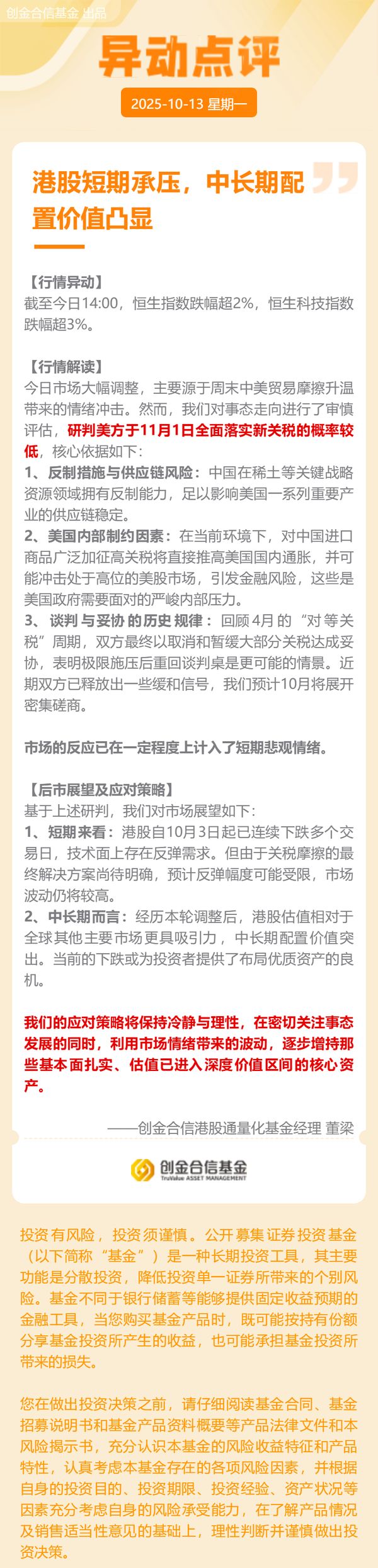
港股短期承压,中长期配置价值凸显
Xin Lang Cai Jing· 2025-10-13 06:43
Group 1 - The core viewpoint is that despite short-term volatility, Hong Kong stocks are currently attractive in terms of valuation, highlighting their medium to long-term investment value [1][4] - The market has already factored in some short-term pessimism, with expectations of a rebound due to technical factors, although the extent of this rebound may be limited by ongoing tariff disputes [3][4] - The current decline in Hong Kong stocks may present a good opportunity for investors to position themselves in quality assets, as valuations are more appealing compared to other major global markets [4] Group 2 - The historical pattern of negotiations suggests that after extreme pressure, parties are likely to return to the negotiation table, with recent signals indicating a potential for easing tensions and intensified discussions in October [3] - The strategy moving forward is to remain calm and rational, closely monitoring developments while gradually increasing holdings in fundamentally strong assets that are now in a deep value range due to market fluctuations [4]

港股短期波动属情绪面扰动 海外资金转向“买质量”
Zheng Quan Shi Bao· 2025-10-12 22:26
Core Viewpoint - The Hong Kong stock market is experiencing short-term fluctuations primarily driven by investor sentiment, rather than long-term investment decisions, with a cautiously optimistic outlook for the fourth quarter [3][4]. Market Trends - The Hang Seng Index saw a significant rise of over 1.6% on October 2, followed by a period of adjustment lasting five trading days [3]. - Various sectors, including chips, technology, innovative pharmaceuticals, and robotics, have recently reached historical highs before entering a downward adjustment phase [4]. Investment Strategy - The focus should be on companies' ability to deliver strong financial results and maintain strategic competitive advantages in the long term [4]. - The current market environment supports both economic fundamentals and company profit growth, with a reasonable valuation level [4]. - There is a notable shift in foreign investment strategies from "buying cheap" to "buying quality," particularly in high-end manufacturing, new energy, innovative pharmaceuticals, and robotics [5]. Foreign Investment Dynamics - There is an accelerating trend of foreign capital returning to the Hong Kong market, characterized by cautious and selective investment in companies with global competitive advantages [4][5]. - Recent upgrades in investment ratings for technology stocks by foreign institutions reflect growing optimism among overseas investors [4]. Sector Opportunities - The Hong Kong stock market is seen as having significant valuation and risk premium advantages compared to other markets like the US and Japan [5]. - The investment landscape is evolving, with a focus on sectors such as innovative pharmaceuticals, AI, high-end manufacturing, and upstream resources, particularly the "going out" trend of Chinese companies [8][9]. Historical Context - Over the past 15 years, the Hong Kong market has transformed from being a supplementary market to an essential component of global asset allocation, particularly highlighted by the 2020 surge in interest in Chinese internet companies [4]. Investment Methodology - The investment approach emphasizes identifying promising industries, understanding core competencies, and recognizing value before market consensus is reached [6]. - The "enhanced barbell strategy" balances growth and value investments, focusing on sustainable long-term growth and static undervaluation [8]. Emerging Trends - The shift from "export" to "going out" for Chinese companies is seen as revolutionary, enhancing their global business expansion and creating new investment opportunities [9].

大成基金柏杨: 港股短期波动属情绪面扰动 海外资金转向“买质量”
Zheng Quan Shi Bao· 2025-10-12 22:11
Core Viewpoint - The Hong Kong stock market has experienced fluctuations due to short-term investor sentiment changes, but the long-term outlook remains cautiously optimistic, supported by valuation advantages and strong ties to the mainland economy [1][2]. Market Trends - The Hong Kong stock market saw multiple sectors reach historical highs during the National Day and Mid-Autumn Festival holidays, followed by a downward adjustment [2]. - The recent adjustments in sectors such as chips, technology, innovative pharmaceuticals, and robotics are attributed to short-term market sentiment rather than fundamental issues [2]. Investment Strategy - The investment strategy emphasizes focusing on companies' long-term financial performance and competitive strength rather than short-term market movements [2]. - The current market environment is characterized by a balance of economic fundamentals, company profit growth, and reasonable valuation levels [2][3]. Foreign Investment Dynamics - Foreign investors are increasingly optimistic about Hong Kong stocks, with a trend of capital returning to the market, albeit cautiously and selectively [2][3]. - The shift in foreign investment from "buying cheap" to "buying quality" reflects a growing interest in leading companies in high-end manufacturing, new energy, innovative pharmaceuticals, and robotics [3]. Sector Opportunities - The Hong Kong stock market is seen as attractive in terms of valuation and risk premium compared to other markets like the US and Japan [3]. - The investment focus includes five key areas: overseas expansion, innovative pharmaceuticals, AI+, high-end manufacturing, and upstream resources [6][7]. A+H Companies - Nearly 80 A-share companies are applying to list on the Hong Kong Stock Exchange, covering various sectors such as pharmaceuticals, telecommunications, and automotive [7]. - The transition of Chinese companies from "export" to "overseas expansion" is viewed as revolutionary, enhancing their global influence and creating new investment opportunities [7].
大成基金柏杨: 港股短期波动属情绪面扰动海外资金转向“买质量”
Zheng Quan Shi Bao· 2025-10-12 22:04
Core Viewpoint - The Hong Kong stock market has experienced fluctuations due to short-term investor sentiment changes, but the long-term outlook remains cautiously optimistic for the fourth quarter, supported by valuation advantages and strong ties to the mainland economy [1][2]. Market Trends - The Hong Kong stock market saw several sectors reach historical highs during the National Day and Mid-Autumn Festival holidays, followed by a downward adjustment [2]. - The recent adjustments in sectors such as chips, technology, innovative pharmaceuticals, and robotics are attributed to short-term market sentiment rather than fundamental issues [2]. Investment Strategy - The investment strategy emphasizes focusing on companies' long-term financial performance and competitive strength rather than short-term market movements [2]. - The current market environment is characterized by a balance of economic fundamentals, company profit growth, and reasonable valuation levels [2][3]. Foreign Investment Dynamics - Foreign investors are increasingly optimistic about Hong Kong stocks, with a notable shift from "buying cheap" to "buying quality," particularly in high-end manufacturing, new energy, innovative pharmaceuticals, and robotics [3][5]. - The trend of foreign capital returning to Hong Kong stocks is accelerating, with a cautious and selective approach towards companies with global competitive advantages [2][3]. Sector Opportunities - The investment focus includes five key areas: overseas expansion, innovative pharmaceuticals, AI+, high-end manufacturing, and upstream resources, with a particular emphasis on the "going global" trend of Chinese companies [5][6]. - The market for traditional consumer sectors, such as e-commerce and travel, is also seen as having potential for discovering undervalued stocks [5]. A+H Company Listings - The trend of A+H companies listing in Hong Kong is gaining momentum, with nearly 80 A-share companies applying for listings, covering various industries such as pharmaceuticals, telecommunications, and automotive [6]. - The transition of Chinese companies from "export" to "going global" is viewed as revolutionary, enhancing their revenue, profit, and global influence [6].
金融工程周报:短期略有超买,逢调积极布局-20251009
Huaxin Securities· 2025-10-09 10:10
- The report introduces a multi-dimensional quantitative stock selection model for Hong Kong stocks, focusing on factors such as price-volume, cash flow, quality growth, and shareholder returns. Among these, shareholder returns and low volatility are identified as the only two long-term effective styles. Specific factors include 12-month annualized volatility, total asset cash recovery rate, shareholder returns (dividend yield + buyback ratio), ROE volatility, and year-over-year ROE_TTM, all of which demonstrate strong stock selection performance[5][19][24] - A systematic quantitative timing model for Hong Kong stocks is also discussed, which selects effective signals from single-factor tests. These signals include the OECD China Economic Leading Indicator, the put-call ratio (PCR) of Hang Seng Index options, and net foreign capital inflows. The model assigns scores based on these indicators, with a composite score above 0.5 signaling a buy for the Hang Seng Index, and below 0.5 signaling a sell[24][42][43] - The report highlights the performance of the Hong Kong "Golden Stock" portfolio, which achieved an absolute return of +107.51% since November 2024, outperforming the Hang Seng Index by +74.83%. Additionally, the "Hong Kong Quantitative Selection 30" portfolio delivered an absolute return of +41.43%, outperforming the Hong Kong High Dividend Index by +26.95%[5][19][22]
外资或进一步增持,基金经理看好港股三大方向
Sou Hu Cai Jing· 2025-10-08 23:31
Core Viewpoint - The Hong Kong stock market is experiencing increased attention from investors, particularly following the initiation of a new interest rate cut cycle by the Federal Reserve, which is expected to enhance liquidity and attract foreign capital into the market [1] Group 1: Market Performance - During the National Day holiday, the A-share market was closed, leading to heightened focus on the performance of the Hong Kong stock market [1] - The Hang Seng Index rose over 1.6% on October 2, but subsequently faced three consecutive days of adjustment [1] Group 2: Investment Sentiment - There is a consensus among public fund institutions to increase allocations to the Hong Kong stock market, driven by its valuation advantages and close linkage to the mainland economy [1] - Industry insiders indicate a significant increase in the willingness of external funds to flow into the Hong Kong stock market, suggesting that Chinese assets represented by Hong Kong stocks may see further accumulation by foreign investors [1]
美联储降息后,最超预期的市场竟是它?
Ge Long Hui· 2025-10-05 10:08
Group 1 - The core message highlights the unexpected surge of the Hong Kong stock market, driven by the Federal Reserve's interest rate cut, AI performance explosion, and extremely low valuations, leading to significant capital inflows [2][4][5] - The Hang Seng Technology Index has reached a 30% valuation percentile over the past decade, indicating it is significantly undervalued compared to its historical levels and other global markets [5] - Southbound capital inflows have surged, with a net purchase of over 160 billion yuan in September alone, indicating a strong demand for Hong Kong stocks, particularly in the internet and AI sectors [4][5] Group 2 - Major tech companies in Hong Kong are heavily investing in AI, transforming it from a concept into a cash-generating machine, with Alibaba, Baidu, and JD.com announcing substantial AI-related investments [7][8] - Companies are focusing on self-developed chips to reduce costs and enhance performance, which is crucial for survival in the competitive AI landscape [7] - The shift in market dynamics suggests that the Hong Kong stock market is no longer merely following trends but is now a primary destination for investment, particularly in the AI sector [9]



港股四季度怎么投?基金经理这样说
Zhong Guo Zheng Quan Bao· 2025-10-03 00:18
Group 1 - The core viewpoint of the articles is that the Hong Kong stock market is expected to benefit from the new round of interest rate cuts initiated by the Federal Reserve, leading to increased foreign investment in Chinese assets, particularly in Hong Kong stocks [1][2]. - Several public funds have reached a consensus to increase their allocation to Hong Kong stocks, indicating a significant enhancement in the willingness of external funds to flow into the Hong Kong market [1][2]. - The Hong Kong stock market has seen a strong performance this year, driven by valuation recovery, confidence restoration, and a shift in global monetary policy [2][4]. Group 2 - The recovery in valuations is attributed to improved earnings from major internet companies, which have exceeded expectations since last year's third-quarter reports [2]. - Global monetary policy changes, particularly the Federal Reserve's new interest rate cut cycle, are expected to favor emerging markets, including Hong Kong stocks [2]. - The influx of capital into the Hong Kong market is supported by increasing demand from mainland investors for undervalued assets [2][4]. Group 3 - The Hang Seng Technology Index has been highlighted as a key area of interest, with fund managers noting its long-term potential despite recent volatility due to increased competition and external uncertainties [4][5]. - The distinction between Hong Kong and A-share technology sectors is emphasized, with Hong Kong focusing more on AI applications and software, which may attract investor interest as the market shifts [4][5]. - The valuation of the Hang Seng Technology Index is currently at a relatively low level, providing a favorable investment opportunity [5]. Group 4 - New consumption sectors, such as trendy toys, new tea drinks, and beauty products, are expected to maintain high growth rates and remain attractive to investors [6]. - The innovative pharmaceutical sector is also a focus, with expectations of improved financing activities due to interest rate cuts, potentially leading to a turning point for the CXO sector [6][7]. - Despite recent volatility in the innovative drug market, confidence remains high among fund managers regarding the long-term prospects of quality pharmaceutical companies [7].
华安国证港股通消费主题ETF(159285):促服务消费若干措施出台,港股通消费迎配置良机
Changjiang Securities· 2025-09-24 14:11
- The Guozheng Hong Kong Stock Connect Consumer Theme Index is constructed using the Paasche weighted method and is calculated daily on a chained basis[3][11][39] - The index selects stocks from the Hong Kong Stock Exchange that meet specific criteria, such as being involved in consumer-related industries (e.g., apparel, jewelry, home appliances, food and beverages) and having mutual market access qualifications[43] - The index excludes stocks with abnormal price fluctuations, significant financial issues, or major operational problems in the past year[43] - The index selects the top 50 stocks based on the highest average daily market capitalization over the past year, after removing the bottom 10% in terms of average daily trading volume[43] - The Guozheng Hong Kong Stock Connect Consumer Theme Index has a cumulative return of 24.22% since its base date (December 31, 2014) as of September 16, 2025, outperforming the Hang Seng Equal Weight Index (-7.82%) and the Hang Seng Index (12.00%)[71] - The index's PE (TTM) ratio is 19.30 as of September 16, 2025, which is lower than 80.88% of the time since its launch on April 11, 2022, indicating a relatively undervalued state[75][77]