硬科技

Search documents
市场大幅回调,关注A500ETF易方达(159361)、沪深300ETF易方达(510310)等产品投资机会
Sou Hu Cai Jing· 2026-01-30 05:06
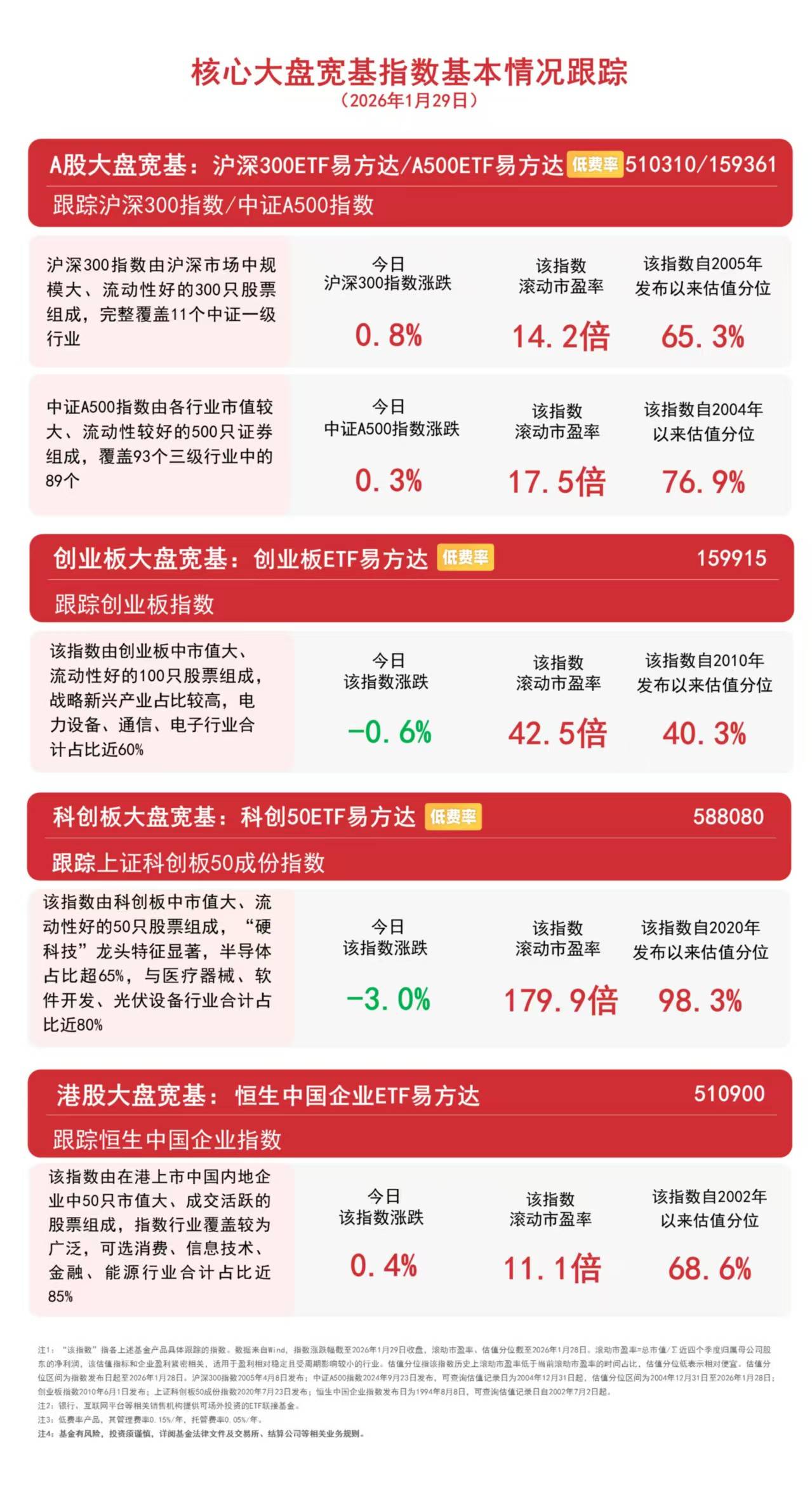
Group 1 - The A-share market showed mixed performance with the Shanghai Composite Index down by 1.19% in the morning session, while the total market turnover reached 1.95 trillion yuan [1] - The sectors that performed actively included agriculture, forestry, food, film and theater, tourism and hotels, CPO, paper, and semiconductors, whereas precious metals, non-ferrous metals, rare earth permanent magnets, photovoltaic equipment, oil and gas extraction and services, chemicals, real estate, steel, and AI application concept stocks saw significant declines [1] - The ChiNext Index decreased by 1.4%, the CSI 300 Index fell by 1.0%, while the ChiNext Index rose by 0.8%, and the STAR Market 50 Index dropped by 0.6% [1] Group 2 - The ChiNext ETF tracks the ChiNext Index, which consists of 100 stocks with high market capitalization and liquidity, with a significant proportion in strategic emerging industries, particularly in power equipment, communications, and electronics, accounting for nearly 60% [4] - The STAR 50 ETF tracks the STAR Market 50 Index, composed of 50 stocks with high market capitalization and liquidity, prominently featuring "hard technology" leaders, with semiconductors making up over 65%, and combined with medical devices and software development, accounting for nearly 80% [4]

盛景嘉成:以耐心资本赋能 护航新经济创新远航
Jing Ji Guan Cha Wang· 2026-01-30 04:31
Group 1 - The core viewpoint of the articles highlights the innovative investment strategies and strong industry presence of the company, 盛景嘉成, which focuses on technology innovation and has established a diverse investment matrix globally [1][2][3] - 盛景嘉成 has invested in numerous successful companies, including国联股份, 康龙化成, and 德方纳米, with a total asset management scale exceeding 14 billion yuan and 274 portfolio companies successfully listed [1] - The company has developed a unique empowerment system that integrates large enterprises' resources with innovative teams, particularly in fields like gene cell drugs and semiconductor equipment [2] Group 2 - 盛景嘉成 has successfully issued technology innovation bonds in the interbank bond market, reflecting high trust from the capital market and recognition of its investment performance [3] - The company aims to focus on core sectors such as AI, embodied intelligence, semiconductors, life sciences, and low-altitude economy, linking global innovation resources to drive China's technological progress and industrial upgrading [3] - Through initiatives like the GIA Global Innovation and Entrepreneurship Awards and industry forums, the company enhances communication between entrepreneurs and investors, amplifying the effects of innovation empowerment [2]
一亿元捐赠背后:为什么硬科技需要“动手”的年轻人?
Jing Ji Guan Cha Wang· 2026-01-30 02:37
Core Viewpoint - A Shenzhen high-tech company, Tuozhu Technology, announced a donation of 100 million RMB to 10 universities, including both traditional engineering schools and a vocational college, Shenzhen Polytechnic, highlighting a shift in talent sourcing in the hard technology sector [1][2]. Group 1: Employment Landscape - The donation reflects the current employment environment where there is a mismatch between the skills of job seekers and the needs of employers, particularly in high-tech manufacturing [3][4]. - The number of college graduates in China is expected to reach 12.22 million by 2025, while youth unemployment rates remain high, indicating a structural issue in the job market [3][4]. - There is a significant demand for high-skilled talent in the hard technology sector, with job postings in high-end equipment increasing by 37.3% year-on-year [3][4]. Group 2: Talent Demand and Supply - The hard technology industry is experiencing a shift in hiring logic, moving away from a strict focus on academic credentials to valuing practical skills and hands-on experience [6][10]. - Companies like BYD and Luxshare Precision are actively seeking skilled technicians, indicating a growing recognition of the importance of practical experience over formal education [11][12]. - The demand for embedded software developers and hardware engineers is rising, but many young graduates prefer administrative roles, leading to a dual challenge of recruitment difficulties and high unemployment [12][17]. Group 3: Educational Institutions and Industry Needs - Shenzhen Polytechnic is positioned as a key player in bridging the gap between education and industry needs, producing graduates who are equipped with practical skills relevant to the hard technology sector [16][20]. - The institution's curriculum is designed to align with the demands of the local manufacturing industry, emphasizing hands-on experience and practical problem-solving [20][21]. - The inclusion of vocational colleges in donation lists signifies a recognition of their role in developing a skilled workforce that meets the evolving needs of the technology sector [21][24]. Group 4: Practical Experience and Problem-Solving - The ability to solve practical engineering problems is becoming increasingly valuable in the hard technology sector, as evidenced by the experiences of graduates who excel in hands-on roles [9][10]. - Companies are finding that graduates with practical experience, such as those involved in robotics competitions, are often more capable than their peers with higher academic credentials [12][14]. - The collaboration between graduates from vocational colleges and top-tier universities in problem-solving scenarios illustrates the importance of diverse skill sets in modern engineering teams [24][25].
一亿元捐赠背后:为什么硬科技需要“动手”的年轻人?
经济观察报· 2026-01-30 02:30
Core Viewpoint - The Chinese manufacturing industry requires both visionary scientists and practical engineers to achieve mutual success and provide substantial returns within the same enterprise, which is essential for the development of the next generation of technology manufacturing [1][27]. Group 1: Educational Contributions - A high-tech company in Shenzhen announced a plan to donate 100 million RMB to 10 universities, including both traditional engineering schools and a vocational college, indicating a shift in talent sourcing [2][3]. - The donation list reflects the company's internal talent data, highlighting the importance of practical skills in the fields that these institutions cultivate [3]. Group 2: Employment Landscape - The employment environment has become increasingly challenging, with a significant number of graduates (12.22 million by 2025) facing high youth unemployment rates (16%-18%) [5]. - There is a structural mismatch in skills, where general office workers are abundant, but there is a shortage of high-skilled talent in hard technology sectors [6]. Group 3: Industry Needs - The hard technology sector, characterized by rapid growth in areas like 3D printing and robotics, has distinct talent requirements that differ from the internet era, necessitating a focus on practical skills [7]. - Companies are increasingly recognizing the value of hands-on experience over academic credentials, especially in precision manufacturing where practical problem-solving is crucial [9][10]. Group 4: Talent Development - Companies like BYD and Luxshare Precision are actively recruiting high-skilled technicians, emphasizing the importance of practical experience over traditional academic qualifications [14][15]. - The demand for embedded software developers and hardware engineers is rising, while many graduates still prefer administrative roles, leading to a dual challenge of recruitment difficulties and employment issues in manufacturing [15]. Group 5: Educational Evolution - Shenzhen Vocational University has transitioned to a vocational undergraduate institution, reflecting a broader redefinition of talent roles in the manufacturing sector [19][20]. - The evolution of the manufacturing industry in Shenzhen has shifted from labor-intensive processes to automated and innovative hard technology, requiring a new breed of technical talent [22]. Group 6: Practical Experience - Students from vocational institutions are gaining practical experience through competitions and projects, making them more attractive to employers compared to those with high academic scores but less hands-on experience [16][17]. - The integration of practical training in educational settings ensures that graduates are job-ready, reducing the need for extensive training by employers [23]. Group 7: Industry Collaboration - The collaboration between different educational institutions and companies is essential for creating a comprehensive talent map that meets the needs of the hard technology sector [23][24]. - The combination of hardware and software skills is critical for the success of technology companies, with a focus on practical problem-solving capabilities [26][27].

2026上海大学企业家商学院年度盛典圆满落幕,共话企业未来新航向
Sou Hu Cai Jing· 2026-01-30 02:15
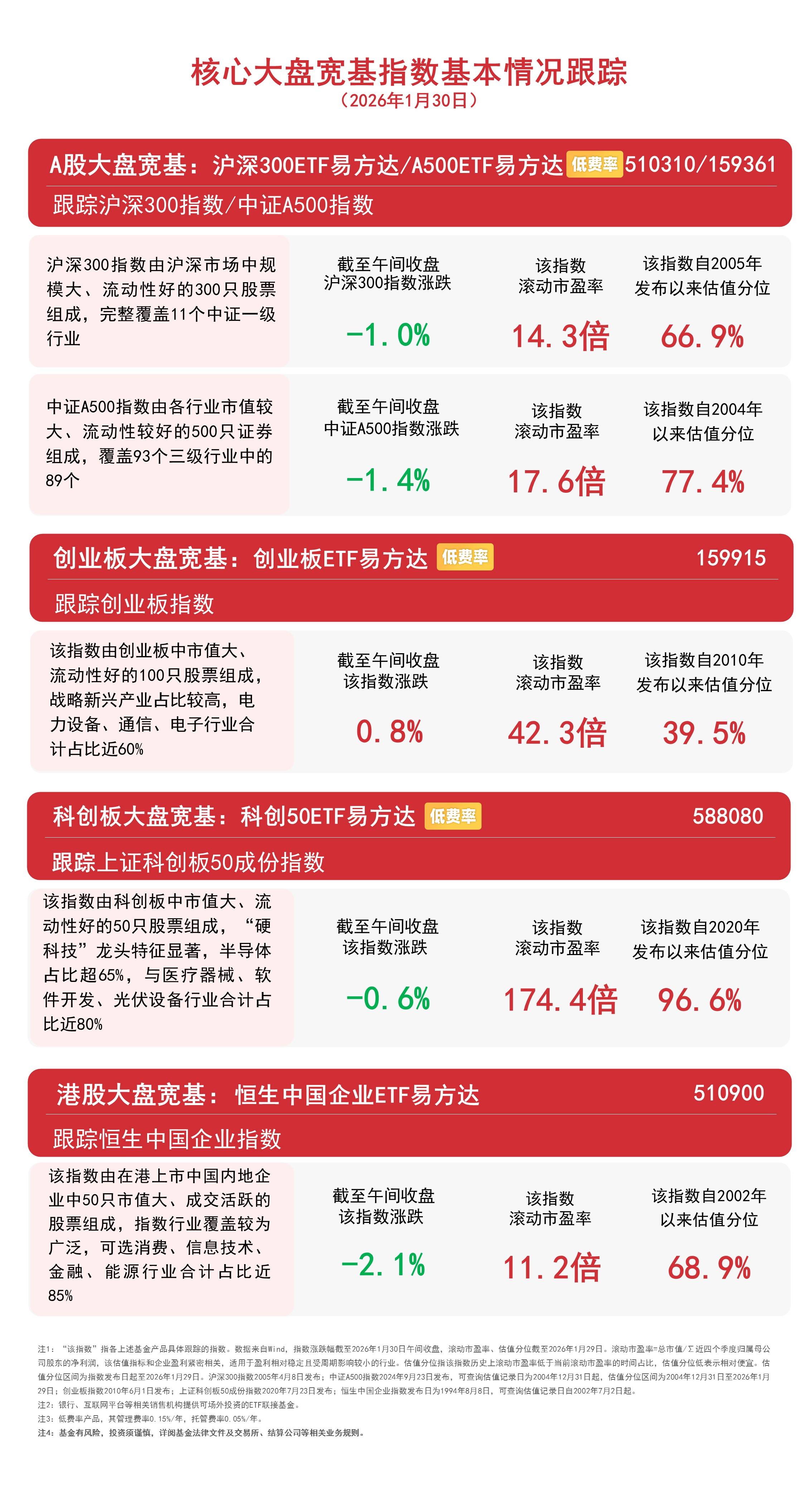
Group 1 - The global economic growth momentum is undergoing a significant shift, with Chinese entrepreneurs facing a "tide era" filled with volatility and uncertainty [1] - The "Tide·Lighthouse" 2026 Shanghai University Entrepreneur Business School Annual Ceremony was held in Beijing, focusing on practical training combined with theoretical discussions for over 300 entrepreneurs [1][3] - The event featured prominent economists and entrepreneurs discussing macroeconomic trends, policy interpretations, and practical business operations, providing a framework for understanding the changing times [3] Group 2 - Economist Xiang Songzuo analyzed global and Chinese macroeconomic trends, highlighting the increasing uncertainty and the divergence between traditional industries and emerging sectors like AI, semiconductors, and innovative pharmaceuticals [3][5] - He emphasized that uncertainty presents opportunities for entrepreneurs to create value, urging them to focus on the "14th Five-Year Plan" priorities and leverage financial tools to navigate economic transitions [5] - Zhang Aoping provided insights into the new policy dividend release logic, detailing the "three-four-seven-twelve" policy cycle and the importance of aligning business development with national needs [5][7] Group 3 - The event adopted a "entrepreneurs teaching entrepreneurs" model, focusing on practical applications through real-world case studies and site visits [8] - Keynote speaker Song Zhiping discussed the importance of desire for success and lifelong learning among Chinese entrepreneurs, emphasizing the need to focus on core competitiveness and sustainable growth [8][10] - The event included practical sharing from various entrepreneurs in sectors like health, international business, and education, highlighting actionable strategies for navigating challenges [10] Group 4 - The ceremony served as a platform for knowledge exchange and collaboration, with a focus on creating an ecosystem for entrepreneurs [12] - The Shanghai University Entrepreneur Business School aims to empower growth-oriented entrepreneurs through practical experiences and resource sharing, distinguishing itself from traditional educational models [14] - The school announced strategic directions for 2026, focusing on profitability, quality of life, and succession planning for the next generation of entrepreneurs [14][16] Group 5 - The event culminated in the signing of strategic cooperation agreements with various organizations to enhance support for entrepreneurs in policy research, industry implementation, and international exchange [18][22] - The Shanghai University Entrepreneur Business School is transitioning from a teaching platform to a collaborative ecosystem, aiming to provide comprehensive support for entrepreneurs [22][23] - The school plans to integrate insights from the annual event into its curriculum, focusing on practical training and cross-industry discussions to guide entrepreneurs through changing economic landscapes [23]
冲上万亿!南山一路攀登永似少年 解码如何从“土地有限”迈向“发展无限”
Shen Zhen Shang Bao· 2026-01-29 17:37
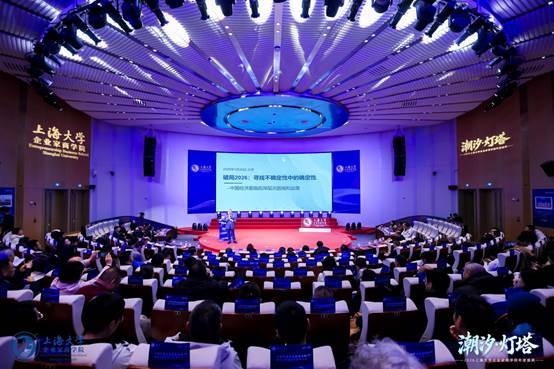
Core Insights - Nanshan District is set to become the first district in China to surpass a GDP of 1 trillion yuan by 2025, contributing over 25% of Shenzhen's economic output with less than 10% of its land area [5][6] - The district's economic growth is characterized by a balanced approach involving investment, consumption, and exports, which collectively form a "stability triangle" against economic fluctuations [5][6] Economic Performance - Nanshan's GDP growth during the 14th Five-Year Plan period is projected to exceed 5.8% annually, with the district achieving 12 economic indicators ranked first in Shenzhen [5][6] - The total investment in projects signed in Nanshan for 2025 is expected to exceed 150 billion yuan, accounting for nearly 20% of Shenzhen's global investment conference total [6] Industrial Structure - Strategic emerging industries now account for 60% of Nanshan's GDP, showcasing a robust industrial structure [7][9] - The district hosts over 200 robotics companies, forming a collaborative ecosystem that enhances innovation and productivity [7][9] Innovation Ecosystem - Nanshan's innovation is driven by a unique ecosystem where large enterprises, SMEs, and innovative startups coexist, fostering a strong internal growth dynamic [8][10] - The district's R&D intensity has reached 7.87%, nearly three times the national average, with a high local conversion rate of R&D results exceeding 60% [9][10] Future Growth Areas - Nanshan is focusing on three future growth areas: low-altitude economy, embodied intelligence, and synthetic biology, aiming to cultivate new economic engines for the next decade [14] - The establishment of the Guangdong Provincial Laboratory for embodied intelligence and the development of low-altitude economic zones are part of Nanshan's strategic initiatives [14] Land Utilization and Development - Nanshan is leveraging limited land resources through innovative projects like the "industrial building up" model, which integrates manufacturing and R&D vertically [12] - The district's GDP per square kilometer is projected to reach 54 billion yuan by 2025, significantly higher than global benchmarks such as Silicon Valley and Singapore [12]
资本长情陪伴 北京金融科技共生成长
Bei Jing Shang Bao· 2026-01-29 14:47
Core Viewpoint - Beijing is positioning itself as the "global artificial intelligence capital" during the "15th Five-Year Plan" period, focusing on the integration of finance and hard technology to foster innovation and high-quality development [3][12]. Group 1: Financial Support for Hard Technology - Financial support for hard technology is evolving from traditional metrics of "heavy reports and collateral" to a focus on "technology and potential," enabling startups to access necessary funding [4][7]. - The successful IPO of the domestic GPU leader, Moore Threads, exemplifies the deep financial support that hard tech companies require, highlighting the importance of equity financing in their early stages [4][5]. - The China Bank Beijing Branch plans to provide at least 50 billion yuan in comprehensive financial support for the artificial intelligence industry over the next three years, demonstrating a commitment to nurturing the sector [6][11]. Group 2: Challenges in Financing Hard Technology - Hard technology companies often face challenges in securing financing due to their asset-light nature and high R&D costs, making traditional financing routes difficult [7][8]. - Many banks are adapting their services to better meet the needs of hard tech firms, focusing on understanding the technology's value rather than relying solely on financial statements [8][10]. - The shift towards a more supportive financial ecosystem is crucial for the growth of hard technology companies, as they often lack the collateral typically required for loans [7][9]. Group 3: Collaborative Growth and Innovation - The integration of finance and hard technology is seen as a "marathon," requiring sustained support rather than quick wins, which is essential for the long-term success of these companies [3][10]. - Banks are increasingly forming partnerships with technology firms, research institutions, and investment entities to create a comprehensive support system that addresses the unique needs of hard tech [11][12]. - The collaborative approach aims to enhance the overall efficiency of financial services while ensuring that hard technology firms receive the necessary backing to thrive in a competitive landscape [10][11].
斥资近10亿港元!险资掘金港股IPO,看好哪些领域?
Guo Ji Jin Rong Bao· 2026-01-29 13:19
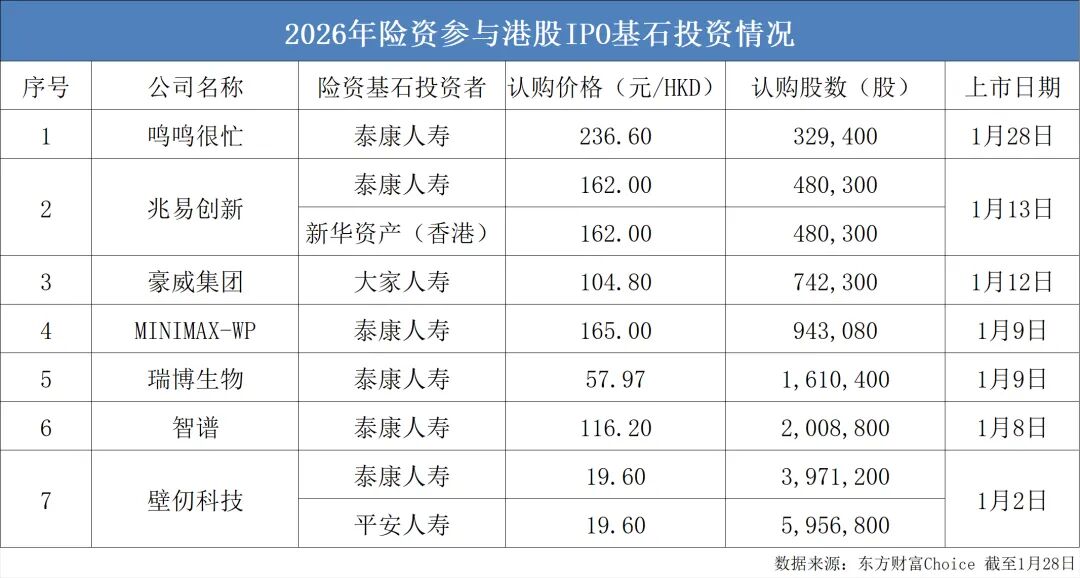
Core Viewpoint - Insurance capital is increasingly participating in Hong Kong IPOs as a response to low interest rates and asset allocation pressures, with significant investments from major insurance firms like Taikang Life and Ping An Life [1][4]. Group 1: Insurance Capital Participation - In 2026, four insurance institutions, including Taikang Life and Ping An Life, have participated in cornerstone investments for seven Hong Kong IPOs, totaling approximately 9.88 billion HKD [1][2]. - Taikang Life has invested a total of 716 million HKD across six IPOs, with individual investments in companies like Mingming Hen Mang and Wallen Technology [3][4]. - Other insurance firms, such as Ping An Life and Xinhua Asset (Hong Kong), have also engaged in cornerstone investments, indicating a broader trend among insurance capital [4]. Group 2: Market Dynamics and Investment Strategy - The shift in insurance capital's participation in Hong Kong IPOs is attributed to a combination of asset allocation pressures and changes in market conditions, with a focus on high-quality, growth-oriented companies [4][5]. - The current environment allows insurance capital to acquire long-term equity assets through IPO participation, which is seen as a more efficient method to gain exposure to the market [5]. - The focus of insurance capital is on sectors like hard technology and new consumption, aligning with national strategic directions and offering potential for long-term returns [6][7]. Group 3: Future Outlook - The trend of insurance capital participating in Hong Kong IPOs is expected to continue in 2026, driven by low interest rates and supportive policies for long-term capital inflow [9]. - Future participation is likely to become more selective, focusing on leading companies and verifiable profit paths, transitioning from broad participation to strategic allocation [9].
上海临港:公司已累计推动对字节跳动、商汤科技等一批知名企业的产业投资
Zheng Quan Ri Bao Wang· 2026-01-29 13:16
Core Viewpoint - The company positions itself as an "integrated service provider and general operator for park innovation ecology," focusing on three leading industries: integrated circuits, biomedicine, and artificial intelligence [1] Group 1: Investment Strategy - The company is actively building an industrial investment matrix around key industries, enhancing its investment attributes towards chain-leading enterprises, unicorns, and gazelle companies [1] - It has successfully promoted investments in well-known companies such as ByteDance, Jiangbolong, Biren Technology, and SenseTime [1] Group 2: Investment Platforms and Focus Areas - The "Shanghai Lingang Ciyuan Venture Capital Fund" serves as the core platform for the company, which emphasizes strengthening its layout and cultivation of cutting-edge and disruptive technologies [1] - The company is increasing its investment support for key industries within the park, concentrating on forward-looking layouts for potential "hard tech" enterprises [1]

沪指窄幅震荡,关注A500ETF易方达(159361)、沪深300ETF易方达(510310)等产品投资价值
Sou Hu Cai Jing· 2026-01-29 11:03
1月29日,A股三大指数涨跌不一,沪指窄幅震荡收出三连阳,全市场成交额超3.2万亿元。板块题材上,白酒、贵金属、油气开采及服务、文化传媒、AI应 用、房地产、保险、银行、猪肉、旅游及酒店板块涨幅居前,光刻机、半导体、CPO、铜缆高速连接、电网设备、PEEK材料等泛科技概念股跌幅居前;港 股走势分化,恒生指数再度创下近4年新高,消费股领涨。 截至收盘,中证A500指数上涨0.3%,沪深300指数上涨0.8%,创业板指数下跌0.6%,上证科创板50成份指数下跌3.0%,恒生中国企业指数上涨0.4%。 | 沪深300指数由沪深市场中规 | マ日 | 该指数 | 该指数 | | --- | --- | --- | --- | | 模大、流动性好的300只股票 | 沪深300指数涨跌 | 滚动市盈率 | 发布以求 | | 组成,完整覆盖11个中证一级 | | | | | 行业 | 0. 8% | 14.2倍 | 65 | | 中证A500指数由各行业市值较 | マ日 | 该指数 | 该指数 | | 大、流动性较好的500只证券 | 中证A500指数涨跌 | 滚动市盈率 | 以来信 | | 组成,覆盖93个三级行业中的 ...