
超级智能

Search documents
英伟达向OpenAI投资千亿美元,400万GPU打造“超级智能”
Hu Xiu· 2025-09-23 00:37
Core Insights - Nvidia and OpenAI have announced a strategic partnership and a significant investment of up to $100 billion to support OpenAI's AI data center plans [1][20]. Group 1: Partnership Details - OpenAI plans to build and deploy a system requiring 10 gigawatts (GW) of Nvidia systems [2]. - The first phase of the data center will consume 1 GW and is set to be deployed in the second half of 2026, with Nvidia's initial $10 billion investment occurring upon completion of the first 1 GW system [6][15]. - The partnership is structured to ensure that funding aligns with the deployment of GPU usage, providing a gradual payment to OpenAI as the project progresses [7]. Group 2: Economic Rationale - Building a 1 GW data center is estimated to cost between $50 billion and $60 billion, with approximately $35 billion allocated specifically for Nvidia's chips and systems [15][16]. - This investment highlights Nvidia's significant role in OpenAI's infrastructure development, ensuring mutual benefits for both companies [17]. Group 3: Market Impact - Following the announcement, Nvidia's stock price surged, with a market capitalization of approximately $4.46 trillion [10]. - OpenAI's anticipated revenue for this year is projected to reach $13 billion, a more than threefold increase from last year's $4 billion [28]. Group 4: Future Projections - OpenAI's revenue forecast for 2030 has been raised by about 15%, potentially exceeding $200 billion, surpassing the recent revenue performances of Nvidia and Meta [29]. - The collaboration is expected to significantly impact the AI infrastructure landscape, marking the beginning of a new era in AI investment [32].


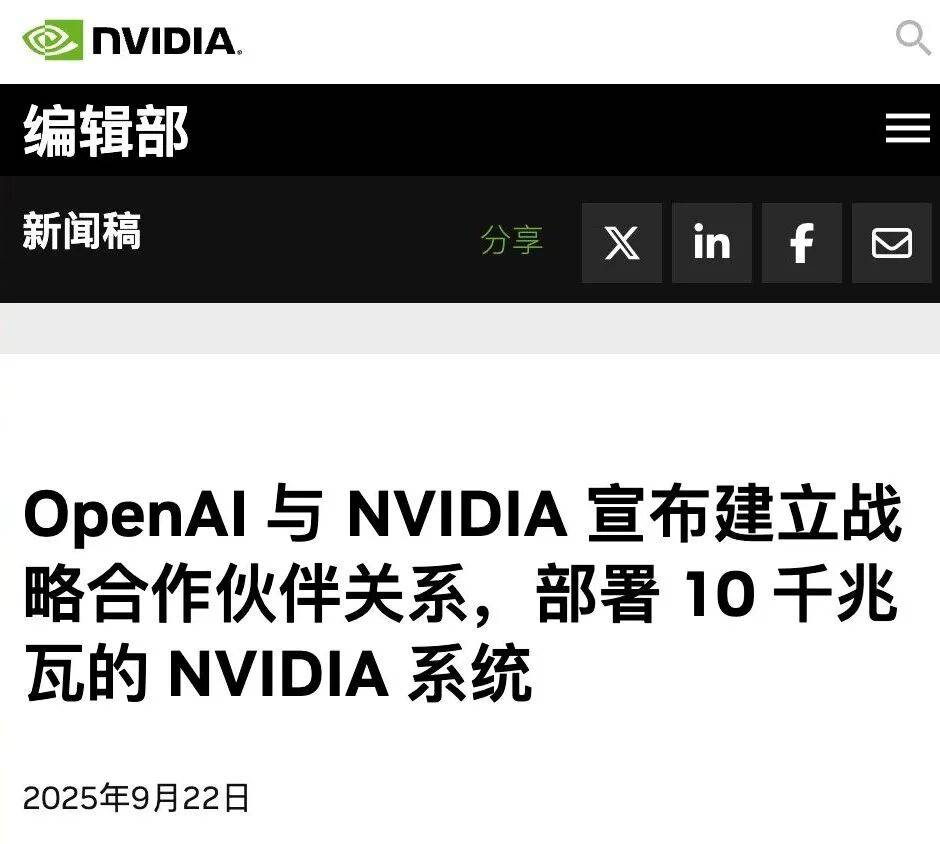
突发:英伟达千亿美元投资OpenAI
Hu Xiu· 2025-09-23 00:25
Core Viewpoint - Nvidia and OpenAI have announced a strategic partnership and a significant investment of up to $100 billion to support OpenAI's AI data center plans [2]. Group 1: Investment Details - The investment will be paid to OpenAI gradually as the deployment of GPUs increases [4]. - This investment represents approximately 2.2% of Nvidia's current market capitalization of about $4.46 trillion [5]. Group 2: Infrastructure and Energy Consumption - OpenAI plans to utilize millions of Nvidia GPU systems to deploy AI data centers, with an energy consumption target of at least 10 gigawatts [7]. - The first phase of the data center will have an energy consumption of 1 gigawatt and is expected to be deployed in the second half of 2026 [9]. Group 3: Strategic Partnership - OpenAI will be the first "beta user" of Nvidia's DGX supercomputer system, highlighting a decade-long collaboration between the two companies [10]. - OpenAI will receive priority in GPU delivery, while Nvidia will benefit from OpenAI's highest priority in external collaborations [11]. - OpenAI will become the preferred "computing" and "network" strategic partner in Nvidia's AI factory growth plan, ensuring optimal performance for OpenAI's models and infrastructure software [12]. - Both companies plan to finalize the specific details of their strategic partnership in the coming weeks [13].
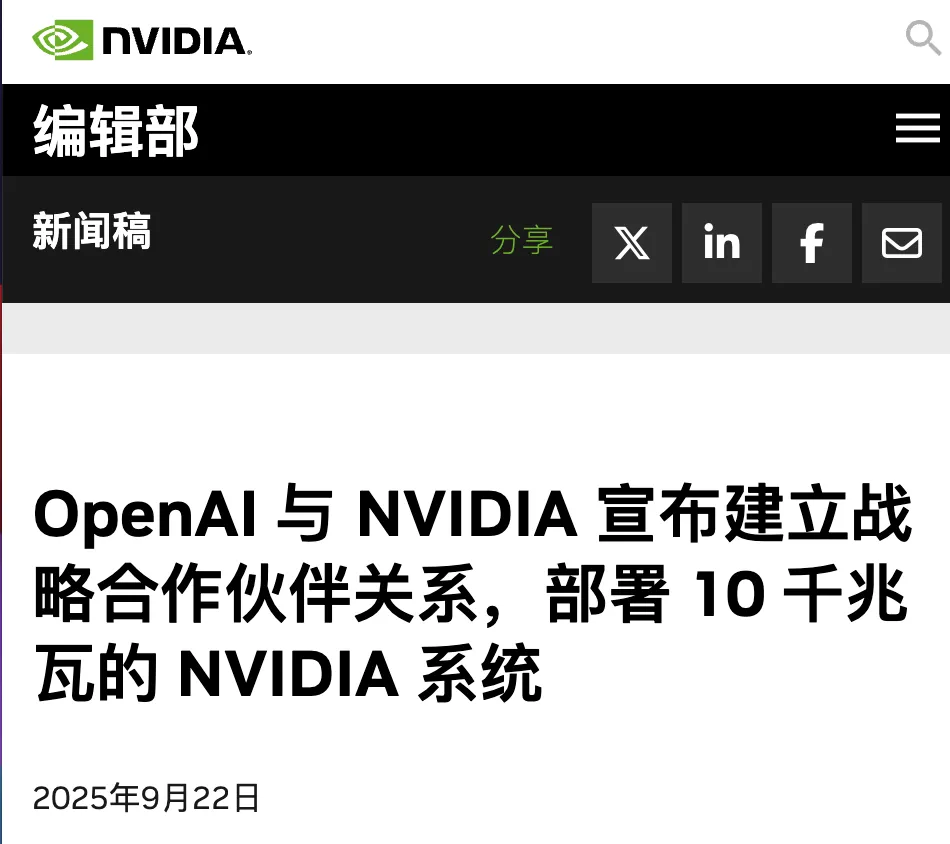
突发|英伟达向 OpenAI 投资 1000 亿美元,400 万 GPU 打造「超级智能」
Sou Hu Cai Jing· 2025-09-22 22:55
Core Insights - OpenAI plans to build and deploy a 10 GW Nvidia system, equivalent to approximately 4 to 5 million GPUs, matching Nvidia's total shipments for the year and doubling last year's output [3][5][12] - Nvidia and OpenAI announced a strategic partnership with an investment of up to $100 billion to support OpenAI's AI data center plans [5][12] Investment and Financials - The partnership will be implemented in phases, starting with a 1 GW data center to be deployed in the second half of 2026, with an initial investment of $10 billion from Nvidia upon completion of the first system [7][14] - Building a 1 GW data center is estimated to cost between $50 billion and $60 billion, with about $35 billion allocated for Nvidia's chips and systems, indicating a significant share for Nvidia in OpenAI's infrastructure [14][17] - OpenAI's revenue is projected to reach $13 billion this year, a more than threefold increase from $4 billion last year, with a revised forecast for 2030 revenue exceeding $200 billion [17][18] Market Position and Competition - The collaboration secures Nvidia a strategic customer in OpenAI, enhancing its position in the AI chip market amid competition from AMD and cloud service providers [14][18] - OpenAI's R&D costs are expected to account for nearly 50% of its total revenue by 2030, significantly higher than the 10% to 20% range typical for other tech giants [17][18] Future Outlook - The partnership aims to accelerate the development of OpenAI's next-generation AI infrastructure, with expectations for significant outcomes in the coming months [12][18] - The AI infrastructure arms race has entered a new phase with investments reaching the billion-dollar mark, indicating a growing demand for computational resources [18]
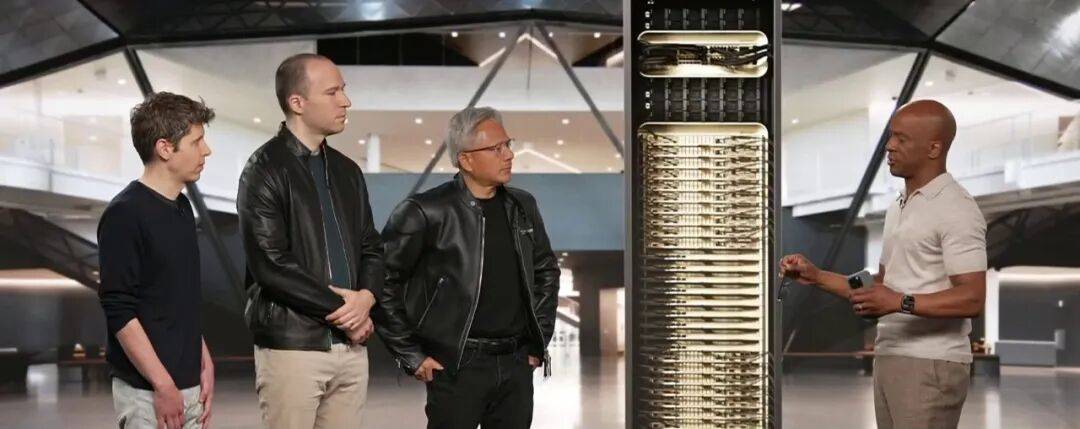
Meta押注智能眼镜:AI助手加持,“超级智能”的雏形?
Jing Ji Guan Cha Bao· 2025-09-18 08:56
Core Insights - Meta is betting on smart glasses as a significant entry point into the future of consumer electronics, with the launch of three new models, including the "Meta Ray-Ban Display" featuring a micro-screen and AI assistant [1][4][6] - The company is shifting its focus from a "metaverse experience" to practical daily use cases for smart glasses, aiming to integrate technology seamlessly into everyday life [2][5] - Despite the excitement around the product, there were technical issues during the live demonstration, highlighting potential challenges in the AI assistant's functionality [3][5] Product Launch - Meta introduced the "Meta Ray-Ban Display" at a price of $799, nearly double the cost of its predecessor, indicating a shift towards positioning the product as a high-end consumer electronic device [1][5] - The glasses are designed to allow users to interact with applications, play music, and share content on social media without needing to pull out their phones [1][2] Market Positioning - The new smart glasses are aimed at everyday users rather than gamers, reflecting a strategic adjustment in Meta's approach to market adoption [2][5] - The design of the glasses is intended to be discreet, resembling regular sunglasses, which may enhance user acceptance compared to bulkier VR devices [2][4] AI Integration - Meta has invested heavily in AI, with billions spent on data centers and restructuring its AI department, viewing smart glasses as an ideal platform for advanced AI capabilities [4][5] - The company envisions smart glasses as the "second pair of eyes" in the AI era, emphasizing the need for daily wear to fully integrate AI into users' lives [5][6] Challenges Ahead - The high price point of $799 raises questions about whether the features justify the cost for consumers [5][6] - Privacy concerns are significant, as the glasses contain cameras and microphones, potentially leading to societal debates about surveillance and data privacy [5][6] - The success of the smart glasses will depend on building a robust application ecosystem, requiring third-party developers to create diverse use cases beyond Meta's own platforms [5][6] Strategic Implications - Meta's attempt to transition smart glasses from a novelty item to an essential tool reflects a broader ambition to define the next computing platform as smartphone growth slows [6] - The company's future in this space hinges on overcoming technical, privacy, pricing, and ecosystem challenges, which will determine whether it can replicate the success of the iPhone [6]

库存周期未来或被AI彻底消除!洪灏与拉斯·特维德高能对话,深谈超智能、商业周期与捕获价值的机会……
聪明投资者· 2025-09-17 08:13
Core Viewpoint - The discussion emphasizes the intersection of macroeconomic perspectives and the evolution of intelligence, particularly focusing on the transformative potential of AI and its implications for future labor systems and economic cycles [3][4][6]. Group 1: Evolution of Intelligence and Economic Impact - Lars Tvede argues that the development of AI is part of a broader cosmic narrative, suggesting that AI is approaching an "innovator stage" where it may achieve self-management and self-evolution capabilities [3][4]. - The potential for AI to significantly enhance productivity and restructure the global economy is highlighted, with a focus on the transition of capital from traditional real estate to computational infrastructure [6][117]. - Tvede emphasizes the importance of understanding three key factors for future economic analysis: technological evolution paths, innovation clusters, and value capture mechanisms [5]. Group 2: Economic Cycles and AI's Role - Tvede predicts that inventory cycles may eventually be eliminated due to real-time AI forecasting, while capital expenditure and real estate cycles will persist but with more rapid and intense rhythms [4][91]. - The discussion includes the notion that AI will enhance the accuracy of economic cycle predictions, utilizing real-time data and advanced modeling techniques [97][100]. - Tvede categorizes economic cycles into three types: inventory cycles (approximately 4.5 years), capital expenditure cycles (9-10 years), and real estate cycles (18-20 years), suggesting that AI will make these cycles more efficient and frequent [92][94]. Group 3: Future of Labor and AI Integration - The conversation touches on the future labor landscape, predicting that by 2050, there could be 4.1 billion intelligent robots, which could potentially produce five times the total output of human labor [45][49]. - Tvede notes that the integration of AI and robotics will lead to a complex task economy where many tasks will be executed by non-human entities, fundamentally altering the structure of the global economy [60][61]. - The emergence of "human cloud," "AI cloud," and "robot cloud" is discussed, indicating a shift towards a more flexible and dynamic task execution system [56][59]. Group 4: Investment Opportunities and Risks - Tvede highlights the potential for significant investment in AI infrastructure, including chips and energy systems, which could exceed 1% of GDP in the coming years [124]. - The discussion also points to the possibility of a new commodity cycle emerging as AI and robotics drive down production costs and influence market dynamics [126][130]. - Tvede expresses optimism about the long-term future, suggesting that the current wave of AI technology will lead to substantial positive changes for society [42][44].
AI产业迎新纪元,万亿级投资风暴来袭!
Zheng Quan Shi Bao Wang· 2025-09-16 23:57
Core Viewpoint - The rise of artificial intelligence (AI) is not just a technological shift but a significant transformation in civilization, with implications for investment opportunities and industry dynamics [1][6]. Group 1: AI Industry Developments - The appointment of a digital minister in Albania marks a historic moment in governance, showcasing the integration of AI into political structures [1]. - Elon Musk predicts that by 2026, AI will surpass human intelligence in key metrics, indicating an approaching technological singularity [3]. - China's State Council has issued a strategic document to implement AI, elevating it to a national priority and signaling a shift from isolated advancements to comprehensive integration [1][12]. Group 2: Investment Opportunities - The 华夏上证科创板人工智能ETF (589010) tracks the 上证科创板人工智能指数 (950180.CSI), which has seen a year-to-date increase of nearly 58% and a one-year increase of 167.46% [2][15]. - The ETF serves as a vehicle for investing in core AI assets, capitalizing on the growth of the AI industry amid significant policy and technological support [2][14]. - The index comprises 30 large-cap stocks, focusing on key segments of the AI value chain, enhancing its potential for capturing investment returns [14]. Group 3: Market Dynamics - The global AI industry is experiencing unprecedented growth, with China's AI market projected to exceed 1 trillion yuan by 2029, driven by a compound annual growth rate of 32.1% [7]. - The competition in AI is intensifying, with major tech companies racing to innovate and improve their AI models, leading to a rapid evolution in capabilities [4][5]. - The AI landscape is shifting from a focus on individual technological breakthroughs to a comprehensive ecosystem approach, with significant implications for global competitiveness [5][11]. Group 4: Technological Advancements - The emergence of large models like DeepSeek signifies a breakthrough in AI technology, enabling cost-effective and high-performance solutions that challenge international counterparts [8][10]. - The integration of AI into various sectors is accelerating, with significant advancements in computational power and model iteration rates [9][10]. - The Chinese AI industry is characterized by a unique growth formula that combines industrial foundation, innovation capacity, and talent reserves, positioning it for future success [11].
AI产业迎新纪元,万亿级投资风暴来袭!
券商中国· 2025-09-16 23:38
Core Viewpoint - The article emphasizes the transformative impact of artificial intelligence (AI) on various industries, highlighting the launch of the Huaxia Science and Technology Innovation AI ETF as a key investment vehicle in this technological revolution [1][3]. Group 1: AI's Global Impact - The appointment of a non-human digital minister in Albania marks a significant milestone in the integration of AI into governance, indicating a shift in political landscapes [2]. - Elon Musk predicts that AI will surpass human intelligence within five years, suggesting an imminent technological singularity [4][5]. - The Chinese government's strategic document on AI signifies a national commitment to integrating AI into various sectors, moving from isolated advancements to a comprehensive national strategy [2][3]. Group 2: Investment Opportunities - The Huaxia Science and Technology Innovation AI ETF (589010) tracks the Shanghai Stock Exchange Science and Technology Innovation Board AI Index (950180.CSI), which has seen a year-to-date increase of nearly 58% and a one-year increase of 167.46% [3][17]. - The index comprises 30 large-cap stocks, focusing on key segments of the AI industry, providing investors with a targeted approach to capitalize on AI advancements [15][16]. - The semiconductor sector holds a significant weight of 47.81% in the index, highlighting its critical role in AI infrastructure and investment potential [15][16]. Group 3: China's AI Market Growth - China's AI industry is projected to grow at a compound annual growth rate of 32.1%, with the market expected to exceed one trillion yuan by 2029 [9][10]. - The emergence of domestic AI models like DeepSeek demonstrates China's capability to compete globally, offering high performance at significantly lower costs [10][12]. - The Chinese government's policies and infrastructure developments are creating a fertile ground for AI applications, enhancing the overall ecosystem for AI growth [13][14]. Group 4: Future Trends and Developments - The AI industry is transitioning from a phase of broad exploration to a more specialized focus on application and ecosystem development [7][8]. - The rapid iteration of AI models and the decreasing cost barriers are facilitating faster commercialization of AI technologies [11][12]. - The upcoming release of new AI models and the integration of hardware and software signify a pivotal moment in the evolution of China's AI capabilities [12][14].


后AGI时代,当99%的人类价值归零,资本主义是否会幸存?
3 6 Ke· 2025-09-12 07:29
Group 1 - The core argument is that while AGI (Artificial General Intelligence) is approaching, there is a lack of deep societal reflection on how the post-AI era will function, particularly in terms of social, economic, political, and ethical transformations [1][2] - The urgency of understanding the implications of the post-AI society is emphasized, with a call for a comprehensive theoretical framework to analyze these changes [2][3] - Zhang Xiaoyu, a scholar with 20 years of experience in political philosophy, is exploring the complex relationships between technology, business, and state destiny, aiming to outline the societal changes brought by the post-AI era [2][4] Group 2 - The discussion highlights the foundational impact of technology on human civilization, suggesting that technology fundamentally alters societal structures and interactions [6][7] - The conversation shifts from immediate concerns about AI's challenges to a deeper understanding of how to conceptualize and interpret the changes AI brings to society [9][10] - Zhang identifies two fundamental principles for understanding the AI era: the emergence law, which states that complex phenomena can arise from simple rules when scaled sufficiently, and the human equivalent, which quantifies human intellectual output in terms of tokens [11][12] Group 3 - The economic implications of AI are discussed, contrasting AI's deflationary impact on employment with the inflationary effects of past technological revolutions like the steam engine [19][20] - The potential for AI to replace a significant portion of jobs is acknowledged, with a focus on the simplicity of tasks being more susceptible to automation [24][23] - The conversation also touches on the societal divide that may emerge, where a small percentage of individuals remain irreplaceable by AI, leading to a significant gap between the "1%" and the "99%" [27][28] Group 4 - The future of human relationships in a post-AI world is examined, suggesting that emotional connections may become less valuable as AI can replicate emotional interactions efficiently [37][38] - The political landscape may shift towards algorithmic governance, where AI serves as an impartial judge, potentially replacing traditional state functions [42][43] - The concept of a new social contract in the AI era is introduced, where the relationship between humans and advanced AI is framed as a time-based agreement rather than a spatial one [49][50]
23岁“神童”被OpenAI扫地出门后,募集15亿美元专投AI,半年收益率47%
Xin Lang Cai Jing· 2025-09-07 09:23
Core Insights - Leopold Aschenbrenner, a 23-year-old from Germany, founded the Situational Awareness fund in San Francisco, achieving an impressive return of 47% in the first two quarters of the year, managing over $1.5 billion in assets [1][4][6] Group 1: Fund Performance - The Situational Awareness fund's return of 47% significantly outperformed the S&P 500 index, which rose approximately 6% during the same period, and the average return of major tech hedge funds at around 7% [4] - The fund's strategy focuses on investments in companies likely to benefit from advancements in artificial intelligence (AI), with a commitment to a "100% All In AI" approach [6] Group 2: Founder Background - Aschenbrenner graduated from Columbia University at the age of 19 and has been recognized as a prodigy, previously involved in research initiatives at Oxford University [4] - He joined OpenAI in 2023, working on a project related to aligning future superintelligent AI with human values, but was later dismissed due to internal conflicts [5] Group 3: Industry Context - Aschenbrenner's insights on artificial general intelligence (AGI) suggest that it could be achieved by 2027, with AI potentially surpassing human intelligence in various fields [5] - The fund has attracted notable investors from the tech industry, indicating strong confidence in Aschenbrenner's vision and strategy [6]

从重金挖角OpenAI/谷歌到招聘急刹车:Meta MSL主要人员梳理,半数华人+75%博士成主力
3 6 Ke· 2025-09-05 07:38
Core Insights - Meta has paused hiring in its AI department after an aggressive recruitment strategy aimed at competing with OpenAI and Google, leading to significant employee turnover [1][2][3] - The recruitment freeze is described as a strategic adjustment to build a more stable structure following a massive talent acquisition effort [3][31] - The internal restructuring involves splitting the AI department into four specialized teams, each with distinct missions, to enhance efficiency and collaboration [32][33] Recruitment Strategy - In June 2025, Mark Zuckerberg invested nearly $15 billion to acquire a 49% non-voting stake in Scale AI, aiming to bolster Meta's AI capabilities [2] - The recruitment strategy included offering signing bonuses in the nine-figure range, with total compensation packages for key talents reaching up to $100 million [2][10] - By July 19, 2025, 40% of the 44 employees in the Meta Superintelligence Labs (MSL) came from OpenAI, 20% from DeepMind, and 15% from Scale AI, with salaries ranging from $1 million to $100 million [10] Employee Turnover - Following the recruitment freeze, at least nine employees from MSL have left within two months, including key figures who returned to previous employers [3][34] - The high compensation for new hires has led to feelings of marginalization among long-term employees, prompting several to resign [3][35] - Internal dissatisfaction has been reported regarding the management style and resource allocation, contributing to the turnover [35][36] Leadership and Team Structure - Alexandr Wang, the CEO of Scale AI, leads MSL, which has faced skepticism regarding his leadership due to his lack of deep AI background [4][9] - The MSL is organized into four teams: TBD Lab (focused on superintelligence), AI Products & Applied Research, MSL Infra (infrastructure), and FAIR (long-term exploratory projects) [32][33] - Key hires include Nat Friedman, Daniel Gross, and Yann LeCun, who bring extensive experience and strategic vision to the team [12][13][14][18] Challenges and Market Context - The recruitment freeze coincides with rising concerns about the sustainability of AI investments, as many projects fail to deliver quick returns [31][38] - Meta's AI assistant has seen low user engagement, with only 10% of monthly active users interacting with it, raising questions about the effectiveness of the current strategy [38] - The company is reportedly considering using models from Google Gemini or OpenAI to enhance its AI product capabilities amid internal challenges [38]
