AI硬件

Search documents
主动量化周报:标的下沉:节奏放缓,科技突围-20260118
ZHESHANG SECURITIES· 2026-01-18 13:26
Quantitative Models and Construction Methods 1. Model Name: ETF Fund Flow Model - **Model Construction Idea**: The model is designed to analyze and predict fund flows into various ETFs, identifying sectors or themes that are likely to outperform based on capital allocation trends [1][11] - **Model Construction Process**: The model tracks daily fund flow data for key ETFs, such as CSI 300 ETF, CSI 500 ETF, and thematic ETFs like Chip ETF, Carbon Neutral ETF, and Chip 50 ETF. It evaluates the net inflow or outflow of funds over specific time periods to determine investor preferences and market sentiment. For example, the model observed significant outflows from broad-based ETFs like CSI 300 ETF and CSI 500 ETF, while recommending thematic ETFs in technology sectors such as chips and carbon neutrality [1][11] - **Model Evaluation**: The model effectively identifies shifts in capital allocation, highlighting potential opportunities in technology-related sectors while cautioning against certain AI application themes [1][11] --- Model Backtesting Results 1. ETF Fund Flow Model - **Key Observations**: - Significant outflows from CSI 300 ETF and CSI 500 ETF, with daily net outflows reaching 114 billion, 715 billion, and 1,048 billion yuan on January 14, 15, and 16, respectively [11] - Recommendations for Chip ETF, Carbon Neutral ETF, and Chip 50 ETF, reflecting a preference for technology sectors like electronics and power equipment [11] --- Quantitative Factors and Construction Methods 1. Factor Name: Style Factors (BARRA Style Factors) - **Factor Construction Idea**: These factors aim to capture the performance of different market styles, such as value, growth, momentum, and size, to identify prevailing market preferences and trends [24] - **Factor Construction Process**: - Fundamental factors: Evaluate metrics like profitability and earnings growth to assess the performance of high-profitability assets relative to the market average - Transaction-related factors: Analyze metrics such as turnover rate, short-term momentum, and beta coefficients to identify stocks with potential for excess returns - Size factors: Examine the performance of small-cap stocks versus large-cap stocks, including non-linear size effects [24] - **Factor Evaluation**: The factors reveal a shift in market preferences, with high-turnover stocks reversing gains, while short-term momentum and high-beta stocks show potential for sustained excess returns. Small-cap stocks exhibit relative outperformance during the observed period [24] --- Factor Backtesting Results 1. Style Factors (BARRA Style Factors) - **Key Observations**: - Profitability-related factors showed recovery, with high-profitability assets outperforming the market average [24] - Transaction-related factors indicated a reversal in high-turnover stocks, while short-term momentum and high-beta stocks demonstrated potential for sustained excess returns [24] - Size factors highlighted the relative strength of small-cap stocks, with non-linear size factors experiencing larger drawdowns [24]
AI硬件板块本周领涨,半导体设备ETF易方达(159558)、云计算ETF易方达(516510)受资金关注
Sou Hu Cai Jing· 2026-01-16 10:50
Group 1 - The AI hardware sector has seen significant gains this week, with the CSI Semiconductor Materials and Equipment Theme Index rising by 9.0%, the CSI Cloud Computing and Big Data Theme Index increasing by 6.4%, and the CSI Chip Industry Index up by 5.2% [1][3] - The semiconductor equipment ETF from E Fund (159558) and the cloud computing ETF from E Fund (516510) have attracted substantial investments, with a combined average inflow of 480 million yuan and 750 million yuan respectively over the first four trading days of the week [1] - Dongwu Securities reports that domestic semiconductor equipment is entering a historic development opportunity, with a strong expansion cycle expected to begin in 2026, projecting an order growth rate exceeding 30% for the entire semiconductor equipment industry [1] Group 2 - The CSI Cloud Computing and Big Data Theme Index has a rolling price-to-sales ratio of 5.5 times, while the CSI Chip Industry Index has a price-to-book ratio of 7.8 times, and the CSI Semiconductor Materials and Equipment Theme Index has a price-to-book ratio of 8.3 times [3] - The CSI Cloud Computing and Big Data Theme Index has shown a cumulative increase of 19.3% over the past month, 28.3% over the past three months, and 15.9% year-to-date, while the CSI Semiconductor Materials and Equipment Theme Index has increased by 29.9%, 39.5%, and 27.7% respectively [8] - The CSI Semiconductor Materials and Equipment Theme Index is composed of 40 representative companies in semiconductor materials and equipment, focusing on AI chip equipment and materials [5]


AI硬件“强者恒强”逻辑延续,关注创业板ETF易方达(159915)等产品配置机会
Sou Hu Cai Jing· 2026-01-16 10:44
Group 1 - The core viewpoint of the article highlights the active performance of AI hardware sectors, such as storage chips and CPO, with significant increases in various indices, including a 2.6% rise in the ChiNext Mid-Cap 200 Index and a 1.7% increase in the ChiNext Growth Index [1] - The current market should focus on the dual growth of "technology + cycle," with AI hardware experiencing a surge similar to the previous peak during 5G base station construction, driven by rapid structural demand for AI computing power [1] - The sustained strength of AI hardware is attributed to the marginal changes in profit growth, which have not yet shown a significant turning point, suggesting a continuation of the valuation bull market [1] Group 2 - The ChiNext Index increased by 1.0%, while the ChiNext Mid-Cap 200 Index and ChiNext Growth Index saw increases of 2.6% and 1.7%, respectively, indicating a positive trend in the market [3] - The rolling price-to-earnings (P/E) ratios for the indices are 43.1 times for the ChiNext Index, 116.6 times for the ChiNext Mid-Cap 200 Index, and 41.8 times for the ChiNext Growth Index, reflecting varying levels of valuation across these indices [3] - The ChiNext Mid-Cap 200 Index consists of 200 stocks with medium market capitalization and good liquidity, with over 40% representation from the information technology sector [4]


人形机器人板块走强,机器人ETF易方达(159530)半日净申购超1亿份
Sou Hu Cai Jing· 2026-01-16 05:08
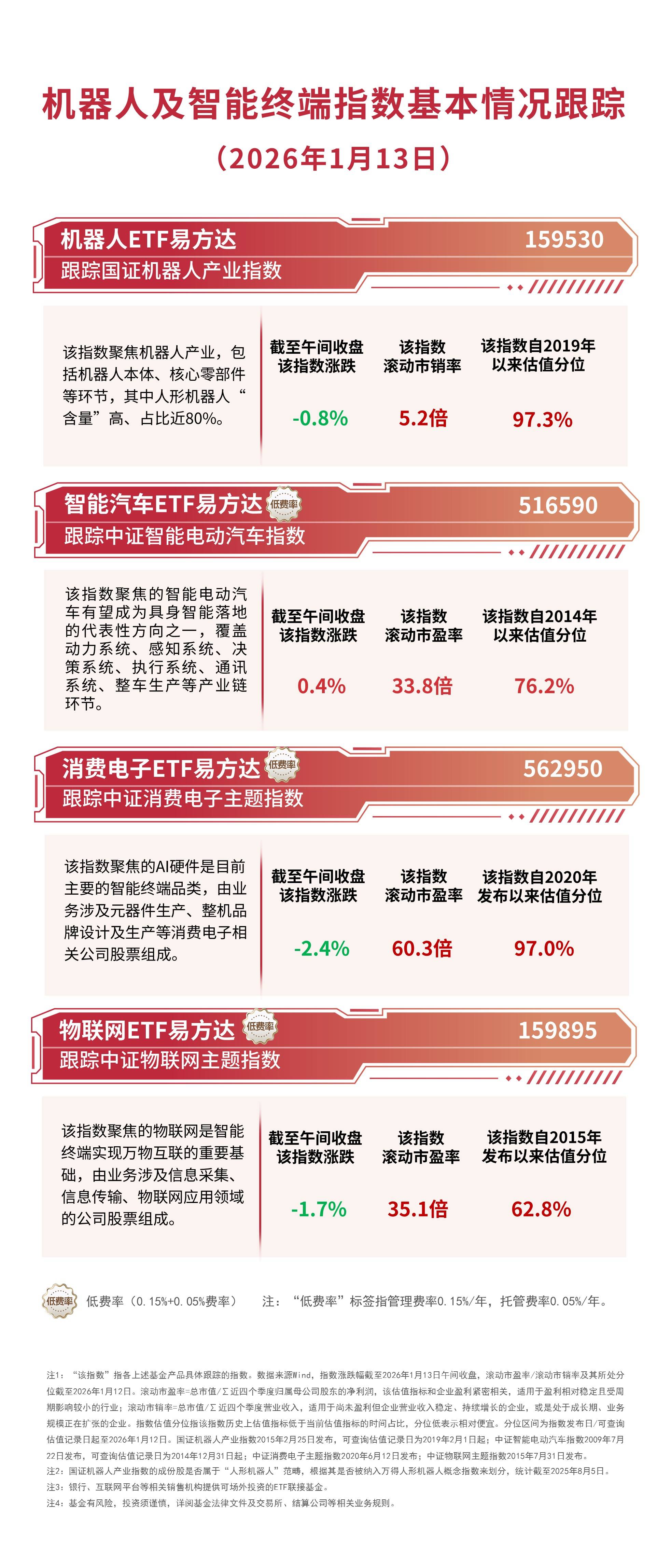
Group 1 - The National Robot Industry Index increased by 3.4%, while the China Securities Intelligent Electric Vehicle Index rose by 0.6%, the China Securities Consumer Electronics Theme Index climbed by 1.8%, and the China Securities Internet of Things Theme Index went up by 0.7% [1][5] - The robot ETF managed by E Fund (159530) saw a net subscription exceeding 100 million units during the half-day trading session [1] Group 2 - The China Securities Intelligent Electric Vehicle Index focuses on the intelligent electric vehicle sector, which is expected to become a representative direction for embodied intelligence, covering various industry chain segments including power systems, perception systems, decision systems, execution systems, communication systems, and vehicle production [3] Group 3 - The China Securities Consumer Electronics Theme Index emphasizes AI hardware, which is currently a major category of smart terminal products, consisting of stocks from companies involved in component production, complete machine brand design, and manufacturing [5]

2026年宏观资配展望:识变、应变-华宝证券
Sou Hu Cai Jing· 2026-01-15 16:40
Group 1 - The report by Huabao Securities provides a comprehensive analysis of the macroeconomic environment and asset allocation for 2026, highlighting a mixed performance of major asset classes in December 2025, with A-shares recovering due to policy adjustments and valuation corrections, while Hong Kong stocks continued to weaken [1][13] - The overseas economic environment shows that the US economy is likely to achieve a "soft landing," with inflation declining, which may lead to 1-2 interest rate cuts by the Federal Reserve in 2026, while domestic economic pressures are rising, with GDP growth expected at 4.8% for the year [2][28] - The asset allocation outlook for 2026 suggests that A-shares may continue to rise but at a slower pace, with a focus on high-growth sectors like AI hardware and semiconductors, while US stocks are expected to maintain a positive trend supported by economic resilience and liquidity [5][11] Group 2 - In the fixed income category, domestic government bonds are expected to experience fluctuations in the first half of 2026, with a potential decrease in yield as interest rate cuts become more likely in the second half [5][11] - The report anticipates a stable to rising trend for the RMB exchange rate in the first half of 2026, with increased volatility expected in the second half as the Federal Reserve halts interest rate cuts [5][11] - Gold prices are projected to continue a trend of oscillating upward, with any pullbacks seen as good buying opportunities, while oil prices are expected to remain under pressure due to oversupply and seasonal demand [5][11]

如何理解央妈今天的讲话?
表舅是养基大户· 2026-01-15 13:33
Core Viewpoint - The article discusses the recent monetary policy adjustments, particularly structural interest rate cuts, and their implications for the financial market, emphasizing a cautious approach to overall interest rate reductions while focusing on targeted support for specific sectors like technology and small enterprises [4][5][6]. Group 1: Monetary Policy Insights - The recent structural interest rate cuts aim to direct funds towards technology and small enterprises rather than allowing capital to circulate in financial markets [4]. - The decision to lower the rates on structural monetary tools and increase quotas for technology re-loans indicates a continuous policy approach rather than a shift towards broad interest rate cuts [5]. - The central bank is cautious about further lowering the OMO rate, prioritizing structural monetary policy and fiscal measures, with a preference for maintaining bank interest margins [6]. Group 2: Market Reactions - Following the announcement of new financing regulations, the financing balance increased by over 150 billion, indicating strong market activity despite regulatory changes [10]. - A significant drop in daily trading volume was observed, with a decrease of over 1 trillion, marking one of the largest single-day volume reductions historically [12]. - The A-share market showed a mixed performance, with a median decline of only 0.4% across over 5,000 stocks, indicating a selective market reaction [21]. Group 3: Sector Performance - The commercial aerospace sector experienced a sharp decline, with leading stocks like China Satellite facing significant losses, highlighting the volatility in high-valuation sectors [24]. - Despite overall market cooling, sectors such as AI hardware and semiconductor equipment showed resilience, with notable gains following positive earnings reports from major companies like TSMC [27]. Group 4: Investment Strategies - The article suggests that the current low-interest-rate environment in China continues to create opportunities for structural investments in the stock market, despite limited room for significant interest rate reductions [7]. - The analysis of foreign capital flows indicates a strategic approach, with foreign investors adjusting their positions based on fundamental valuations, as seen in the case of Industrial and Commercial Bank of China [42].

财通基金贾雅楠:消费投资需紧扣“时代贝塔”,关注情绪消费、出海与AI硬件新机遇
Xin Lang Cai Jing· 2026-01-15 07:24
Core Insights - The current investment opportunities in the new consumption era are centered around three main directions: emotional-driven new demands from young people, the strategic upgrade of Chinese consumer brands from "capacity going abroad" to a systematic approach involving "technology, brand, and culture," and the new growth curve in consumer electronics hardware driven by AI [1][5]. Group 1: Young Consumer Trends - The main consumer force has shifted to the post-95s and post-00s generations, characterized by "high wealth security and low psychological security" [6]. - Data indicates that 75.7% of young people are willing to pay a premium for interests, 63.9% use e-commerce daily, and 70% rely on KOL recommendations, with a savings rate below 15% [6]. - This generation's consumption behavior is marked by impulsiveness, high frequency, weak brand loyalty, and low price sensitivity, leading to the emergence of emotional consumption sectors such as gaming, trendy toys, and pets [6]. Group 2: Strategic Upgrades for Brands - In the context of domestic growth slowdown, going abroad has become a strategic necessity for consumer brands [2][6]. - Successful international expansion requires building a systematic capability that includes "capacity + technology + brand + culture," which encompasses overseas production layout, high-value R&D, brand operation, and cultural soft power output through trendy toys and games [2][6]. Group 3: AI in Consumer Electronics - AI is reshaping the supply side of consumer electronics, with projections indicating that the AI hardware market will reach $31.2 billion by 2025, growing at 22%, significantly outpacing the overall consumer electronics market growth of about 2% [2][6]. - Devices with cognitive/AI capabilities, such as AI PCs, AI smartphones, and AI glasses, are becoming focal points for capital and industry chains, opening up new business opportunities [2][6].

20cm速递|科创综指ETF国泰(589630)涨超2.4%,科技主线韧性显现
Sou Hu Cai Jing· 2026-01-14 02:45
Group 1 - The core viewpoint of the article highlights the resilience of the technology sector, driven by liquidity easing, policy support, and high industry prosperity [1] - The AI hardware sector is benefiting from a global technology cycle, with marginal profit growth (ΔG) showing no signs of a turning point, indicating continued strength [1] - AI applications are transitioning from computational infrastructure to scenario realization, accelerating commercialization due to policy guidance, demand release, and increased capital investment [1] Group 2 - New themes emerging from the 14th Five-Year Plan, such as commercial aerospace and brain-computer interfaces, have the potential to become new mainlines in the industry [1] - The cyclical industries are performing actively due to improvements in PPI and supportive policies against internal competition, creating a dual growth pattern of technology and cyclical sectors [1] - The ChiNext Index ETF Guotai (589630) tracks the ChiNext Index (000680), which has a daily price fluctuation limit of 20% and covers approximately 97% of the market capitalization with over 500 constituent stocks [1]
当CES的“AI大脑”遇上华强北的“硬身躯”
Nan Fang Du Shi Bao· 2026-01-13 14:52
Core Insights - The consensus at the 2026 CES in Las Vegas is that AI must transition from cloud-based algorithms to physical entities [1] Group 1: Speed and Efficiency - The "three-circle linkage" ecosystem in Huaqiangbei allows for rapid prototyping and manufacturing, compressing the entire process from R&D to production [4] - Huaqiangbei's ability to produce prototypes within a week is crucial in the fast-paced AI technology landscape, making it a global accelerator for AI hardware [4] - The region has shipped 400 million packages containing AI toys and chips globally, showcasing its manufacturing prowess [4] Group 2: Evolution of Identity - Huaqiangbei is transitioning from a trade hub to a center for AI commercialization, driven by collaboration between scientists and engineers [6] - The introduction of new policies has positioned the government as a "scene provider," facilitating the integration of scientific research with engineering capabilities [6] Group 3: Embracing Individual Entrepreneurship - The rise of "one-person companies" (OPC) in Huaqiangbei reflects a shift towards individual entrepreneurship, enabled by AI tools [7] - The establishment of the first OPC innovation community aims to lower barriers for entrepreneurs, allowing them to focus on creativity while outsourcing supply chain management [7] - Huaqiangbei's adaptability to industry changes positions it as a vital player in the global tech landscape, acting as a stabilizing force for innovation [7]
人形机器人板块早盘回调,资金逆势加仓,机器人ETF易方达(159530)半日净申购超3000万份
Sou Hu Cai Jing· 2026-01-13 05:11
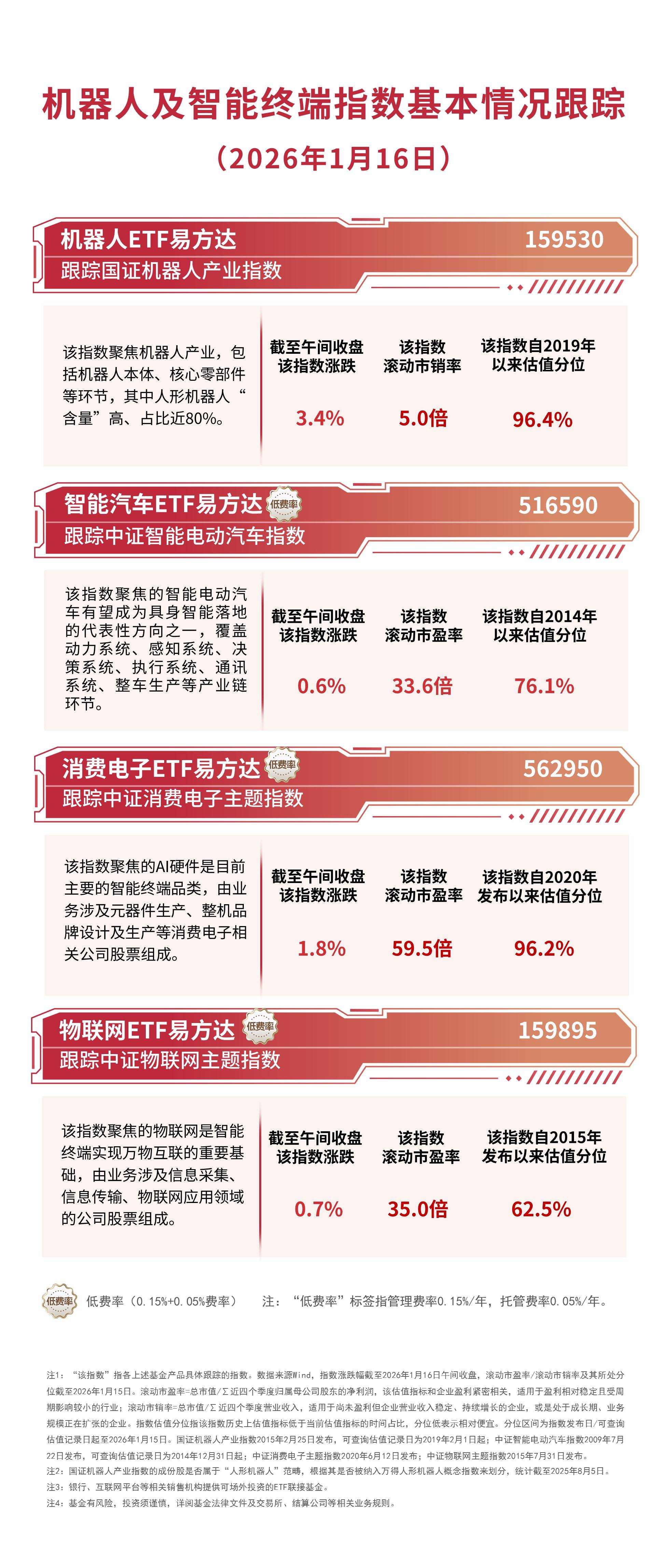
Group 1 - The index focuses on smart electric vehicles, which are expected to become a representative direction for embodied intelligence, covering various segments of the industry chain including power systems, perception systems, decision systems, execution systems, communication systems, and vehicle production [2] Group 2 - The E Fund Consumption Electronics ETF tracks the CSI Consumption Electronics Theme Index, which focuses on AI hardware as a major category of smart terminal products, comprising stocks of companies involved in component production, complete machine brand design, and production [4] Group 3 - The E Fund IoT ETF tracks the CSI IoT Theme Index, which has shown a decline of 2.4% as of the midday close [6]